Video yükleniyor...

Video Yüklenemedi

Ana Sayfaya Dön

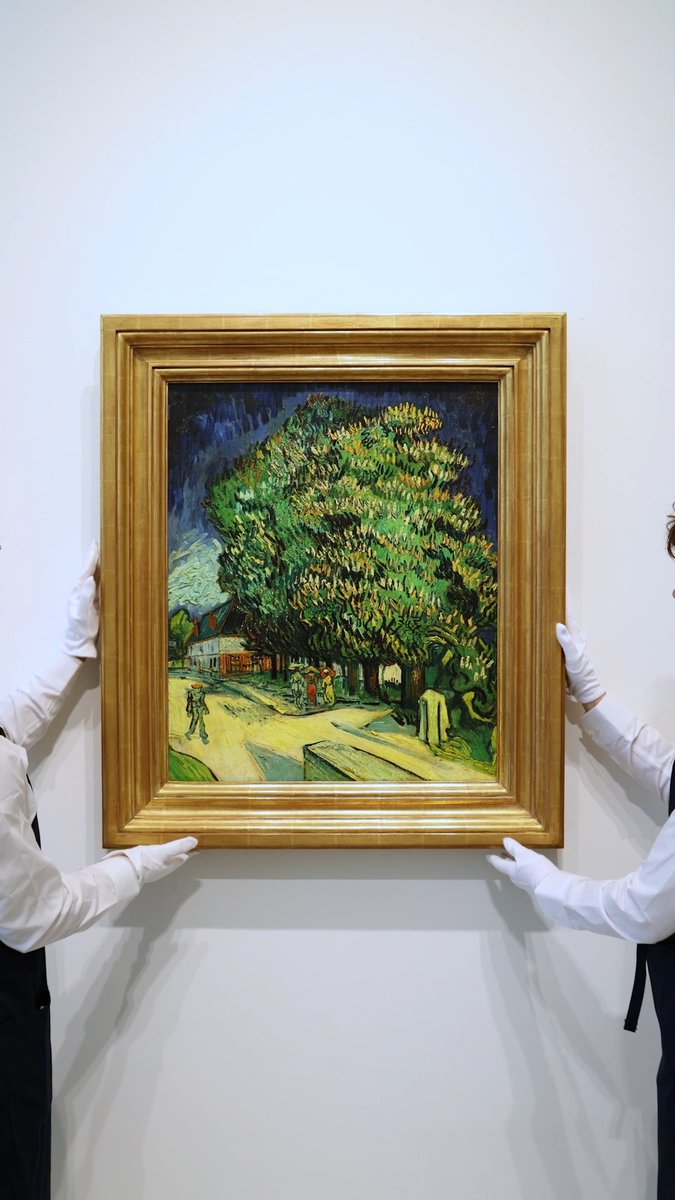
Vincent van Gogh accidentally solved a complex physics problem while inside an asylum. In 2004, scientists analyzed The Starry Night, they found something magical. His swirling brushstrokes perfectly match Kolmogorov’s formula for fluid turbulence. This formula describes how energy flows through the universe. Physicists of his time could not...

374,313 görüntüleme • 25 gün önce •via X (Twitter)

0 Yorum

Yorum bulunmuyor

Orijinal gönderinin yorumları burada görünecek

Benzer Videolar

One day, a man was driving his van through a village in southern Xinjiang. A man wearing a cap approached from the roadside with a smile on his face, though his eyes were searching the vehicle for something. Thinking the man might be hungry, the driver offered him some snacks—treats that were hard to come by in the village. However, the smile on the cap-wearer’s face dimmed, and he turned away in disappointment. Sensing something was amiss, the driver decided to follow him home to see if he needed help. Once inside, the man unwrapped layer upon layer of cloth to reveal an old radio. He twisted the dial with force, pointed to his ears, and made muffled sounds in his throat. In that moment, the driver finally understood: this man, who could not hear the world, was using all his strength to find batteries for his silent radio. His earlier gazing at the van had simply been a desperate attempt to find a vendor selling batteries. The driver, a kind soul, grasped his meaning immediately. He took him to the county town to buy fitting batteries, purchased shoes and other daily necessities for him, and promised to take him out again next time. On the way back, as the man sat in the passenger seat with his beloved radio clutched in his hands, his smile returned—bright as it was at the beginning. But this time, the joy came not from the radio waves, but from the love of a stranger. I do not wish to specifically mention their ethnicities, for some warmth needs no labels. It is just like sunlight falling on everyone's shoulders, never asking who you are.🌞

AL-fira 🇨🇳

34,956 görüntüleme • 2 ay önce

Class of 1984 (1982) Class of 1984 was a commercial success relative to its modest $3.2–$4.3 million budget, earning over $6–$7 million at the box office. It achieved broader financial success through the home video and cable markets, estimated at $15–$20 million in total. The film is celebrated as a definitive cult classic of the early 1980s. Its "video nasty" reputation stemmed from extreme violence, including a graphic table saw death and a brutal rape scene, which nearly earned it an X rating. Modern audiences value it as a bleak, nihilistic time capsule of the early '80s punk aesthetic and urban decay. It is famous for featuring a young, pre-Family Ties Michael J. Fox in a supporting role. Its status is solidified by high-end boutique releases, such as the Shout! Factory Collector’s Edition. The film was directly influenced by A Clockwork Orange (1971) and Blackboard Jungle (1955). In turn, it influenced several "school violence" and vigilante films: It spawned two sci-fi-themed sequels: Class of 1999 (1990) and Class of 1999 II: The Substitute (1994). Films like The Principal (1987), The Substitute (1996), and Class of Nuke 'Em High (1986) are often cited as spiritual successors or parodies. Timothy Van Patten, who played the menacing gang leader Peter Stegman, is now better known as an Emmy-winning director of prestigious series like The Sopranos and Boardwalk Empire. Van Patten personally wrote and performed the piano concerto his character plays in the film, a scene often cited as a highlight that revealed Stegman's complex, "yuppie" background. While director Mark Lester expected Van Patten to become a major acting star following his "riveting" performance, Van Patten eventually found his greatest success behind the camera. His portrayal remains iconic for its use of low-angle shots to maximize his threatening presence despite his clean-cut appearance.

Tom😈Loves❤️Horror😱

11,070 görüntüleme • 6 ay önce

Elon Musk explained how he makes every decision in a single sentence. Musk: “Whatever the limiting factor is on speed, I’m gonna attack that.” Not manage it. Not commission a study on it. Not make peace with it. Attack it. Musk: “If capital is a limiting factor, then I’ll solve for capital. If it’s not a limiting factor, I’ll solve for something else.” Sounds simple. It’s the furthest thing from simple. The entire professional class is built on the opposite instinct. They identify the constraint. Then they build a career around managing it. They become the expert on why things can’t move faster. Why it’s too expensive. Too risky. Too early. They don’t solve for the limiting factor. They become the limiting factor. And they get promoted for it. The biggest bottleneck in most organizations isn’t capital. Isn’t technology. Isn’t regulation. It’s the person in the room whose entire identity depends on the problem staying unsolved. Because once the problem is solved, so is their job title. Musk doesn’t manage that loop. He breaks it. He asks the one question the room agreed to stop asking. Why is this the speed. Why is this the cost. Why is this the timeline. And when the only answer is “because that’s how we’ve always done it”… He knows he’s found the real constraint. The human one. This is why he operates across rockets, cars, AI, brain interfaces, tunnels, and social media at once. Not because he’s reckless. Because the method works everywhere. Find the bottleneck. Solve for it. Move to the next one. Repeat until physics stops you. Not politics. Not bureaucracy. Not consensus. Physics. Most people never get anywhere near the physics. They stop at the first human objection and treat it like a law of nature. Musk treats human objections as engineering problems. That’s what his competitors can’t solve for. Not his capital. Not his reach. He refuses to honor the constraints they’ve spent entire careers respecting. And once you watch someone walk straight through the wall you built your whole life around… You don’t just question the wall. You question everything you built against it.

Dustin

71,180 görüntüleme • 1 ay önce

Next in who after the Ramanujan Series? If Ramanujan was the Source Code, Mudumbai Seshachalu Narasimhan (1932-2021) was the Compiler. He took the raw energy of Indian mathematical intuition & turned it into a formal, global language that even the top physicists in the world now use to explain reality. M.S. Narasimhan (known as MSN) was born into a rural family in Thandarai, Tamil Nadu. MSN was not a fan of the repeat what you are told school system. He was obsessed with extra problems at the end of textbooks that required original thinking. There was no high school in his village. To get an education, he famously traveled several KMs every day on a bullock cart. He ended up at Loyola College, Madras, under Father Racine. Racine realized early MSN was a fearless thinker who could handle the latest French mathematics. In the 1960s, mathematics was split into silos: people who studied shapes (Geometry) did not talk much to people who studied eqns (Algebra). Narasimhan was the man who found a wormhole connecting them & the career defining moment was the "Narasimhan-Seshadri Theorem" (1965). This is the Kohinoor of his career. Working with his lifelong friend C.S. Seshadri, he proved a result so deep it is still taught at every major uni today. They linked Unitary Representations (a complex way of describing symmetries in topology) to Stable Vector Bundles (a way of describing shapes in algebraic geometry). Yrs later, physicists realized this math was exactly what they needed to describe Gauge Theory & Quantum Chromodynamics (the study of how sub-atomic particles stick together). If we ever hear a mathematician talk about the Harder-Narasimhan Filtration, they are referring to a sorting machine MSN co-invented. In complex geometry, some bundles are stable (smooth) & some are unstable (jagged). Narasimhan & Günter Harder proved that every jagged bundle can be perfectly sliced into a unique sequence of smooth ones. This filtration is now used in Number Theory to solve problems that Ramanujan himself might have found fascinating. MSN was famously absent-mindedly brilliant, his wife, Sakuntala (a renowned singer), once recalled that for their honeymoon, MSN packed a suitcase full of Tamil literature & advanced math books. He spent the trip solving eqns be/w sightseeing! A former student recalls playing tennis when MSN walked up & asked, "You have learned a lot of good mathematics, but do you have any mathematical problems to work on?". They spent the next 10 days working day & night to prove a major result in differential geometry. His philosophy was: "Solve the big problem 1st, then worry about the details." MSN is 1 of the most decorated Indian scientists in history: King Faisal International Prize (2006): Often called the Arab Nobel, he won this jointly with Sir Simon Donaldson for his work linking math & physics. FRS & Padma Bhushan: He was elected a Fellow of the Royal Society (1989) & awarded the Padma Bhushan (1990). Chevalier de l'ordre National du Mérite: The French govt knighted him for his work in bridging the Indian & French schools of mathematics. He served as the 1st chair of the National Board for Higher Mathematics & headed the math division at the ICTP in Italy. He made sure that Indian students did not have to leave India to become world-class.

Parimal

13,502 görüntüleme • 2 ay önce

BREAKING NEWS: CHINESE SCIENTISTS PROVED EINSTEIN WRONG by performing an “impossible” experiment, a top US science journal reported in its latest issue. Iconic scientist Albert Einstein outlined an experiment on paper a century ago to disprove claims by an up-and-coming Danish physicist named Nils Bohr. But Chinese scientist Pan Jianwei and his team actually managed to do the experiment in real life, said a report in a publication of the American Physical Review. This week, newspaper headlines are saying things like “Chinese physicists prove Einstein wrong and put century-old debate to an end”. But that’s actually not true. And I’ll explain why below. . LASER TWEEZERS But let’s start with what is true – and is pretty amazing, too. The Chinese team managed to measure the physical impact that light has when it hits a surface—and they did it by isolating a single photon of light and shooting it at a single atom, held in place using a pair of “tweezers” made out of tiny laser beams. Why and how did they do this and what were they trying to prove? Full details and diagrams can be found in the video. Why do I say the headline writer got it wrong? This one says the Chinese scientists “put century-old debate to an end”. . NOT ACTUALLY TRUE That’s not true. The debate ended more than half a century ago, by which time, the majority of the world’s physicists had decided that Bohr was right and Einstein was wrong. And this wasn’t just a measure of opinions – many experiments had been done to reinforce this fact. So what the Chinese scientists just did was to create an elegant and precise experimental set-up that reinforces what physicists had already agreed on—and which can be replicated around the world to make further discoveries. So it is a very impressive feat, for sure. Meanwhile, thanks to Einstein, Bohr and Pan for showing the world exactly how photons work. They are very important – and remember, this information is being sent to you right now by a large army of photons!

Nury Vittachi

35,679 görüntüleme • 7 ay önce

I know a setup like this for many people would look cool and convenient but hear me out. I would only utilize something like this while parked in a camping area with other people. I would not use this by myself in the middle of the woods like this. I don’t feel they are safe and I’ll explain why. First off and most importantly, I don’t see a safe way to secure it. It’s all thin plastic sheeting meant to be waterproof but can be easily cut to gain access. If anyone wanted to cause harm or rob you, all they have to do is cut through the sheeting and they would have access to everything. It wouldn’t be hard to break into this. Then I look at how long it takes to setup, while it shows one person can set this up by themselves. Look at how long it takes to do this, it’s very impractical. I feel something like this that’s an add on to a vehicle should be much easier, like pushing a button and everything is pops out by itself. In an emergency I couldn’t imagine trying to fold things back in the right way while trying to escape. Could you imagine trying to outrun a bear in this only for it to be ripped off by tree branches cause you couldn’t fold it in time? The scenario I’m thinking of is what if I am being chased by a wild animal like a wolf or a bear. I couldn’t just hop in my Jeep and take off with this setup. Everything is folded out and tethered into the ground. It’s not like a traditional tent I could leave behind. If I was out camping with friends for a few days I think this could be ok. But doing a van life of camping for months at a time during the summer months wouldn’t be safe or practical as a solid unit like a standard RV. I wouldn’t be comfortable or safe in something like this.

SonnyBoy🇺🇸

406,773 görüntüleme • 1 ay önce