Загрузка видео...

Не удалось загрузить видео

На главную

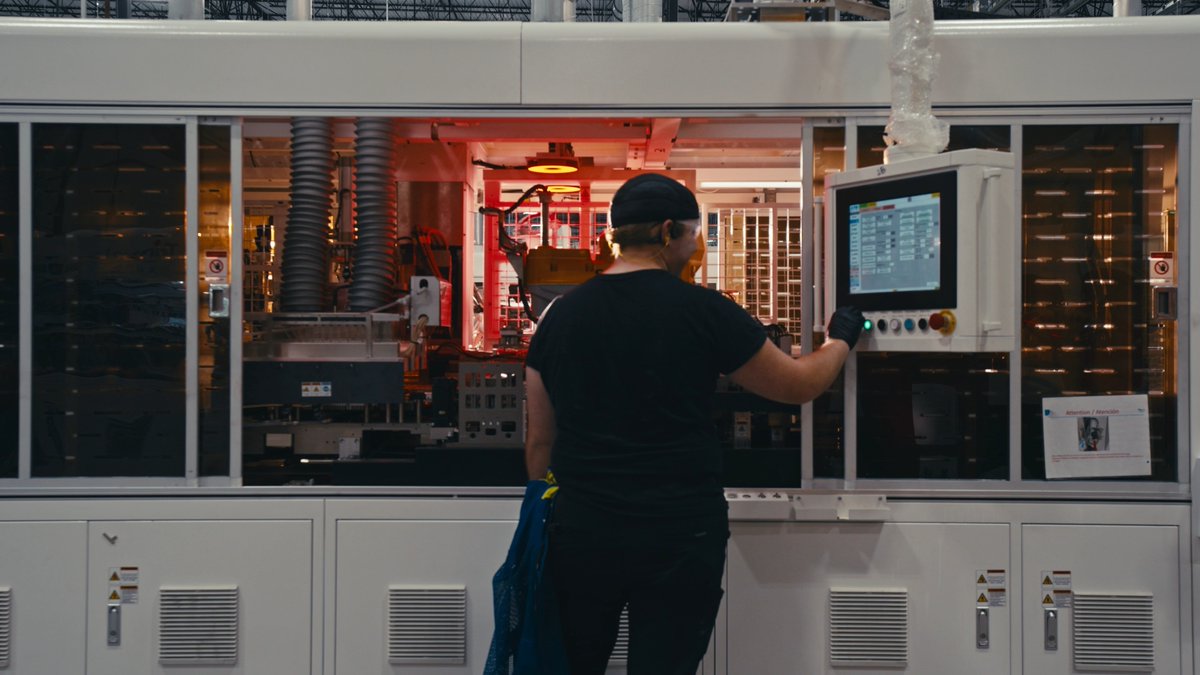
Visited Bharat’s largest solar cell manufacturing facility. World class scale, technology & precision. Complex chemistry behind every solar cell involves ultra-pure materials. The process involves complex gases and specialty chemicals, handled in cleanroom environments. 📍Waaree Energies at Chikhli, Gujarat

117,822 просмотров • 1 год назад •via X (Twitter)

Комментарии: 0

Нет доступных комментариев

Здесь появятся комментарии из оригинального поста
Похожие видео

Canada's first orbital-class rocket engine is now being manufactured! Our patent pending Hadfield-150 engine is the largest and most powerful rocket engine ever built in Canada, and the first known Canadian orbital-class engine to make it to this stage. The Hadfield-150 builds on everything we learned after years of painstakingly designing, manufacturing, and testing the Hadfield-10 series, our first regeneratively cooled and additively manufactured liquid rocket engine. Every engine test, both successful and unsuccessful on our Darkhorse test stand at Area 66, retired risk that's now carried straight into Hadfield-150 and sovereign orbital launch for Canada. A few details about the Hadfield-150 engine series: ✅ Designed to power Tundra and Tundra+, our light and medium-lift launch vehicles, and built to scale to Tempest, our larger reusable medium lift vehicle ✅ Manufactured entirely in-house, from design to print to test, for true sovereign launch capability ✅ Produced at Rocket Factory 1, on our expanding fleet of metal additive manufacturing systems at the AMA Lab, including the largest known metal 3D printer in Canada ✅ Designed for reusability and medium-lift scale from the outset, and built to significantly cut the time, infrastructure, manufacturing and cost iterative engine testing usually requires, with room to scale to even larger engines by leveraging the same design ✅ Capable of engine-out functionality, so losing one on an early flight doesn't have to mean losing the mission ✅ Optimized for Canada's Launch the North initiative, to deliver sovereign operational capability in a time and cost efficient manner Initial testing starts later this year at our new Blackhawk orbital engine test cell at Area 66, our private test range in Ontario. Stacked, integrated vehicle testing comes later at the Atlantic Spaceport Complex, our spaceport in Newfoundland and Labrador. Stay tuned for some exciting and fiery milestones ahead! 🚀🇨🇦 National Defence Defence Research and Development Canada Canadian Space Agency Transport Canada NGen Canada

NordSpace 🇨🇦

27,824 просмотров • 3 месяцев назад

Canadian Solar [Full Investment Thesis]: Everything You Need to Know About $CSIQ “THE GREAT SOLAR RECKONING” ☀️ 🔋$CSIQ became my largest position earlier this year, after I had been studying the company since 2023. Here is my 250-page, ~three-hour presentation on Canadian Solar. I made this video to compress the 1,000+ hours of work already done here, hopefully helping speed up the learning curve for anyone interested.☀️🔋 This is not meant to be flawless. It is meant to be done. I believe $CSIQ is entering one of the most promising periods in its history. With $15B+ in total assets, three multi-billion-dollar businesses spanning solar manufacturing, storage manufacturing, and project development across six continents, and a mere ~$1B market capitalization, Canadian Solar is poised to be one of the top energy performers in 2026. The market has left this company for dead. But underneath the surface, the foundations of the business have been getting stronger: - While the solar industry wrongly spent on building overcapacity, Canadian Solar was one of the few companies slowing down and investing upstream into its project development arm. - While everyone looked to globalize supply chains, Canadian Solar has been building its manufacturing presence in the U.S. since 2023. - While much of the industry was still debating battery storage, Canadian Solar was already building gigawatt-scale projects in 2021. Today, it is reaping the benefits of having been a first mover. This is the story of a company that, despite operating in a ruthless and complicated industry, has consistently been deliberate and rational in its capital allocation decisions. It remains founder-led, with the founder still owning ~20% of the company. Shareholder value creation will always be top of mind, regardless of the market’s current irrationality. The solar industry, like every commodity industry, is deeply cyclical. I am convinced we have already seen the worst of it, and that better profitability is ahead for equipment manufacturers. This is already starting to show in CSI Solar’s Q1 2026 results, with $100M+ in operating profit for the quarter. The supply-demand imbalance for electricity should result in excess profitability. $CSIQ is about to make the undeniable obvious: Canadian Solar is a Western (actually, global) leader in renewable energy. Not middle of the pack. At the very top. They produce ~25 GW of solar modules per year and ~15 GWh of storage per year. For reference, the entire U.S. added roughly 60 GW of total generation capacity in 2025. And they do not only manufacture. They also develop, engineer, construct, and operate billions of dollars of energy assets. That creates a powerful learning and feedback loop between manufacturing and operations, allowing them to stay ahead of the curve. Their BESS experience is the clearest example. At first glance, my estimates and projections may look overly optimistic. But I would ask you to take the time to analyze each one individually. I think you will see that even my bull case uses assumptions that many people already treat as base case assumptions for comparable companies such as $FLNC, $TE, $FSLR, $AMRC, $NXT, and others. My base case assumes roughly half the profitability the industry expects from peers, and still results in an ~10x investment opportunity. Not growing into it. Worth that today. Please feel free to share your thoughts, feedback, questions, and pushback!! ☀️☀️🔋🔋 Timeline CSIQ: 0:00 Introduction 1:38 Executive Summary 11:35 Macro 18:15 Corporate History 21:00 Management & Team 25:10 Solar Industry & Market 42:47 CSI Solar - the $7B solar behemoth $CSIQ owns 57:00 Project Demand - CSI Solar 1:00:05 BESS Subsidiary with Multi-GWh Firm Orders 1:05:35 Project Demand for e-Storage/BESS 1:11:44 Recurrent Energy - The Multi-Billion Renewable Project Developer 1:34:36 US Manufacturing - 10GWs of Capacity and First Ever to Produce Solar Cells Domestically 1:56:15 Competitors 2:19:29 Litigation 2:28:32 Quality 2:30:52 Valuation & Financial Analysis 2:40:40 Conclusion 2:43:15 Miscellaneous Disclaimer: This post is for informational and educational purposes only and does not constitute financial advice, investment advice, or a recommendation to buy or sell $CSIQ or any other security mentioned here. I am not a registered investment advisor (RIA). Always do your own research (DYOR). I and/or accounts under my management or discretion, may currently hold positions in $CSIQ and may purchase or sell shares at any time without further notice. My opinions, price targets, and allocation suggestions are my personal views and can change without prior notice. Investing in stocks involves a significant risk of loss of capital. Past performance is not indicative of future results. If you found this useful, follow me for more deep dives like this. I spend a ridiculous amount of time studying this whole ecosystem. Please like and share this post if you think more people should be aware of how attractive Canadian Solar could be as an investment opportunity.

Lucas Sacerdote🔋

102,146 просмотров • 5 месяцев назад

🚨 LOS ANGELES IS BREATHING TOXIC SMOKE UNDER A STATE OF EMERGENCY — AND THE BLACKROCK CONNECTION IS RINGING ALARM BELLS A massive fire has been burning for days at a Lineage cold-storage facility in Boyle Heights, sending a thick smoke plume across Los Angeles while residents are being warned about air quality and urged to limit exposure. Millions of people are being told to stay inside, keep their windows closed, avoid outdoor activity, and change the way they live because a single corporate facility suffered a catastrophic failure. This isn't some small warehouse on the edge of town. Lineage is one of the largest cold-storage companies on Earth, operating hundreds of facilities and controlling a critical piece of the food supply chain. The Boyle Heights complex is a massive industrial site packed with refrigeration systems, specialized insulation materials, rooftop solar infrastructure, and tens of millions of pounds of stored food. And this isn't the first major fire linked to this location. The same facility experienced a significant rooftop solar panel fire in 2024. Now another massive fire is burning for days, emergency declarations have been issued, toxic smoke continues drifting across the region, and millions of people are left dealing with the fallout. Then people started looking into who stands behind the company. Can you guess who’s among the major institutional investors? BlackRock…. and Vanguard. And that's where the questions start. Every time something like this happens, the public is told everything is under control. Every time the warnings get extended. Every time the smoke keeps coming. Every time ordinary people are expected to absorb the consequences while the corporations behind these facilities keep moving forward. Maybe it's exactly what we're being told. But after the emergency declarations, the repeat fire, the toxic smoke, and the Wall Street connections, a lot of people aren't so sure. How many times are people expected to ignore the red flags before they start connecting the dots?

HustleBitch

25,470 просмотров • 3 месяцев назад

🇪🇺🔥 Europe’s manufacturing edge is at real risk – too much capacity is moving to China, and what stays is hard to scale. The surprising solution might be a two-arm robot cell being built in a new lab in Ljubljana. I visited Sunrise Robotics to see how they’re building a new type of automation that could reshape European industry. Why it matters: • Europe is the world’s #2 manufacturing hub (~17–18%) • 50%+ of output is small-batch (high-mix/low-volume) → hard to automate • Millions of workers will retire or be out of job due to outsourcing • Sunrise created a standardized, simulation-trained cell • One operator can supervise multiple of these stations to build more complex products • This is a key to keeping factories – and competitiveness – in Europe I truly think Sunrise can become a global automation leader – disclaimer: I was their first (small) investor and first (big) fan. 🔥 The video shows everything: the test lab, the simulation stack, the UI, the assembly line, the first production batches… and a deep dive with CEO Tomaž Štolfa on the vision behind it. Full video link in the reply. If you enjoy it, please like + subscribe on YT – this really helps boost this kind of content. 🔥 If you care about robotics, automation, European competitiveness, or the future of work – checkout this video. PS: I was absurdly sick during the shoot… apologies for any sloppy camera work and spaced-out staring 😅

Andreas Klinger 🦾

34,031 просмотров • 11 месяцев назад

The NPP should do well to document the legacy of Nana: ●Free SHS ●STEM Education. ●1st ICT Kindergarten ●Historic 80 educational projects commissioned in one day. ●Over 150 Astroturfs built from only 3 in 2016. ●307 ambulances nationwide (unprecedented) ●Free TVET. ●Agenda 111. ●Upgrading our police and security services. ●Restoration of trainee allowances. ●Free Dialysis, sickle cell and childhood cancer treatments under NHIS ●1 district 1 factory. The largest industrialisation drive since independence. ●Ghana now has 6 automobiles operating in Ghana (Nissan, VW, Toyota, Sinotruk, Peugeot, Suzuki) ●Ghana now has the largest medical drone delivery service in the world. ●Ghana now has the largest bitumen manufacturing plant in Africa. ●Ghana now has the largest pharmaceutical plant in West Africa (Atlantic lifesciences) ●West Africa's largest floating solar plant on the Bui reservoir. ●Digitalisation. ●Biometric multipurpose Ghana card. ●No Cholera outbreak since 2017. ●12,000 km of roads. ●14 Fishing landing sites and ports. ●Prempeh I International Airport. ●Tamale International Airport. ●Sunyani Airport reopened (closed in 2015). ●1st Private Jet Terminal at KIA ●University of Health and Allied Sciences Phase 2 ●Biggest midwifery school in West Africa UHAS. ●The first 4 tier interchange in Ghana at Pokuase. ●Eastern Corridor roads ●Kayayes being developed with lucrative skills in Free TVET hostels. ●Digital Address System. ●Reconstruction of Appiatse. ●Cocoa farmers pension scheme. ●Free WiFi in 700 plus senior high schools and tertiary institutions. ●Zongo Development Fund. ●Introduction of Paperless Port. ●Over 100 buses for secondary schools ●Over 10,000 CCTV cameras installed nationwide. ●African of the year award. ●No Guarantor student loan policy. ●Ghana now has the seat of the African Free Continental Trade ●Tema Mpakadan railway. ●10 Multipurpose Youth Sports Centers (5,000 stadium capacity). ●Borteyman Sports complex. ●University of Ghana Sports Complex. ●Greatest tourism drive: Year of Return, Beyond the Return and Destination Ghana. ●Ghana now has the highest number of returnees in Africa (diaspora folks who have naturalised as Ghanaians) ●Decentralisation of 6th March celebrations to boost local tourism. ●Approved visa free travels for all African passport holders ●Completion of Euroget hospitals and many ●Over 100 hospital and health projects completed aside Agenda 111 ●Expansion and Dualisation of Accra Kumasi Road and Tema Motorway. ●Local streaming app for musicians. ●1st Creative Arts school ●Ghana is now the largest exporter of Yam in the world. ●NPP took agric from negative under Mahama to 8.4%. ●Took Gold reserves from 8.74 tons to 28.1 tons largely due to Gold for Oil program. ●Kwame Nkrumah Museum and Asomdwe Park. ●Bonwire Kente Museum ●District Road Improvement Program. ●1 Student 1 Laptop ●Nana Addo kept the lights on for 8 years. ●Built 3 new fire service schools from only 1 as at 2016. ●Ghana's highest ever Cocoa production 1 million metric tons (2020/2021) ●Cocoa Mass Spraying and Hand pollination. ●Increased Cocoa bag prices from 476gh in 2016 to 3100gh in 2024. ●Ghana has not imported Maize since 2017 ●Ghana now the largest producer of Coconut (412,459 tonnes/annum) ●UGMC Phase 2 ●Komfo Anokye Hospital Maternity ward ●Kumasi Kejetia Central Market Phase 2 ●Many housing project all across Ghana. ●National rent assistance scheme. ●Lawra Solar plant farm ●Pokuase Bulk Power supply ●Installation of K1TTP to improve power supply in the middle belt. ●1st and 2nd ladies refunding the state back their allowances. ●1st Islamic Nursing school ●Built 77 public libraries nationwide making it 137 (60 public libraries in total as at 2016) ●Local production of PPE's and drugs ●Green Ghana Project ●YouStart initiative to invest in youth businesses. ●Slashing down government appointees salaries by 30%. 1/2

#GhanaRemembers🗨🇫🇷🇬🇭

45,777 просмотров • 1 год назад

$ASTI Ascent Solar Technologies Space and Drone Solar Panels The "Going to Zero" or Mispriced Space/Drone Solar Play Intro and comparison to $RKLB and $RDW panels Let’s get the ugly stuff out of the way first. $ASTI is a distressed penny stock with a ~$5M-$10M market cap. • They burn millions in cash. • 2024 Revenue: ~$40k. 2025 Revenue (YTD): ~$60k. • They generate less revenue than a single Tesla Model Y. • They have diluted shareholders relentlessly. $ASTI just raised $2M in December with the potential of $3.5M more via warrants while being a ~$5M mcap "company". Yikes. To most, this is "uninvestable trash." Stay away. Full stop. So why did I buy ~5% of the float? IF the technology works and IF they execute then I believe this is a massive market pricing dislocation about to inflect. They have been grinding for years and may finally be hitting an inflection point. $RKLB Rocketlab is the king of space solar and they are my second largest position overall, but here is why $ASTI might be a very high risk but asymmetric bet in Space & Defense right now. 1. The Tech Pivot: Flexible CIGS vs. The World Ascent started in 2005 but pivoted 2 years ago from consumer to pure-play Space & Defense. They have sunk ~$250M and 20 years of R&D into proprietary CIGS (Copper-Indium-Gallium-Selenide) thin-film technology while building out fully domestic and vertically integrated manufacturing capabilities. The Physics: • Thickness: 0.03 mm (Thinner than paper). • Flexibility: Wraps around drones/satellites; rolls up like a poster. • Durability: "Self-Healing" capabilities against space radiation. Can take a bullet or micrometeoroid and keep working. Can handle shocks/vibration. Does not shatter. The Metric that Matters: Specific Power (W/kg) (aka energy to weight ratio) In space, mass means cost and difficult decision decisions. • Rocket Lab ($RKLB) / Spectrolab: ~150 W/kg (System level). • Ascent Solar ($ASTI): ~1,960 W/kg (Module level). $ASTI is roughly 10x lighter for the same power output potential (mass-wise). This frees up design limitations and cost. 2. The Competition: $RKLB & $RDW Rocket Lab (SolAero) & Redwire (iROSA): • Tech: Rigid Crystal Cells (Multi-junction) embedded in a fabric mesh. • Pros: Extreme Efficiency (~30%+). Perfect for limited surface area. • Cons: Heavy, Brittle, Expensive ($3k-$10k per Watt). Manufacturing multi-junction cells (SolAero) involves slowly growing crystals in a vacuum chamber. With radiation the panels degrade and loose efficiency over time which will limit the satellite lifespan. • Use Case: James Webb Telescope, Flagship missions. Ascent Solar (ASTI): • Tech: Flexible Thin-Film on Plastic. • Pros: Ultra-light, Durable, Cheap ($500-$1k per Watt). Manufacturing CIGS is roughly similar to printing newspapers (roll-to-roll). The panels are radiation degradation resistant and will outlive the satellite • Cons: Lower Efficiency (~17.5%). Requires 2x surface area. • Use Case: Mega-Constellations (Starlink/Amazon Leo), Small/Low cost satellites, Drones, Deformable surfaces. The lower efficiency is not an ASTI failing. It is the inherent physics trade-off of not using glass/rigid silicone. The downside however is increased atmospheric drag with very larger/massive panel sheets. Because ASTI modules are ~50% less efficient than rigid panels, they require ~2x the physical surface area to generate the same amount of power. In GEO (High Orbit): Drag doesn't matter. Weight savings are king. A massive solar array allows for more sensors and longer project lifespan. ASTI is highly competitive here. In LEO (Low Orbit): Atmospheric drag is real. A massive solar array acts like a large parachute, causing the satellite to de-orbit faster unless it burns more fuel to stay up. At LEO, smaller satellites are a better fit for ASTI. 3. Durability & Radiation "Self-Healing" Radiation Hardness This is ASTI's "Ace in the Hole" for physics. The Problem: In space, high-energy protons (radiation) smash into solar cells, creating atomic "defects" that trap electrons. Over time, this kills the panel's power output (degradation). The CIGS Advantage: CIGS (Copper-Indium-Gallium-Selenide) material has a unique property where heat (annealing) allows the atomic structure to relax and "heal" these defects. Self-Healing: Because CIGS heals at relatively low temperatures (often achieved just by the sun heating the panel), it suffers significantly less degradation than traditional Silicon or even some GaAs panels over long missions in high-radiation belts (like MEO or GEO). Lifespan: While a rigid GaAs panel might lose 15-20% of its power over 15 years (enough to kill a satellite), CIGS panels heal and can maintain a flatter power curve, potentially outlasting the satellite itself in high-radiation orbits. 4. Brittleness & Flexibility ASTI (CIGS on Polyimide): Flexible. You can roll it like a poster. It can take a bullet or micrometeoroid and the hole will just be a dead spot; the rest of the panel keeps working. It does not shatter. Redwire (ROSA) & Rocket Lab (SolAero): Brittle Cells on a Flex Blanket. $RDW's ROSA (Roll-Out Solar Array) typically uses rigid multi-junction cells (made by SolAero/Rocket Lab or Spectrolab) mounted on a flexible mesh fabric. The Risk: If you bend the cells too far, they crack. They rely on the mesh backing for flexibility, but the active generating material is still a brittle crystal wafer. Much heavier, more expensive, and less durable than $ASTI's option 5. The Inflection Point (Why Now?) After years of silent struggle, late 2025 has seen an explosion of activity. Recent Agreements (Nov/Dec 2025): NovaSpark: Hydrogen-powered military drones. $ASTI panels generate power in the field → NovaSpark creates hydrogen fuel. CisLunar Industries: Integrating ASTI solar with power conversion hardware for deep space longevity. Defiant Space: A strategic alliance to act as the "door opener" for classified DoD/NATO programs. More headlines: Ascent Solar Technologies Provides Leading Space Company with Thin-Film PV modules for Spacecraft Power Generation Testing in Cislunar Space December 03, 2025 08:00 ET Ascent Solar Technologies Delivers Thin-Film PV for Saltwater Environment Durability and Space-Based Power Beaming Testing October 14, 2025 08:00 ET Ascent Solar Enters Teaming Agreement with Emtel Energy USA to Advance Thin-Film PV Energy Storage Capabilities September 16, 2025 08:00 ET Ascent Solar Technologies Signs MOU with Star Catcher Industries to Improve Power Capabilities for Thin-Film Solar Technology in Space August 28, 2025 08:00 ET Ascent Solar Technologies Establishes Rapid Thin-Film PV Delivery Process to Provide Customized Space Solar Products Ahead of Schedule on Mission Enabling Timelines August 07, 2025 08:00 ET The Pipeline (From Aug Corporate Presentation) 18 new NDA's signed in 2025. They are field testing with 3 major players: • Company A: Mega-constellation (+2,500 satellites). • Company B: Space Defense (Explicitly mentioned "Golden Dome"). • Company C: Satellite Manufacturer (30-200 unit scale). Management: New board members include a former founding member of SpaceX and a retired Air Force General and Deputy Assistant Secretary for Contracting (acquisitions expert). The company started in 2005 based out of Colorado, but two years ago pivoted to Space & Defense and away from consumer applications. Made in USA: Defense contracts heavily favor domestic supply chains. ASTI manufactures in Colorado. This is a huge moat against cheap Chinese solar. In their Q3 report they note that their market has seen sudden recent acceleration. The space solar industry is currently only capable of 8 to 12 MW per year of production meanwhile the demand is growing to over 100 MW per year. 6. The Risk (The Sword of Damocles) ⚠️ This is critical. $ASTI just raised ~$2M in December. Attached to that raise are ~2 Million Warrants with a strike price of $1.70. These are exercisable immediately. If the stock rips to $3.00, warrant holders exercise at $1.70 and dump on the market for a risk-free 76% profit. This creates a massive "sell wall" and potential 40% dilution of the float. Summary: This is a binary bet. • Bear Case: They run out of cash in 6 months, dilution spirals, stock goes to $0. • Bull Case: They land one of the "Company A/B/C" contracts. Revenue jumps from $60k to projected $20M+ in 2026. The stock reprices from a "bankrupt penny stock" to a "critical defense/space supplier." I have gradually accumulated ~5% of the float. I am ready for it to go to zero. But if the space economy demands "Cheap, Light, and Durable," $ASTI is the only public pure-play. Disclaimer: This is a very high-risk microcap. Do your own due diligence. Not financial advice.

YeahDave

208,571 просмотров • 10 месяцев назад

In a newly released technical update, SpaceX's leadership team, which includes communications manager Dan Huot, Director of Satellite Engineering Ian Dahl, and CEO Elon Musk, detailed a highly ambitious infrastructure roadmap to design, manufacture, and operate specialized artificial intelligence computing satellites at scale. Positioned as a major strategic pillar to dramatically elevate civilizational energy and processing capacity on the Kardashev scale, this strategy moves past traditional communications architectures into massive orbital server arrays. Here is the complete breakdown of the core technologies and timelines driving this space-based intelligence revolution: 🛰️ AI1 satellite power and compute capacity Ian Dahl and Elon Musk introduced the baseline performance targets for the first-generation AI1 satellite, explaining how its custom hardware is engineered to operate like an orbital data center server rack. Ian Dahl noted that their direct operational experience with xAI guided them to target a 150-kilowatt peak power capacity. To manage active machine learning workloads continuously, Elon Musk explained that the satellite is optimized to maintain a sustained average compute power envelope of 120 kilowatts, which directly mirrors the real-world performance of a terrestrial NVIDIA server rack. The official presentation slides outline several key operational metrics for this payload configuration: ⚡ The custom architecture delivers a 150 kW peak compute payload. 🔋 The system maintains a 120 kW sustained average compute payload under active workloads. ⚖️ The hardware achieves a highly optimized power-to-weight density of 70 kW per ton. 🔄 The layout features a completely interchangeable compute provider design. "We thought that the right place to start is around the 150 kilowatt peak power level. But as we look at the workloads with our experience with xAI, we see that we can support about 120 kilowatts of average compute. The 150 kilowatt peak power level roughly matches what, say, an NVIDIA GV300 rack would do. A more reasonable operating envelope would be around 120 kilowatts average power, but it can peak up to 150. So it is basically thinking about it as a rack of compute in space." --- 📐 AI1 satellite dimensions and thermal efficiency specs Elon Musk detailed the physical layout of the AI1 satellite, highlighting the massive dimensions required to accommodate its immense power and cooling hardware. He shared specific design criteria, explaining that the engineering relies on a custom 150 kW solar array paired with a high-capacity deployable liquid radiator thermal management system. The technical specifications of this vehicle layout include: 📏 The structural frame features a massive 70-meter wingspan. ↕️ The vehicle spans a total deployed height of 20 meters. ☀️ The onboard solar array delivers an efficiency of 250 W/m² using technology manufactured in Bastrop, Texas. 🌡️ The thermal system utilizes a 110 m² deployable liquid radiator to cleanly dump waste heat. 🔄 The cooling architecture incorporates redundant pumping loops for mission safety. 🛡️ The exterior contains integrated micrometeoroid shielding to protect the fluid lines. 🧭 The double-sided radiators achieve a dissipation rate of 1400 watts per square meter while remaining oriented knife-edge to the sun. "The assumptions here are 250 watts per square meter for the solar array and about 1400 watts per square meter for the radiators. The radiators are double-sided, radiating on both sides, and they're oriented knife-edge to the sun. They have about a 70-meter wingspan, so these are fairly large." --- 🧩 Simplified design architecture built on Starlink V3 tech Elon Musk explained that despite the satellite's imposing size, its internal architecture is fundamentally much simpler than a standard Starlink satellite. Because it lacks heavy phased array and parabolic communications antennas, the entire vehicle layout is completely streamlined around a few essential structural modules: 🎛️ The hardware framework is arranged around a centralized compute module. ☀️ Large deployable solar arrays extend outward to capture orbital energy. 🌡️ A deployable liquid-radiator thermal management system controls active operational temperatures. 🔄 The engineering team heavily leverages the component evolution and manufacturing experience gained from developing the Starlink V3 vehicle platform. "The AI satellite is actually much simpler than a Starlink satellite. A Starlink satellite has gigantic phased array antennas, parabolic antennas, and a lot of laser links, making it much more complicated. An AI satellite is essentially a lot of solar cells, a radiator, and you still need some laser links, but you don't have all of the super complex antennas that you have on a Starlink satellite. A lot of this is technology we've already made for the Starlink V3 satellites." --- 🔌 Interchangeable compute reference designs and high connectivity Elon Musk outlined a modular hardware approach for the satellite's payload, allowing it to house a variety of industry-standard processing units depending on client requirements. This interchangeable compute rack is supported by a high-bandwidth connectivity loop that links separate orbital units together or transmits data directly back to Earth. The core network parameters include: 🧠 Reference designs are fully established to seamlessly accommodate NVIDIA Reuben chips. 💾 The system architecture is built to support alternative setups using NVIDIA GB300 chips. 💻 Custom hardware layouts are explicitly designed to integrate Google TPUs. 🌐 The onboard communications setup delivers roughly 1 terabit of laser link connectivity. ⏱️ The network closes the communication loop directly with the main Starlink constellation at an ultra-low latency of only 3 milliseconds. "Our current reference design is for NVIDIA Reuben chips, or it could be either GB300 or Reuben chips. We'll also have a reference design for TPUs. Essentially, you can put up any existing chips into orbit. There would also be probably something on the order of a terabit of laser link connectivity from the satellite. Then you can connect these racks of compute to each other by the laser links or directly to the Starlink constellations. Light travels 300 kilometers per millisecond, so that's about three milliseconds away." --- 🏭 The "gigasat" AI satellite and solar production hub in Bastrop, Texas Dan Huot highlighted that the primary production hub for this entire hardware ecosystem is anchored at their sprawling complex in Bastrop, Texas, officially designated as the Gigasat factory. Elon Musk verified that construction is already actively underway on the solar manufacturing facility to feed the project's supply line, with plans moving forward to construct the adjacent AI satellite assembly lines. The physical footprint and timeline of this manufacturing hub are defined by the following benchmarks: 🗺️ The company has over 1,000 acres of land currently owned or under contract for the site. 🏢 The manufacturing complex boasts a massive structural building potential exceeding 11 million square feet. ⚙️ The facility will vertically integrate production to manufacture solar ingots, wafers, solar cells, and completed AI satellites. 📅 Both the solar and AI satellite production lines are targeted to be operational at a viable volume by the end of next year. "We're going to be building a lot of satellites and we're going to be building them here in Bastrop. We already have the solar manufacturing facility under construction, and then we will be building out the AI sat production building soon. We expect to have the AI sat production, the solar production, and all of that operating at some reasonable volume by the end of next year." --- 🏢 The 100-million-square-foot "terafab" chip factory Elon Musk revealed a massive, long-term scaling strategy to build an immense chip manufacturing facility dubbed the "terafab" to completely bypass global semiconductor volume constraints. This manufacturing infrastructure is designed to transition the company into next-generation industrial scaling by producing highly specialized computing components at an unprecedented volume. The scale of this infrastructure project is defined by several extraordinary engineering and production benchmarks: 🏭 The colossal factory is projected to span approximately 100 million square feet, making it ten times larger than the current Tesla Gigafactory Texas. ⚡ The facility is structurally engineered to achieve a massive manufacturing output of 1 terawatt per year once fully operational. 📦 This unprecedented physical footprint provides the capacity required to manufacture 1 billion full-reticle equivalent chips annually. 🔌 Each individual chip manufactured by the facility is designed to run at a power capacity of 1 kilowatt. 🇺🇸 The total scaled output of the facility represents an energy footprint that is exactly double the current annual electricity consumption of the entire United States. "In order to get to the next order of magnitude, you need a gigantic chip factory. To give you a sense of scale here, we expect that the terafab is going to be around 100 million square feet, which is 10 times the size of the Tesla Gigafactory Texas. From a logic die standpoint, that's like having a billion chips per year with a kilowatt per reticle, scaling to a terawatt per year. That is twice the current electricity consumption of the United States." --- 📶 Next-generation high-volume Starlink terminals Dan Huot and Elon Musk introduced their next-generation Starlink user terminals, which have been redesigned specifically to achieve massive manufacturing throughput. Elon Musk pointed out that these newer models will be produced in vastly higher volumes than current hardware designs to fulfill their long-term global deployment targets: 📈 The upgraded user hardware is manufactured at a much higher volume capacity than existing units. 🌍 The company's ultimate target is to successfully deploy a few hundred million of these next-generation terminals worldwide. "In fact, these are the new Starlink terminals, which we made in much higher volume than the current terminals. Ultimately, we think there's probably going to be a few hundred million Starlink terminals out there." --- 📈 Aspirational timeline for orbital AI compute scaling Elon Musk laid out an ambitious, multi-year execution timeline detailing how the company plans to progressively scale space-based processing power. The roadmap targets an initial run-rate by the end of next year and sets an aggressive pace to increase total operational capacity sequentially through a structured, multi-phase timeline: 1️⃣ The initial target aims to hit an annualized run-rate of 1 gigawatt of space AI compute by the end of next year. 2️⃣ The capacity scales to an annualized rate of 10 gigawatts within the next two and a half years. 3️⃣ The operational envelope expands to reach 100 gigawatts in three and a half years. 4️⃣ The long-term deployment plan scales directly to a full terawatt capacity per year using the output of the terafab. "The goal is to get to roughly an annualized rate of a gigawatt per year by the end of next year in terms of space AI compute. Then aspirationally, we want to scale that by an order of magnitude per year. In two and a half years, hitting an annualized rate of 10 gigawatts a year in space, and in three and a half years, maybe a hundred gigawatts, going beyond that with the terafab to scale to a terawatt per year." --- 🌕 Ultimate scaling via lunar production and mass drivers Elon Musk explained that scaling three orders of magnitude past a single terawatt forces a transition completely off-planet to avoid the logistical penalty of Earth's deep gravity well. The vision relies on establishing manufacturing infrastructure directly on the moon to leverage localized resource loops and zero-atmosphere physics: 🌙 The company plans to establish localized raw production lines on the moon to fabricate solar panels, photovoltaics, and radiators from lunar materials. ⚡ Manufacturing components locally avoids the massive fuel and mass penalties of transporting heavy structural materials from Earth. 🧲 Because the moon has no atmosphere and only one-sixth of Earth's gravity, the facility will utilize an electromagnetic mass driver to launch completed satellites. 🚀 Operating essentially as a linear electric motor rail gun, this mechanism will shoot fully assembled AI satellites straight into deep space without relying on chemical rockets. "The only way that we can really see that you can achieve that is on the moon with a mass driver, essentially where you do local production of photovoltaics, solar panels, and radiators on the moon. Because the moon has no atmosphere and only one-sixth Earth's gravity, you can accelerate the AI satellites into deep space without a rocket. You can basically shoot them into space using an electromagnetic gun, like a rail gun type—it's basically a linear electric motor."

Ming

22,203 просмотров • 4 месяцев назад

Arizona Secures Critical American Biofactory Hard Tech Headlines: - REGENT, the American seaglider startup, has successfully demonstrated its autonomous seaglider at Silent Swarm. It is the first defense-specific wing-in-ground-effect craft in U.S. history. - Textron Inc. has secured a $230M+ deal with the U.S. Navy for two Ship-to-Shore Connectors, amphibious hovercraft designed to move troops, vehicles, and supplies from ships offshore directly onto beaches. - Precigenetics, the startup developing real-time living-cell imaging technology, is expanding to a new biofactory in Arizona, where it plans to manufacture critical biohardware in the U.S. - Smack Technologies has secured a $61M Series B led by Costanoa Ventures. Smack is developing a frontier AI lab for defense, enabling autonomy decisions to be made at the campaign level. The startup is using the funding to develop custom hardware to deploy its models on-prem. - EdgeRunner AI, in partnership with the U.S. Army’s AI2C, has introduced a new military-focused large language model that reduced error rates by 37% across Army-specific tasks and is designed to run locally at the tactical edge. - Grounded has raised a $5M seed round. The Detroit startup develops software-defined, modular commercial electric vehicles and is expanding production into a new 50,000-square-foot facility. - Eoptic, Inc., the advanced imaging firm, has secured a deal to supply multiple payloads for strategic space imaging programs, with first deliveries planned for early 2027. - Aerogen Systems has launched out of Y Combinator, developing self-cleaning infrastructure for semiconductor manufacturing that creates ultra-clean environments around wafers. - Saildrone has opened a European HQ in Copenhagen and is expanding USV production in Europe, including its next-generation Surveyor at Umoe Mandal’s facility in Norway. - Skanska and Stacy Witbeck secured a $2.43B contract to expand LA Metro’s rail infrastructure in the San Fernando Valley. - Einride is purchasing 500 Tesla Semi trucks, the largest Tesla Semi order in history. - The U.S. Army has awarded Elroy Air $46M to advance autonomous heavy-lift aircraft for moving cargo across contested environments. The VTOL can carry 500+ pounds of cargo, fly up to 450 miles, and operate without runways in austere environments. - Valinor Enterprises announced HarborPOD, designed to turn autonomous systems into casualty evacuation or resupply platforms. We break it down in today’s Hard Tech Headlines video.

Atoms Not Bits

12,083 просмотров • 1 месяц назад

To everyone who’s been waiting for a Starryblu Card: Recently, we’ve received many questions about card production and delivery timelines. We’ve also seen some people ask: “Is Starryblu intentionally creating scarcity?” We want to answer that clearly: No. Right now, our priority is to work through the existing backlog and get cards into the hands of users who have already been waiting. Before we can serve more users at scale, we need to strengthen our production and delivery capacity and fulfill the applications already in progress. We also want to clarify one point. Starryblu does provide a separate application channel for selected creators participating in brand collaborations and product experience programs. However, this does not mean that users applying through the standard process are being pushed back or made to wait longer because of these partnerships. For users who have already entered the standard application process and have been waiting for some time, clearing the existing backlog remains one of our highest priorities. First and foremost, to everyone who is still waiting: We’re sorry. You’ve waited too long. Producing a Starryblu Card is more complex than it may seem. As a financial product, every card must go through the required review, risk, and compliance checks. A complete card package also involves more than the card itself. Items such as the magnetic card sleeve and dedicated packaging typically require coordination with three or more suppliers. Our DEITY Card also includes a leather card holder, which adds further suppliers and production steps to the process. Once all materials have arrived, each card and its accessories need to be checked, matched, and packed individually. At present, this packing process is handled manually by our team. From there, cards are consolidated in Singapore before being shipped worldwide. Different countries and regions also involve different international shipping partners, customs procedures, and local delivery networks. The full process looks roughly like this: Review → Card production → Supplier production → Materials received → Manual packing → Singapore distribution → International shipping → Local delivery But a complicated process is not an excuse. Demand has grown much faster than we anticipated, and we acknowledge that our current staffing and fulfillment capacity have not kept pace. We are actively adding and reallocating resources to improve card production and fulfillment. At the same time, our team continues to support users with card activation, payments, and issues that may arise during everyday use. We don’t just want your card to arrive sooner. We want you to receive it and feel confident that it will work reliably when you need it. We are not trying to create artificial scarcity, and we are not intentionally making anyone wait. Thank you for holding us accountable, for your understanding, and most of all, for your patience. We’re sorry we’ve kept you waiting. 💙 Starryblu Team

Starryblu

20,926 просмотров • 24 дней назад

I want a future generation to know these are some of the many things Nana Addo did for Ghana: ●Free SHS ●STEM Education. ●1st ICT Kindergarten ●Historic 80 educational projects commissioned in one day. ●Over 150 Astroturfs built from only 3 in 2016. ●307 ambulances nationwide (unprecedented) ●Free TVET. ●Agenda 111. ●Upgrading our police and security services. ●Restoration of trainee allowances. ●Free Dialysis, sickle cell and childhood cancer treatments under NHIS ●1 district 1 factory. The largest industrialisation drive since independence. ●Ghana now has 6 automobiles operating in Ghana (Nissan, VW, Toyota, Sinotruk, Peugeot, Suzuki) ●Ghana now has the largest medical drone delivery service in the world. ●Ghana now has the largest bitumen manufacturing plant in Africa. ●Ghana now has the largest pharmaceutical plant in West Africa (Atlantic lifesciences) ●West Africa's largest floating solar plant on the Bui reservoir. ●Digitalisation. ●Biometric multipurpose Ghana card. ●No Cholera outbreak since 2017. ●12,000 km of roads. ●14 Fishing landing sites and ports. ●Prempeh I International Airport. ●Tamale International Airport. ●Sunyani Airport reopened (closed in 2015). ●1st Private Jet Terminal at KIA ●University of Health and Allied Sciences Phase 2 ●Biggest midwifery school in West Africa UHAS. ●The first 4 tier interchange in Ghana at Pokuase. ●Eastern Corridor roads ●Kayayes being developed with lucrative skills in Free TVET hostels. ●Digital Address System. ●Reconstruction of Appiatse. ●Cocoa farmers pension scheme. ●Free WiFi in 700 plus senior high schools and tertiary institutions. ●Zongo Development Fund. ●Introduction of Paperless Port. ●Over 100 buses for secondary schools ●Over 10,000 CCTV cameras installed nationwide. ●African of the year award. ●No Guarantor student loan policy. ●Ghana now has the seat of the African Free Continental Trade ●Tema Mpakadan railway. ●10 Multipurpose Youth Sports Centers (5,000 stadium capacity). ●Borteyman Sports complex. ●University of Ghana Sports Complex. ●Greatest tourism drive: Year of Return, Beyond the Return and Destination Ghana. ●Ghana now has the highest number of returnees in Africa (diaspora folks who have naturalised as Ghanaians) ●Decentralisation of 6th March celebrations to boost local tourism. ●Approved visa free travels for all African passport holders ●Completion of Euroget hospitals and many ●Over 100 hospital and health projects completed aside Agenda 111 ●Expansion and Dualisation of Accra Kumasi Road and Tema Motorway. ●Local streaming app for musicians. ●1st Creative Arts school ●Ghana is now the largest exporter of Yam in the world. ●NPP took agric from negative under Mahama to 8.4%. ●Took Gold reserves from 8.74 tons to 28.1 tons largely due to Gold for Oil program. ●Kwame Nkrumah Museum and Asomdwe Park. ●Bonwire Kente Museum ●District Road Improvement Program. ●1 Student 1 Laptop ●Nana Addo kept the lights on for 8 years. ●Built 3 new fire service schools from only 1 as at 2016. ●Ghana's highest ever Cocoa production 1 million metric tons (2020/2021) ●Cocoa Mass Spraying and Hand pollination. ●Increased Cocoa bag prices from 476gh in 2016 to 3100gh in 2024. ●Ghana has not imported Maize since 2017 ●Ghana now the largest producer of Coconut (412,459 tonnes/annum) ●UGMC Phase 2 ●Komfo Anokye Hospital Maternity ward ●Kumasi Kejetia Central Market Phase 2 ●Many housing project all across Ghana. ●National rent assistance scheme. ●Lawra Solar plant farm ●Pokuase Bulk Power supply ●Installation of K1TTP to improve power supply in the middle belt. ●1st and 2nd ladies refunding the state back their allowances. ●1st Islamic Nursing school ●Built 77 public libraries nationwide making it 137 (60 public libraries in total as at 2016) ●Local production of PPE's and drugs ●Green Ghana Project ●YouStart initiative to invest in youth businesses. ●Slashing down government appointees salaries by 30%. ●2.3 million direct and indirect jobs created. ●Moving unemployment from 8.4% in 2016 to 4% in 2024 according to Fitch Solutions ●Took economic growth from 3.4% in 2016 to 7.2% in 2024 in global crisis. ●Created 6 Extra regions and built their administrative offices. ●Free electricity and water during covid 19 lockdown. ●Paid workers salaries and allowances during covid 19 lockdown and pandemic. ●Saved Ghana 10 trillion cedis in judges debts ●Resolving the Dagbon crisis #AkufoAddolegacy

#GhanaRemembers🗨🇫🇷🇬🇭

29,360 просмотров • 1 год назад

Hello, Ghana 🇬🇭 Your Excellency, John Dramani Mahama Hello Africa and the world. We 3Farmate are proud to announce the official launch of FAMA—Ghana's FIRST AI-powered autonomous farming robot for large-scale crop production. Founded in 2021 by Clinton 🛸 (CEO) and Koffi-Cobbin (CTO), the company began in a dorm room at Kwame Nkrumah University of Science and Technology, where its first prototype was developed. Since then, the team has engineered FAMA into a full-scale autonomous robot capable of planting seeds, applying fertilizer, weeding, and spraying across real farm environments. FAMA navigates using a vision-based AI system instead of GPS, allowing it to operate reliably in areas where GPS is unavailable or inconsistent. The robot runs on batteries charged by solar panels while in the field and can operate across uneven terrain, loose and muddy soils, and variable weather conditions. A single operator can oversee multiple robots, each covering 27 to 35 acres per day with sub-85mm planting precision. 3Farmate targets large-scale staple crop producers in Ghana, starting with corn and soybeans. We operate a service model, charging farmers per acre and removing the need for upfront equipment investment. Over 70 farmers and several large-scale crop production companies are currently in discussions, with commercial deployments beginning in the 2026 planting season. Approximately $200,000 has been raised to date, including investment from 776 Foundation (Alexis Ohanian, Reddit co-founder) and a grant from Kosmos Innovation Center Ghana. Our team consists of young engineers specializing in robotics, embedded systems, software, and mechanical design. With 8 major iterations, 60+ field test runs, 100+ cumulative acres covered, and thousands of runtime hours in real farm conditions, FAMA is market-ready to become the ultimate farmer-assistant. We built FAMA right here in Ghana, inspired by Dr. Kwame Nkrumah’s belief that “Africa must industrialize to achieve true independence.” We built FAMA as a true testament to every young engineer in Africa that “IT IS POSSIBLE.” FAMA is designed to operate seamlessly on Ghanaian soil and is adaptable to diverse agricultural environments worldwide. Join us as we drive innovation across global agriculture. We call on the government of Ghana, stakeholders, international organizations, and agri-industry leaders to partner with us in transforming agriculture together. This is not history in the making, because history has already been made, and we thank you for being a part of our journey. On this note, we are officially launched! For more information, visit 3FARMATE – The future is here.

MARK OFORIQUAYE

152,278 просмотров • 6 месяцев назад

The Iran conflict is a reminder that we must accelerate the transition away from fossil fuels, say many in the media. Iran’s disruption of shipping through the Strait of Hormuz means the world is now losing 13 million barrels per day of oil and refined products, which is over 10% of global consumption. After QatarEnergy, the world’s largest LNG exporter, declared force majeure on all exports after Iranian drone strikes, Asian buyers scrambled to redirect orders to Australia. But then, last week, a cyclone slammed into Australia’s LNG corridor, forcing shutdowns at three of the country’s largest facilities. David Wallace-Wells in the New York Times noted, “No one has ever started a war over solar panels.” But nobody goes to war over solar panels for the same reason nobody goes to war over candles: they cannot power the things that economies, civilizations, and wars run on. A gallon of jet fuel contains 34 kilowatt-hours of energy in a package weighing six pounds. A lithium-ion battery storing the same energy weighs 250 pounds. That density gap is why every military on earth runs on liquid hydrocarbons, why every container ship crossing the Pacific burns bunker fuel, why every combine harvester in Iowa runs on diesel, and why every 747 landing at Heathrow runs on kerosene. The fact that nobody wages war over solar panels is evidence of their limitations, not superiority. Many respond by claiming that fossil fuels persist because of government subsidies and political favoritism. The IMF says global fossil fuel subsidies total $7 trillion. UN Secretary-General Antonio Guterres cited that number when he called for eliminating “fossil fuel subsidies that distort markets and lock us into the past.” But the $7 trillion figure is almost entirely fictional. The IMF’s own data show that only 18% of its subsidy estimate reflects actual government spending or undercharging for supply costs. The remaining 82% consists of what the IMF calls “implicit subsidies,” a theoretical construct that assigns a dollar value to the environmental and social costs of burning fossil fuels and then treats the failure to tax those costs as a subsidy. By that logic, any product whose price does not reflect the full externalized cost of its production is “subsidized.” The real problem is that the world overinvested in green energy and underinvested in oil and gas. Globally, the IEA’s World Energy Investment 2025 report documented that $2.2 trillion flowed to clean energy in 2025, exactly double the $1.1 trillion invested in oil, natural gas, and coal combined. In the U.S., federal tax expenditures for green energy end users in fiscal year 2025 alone totaled $57.9 billion. That figure exceeds the aggregate of all federal fossil fuel tax expenditures over the 31-year period from 1994 to 2025, totaling $50.8 billion. The oil and gas extraction sector generated $1.8 trillion in total U.S. revenues in 2024, meaning that the $3 billion in actual government support represents 0.17% of industry revenue, an economic rounding error. Renewable energy hardware is overwhelmingly manufactured in China, creating a supply chain dependency that is more precarious than the oil dependency it purports to replace. China’s share of global polysilicon, ingot, and wafer production has reached approximately 95%. China controls 91% of rare earth processing and 94% of the permanent magnet production essential for wind turbines. China dominates more than 75% of global solar cell and module manufacturing and is projected to control nearly 60% of all critical mineral refining by 2030. In 2025, Beijing weaponized this dominance, and bismuth prices surgednearly 500% overnight. Had the world spent the past decade building the oil, gas, LNG, pipeline, and fertilizer infrastructure that engineers designed and companies proposed, the Hormuz crisis would still be a serious geopolitical event, but it would not threaten to cause a recession. The Atlantic Coast Pipeline, a 600-mile natural gas line from West Virginia to North Carolina, saw its cost double from $4.5 billion to $8 billion during years of environmental litigation before Duke Energy and Dominion Energy cancelled it in July 2020. The Constitution Pipeline from Pennsylvania to New York died the same year. The PennEast Pipeline won its case at the United States Supreme Court in 2021 and still could not get built because New Jersey refused to issue state permits. In Canada, TransCanada abandoned the $15.7 billion Energy East pipeline in 2017 after the National Energy Board required an unprecedented review of upstream and downstream emissions... Please subscribe now to support Public's award-winning investigative journalism, watch the full video, and read the rest of the article!

Michael Shellenberger

58,648 просмотров • 6 месяцев назад

Jeff Bezos just announced the largest industrial takeover plan in history. He's raising $100 BILLION to acquire manufacturing companies across aerospace, defense, and chipmaking and REPLACE their workforces with AI. He's calling it a "manufacturing transformation vehicle." But here's the full picture and what actually makes this so genius: 6 months ago, Bezos quietly launched Project Prometheus with $6.2 billion in funding. His co-CEO is Vik Bajaj, a physicist who helped build the self-driving car project at Google X that became Waymo. They've been hiring from OpenAI, DeepMind, and Meta's AI division. Blue Origin CEO David Limp just joined the board. And the technology they're building isn't chatbots or content generators... It's digital twins. AI systems that simulate entire factories, stress-test materials, model supply chains, and design products without a single human touching the process. The kind of AI that could design a rocket engine, test it virtually across a million simulations, and manufacture the perfect version on the first attempt. That was phase one. Build the AI. And phase two just started: Now Bezos is flying to the Middle East pitching sovereign wealth funds. He went to Singapore meeting the world's biggest asset managers. He's in talks with JPMorgan Chase. The pitch: Give me $100 billion. I'll buy the factories. I'll install my AI. I'll automate the workforce. Then I'll SELL the playbook to every manufacturer on Earth. He's not licensing software to companies and hoping they adopt it. He's BUYING the companies and doing it himself. Think about what that means: Every other AI company sells tools and waits. OpenAI sells API access. Anthropic sells Claude subscriptions. Microsoft sells Copilot licenses. Bezos said forget that. I'll buy the entire production chain, replace the humans at the source, prove the model works with my own money, and then scale it globally. He did the exact same thing with retail. Amazon didn't sell software to bookstores. Amazon BECAME the bookstore. Then the department store. Then the grocery store. Then the pharmacy. Then the cloud. Now he's doing it with factories. And the fund is targeting the industries that matter most. Chipmaking. Defense. Aerospace. The sectors governments cannot afford to let fail. Which means once Bezos owns and automates these companies, governments become dependent on his AI infrastructure the same way they became dependent on AWS. The last time Bezos launched something at this scale, Amazon Web Services now powers a third of the internet. The US intelligence community runs on it. The Pentagon runs on it. Now imagine that same lock-in but for manufacturing. The man who automated how America shops is about to automate how America builds. And he's doing it with $100 billion of other people's money while risking about 2% of his own net worth through Prometheus. If it fails? Sovereign wealth funds take the loss. If it works? Bezos controls the AI operating system for global manufacturing. At a conference in Italy last year, Bezos said: "AI can have a huge impact on every company in the world, including manufacturers." That wasn't just a prediction. That was literally his business plan.

Ricardo

173,241 просмотров • 6 месяцев назад