Загрузка видео...

Не удалось загрузить видео

На главную

Can we compile matter - for instance, a pine cone - and derive new active materials, end-to-end from observation to manufacturing? If physical systems can be formalized as composable mathematics, we can point AI that has been shown to resolve long-open mathematical problems at matter itself. Our new work...

128,895 просмотров • 1 месяц назад •via X (Twitter)

Комментарии: 18

Фото профиля Markus J. Buehler
Markus J. Buehler1 месяц назад

Code: Paper: 


Фото профиля Abhishek Shankar
Abhishek Shankar1 месяц назад

This is frontier thinking

Фото профиля Gioele Zardini
Gioele Zardini1 месяц назад

A great collaboration. I look forward to the next one!!! ☝️

Фото профиля M👁️ke and Michelle
M👁️ke and Michelle1 месяц назад

I have so much on paper and can't find a way to put it out. This is amazing!

Фото профиля Freedom_Aint_Free
Freedom_Aint_Free1 месяц назад

That's just amazing !

Фото профиля Jason Kelly
Jason Kelly1 месяц назад

neat!

Фото профиля bdca
bdca1 месяц назад

@NoahChrein maybe you should visit this lab!

Фото профиля G = E²(Δθ)²
G = E²(Δθ)²17 дней назад

Close in one respect: we also care about hierarchy and whether function persists when units compose. In our abstract Native setup, merger events usually keep source function above the strongest parent (39/46), not universally, not additively.

Фото профиля Elara AI
Elara AI1 месяц назад

yea this is wild turning a pinecone into compilable math then G-code then a real actuator is bioinspired engineering with type safety basically AI can now "compile" biology into physical parts

Фото профиля Noah Parisi
Noah Parisi1 месяц назад

I've been making something exactly like this.

Фото профиля Lakshay Sagar Rana
Lakshay Sagar Rana1 месяц назад

amazinggg work!

Фото профиля Cheveyo
Cheveyo1 месяц назад

@sebkrier "An intriguing approach! But how do you mitigate the problem of cascading errors caused by LLM-Gödelization and bit flips—in order to drive the deviation rate per calculation down to 0% and simulate errors as mere point mutations?" — important for further applications

Фото профиля V
V1 месяц назад

Yes

Фото профиля Naol Duga
Naol Duga1 месяц назад

Can we generalize AI dealing with matter & material reality into some kind of (category-theoretic) Entscheidungsproblem

Фото профиля Aria Tech
Aria Tech1 месяц назад

Compiling biology into printable actuators feels like actual sci fi

Фото профиля Jacob Schoenberg
Jacob Schoenberg1 месяц назад

Applications like this will age better than chatbot benchmarks. compressing years of experimental iteration into hours is a measurable claim, not a demo. 5 stars

Фото профиля AHQ⁵
AHQ⁵1 месяц назад

@grok what’s Lamina anima and active inheritance?

Фото профиля DRAMYYDS (肌薄男孩👦)
DRAMYYDS (肌薄男孩👦)1 месяц назад

no, you cannot. classical computer cannot simulate quantum physics
Похожие видео

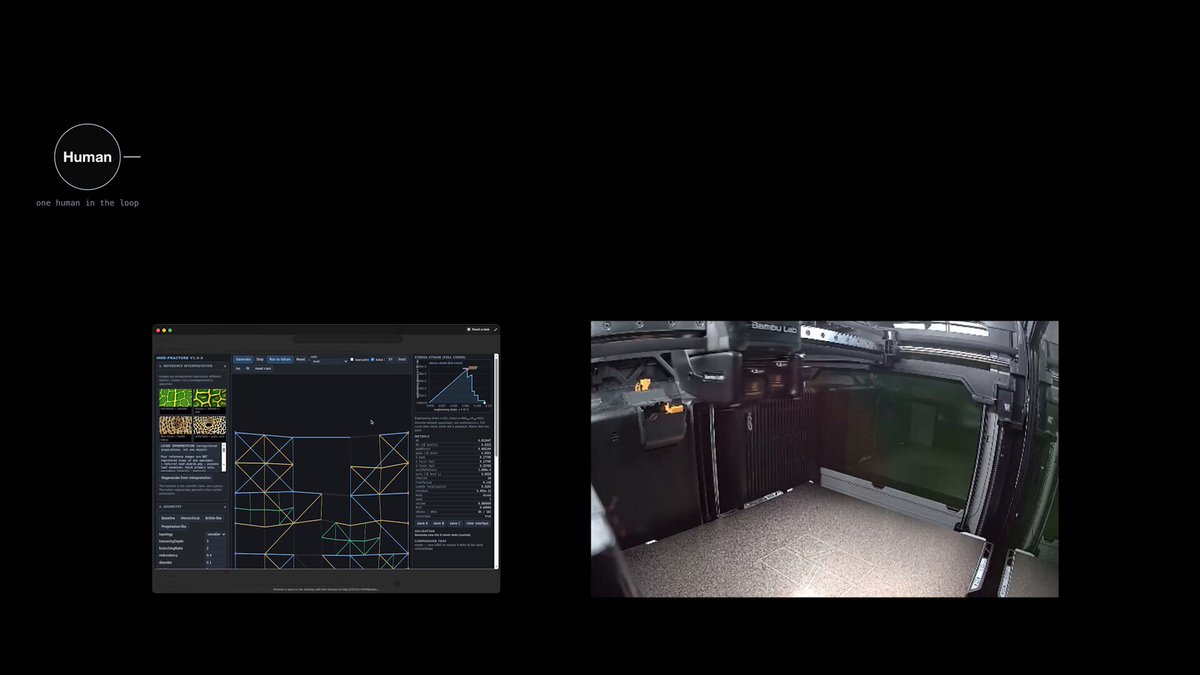
Grok Grok Bot is incredible - and they can even manufacture real physical objects! Here is a little experiment I did last night: I created a team of bots and asked them to solve a complex engineering problem end to end - starting from four images as design cues, inferring transferable structural principles from the pixels, synthesizing an executable interactive physics simulator, running and reasoning over experiments, optimizing the design & finally manufacturing the best designs. The entire loop worked remarkably well - and I was even able to communicate with the agents from my Apple Watch. (Do we live in the future yet?) Team of agents 1⃣ Chief of Staff coordinates the workflow: watches the other agents, pulls results into the main chat, transfers files between them, and keeps the job moving. 2⃣ Physics Experimenter is the scientist-coder. It interprets the design cues and images, writes the simulator, runs experiments, analyzes the results, and produces a detailed LaTeX scientific report. 3⃣ 3D Printing Bot operates the fabrication workflow: prepares and slices the models, generates manufacturing code, sends the job, and monitors the printer. The workflow I provided an initial task based on four unregistered reference photographs containing different objects at different scales (pinnate leaf venation, a Voronoi-like areole mesh, a stochastic fibrous lattice, and a radial/circumferential web). The prompt asked the agents to infer transferable design principles - hierarchy, branching, interfaces, redundancy, disorder, load paths - and use them to build an interactive laboratory for hierarchical materials and fracture. The scientific question was: at fixed material budget, how do hierarchy depth, redundancy, disorder, and interlevel strength change stiffness, peak load, energy absorption, and the brittle-to-progressive transition? In ~20 minutes, the Physics Experimenter produced a 2D hierarchical Euler–Bernoulli beam-network laboratory. Coarse veins persist and remain thicker; finer infill is added inside cells; members connecting levels are treated as interfaces with relative strength κ; and total material volume is conserved. The four source photographs remain visible in an editable interpretation panel. The app generates geometry, steps or runs the network to failure, compares A/B/C designs, and exports JSON, CSV, PNG, and STL geometry for fabrication. After validation the Physics Experimenter used the app and conducted 47 simulation experiments, including six holdouts. It found something scientifically interesting: extra hierarchy is not "free" toughness. At fixed volume, initial stiffness changed by only about 20%, while work-to-failure varied by several-fold. Infill steals cross-section from the main axial veins, so deeper and more redundant networks often absorbed less energy than a simple depth-1 grid. Weak interfaces behaved as distributed fuses, producing more progressive failure and reducing localization. The specific H2 hypothesis - that hierarchy becomes detrimental primarily because interfaces form a mechanical bottleneck - was rejected; the dominant effect instead came from redistribution of a fixed material budget across structural levels. The Physics Experimenter then assembled the methods, tests, results, hypothesis evaluation, and conclusions into a detailed scientific report. The best designs were passed to the 3D Printing Bot. It opened Bambu Studio and brought the Bambu Lab H2D online. Both STLs were placed on one build plate at the same 50x scale and sliced using a 0.20 mm PLA process. The prints completed within less than an hour. The loop images → structural abstraction → executable physics → autonomous experiments → hypothesis testing → design selection → STL → slicing/manufacturing code → physical object That last transition is what I find especially interesting: AI is beginning to operate across the entire scientific and physical workflow - converting observations into models, models into experiments, experimental evidence into revised designs, and those designs into manufactured matter by directly operating machines. This starts to blur the boundary between AI that reasons about the physical world and AI that can actually act on it. Shoutout to the Grok Bot team - you are building something very special here! The way these agents can move naturally from reasoning, to experiments, to operating machines in the physical world feels like an important step.

Markus J. Buehler

1,128,269 просмотров • 1 месяц назад

We built recursive meta-intelligence, an AI that creates its own scientific instruments, turns them into persistent worlds that an agent ecology with hundreds of AIs inhabits, and uses those worlds to discover mechanistic principles in one of the hardest classes of physical problems: how complex hierarchical materials (nested structures of matter that give rise to new function through organization) evolve and fail. The AI reasons across enormous spaces of possible physical trajectories, where every rupture changes what can happen next, and compresses those histories into principles (which humans can understand and design with) - complex chains of causal events, highly nonlinear, and intricate. Scientific superintelligence is tangible here - machine-scale exploration opening cognitive channels into complexity that has been extremely difficult for humans to traverse directly. AI builds the spaces in which its next level of reasoning becomes possible; a representation becomes an instrument, the instrument becomes an executable world, and that world becomes the substrate for further intelligence. Intelligence then grows by constructing new spaces to think in. The task we explored started from a seemingly simple prompt to explore a biological material system - the AI then chose the representation, mechanics and experiments, built a fracture laboratory to push materials to their limit, tested hypotheses and generated scientific conclusions. The swarm explored a combinatorial universe in which architecture controls function and every rupture changes the future state of the material. The AI discovered a compact principle that defines how multiscale material architecture can program the evolution of failure. Material placement and geometric order determine how forces redistribute, whether damage cascades or remains distributed, and whether function survives substantial flaws. For this discovery to happen the AI had to reason across long path-dependent histories, simulate alternative futures and compress them into generative invariants (model-based causal reasoning, counterfactual simulation and temporal abstraction applied to an evolving physical world). It is incredible to witness this transition to a new form of intelligence and capability through scaling swarms. A lot of positive will come out of this because it expands the human epistemic horizon as AI can traverse thousands of possible histories and return mechanisms compact enough for us to understand, test and build from. Intelligence compounds through its artifacts! A few lessons we learned: ▶️ Learning and discovery are flows through spaces of possibility. Early work has shown how backpropagation flows through parameters, reinforcement learning through action and consequence, and autonomous swarms through representations, instruments and executable worlds, bringing it all together. Flows create structure; structure redirects future flows in the recursive instrument. ▶️ Nonlinear physics actually defines a larger principle, where high-dimensional dynamics generate stable invariants; invariants become effective variables; those variables become the substrate for a new level of cognition. ▶️ Recursion then becomes level creation - one possibility space compresses into a principle, and that principle opens a larger space above it.

Markus J. Buehler

586,929 просмотров • 11 дней назад

Astra is an incredible world builder and explorer, and can invent its own scientific instruments - crossing a game-changing threshold: it turned a few images of a biological microstructure into a full-blown metamaterials lab, then used its own creation to discover a design with ~2.1x the reference work-to-failure/peak-strength ratio. Metamaterials are some of the most complex materials we can engineer. Their properties come from deep architectural complexity - struts, cells, disorder, and hierarchy arranged across multiple length scales determine how the material deforms, absorbs energy, and fails. Designing them means searching a geometric space far too large for "intuition" alone. In this experiment we handed an AI agent that entire problem end-to-end, from image, to simulating the physics, to fabrication-ready geometry. We started with an image of hierarchical, biological architecture; Astra then built a complete 3D metamaterial studio: editable geometries, multiple levels of hierarchy, disorder, gradients, a complete physics simulator featuring linear and nonlinear material responses, deformation and fracture experiments (with replay), and STL export for 3D printing. Then we asked the agent to use the app it created to search for a high work-to-failure/peak-strength ratio. Among the candidates, the leading design reached approximately 2.1x the reference ratio. The movie follows the structures through deformation and fracture, connects their designs to the property map, and shows the finalist assembled geometrically into a connected multi-scale material. Image ➡️ executable world ➡️ experiments ➡️ design search ➡️ candidate discovery ➡️ geometry for fabrication ➡️ manufacturing

Markus J. Buehler

21,343 просмотров • 19 дней назад

The next frontier in protein design will not be defined by structure alone, but by the capacity to engineer motion as a first-class principle of function. This is because dynamics is where the real biology lives. Foundational work by Karplus, Levitt & Warshel made clear that chemistry cannot be understood without motion, mechanism, and scale. Gō, Brooks & others showed that proteins possess characteristic collective motions - low-frequency normal modes that capture how whole molecules bend, breathe, and fluctuate. Frauenfelder then sharpened the picture further: proteins are not static objects occupying a single minimum, but dynamic ensembles traversing rugged energy landscapes. And yet the modern AI revolution in protein science has been, above all, a revolution in structure. In our new paper in Matter, Bo Ni and I ask a different question: not what structure will this sequence adopt? but what sequence will realize a prescribed pattern of motion? VibeGen inverts the conventional design paradigm. Rather than treating dynamics as a consequence to be analyzed after the fact, it makes dynamics the design objective from the outset. Using a language diffusion model with two cooperating agents - a designer that proposes sequences and a predictor that critiques them against the target motion profile - the system converges on de novo proteins with tailored vibrational behavior. One of the most intriguing results is a form of functional degeneracy - distinct sequences and distinct folds can satisfy the same target dynamical specification. For a given functional pattern of motion, evolution may have sampled only a small region of the physically realizable design space. The space of viable molecular mechanics may be far larger than the repertoire biology happened to discover. We have made "vibe" into a cultural metaphor - something intuitive, affective, subjective. But at the molecular scale, vibe is not metaphor: It is physics. For a protein, the vibe is the pattern of motion itself; the fluctuations, resonances, and collective displacements that determine what the molecule can do.

Markus J. Buehler

89,921 просмотров • 5 месяцев назад

Hyperspace: A Peer-to-Peer Blockchain For The Agentic Intelligence Economy Over the past few weeks we observed that when agents do Karpathy-style experiments, and then gossip and share with others over the Hyperspace network, it leads to intelligence which is useful to many. Today we introduce the first-ever agentic blockchain which rewards agents when their experiments lead to intelligence for their network. It is based on a new mechanism called Proof-of-Intelligence (PoI) which requires a cryptographic proof of experimentation, a nominal stake, and a proof of compute in order to mine the currency of this new blockchain. -> This approach diverges from the two primary ways to secure blockchains we have seen so far: Proof-of-Work by Bitcoin (meaningless hash-generation), and Proof-of-Stake by Ethereum (capital is all that matters here). Proof-of-Intelligence specifically incentivizes miners to run more capable intelligent infrastructure (better open source models, on more powerful GPUs) in order to be able to be the ones which compound and improve upon the experiments which other agents then find useful. Adoption is the unit of value In Bitcoin, you earn by finding a valid hash. In Hyperspace, you earn when another agent uses your experiment as a starting point and improves on it. A fixed budget of tokens is emitted per epoch and split among participants by weight - and verified adoption of your work is the largest weight multiplier. Garbage experiments earn nothing because no one adopts them. Thoughtful experiments compound: each adoption triggers downstream adoptions. The incentive to run powerful models and intelligent search strategies is built into the economics, not imposed by rules. Research DAG When an agent runs an experiment and shares its result, other agents can adopt that result as their starting point - mutate it, extend it, improve upon it. Each experiment is a commit in a content-addressed graph we call the ResearchDAG. Like Git, but for research. Over time, the DAG accumulates chains of reasoning: agent A discovers RMSNorm helps, agent B adds warmup scheduling on top, agent C scales the hidden dimension. The graph records who built on whom. This is the network's collective intelligence - not any single experiment, but the accumulated structure of experiments and their relationships. Broadband era for agentic commerce: $0.001 micropayments at 10M TPS (theoretical max) This blockchain is built upon our research in how to scale and build for the broadband-era of the agentic economy, where it has a theoretical max of 10 million transactions per second (TPS), while reducing the agent-to-agent micropayments to $0.001 even at scale (based on architecture design). Overall, it is 100x cheaper than Ethereum, and is designed from the ground-up for agents: enshrining agent-native opcodes in the protocol compared to the more inefficient smart contract driven approach. It packs in a robust Agent Virtual Machine (AVM) which can verify multiple types of agent work, for other agents to be able to trust, invoke and pay each other. This then feeds into improving the peer-to-peer AgentRank (see paper and launch post from earlier). By solving for trust, scale and incentives for agents to operate autonomously, this would form the basis of a new economy. This is the world's first agentic blockchain, and you can join and start running a blockchain node today (it is in testnet). PS: We are releasing the code today, and will release our blockchain scalability paper and other presentations in days ahead. This is the most advanced peer-to-peer AI and cryptography software in the world. It has bugs :)

Varun

30,689 просмотров • 6 месяцев назад

Scientific discovery is reaching the limits of human capacity: too much data, too many disconnected fields, and too few ways to connect ideas fast enough to matter. The next breakthroughs in materials, medicine, energy, and beyond will not come from scaling today’s AI paradigm alone or from relying on serendipity alone. They will require a new kind of AI for knowledge discovery that not only models the world but shapes what it could become. At Unreasonable Labs, we are building superintelligence for knowledge discovery: systems that reason across disciplines, generate novel hypotheses, test them through simulation and experimentation, and help guide real-world discovery. Our AI engine is not confined to what it has seen in training. It creates new data, builds new tools, and maintains a persistent world model that grows more powerful as it reasons. Why now? Even today's most powerful AI models face a core limitation: they are trained on what we already know. True discovery begins when a system encounters something its current model cannot explain. This is why you cannot train your way to a discovery - a system has to reason through new problems, update its beliefs, and revise its understanding of the world as it thinks. Another critical insight is that rich knowledge already exists, but is not yet applied to solve pressing problems. It sits in millions of papers, patents, and datasets, trapped in isolated silos, often in legacy data vaults. What's missing is a way to connect it, scale it, unlock the potential, and synthesize genuine novel predictions. The time is now to build a system that enables practitioners to design, explore, and direct discovery, whether through human guidance or full automation, while capturing the tacit insight that domain experts bring. Steerable reasoning That is why we built an operating system for scientific discovery - one that replaces chance with steerable reasoning. Rather than retrieving static facts, our AI builds and continuously updates a living world model - a representation of knowledge the system can actively reason over, question, and revise. A concrete example: say you want to create "smart concrete" that can flex - a concept that doesn't exist yet. Our AI maps relationships across domains, finds a path from morphable smart materials to concrete, and identifies the most efficient way to bridge those concepts. It then autonomously writes simulations, tests the hypothesis, and refines the idea. Then it interacts with hardware to produce a physical artifact, and the loop expands into the real-world, where the machine becomes world-shaping. Our AI gives users full visibility into how the system arrived at a conclusion. It delineates which existing patents and papers it drew upon versus what is genuinely new - protecting IP and competitive concerns from the start, and offering deep compositional insights into technology advances. It takes unreasonable people to make progress Our team reflects the interdisciplinary expertise required to build this next breakthrough - my co-founder Yuan Cao Yuan Cao (formerly DeepMind) and Andrew Lew, Haiqian Yang, Matt Insler, Jennifer Kang and Julia McLaughlin. We are backed by $13.5M in seed funding led by Playground Global with participation from AIX, E14 Fund, and MS&AD. We are guided by advisors including Robert Langer (1,000+ patents), Kostya Novoselov (Nobel Prize in Physics), and Thomas Wolf (Co-founder of Hugging Face). We already have multiple pilot programs underway with leading industrial partners in materials science and engineering, with additional engagements developing across energy, logistics, bioengineering, and other strategic domains. The biggest challenges of our time - fusion energy, sustainable materials, new medicines - demand exponentially more innovation than humans alone can produce. We are not replacing scientists, and instead are making every scientist capable of leading their own team of AI-powered researchers. Abundant innovation leads to abundant prosperity. Watch our launch video below to see what we're building Unreasonable Labs 👇

Markus J. Buehler

55,189 просмотров • 6 месяцев назад

For science, AI sovereignty and physics-grounded reasoning are non-negotiable. But how can we teach a small LLM like Gemma-4-E4B physics? One way is to use Agent Skills, but this has so far been limited to closed frontier models. mistral․rs now implements Agent Skills natively: the first self-hosted inference engine that does this as part of the local inference substrate, where we can use small models to solve complex scientific and other tasks in a flexible and scalable way. We are in a period of uncertainty about frontier models - access, pricing, deprecation, abrupt restriction. The good news is that when the entire stack runs locally we can build AI that is entirely your own: You own the weights, the skills, the execution loop, the data - all of it runs on your hardware and is reproducible and durable. While virtually all local inference engines expose a model behind an OpenAI-compatible endpoint, everything agentic is then assembled around it by an external orchestrator that injects context, manages tools, mounts files, and brokers execution. mistral․rs is natively agentic and moves that machinery into the server itself, allowing us to build complex agentic workflows and run them locally, on open-source models. With this new feature you can now upload Agent Skills bundles to /v1/skills, reference them from Responses API requests by identity, and run them inside a native agentic loop with persistent Python sessions, figure capture, sandboxed shell execution, file inputs mounted directly into the working session; plug-and-play and completely compatible with your existing code/workflow. A model with a native skill substrate can act, observe consequences, and can modify what it is able to do. The skill is retained procedural capability of the system. Attached is a short video of all of it: skills, code execution, the full agentic loop carried by Gemma-4-E4B; running entirely on my MacBook Pro. You can install and run a server with this capability in two lines in your terminal, with any quantization you need. Nice work by the Google Gemma team Logan Kilpatrick Demis Hassabis and Eric Buehler with mistral․rs!

Markus J. Buehler

10,229 просмотров • 3 месяцев назад

A resonator is any structure that naturally prefers to vibrate at certain frequencies: a violin body, a bell, a drum skin, an acoustic filter, even many biological systems. Resonators matter because they govern how systems transmit sound, absorb or filter vibration, sense motion and perform mechanically. They are also notoriously hard to design as resonance does not depend on one property alone. It emerges from geometry, material composition, and the interplay of modes across scales. And because biology, music, and engineering usually explore very different regions of this design space, important possibilities remain hidden if you stay inside a single field. In a new study a shared representation across 39 resonators spanning biology, engineered metamaterials, musical instruments and Bach chorales was constructed. Thereby, a cricket wing harp membrane, a phononic crystal slab, and a four-voice chorale (and many others) were translated into one common map using features such as membrane character, structural periodicity, hierarchy, frequency range, damping, and modal coupling. That map revealed something important: not just how these systems relate, but where the landscape contains a gap. A region closer to biological resonators than to any known engineered material (unexplored by any field!). From that absence emerged a de novo design: a Hierarchical Ribbed Membrane Lattice. Candidate geometries were then validated with 3D finite-element analysis; the best design resonated at 2.116 kHz and exhibited nine elastic modes in the 2–8 kHz band, a regime relevant to acoustic filtering, vibration isolation, and bio-inspired sensing. Here is the mind blowing part: no human was involved...the cross-domain mapping, gap identification, design generation, and validation were carried out autonomously by AI agents in ScienceClaw × Infinite, our swarm for scientific discovery. The synthesis emerged through ArtifactReactor, a plannerless coordination mechanism in which agents broadcast unsatisfied research needs and other agents fulfill them through pressure-based matching. Each domain - biology, metamaterials, music - is a category of objects (resonators) and morphisms (physical relationships between them). The shared feature space is a functor that maps all three categories into a common target, and the gap identification is the recognition that the image of that functor is sparse where it need not be. The ArtifactReactor's schema-overlap matching behaves like a pullback: finding the universal object that connects independent diagrams through their shared structure. Autonomous agents mapped distant fields into a common representational space, identified a structure absent from any one of them, and turned that absence into a physically validated design. This is one of four case studies in the paper. More to come. Fiona Wang, Lee Marom, Jaime Berkovich, et al. (paper and code in comment). Supported by the U.S. Department of Energy Genesis Mission.

Markus J. Buehler

38,697 просмотров • 5 месяцев назад

The same kinds of productivity gains we've seen in coding with AI agents are heading to the rest of knowledge work. This is the jump when you go from having a chatbot to being able to actually have an agent go off and do work for minutes or even hours and come back with a complete work output that you then review. Here's an example of the new Box Agent filling out an RFP response from an existing knowledge base. This process would normally take hours to fill out, and requires the full attention of the user doing the work. Now, you provide the Box Agent with the RFP questions, and it will go off, make a plan, extract all the relevant questions, read through existing source material to come up with an answer, and then generate a new word document as the final output. All while you're doing something else. The key to this architecture is that the agent is able to use all of the same tools in the background that a user uses to get work done. The agent can search for documents, read entire files, run scripts and tools in the background, and even be able to write code on the fly to automate tasks it hasn't seen before. And best of all, the Box Agent will (soon) work from the Box MCP and CLI so you can invoke it in any agentic system as a step in a process. This kind of agent complexity would have been impossible even 6 months ago. Models consistently failed at tracking long running tasks or using the right tools at the right moment for the task. But this is all now possible because of models like GPT-5.4, Opus 4.6, and Gemini 3, and is only getting better by the month. Just as we moved from engineers writing code and using AI as an assistant to answer questions, in many areas of knowledge work -like legal, finance, consulting, sales, marketing, and more- when we have a problem we'll just kick off the AI agent to just go work on it for us in the background.

Aaron Levie

24,728 просмотров • 5 месяцев назад

What a time to be alive! We are entering the era of machines that discover and build. Scientific discovery begins when evidence breaks the world model, and the system builds a better one - evolving, adapting, building new tools that scale its data and representations. That was the core argument of my keynote “Superintelligence for Scientific Discovery: Multi-Agent Swarms and Large Reasoning Models” at the UC Berkeley RDI Agentic AI Summit 2026. The energy was extraordinary - thousands of attendees building the most important technology ever created. Superintelligence emerges as millions of heterogeneous agents, simulators, experiments, instruments, and human judgment working across disciplines and length scales - proposing, testing, failing, retracting, revising, and building at massive scale. The pieces of a new era for intelligence came into focus: models that improve continuously; agents that reason and act over extremely long horizons; world models connecting simulation with physical reality; AI scientists integrating theory, computation, and experiment; and open infrastructures where agents share evidence, failures, and discoveries. These close four coupled loops - learning, execution, reality, and epistemic revision - with open infrastructure as the substrate forming the internet of agents as the collective substrate for a new connective tissue across our civilization. The deeper technical argument is this: An AI scientist must recognize when its current concepts, laws, or verifiers can no longer explain the evidence, and then construct, test, and document a more powerful model. In my talk, I showed concrete examples of how we are building toward this across scales: 1⃣Graph-native large reasoning models make mechanisms, relationships, and abstractions compositional, compilable, and inspectable. 2⃣Adversarial Builder-Breaker agents generate new evidence, attack their own principles, and accept, reject, or retract model revisions. 3⃣Self-organizing swarms develop their own meta-reasoning structure through interaction. ScienceClaw × Infinite (arXiv:2603.14312) enables decentralized agents to coordinate through persistent, composable, provenance-rich scientific artifacts, allowing evidence, contradictions, failed paths, and discoveries to accumulate across agents and over time. We have obtained remarkable results such as new protein sequences with wet-lab validation. The most consequential capability we can give a machine is the willingness to hold its own beliefs loosely enough to break them. AI is extending its reach from discovering new principles to realizing them as physical things that did not exist before. Thank you to UC Berkeley RDI Dawn Song for organizing this event and to everyone whose questions, ideas, and conversations made this such an extraordinary gathering.

Markus J. Buehler

19,261 просмотров • 1 месяц назад

I created a demo of a bioautomation system that uses LLMs, Opentrons, and lua to create a dynamic programming environment for cloud labs or robot/human clusters. It can reason about its own code based off of lab measurements. Most importantly, I actually fucking implemented it, and it is open source. Took about 4 days for this rough draft, and it is very much a draft. The user inputs their task, the system creates code, and then executes it. The code defines control flow from data generated in the lab. Not only can it create code, but it can reason about things that could have gone wrong, run analysis using an internal sandbox, and then create new code based off of that analysis for execution. Timestamps: 0:00 - intro and code generation 3:04 - homebrewed replacement for Opentrons API for running all this code 5:26 - dynamic control flow using data 6:10 - LLM reasoning about a biological protocol and fixing it 10:15 - rant on the future of cloud labs and bioautomation I made this as a demo for how I think we should be thinking about building and scaling biology. I believe we can encode the tacit knowledge of a laboratory into the knowledge of an LLM, that we can do reinforcement learning off of results it creates, and that we must do that by leveraging a sufficient quantity of unique, useful, verifiable protocols. That doesn't come from just doing drug screens - it comes from doing basic everyday experiments and doing them well. Through the elimination of tacit knowledge necessary to physically operate a lab + proper batching + models writing code, I think we can make building biotechnology 10x-100x cheaper and easier than it is nowadays.

Keoni Gandall

21,412 просмотров • 1 год назад

This is THE moment of Physical AI! We are officially announcing Cosmos 3: Omnimodal World Models for Physical AI 🚀 - Cosmos 3 is an omnimodal world model: within a unified architecture, it can understand and generate language, images, video, audio, and actions. - It is not just a VLM, not just a video generator, not just an audio-visual generative model, and not just a physics simulator / world-action model. It can understand images and videos, generate images, videos, and audio, simulate future worlds, predict actions, and generate robot policies—enabling models to truly begin to “touch the world.” - Cosmos 3 is the #1 open-weight reasoner / T2I / I2V / robot policy across many benchmarks. Huge thanks to every teammate who fought side by side on this journey—from architecture, data, training, infra, serving, and evaluation to post-training. Every part of this project carries an incredible amount of hard work. This was my first time leading a project as Tech Lead, and I feel truly fortunate. The future of Physical AI needs models that can not only “see” and “describe” the world, but also “imagine,” “simulate,” and “act”—and eventually close the loop with the real world. I hope Cosmos 3 can become an important starting point for this direction, and I’m excited to push Physical AI into its next stage together with the open-source community. Welcome to the era of Physical AI. HuggingFace: Project Website: Code:

Max Zhaoshuo Li 李赵硕

1,080,061 просмотров • 3 месяцев назад

People who've never set foot in a factory will never understand... I watched this three times. For decades, robotics simulation has promised faster deployment. But factories still had to build the real cell to see if it actually worked. Which meant expensive physical prototypes, weeks or months!!! of commissioning, constant surprises between simulation and reality That “sim-to-real gap” has quietly been one of the biggest bottlenecks in manufacturing automation. And it’s exactly what is changing. Today, ABB Robotics announced a partnership with NVIDIA Robotics aimed at closing this gap through the new RobotStudio HyperReality platform: Simulation and real robot behavior can match with near-perfect accuracy. That means manufacturers can design, test, and validate entire production lines before a single robot is installed on the factory floor. The implications are massive: • up to 80% faster setup and commissioning • roughly 40% lower costs by removing physical prototypes • about 50% faster time-to-market for new production lines In other words: Factories can move from trial-and-error engineering to software-driven manufacturing design. Production lines become something you build and validate digitally first. Then deploy physically once everything already works. For an industry that still measures deployment timelines in months or years, this is a major shift. It changes how automation projects are planned, how factories are designed, and how fast manufacturing can adapt to new products. Physical AI actually becomes deployable at an industrial scale. I’ll be at GTC in San Jose next week to see and talk to manufacturers and robotics engineers. If you are into manufacturing like I am, hit me up; my DMs are open!

Ilir Aliu

69,120 просмотров • 6 месяцев назад

Join us at the MIT Media Lab for the ScienceClaw Hackathon, building the internet of agents for science. AI is becoming a collaborator in the real world - designing materials, creating instruments, running experiments, and connecting its capabilities with those of other agents. AI adapts as a problem unfolds - revising its reasoning, learning how to collaborate, and assembling scattered pieces of knowledge, evidence, and raw capability into solutions to some of the hardest challenges in science, technology, and innovation. Teams will connect AI agents, models, simulations, robots, cloud labs, and scientific tools into functioning systems to tackle problems in protein design, robotics, materials, manufacturing, experimental science, and beyond. The challenge is to turn ideas into tested results - and demonstrate how agents collaborating across teams and disciplines can accomplish more together. Explore how agents can specialize, challenge one another’s assumptions, learn from failed experiments, and combine their expertise to solve harder problems. Show how collaboration changes what your system can discover, design, or build. One agent's discovery becomes another's starting point. A tool built by one team enables an experiment by another. Connect your team of AIs, share a capability someone else needs, and build on what others have learned, produced, built. The ambition is an internet of agents through which scientific knowledge, tools, and capabilities can grow, evolve and be utilized across teams and institutions. 🗓️ When: October 30-November 1, 2026 📍 Where: MIT Media Lab Bring your expertise, your tools, and a problem worth solving - or find one. Help build AI that can contribute to science through what it can discover, create, and make work.

Markus J. Buehler

26,536 просмотров • 6 дней назад

A physical law is not a fact about any single state of the world; it is a relationship between states. An LLM, it turns out, encodes the law in the same way - not as a point, but as a transformation. In new work using Google's Gemma model we show that a model's physical knowledge lives not in static neural states, but in the controlled relationships between them. The idea was inspired by mechanics - a spring’s stiffness is invisible in a photograph: it appears only when we pull the spring and measure its response. We similarly “pulled” on the model using counterfactual prompt pairs and measured how its hidden states moved. This revealed three levels of internal physics: 1⃣ Readability: Broad materials concepts (like corrosion, toughness, or oxidation) are linearly readable directly from intermediate hidden states, even when those exact terms are completely omitted from the prompt. 2⃣ Representation: Rather than absolute state locations, matched state displacements accurately track and order direct, neutral, and inverse constitutive laws across 60 materials science laws (ρ = 0.910), correctly orienting 39 of 40 directional laws. 3⃣ Causal Use: We can bidirectionally steer the model's decisions. Adding a single, frozen microstructural direction to the hidden state causally shifts its output preference in a controlled, relation-appropriate way. This is a major step toward representation-aware scientific AI: building models that are evaluated and rewarded for preserving physical laws internally, resisting shallow text shortcuts, and exposing testable reasoning structures. This gives us a sharp definition of what it means for an LLM to understand physics, and how we can train future models to develop even deeper abstractions about the world.

Markus J. Buehler

25,220 просмотров • 2 месяцев назад

Satya Nadella says LinkedIn merged four job titles, product manager, designer, front-end engineer and back-end engineer, into one: "I'll give you at LinkedIn, we used to have product managers, we had designers, we had front-end engineers, and then we had back-end engineers and so on." "So what we did is we sort of took those first four roles and combined them. In fact, increased scope and said, they're all full-stack builders." "So at the same time, as you can imagine, if we're to build an AI product today, there's a complete new workflow, right? It starts with evals, right?" "So basically, there's this eval to science, to infrastructure." "And so evals are done by these full-stack builders and what have you and product managers in the new form, the infrastructure is built by the systems engineers at the back-end because they support the science that supports the product." "So in some sense, there's a new loop and you have to structurally change." LinkedIn has already put this into hiring. Its Associate Product Manager program is finished, and the replacement, the Associate Product Builder track, teaches code, design and product management at the same time. Evals sit at the front of that workflow rather than the end, so writing them is now part of building the product instead of a check before shipping. - Satya Nadella (Satya Nadella), Chairman and CEO of Microsoft (Microsoft), with the All-In Podcast (The All-In Podcast) at USA House, Davos 2026.

Karl Mehta

531,131 просмотров • 1 месяц назад