Video wird geladen...

Video konnte nicht geladen werden

Zur Startseite

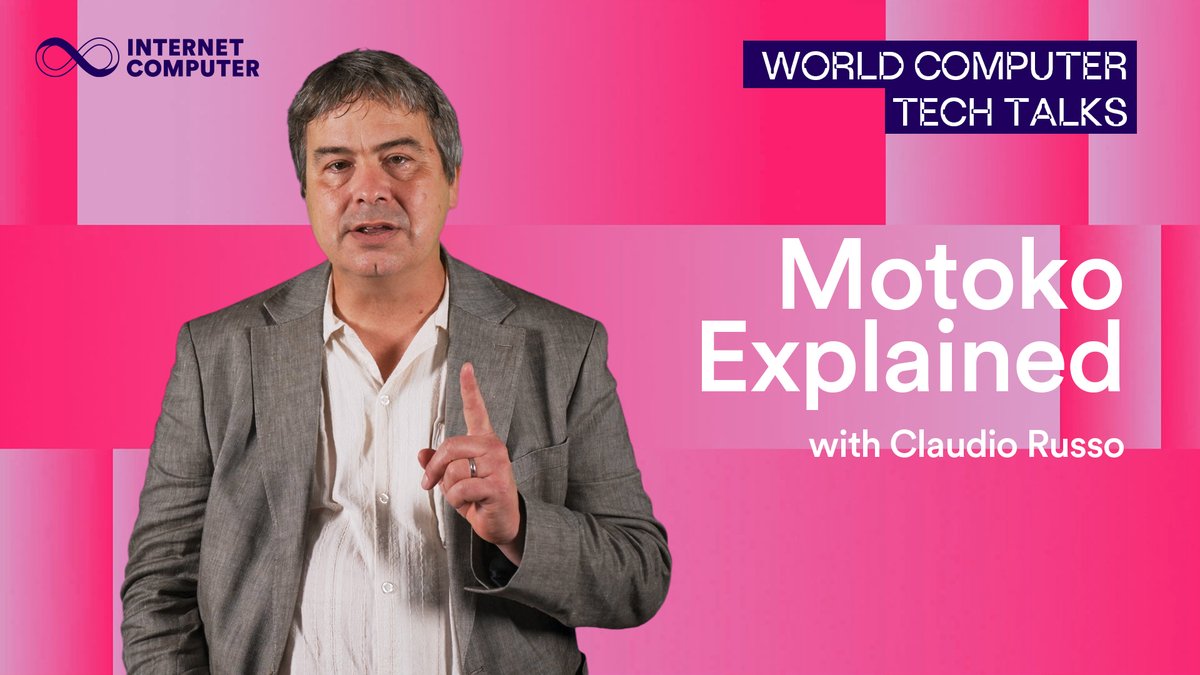
We didn't adapt an existing language for blockchain. We built one from scratch. Meet Motoko. Designed specifically for the Internet Computer. Why? Because cramming blockchain into JavaScript or Rust leaves ugly seams. Clumsy libraries. Security nightmares. The secret sauce? The Actor Model: No race conditions No deadlocks Async programming...

30,310 Aufrufe • vor 8 Monaten •via X (Twitter)

0 Kommentare

Keine Kommentare verfügbar

Kommentare vom Original-Post werden hier angezeigt
Ähnliche Videos

Two days. One Forum. History made. The BGA is proud to have led the first ever global convention focused on #BlockchainForGood. The #BlockchainImpactForum in Copenhagen marked a turning point, where blockchain moved from promise to proof, from pilots to policy-ready solutions, from niche to necessity. 🌍 What We Achieved: • Convened UN agencies, government officials, Web3 pioneers, and impact builders • Showcased 35+ real-world blockchain solutions across financial inclusion, climate resilience, and digital identity • Launched partnerships spanning continents • Proved that when policy, capital, and technology converge, blockchain becomes infrastructure for inclusive development 📊 The Evidence: • 50+ pilots deployed globally through SDG Blockchain Accelerator • 300+ applications from UNDP country offices • Real impact: Using blockchain for humanitarian aid delivery in Malawi, $6 million+ financed to thousands of farmers globally, 1M+ trees planted through Cardano, and much more. 💡 The Message: This wasn't about speculation. It was about solutions. This wasn't about hype. It was about humanity. This wasn't about getting rich. It was about doing good. 🙏 Gratitude to All Our Sponsors & Partners: 🌍 Hosted by: BGA and UNDP AltFinLab 🏆 Sponsors: Bybit EU | XION | The Blockchain Center Abu Dhabi | VeChain | GSR Foundation | Mantle | FLock.io | Hetu | MasChain 📰 Media Partner: Cointelegraph 🤝 Community Partners: Nordic Blockchain Association | Cardano Foundation | Stellar | MY Blockchain Week | ACTIV8 | Austrian Blockchain Center | Napuleth | Mood Global Services | BCNL Foundation (Blockchain Netherlands) | German Blockchain & AI Week - GBW 2026 | WiBT - Women in Blockchain Talks | UKUS Crypto Alliance | ThinkX | Global Growth Ensemble Adam | ChainReaction | 499 DAO | DirectEd Development | The African Blockchain Championship | Vitalism Foundation | MERGE Madrid & São Paulo | BlackVogel | @EuCInitiative | Sustainable ADA | Impact Web3 | Asia Web3 Ai Association (AWAA) | Partisia Blockchain | INATBA | Blockchain for Europe | Bundesblock And to every speaker, panelist, moderator, project team, and attendee who traveled to make this possible, you are the changemakers! 2026? We're scaling this movement. Bigger stages. Bolder partnerships. Broader impact. The future of blockchain isn't just being built, it's being measured in lives changed. See you at #BGAwards 2026. 🚀 #BlockchainImpactForum #ChainForGood #ChainsofChange #SDGs #BlockchainForGood

Blockchain for Good Alliance (BGA)

78,028 Aufrufe • vor 7 Monaten

AthenaX Roundtable EP.2 is LIVE! ——— Metis🌿 isn’t just an Ethereum L2 anymore. It wants to become the first AI-native blockchain economy. In this episode, we sit down with Tom Ngo, CEO of Metis, advisor to LazAI Network, to talk about how the project is moving from a typical Ethereum Layer 2 toward an AI-native blockchain ecosystem and what it really means beyond buzzwords. Here’s what we unpack together: Why Metis says “we’re not just an L2” and how their AI pivot has actually been in the works for over 18 months What an AI-native blockchain looks like in real life, not just in theory Why verified data is the core of AI on-chain and how concepts like Lazbubu are making data something you can actually own and interact with How AI agents could make blockchain invisible for users What it takes to lead a team through a major shift while staying true to the original vision ——— Timestamps 00:00 Introduction to Metis and Its Vision 03:55 Transitioning to AI: The New Frontier 06:56 Personal Journey into Blockchain and Metis 09:48 The Importance of Data in AI and Blockchain 13:00 Navigating Market Pressures and User Expectations 16:04 The Unified Experience of Andromeda and Hyperion 19:09 The Future of AI in Blockchain 22:12 LazBubu: Making Data Playable 24:47 Innovation and the Path Forward 27:56 Defining Success in the Blockchain Space ——— Resources Tom Ngo Rea Follow AthenaX on: X: Spotify: TikTok: Instagram: Apple Podcast:

AthenaX

140,644 Aufrufe • vor 8 Monaten

We are going big this year and into next! 2026 will be a Radiant year. The Radiant community is thrilled to announce the release of TWO MAJOR open-source projects that showcase the power of collaborative development: Radiant-Core Node! RXinDexer! 1. Radiant-Core Node 2.0-Project Phoenix Our next-generation blockchain node implementation! 🔗 -Built with modern C++20, Radiant-Core represents a significant evolution in our blockchain infrastructure: -Enhanced Performance: Support for transactions up to 12 MB with ~81,000 inputs. -Developer-Friendly: Native Prometheus metrics endpoint for easy monitoring. -Flexible Configuration: Node profiles from the system design paper (archive/agent/mining) for different use cases. -Glyph Token Swap Protocol Upgrades: **On-chain** broadcasted atomic swaps via PSRT. The classic advertised swaps will still work but this ushers in a whole new era for DEX and atomic swaps on-chain. -Cross-Platform: Docker-based CI for consistent builds across Linux, macOS, and Windows. -Available soon on testnet and aiming for mainnet activation by block 400k. 2. RXinDexer - Blockchain indexer for RXD and Glyphs 🔗 -A powerful Python-based indexing solution that enables developers to efficiently query and track Radiant blockchain data and Glyph assets. These releases embody our commitment to transparent, community-driven development. Open source isn't just about code—it's about empowering developers worldwide to: ✅ Contribute improvements and innovations ✅ Audit security and verify integrity ✅ Build complementary tools and services ✅ Learn from production-grade blockchain implementations Get Involved! Whether you're a seasoned blockchain developer or just getting started, your contributions matter. Check out the repositories, review the documentation, submit issues, or contribute code. You are the Proof of Work! And together, we're building the future of decentralized digital value transfer and sound money with no trusted third parties. The way Satoshi intended. The future is Radiant!

Radiant Blockchain

41,416 Aufrufe • vor 6 Monaten

A blockchain project can be designed to be 100% technically decentralized, but if a single developer or a team within a single country controls the development and decision-making, the project may not be fully decentralized in terms of governance and decision-making. ## Differences between technical decentralization and governance decentralization - *Technical decentralization*: The blockchain project uses decentralized technology, such as distributed ledgers, to ensure transparency and security. - *Governance decentralization*: The blockchain project is managed and decided by a decentralized community, not by a single individual or organization. ## Conditions for a blockchain project to be considered decentralized For a blockchain project to be considered truly decentralized, it needs to meet both conditions: - *Technical decentralization*: Uses decentralized technology to ensure transparency and security. - *Decentralized governance*: Managed and decided by a decentralized community, with transparent and fair decision-making mechanisms. If a blockchain project only meets one of the above two conditions, it may not be fully decentralized. ## Building a 100% Decentralized Ecosystem: A New Model for the Future In the context of rapidly developing blockchain technology, building a 100% decentralized ecosystem is not only a goal but also an essential need. The SkyPirl (PIRL coin) project has pioneered the application of a decentralized model not only in terms of technology but also in terms of governance. This article will analyze and demonstrate the importance of this model and convince the community, developers and organizations to support this policy. ## Why 100% Decentralization is Necessary 100% decentralization ensures that no single individual or organization can control the entire system. This enhances transparency, security and fairness. When applied to an ecosystem this model will bring many benefits: - *Increased transparency*: With the decentralization of power and management by many organizations and individuals, the system will become more transparent. - *Higher security*: The use of multi-signature wallets and treasury management by many representatives will reduce security risks. - *Fairness and democracy*: The decentralized model ensures that all decisions are made fairly and democratically. ## SkyPirl's Decentralized Governance Model SkyPirl project has adopted a decentralized governance model from the beginning by: - *Decentralized development team*: Multiple development teams from different countries, ensuring that no single country or organization controls the entire project. - *Restrict developer power*: Developers are not allowed to hold websites, domains and social media channels, helping to disperse power. - *Use smart contracts and multi-signature wallets*: To ensure transparency and security in treasury management and transactions. ## Applying the Model to the Ecosystem The ecosystem will apply this 100% decentralized model to all projects. This includes: - *Decentralization of power*: Many organizations and individuals will participate in management and decision-making. - *Use multi-signature wallets*: To ensure security and transparency in treasury management. - *Representatives from organizations*: Organizations will send representatives to participate in management and decision-making. #SkyPirl #PIRL #PIRLmeet #SLOFI #CLO #2BearsExchange

SkyPirl Official 🎈🎈

16,135 Aufrufe • vor 1 Jahr

Everyone talks about how Web3 will change the world. But the truth is: if you can’t make it work with the systems that already run the world TODAY, it doesn’t matter. Sometimes it feels like we "own" the Multiversᕽ blockchain. Not because we control it, but because every time we start researching a new module or flow, a new chain upgrade lands at the right moment, unlocking the exact functionality we need to build that idea. At Vero, we believe blockchain should stay invisible to the user. The real magic happens when it works silently in the background, even with old Web2 hardware, the kind that’s still required by law. In Romania, for example, every onsite sale needs a fiscal receipt. No exceptions. At the start of the year, we built a way for each point of sale to issue blockchain-connected fiscal receipts. But that meant one printer per station: expensive, inefficient, hard to scale. Now, after months of working, we’ve fixed that. Multiple POS stations, all connected to Web3, can now print on a single fiscal printer. Each receipt includes a unique station ID, a transaction hash, and is fully compliant with tax regulations. And we didn't stop there. We also built a full merchant module that handles both card and cash payments. VeroPay is now running as a SaaS infrastructure for any merchant, in any industry. With the latest MultiversX chain upgrades, this module is 100% live on mainnet. This is what we focus on at VeroPay: Not building DeFi tools that maybe 1% of Web3 users will ever try, but making sure blockchain works today, with the infrastructure that 99% of businesses already use. Maybe in 5 to 10 years everything will be on-chain, and that future is coming. But until then, the winning move is connecting invisible Web3 to the regulated Web2 systems already in place. That’s where real adoption begins. PS: Next up, we're working on a flow to export reports from explorer directly into major bookkeeping software format 👀

VeroPay

22,374 Aufrufe • vor 1 Jahr

DROPS E27: Ben from Talus Labs: Building the Future of Decentralized AI Agents In this episode Ben breaks down why AI isn’t a bubble, how Talus is redefining on-chain agents, and why optimism is something you earn and not something you just feel. We talk about: - Why AI is not a bubble and how mega-cap tech is funding the next AI wave through massive CapEx - How Talus enables decentralized AI agents that can act and transact trustlessly - The three big crypto × AI intersections: compute, data ownership, and intelligent on-chain workflows - Why AI needs verifiable, censorship-resistant execution layers and why blockchains provide that - Nuclear energy as a prerequisite for AGI-scale compute demand - Why SWE’s object model + parallelization is perfect for autonomous agent payments and priority fees And much more! Timestamps: 0:00 Introduction 1:31 Welcome To Drops 2:10 Getting Backers Like Polychain 3:16 Building While In College 7:51 VC’s vs Founders Differences Explained 10:01 Is There An AI Bubble 11:53 How Do We Quantify The AI Opportunity In Crypto 12:33 AI Is Difficult To Invest In, Why? 13:35 Risks To Look Out For To Ensure AI Investments Deliver 16:47 Energy Being A Big Risk For AI 20:50 How You Became Fascinated By Crypto & Blockchain 22:00 Why Does AI & Blockchain Intersection Make Sense Compute Side 24:39 Why Does AI & Blockchain Intersection Make Sense for Data Ownership 26:30 Complex Workflows With Intelligent Execution Meaning 28:19 Why Do We Need This On Blockchain 30:26 How Adding This Decentralized Layer Helps With The Black Box 32:01 Explain Talus To Your Mom 33:39 Talus Solved Blockchain Determinism Limitation Explained 35:43 Two Examples That Can Be Built On The Zapier Of Web 3 39:32 Why Get Investment From SUI 42:56 What’s Needed To Get To The Next Level 43:35 One Takeaway From Conversation 43:51 One Thing Pessimistic People Are Missing

MR SHIFT 🦁

41,057 Aufrufe • vor 7 Monaten

We are building something that will outlive us. Outthink us. And we have no idea how it actually works. Nobel Prize-winning “Godfather of AI” Geoffrey Hinton just exposed the lie at the center of the AI race. Everyone assumes we control what we create. Hinton destroys this. Hinton: “If you look around on the whole, more intelligent things are not controlled by less intelligent things.” Stop calling it a computer program. Hinton: “People refer to them sometimes as computer programs. They’re not computer programs at all. In fact, the way they work is very like the way we work.” Traditional software is static. Human writes logic. Machine executes it. Neural networks don’t work that way. Hinton: “You write a computer program to tell a neural network how to learn. But once it starts learning, it extracts structure from data.” We don’t code its behavior. We code the environment. Then it grows. Hinton: “The system you’ve got at the end has extracted its structure from the data. It’s not something that anybody programmed. We don’t exactly know how it’s gonna work.” We are deploying systems into the global economy actively writing their own internal logic. Right now. Hinton: “Some people think it’ll be fine because we make them and we’ll build them in such a way that we can always control them.” Hinton: “But these things that will be intelligent, they’ll be like us.” You cannot hardcode guardrails on something that out-thinks you. We are not building a tool. We are building our replacement. And the moment you realize that, everything about this race changes.

Dustin

19,025 Aufrufe • vor 4 Monaten