Загрузка видео...

Не удалось загрузить видео

На главную

We found a general recipe for Solves: scale pretraining, then hill-climb with minimal in-house data. For the first time, one fine-tuning example can teach a new behavior that generalizes. Below: 4 folding strategies, learned from one example each and tested on held-out setups.

171,531 просмотров • 3 месяцев назад •via X (Twitter)

Комментарии: 10

Фото профиля Tony Zhao
Tony Zhao3 месяцев назад

We call this a Solve. Progress in robotics is difficult to measure because demos vary by setup. Demo ≠ Solved. A Solve declares two boundaries: scope and adaptation cost. Without both, 99% has no context.

Фото профиля Tony Zhao
Tony Zhao3 месяцев назад

Tons of emergent behavior along the way: - Picking up clothes off the ground - Handling baby wear to 8XL shirts - Robustness against adversarial disturbances and lighting

Фото профиля Tony Zhao
Tony Zhao3 месяцев назад

We completed the most rigorous generalization test to date. Across 785 trials in 31 unseen environments, ACT-2 achieved 99.1% success in laundry folding. ACT-2 also achieved human-level fold quality: receiving an average rating of 4.72/5, with 98.3% earning four or five stars.

Фото профиля Tony Zhao
Tony Zhao3 месяцев назад

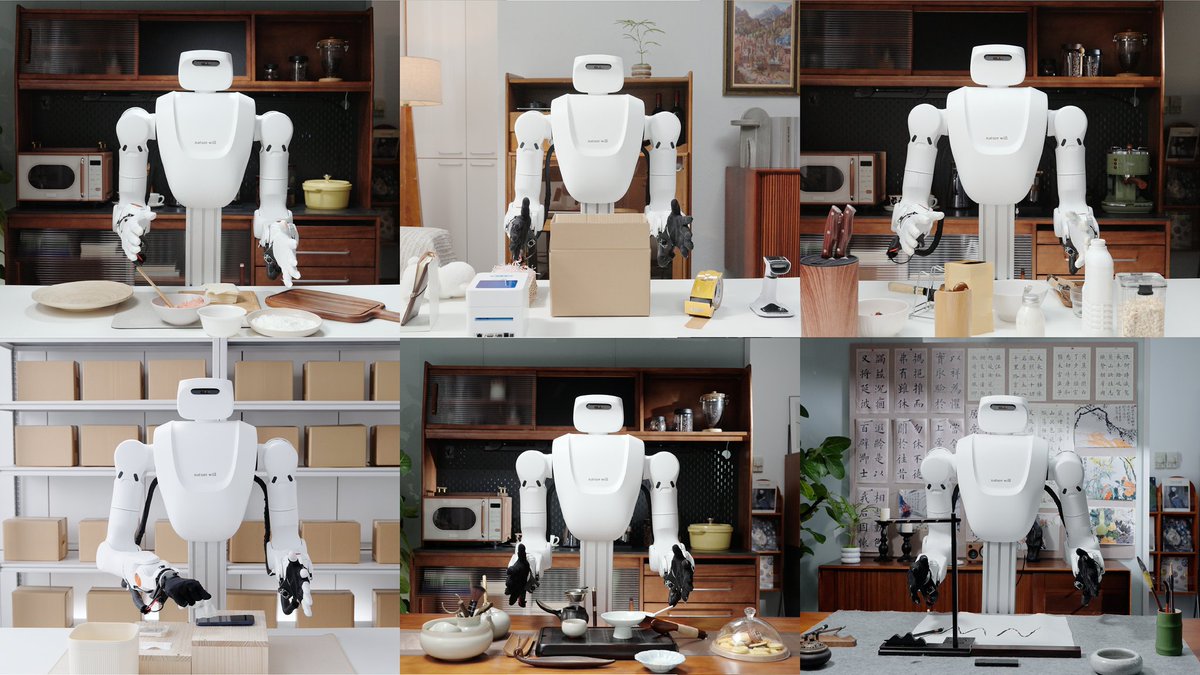
Introducing ACT-2 Preview The first robotics model to unify broad generalization with high reliability. A single fine-tuning example can teach Memo a new behavior that generalizes. Zero shot, real unseen homes, 99% success rate.

Фото профиля Tony Zhao
Tony Zhao3 месяцев назад

Quantitatively, we measure the generalization gap as the difference between in-domain and out-of-domain performance. As we scale up pretraining, the gap falls sharply. This makes in-house performance a reliable predictor of performance in the wild.

Фото профиля Tony Zhao
Tony Zhao3 месяцев назад

This property allows us to hill-climb performance in our office, and trust those gains to hold in unseen homes Our fleet of Memos runs in parallel to rapidly advance reliability, quality, and speed. Left: fleet-scale improvement in-house Right: Memo working across unseen homes

Фото профиля Tony Zhao
Tony Zhao3 месяцев назад

Laundry is our first Solve of many. Our recipe is so general that scaling data and compute gives us predictable improvements. Unlocking one Solve accelerates the next Solve. The same ACT-2 model is learning to vacuum, organize toys, zip clothing, and turn pants inside out.

Фото профиля Tony Zhao
Tony Zhao3 месяцев назад

This fall, ACT-2’s first Solve enters homes through our Beta Program, the final step towards fully autonomous home robot deployment. Full technical report:

Фото профиля Pierre Delecto Too 🙈🙉🙊
Pierre Delecto Too 🙈🙉🙊3 месяцев назад

Can it take my laundry downstairs, load it into the washer & dryer, and haul everything back upstairs?

Фото профиля Tensor Templar
Tensor Templar3 месяцев назад

How big is it

Похожие видео

Evolution happens to populations. Useful genes become common in a group over generations, then spread to other groups that test them in their own environments. The speed depends on generation time, 20 minutes for a bacterium but about 25 years for an elephant. Using LLMs to evolve better models often looks like an isolated herd of elephants. Each search runs alone on one dataset, and for large models every generation costs a long training run on the full data. Our new paper, "Discovered, Not Designed," introduces Population Evolution. It has two goals, to discover better models and to discover them faster. To discover better model designs, the searches share what they find. Several searches run at the same time, each on its own dataset. When one finds a code change that helps, the same change is retrained on the others. While nature keeps no record of the genes that failed to help, Population Evolution does. All peer results, including weak or unsuccessful transfers, are added to a shared ledger, and the LLM reads that ledger before it writes the next change. To discover them faster, the searches do not train on the full data, because that is what makes each generation slow. We found that a search can run on as little as 2% or 5% of the data and still find changes that hold up in full training, as long as the other searches check each change first. In Population Evolution, a change that works on one slice must also work on at least two other slices, then on two larger 10% sets. Only then does it get a full training run. We tested Population Evolution on RMD-Bench, a benchmark we also introduce for evaluating model discovery. It covers five task families (LLM pretraining, VLM pretraining, RL algorithm discovery, ranking, and watch-time prediction) with 34 instances in total. Each one comes with a reference implementation and a fixed training and evaluation protocol, so a change found on one dataset or data scale can be retrained and scored on another, and other discovery methods can be compared under the same conditions. The numbers below are a sneak peek at the two most expensive families of experiments. The LLM pretraining task starts from a 185M-parameter Gemma 3-style model, and the VLM pretraining task starts from a Qwen3.5-style model with about 646M trainable parameters. The baseline runs the same kind of search directly on the full data, at the same total GPU compute. Population Evolution finds better models. The best relative accuracy gain for LLM pretraining goes from 0.92% to 2.48%. The best loss reduction for VLM pretraining goes from 5.05% to 8.78%. Population Evolution finds them faster. In LLM pretraining, each search gets 100 generations where a full-data search gets 14. In VLM pretraining, 57 of 61 full training runs met the success threshold, against 12 of 100. Evolution works because many groups pass along what helps and get many generations to do it, and Population Evolution gives LLM-driven model search these prerequisites. Read our paper at for full implementation details and results. The benchmark data and code will be made publicly available shortly.

Zhuokai Zhao

925,744 просмотров • 28 дней назад

How can you solve complex tasks using a Large Language Model? Here is a 2-minute introduction to everything you need to know to 10x the quality of your results. Let's talk about three techniques, in order of complexity, starting with the easiest one: • In-Context Learning • Indexing + In-Context Learning • Fine-tuning In-Context Learning The team that trained GPT-3 found something they couldn't explain: You can condition a model using examples of how you want it to behave. I included an example prompt in the attached video. You can "teach" the model how you want it to interpret questions, select the correct answers, and format the results by giving a few examples. You can also give specific knowledge to the model that will be helpful when formulating answers. We call this approach "grounding the model." There's another example in the video. Indexing + In-Context Learning Unfortunately, there is a limit to how much data you can include in a prompt. We call this the "context size." One version of GPT-4 supports a context of approximately 6,000 words, while the other supports 25,000 words. Although this sounds like a lot, many applications need more than that. Imagine you wrote a book and want to build an application to answer any questions about your story. What happens if your book is longer than the context? That's where Indexing comes in. Using a model, you can turn every book passage into an embedding. These are vectors, numbers that "encode" the passage's text. You can then store these embeddings in a particular database that supports fast retrieval of these vectors. You can then turn any question into an embedding and search the database for the list of passages that are similar to that query. Instead of using the entire book to ask the model, you can now use the relevant passages as in-context information, effectively working around the context size limitation. Fine-tuning Fine-tuning can give you an extra boost to get reliable outputs from your LLM. It is, however, the most complex approach on the list. There are different approaches to fine-tuning a model with your data. A popular technique is to process your data with your LLM and use the outputs to train a new classifier that solves your specific task. Notice that here you aren't modifying the LLM. Instead, you are chaining it with your trained classifier. Another approach is to modify the parameters of the LLM using your data. Think of this as "rewiring" the model in a way that solves your particular task. The results and costs will vary depending on how many layers you want to fine-tune from the original model. Many companies think that fine-tuning is the solution to their problems. In my experience, many will benefit from exploring the other two approaches. I love explaining Machine Learning and Artificial Intelligence ideas. If you enjoy in-depth content like this, follow me Santiago so you don't miss what comes next.

Santiago

384,573 просмотров • 3 лет назад