Video wird geladen...

Video konnte nicht geladen werden

Zur Startseite

We sat down with Michael Levin, developmental biologist at Tufts University, about the emerging field of developmental bioelectricity: how electrical signals help control how organisms build and regenerate themselves. Levin explains how voltage gradients, ion channels, and gap junctions guide embryonic development and encode large-scale anatomical information that cells...

18,995 Aufrufe • vor 2 Monaten •via X (Twitter)

0 Kommentare

Keine Kommentare verfügbar

Kommentare vom Original-Post werden hier angezeigt

Ähnliche Videos

New episode with Dr. Konrad Kording (Kording Lab 🦖), professor of bioengineering and neuroscience at the University of Pennsylvania (Penn) and co-director of CIFAR's Learning in Machines & Brains program (CIFAR). Konrad works at the intersection of causality, machine learning, and neuroscience, building rigorous methods for causal reasoning when experiments aren't possible — and challenging how researchers interpret neural data and build AI. Konrad argues the most promising path to understanding how the brain works is to read the brain’s wiring directly, down to the molecular detail of each connection, and to build compilers and simulations to understand the brain’s computation directly. In this episode we go deep into how neurons work, how neurons wire together, and how organic and artificial neural networks differ. We discuss why organic neurons are doing much more; how a model of a single organic neuron can solve MNIST — computing more like a 3-layer artificial neural network; how the brain might learn by solving credit assignment with only local signals; how to approximate backprop without a global algorithm; why AI and humans are intelligent along different dimensions; why Konrad isn’t very worried about AI replacing us; economic models of intelligence and physical work; and much more. Konrad is a brilliant, contrarian thinker who explains complex concepts very intuitively. It is a solid computational neuroscience primer. I hope you enjoy this conversation as much as I did! Other links to this episode and references below. Chapters 00:00:00 Introduction 00:01:01 How organic neurons work 00:24:13 How the brain learns: circuits and credit assignment 00:45:29 Recording the brain 00:52:47 Why simulating brains is hard 01:05:00 A new approach: connectomes and compilers 01:21:00 Why simulate brains? 01:29:50 How AI and human intelligence differ 01:41:04 Evolution, intelligence and AI risk 01:52:42 Robotics, causality, and the roots of intelligence 02:05:53 AI for science and scientific rigor 02:13:05 The economics of intelligence 02:27:50 A hopeful future

Juan Benet

49,297 Aufrufe • vor 1 Monat

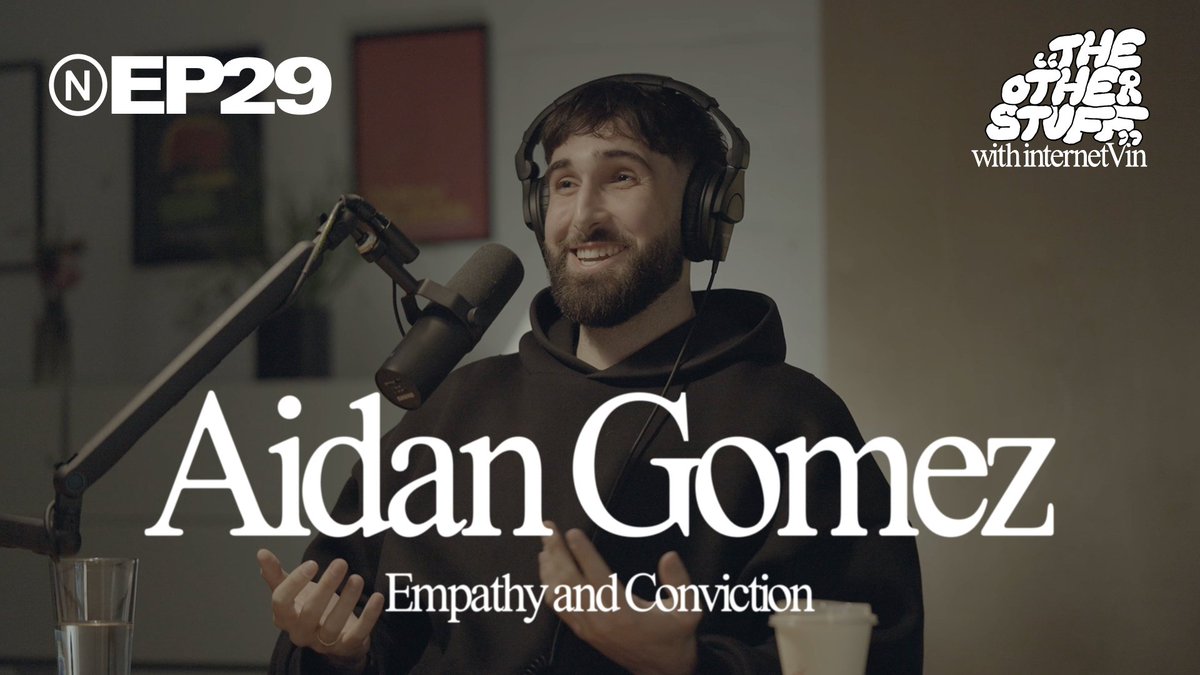
Aidan Gomez (Aidan Gomez) is a computer scientist, co-author of the seminal paper ‘Attention Is All You Need,’ and the CEO of Cohere. In this episode, we discussed his upbringing in the cabin his grandfather built in Codrington, a small town North of Brighton, and the values that were instilled in him through his family. We explored his path from Codrington to his undergraduate studies at the University of Toronto, emailing Geoffrey Hinton, and joining Google Brain where he co-wrote the paper on transformers. We discussed how he met his co-founders Ivan Zhang and Nick Frosst, and his insights on what it means to build a meaningful, successful company in Canada. Aidan shares his conviction about what is at stake — for Canada and for the world at large. This is a conversation about family, values, and what it means to live with conviction. The Other Stuff is hosted by internetVin — filmmaker, entrepreneur, and possibly the most curious man on Earth. Produced by New. The Other Stuff #29 — Aidan Gomez: Empathy and Conviction — Timestamps 00:00:00 Intro 00:03:10 The Malleability of Toronto 00:11:06 Growing Up in Codrington 00:13:50 The Story of Aidan Gomez’s Family 00:27:23 Introduction to the Internet 00:30:39 Values and Work Ethic 00:35:46 University of Toronto’s AI Scene 00:40:48 Emailing Geoffrey Hinton 00:42:16 Google Brain 00:45:15 Dropout: A Simple Way to Prevent Neural Networks from Overfitting 00:49:48 The Beauty of Research 00:54:24 One Model to Rule Them All 00:59:54 Meeting Ivan Zhang and Nick Frosst 01:04:00 The Birth of Cohere 01:06:56 Twitter Influencers and Alex Friedland 01:11:48 Being the CEO 01:12:51 Building for Canada 01:15:01 Three Fundamental Ingredients of Building a Company 01:21:39 Working with the Canadian Government 01:24:39 Reflexivity in Canada 01:36:22 What Is Evil? 01:42:40 The Role of AI in the World

The Other Stuff Podcast

45,297 Aufrufe • vor 7 Monaten

We sat down with Philip Johnston, co-founder and CEO of Starcloud, at MIT to discuss why the future of data centers might be in space. After graduating Y Combinator less than 2 years ago, Starcloud just raised an impressive $170M Series A at a $1.1B valuation led by Benchmark and EQT Ventures & Growth. The conversation covers everything from solar physics and cooling systems to GPU economics, radiation hardening, launch costs, and satellite design. Philip also shares what it takes to build a unicorn deeptech startup. We discuss his experience with YC, the skepticism around their demoday launch, and the crazy last minute race to get Starcloud’s first satellite onboard their scheduled Falcon flight. Full episode is here on X and at any of the links below (see comment). Timestamps: 00:00 - Intro 01:12 - What is Starcloud? 02:44 - Why do data centers need to go to space? 06:15 - Can’t we just build more solar panels on earth? 11:10 - Economic analysis of Starcloud 19:56 - How does Starcloud’s cooling work? 28:26 - Training an LLM in space 32:07 - Addressing critics on space Twitter 34:23 - Is Starcloud overfunded? 35:59 - Will demand for data centers keep going up? 38:11 - GPU lifespan and disposal in space 39:47 - Bus structures 41:43 - Starcloud’s origin and founders 49:29 - Fundraising, Competition, and Meeting Expectations 53:29 - Satellite size and collisions 56:29 - Manufacturing Bottlenecks 1:00:20 - Starcloud 1 tests 1:01:57 - Acceleration after YC 1:03:43 - Testing on Earth 1:05:06 - Motivations for Starcloud 1:06:45 - Data centers on the Moon 1:08:12 - Interacting with AI companies 1:08:18 - What’s next for Starcloud? 1:14:01 - Other uses for Starcloud satellites 1:17:56 - Lunar hotels and space elevators 1:24:28 - Complementary business ideas to Starcloud 1:29:51 - Philip’s competitive twin 1:32:18 - Philip and Mike’s thoughts on YC 1:36:04 - Advice for young entrepreneurs Elon Musk Scott Manley Kyle Hill Hank Green

632nm

46,599 Aufrufe • vor 4 Monaten

Today’s guest on the Free Radicals podcast is José Luis Ricón Fernández de la Puente, head of theory Retro Biosciences and blogger Jose is a prolific blogger, covering a wide breadth of topics across economics, philosophy, progress studies, science funding, much more, and of course longevity. His works have been published by a16z, Works in Progress and Adam Smith Institute. Our conversation is wide ranging, spanning a deep dive on Retro’s work to replace and engineer microglia to rejuvenate the brain and how our cells have the ability to turn back the aging clock but choose not to. We also covered the technological stagnation and why biological engineering is the new frontier of progress, as well as philosophical topics like transhumanism and how a future of total biological control might impact our values and way of life. Be sure to follow me and Eric Dai to stay up to date on the latest news in longevity biotech! And Special thank you to NFX & omri_drory for lending us their beautiful podcasting studio! 0:00 Intro 2:49 What is aging & why cells have a tough choice to make 9:02 When cells choose to reverse aging themselves 12:43 Cellular vs Organismal Aging & the magic wand experiment 18:31 What is reprogramming 22:40 How reprogramming plays a role in DNA damage repair 25:42 Do we already know how to cure aging? FOXO3! 28:37 How to cut through the complexity of interconnected biology 32:32 Why transcription factors are so great for intervening 36:49 Does a rejuvenation program exist already in the genome 38:51 Michael Levin: from thinking in terms of genes to morphogenesis 48:14 Tech stagnation and why physics is cooked 55:03 Why doesn't the world look more futuristic 57:26 Transhumanism & asking ourselves what we want out of life 1:05:34 Do we need war for technological progress 1:09:31 Government role in science funding 1:15:06 How Jose became the Head of Theory at Retro 1:24:53 How AI might put software engineers out of a job, and push them towards biotech 1:27:28 What it takes to get a flywheel in biotech 1:29:04 Rejuvenation vs Prevention 1:34:23 Aging is the coolest hardest problem to work on 1:36:09 What does it take to cure aging 1:42:25 Delivery mechanisms for genetic therapies 1:48:53 Retro's work to replace microglia and engineer them outside the body 1:59:10 Consciousness 2:00:39 Jose's Origin Story

Daniel Shur

13,616 Aufrufe • vor 4 Monaten

My conversation with OpenAI co-founder Greg Brockman This is the most detailed first-person account of the 72 hours after Sam Altman was fired. We also go deep on what comes next: the global race to AGI, why ChatGPT stopped showing reasoning, how much of OpenAI's own code is now written by AI ("it's hard to know what percent is not"), and the untold story of how OpenAI actually started in 2015. 00:00:00 Introduction 00:00:49 Meeting Sam Altman and Starting OpenAI 00:02:40 Building the Founding Team 00:04:25 DeepMind's Lead Over OpenAI 00:04:54 Changing OpenAI to a For-Profit Model 00:06:05 Breakthrough Moments at OpenAI 00:08:22 What Dota 2 Meant for OpenAI 00:10:04 Reasoning Versus Prediction 00:11:59 Tensions Grow at OpenAI 00:15:44 Sam Altman's Firing 00:17:49 Greg Quits OpenAI 00:19:56 Sam Explores Deal with Microsoft's Satya 00:20:28 Petition for Altman's Return 00:23:43 Ilya Sutskever Leaves OpenAI 00:24:59 Lessons Learned after Sam Ousting 00:28:22 The Thing Ilya Said that Greg Can't Forget 00:32:22 Is AI Going Parabolic? 00:33:24 How Much of OpenAI's Code is Written by AI? 00:36:21 Do AI Chatbots Tell Us What We Want to Hear? 00:38:06 The Global AI Race to Reach AGI 00:38:40 What Happens if US Doesn't Reach AGI First? 00:39:49 Are Countries Stealing AI Advancements? 00:40:38 Why ChatGPT No Longer Shows Reasoning 00:41:47 The Finite Constraints of Compute 00:43:38 On Investing Early in Data Centers 00:46:31 The Future of Data Center Specialization 00:47:52 How to Decide Whose Queries to Serve 00:49:08 OpenAI on Consumer vs Enterprise Models 00:53:05 Data Centers in Space? 01:00:56 What Should AI Regulation Look Like? 01:04:33 The Future of AI-Powered Entrepreneurship 01:04:44 AI and Job Loss 01:07:15 The Skills Young People Should Invest In 01:11:30 What Does Success Look Like For You? Full episode on X below. Also find it on: • YouTube: • Spotify: • Apple:

Shane Parrish

450,952 Aufrufe • vor 3 Monaten

Allie Beth Stuckey has never been afraid to speak truth in a world that often rewards silence. In this conversation, we talked about faith, conviction, and what it means to stand firm when culture pushes you to conform. Allie opened up about her journey into broadcasting, how motherhood reshaped her worldview, and why she believes women today are desperate for truth, not validation. We also talked about the cost of conviction, how to disagree without dehumanizing, and why faith must come before fear, especially in media and leadership. We discussed the state of Christianity in America, the pressure many young people face to compromise, and how social media has changed the way we share and live out our beliefs. Allie’s perspective is strong but full of grace, rooted in both intellect and compassion. This conversation was about more than faith or influence. It was about courage, clarity, and holding fast to what is true even when it is unpopular. Chapters: 0:00:00 - Intro 00:03:02: Allie Beth’s Personal Life 00:15:25: Allie Beth’s Thoughts on Marriage 00:21:20: Advice to Young Women on Finding the Right Partner 00:27:10: Lessons from Allie Beth’s Life 00:32:44: Dealing with Shame 00:41:32: Are Eating Disorders Considered Sinful? 00:46:16: Differences Between Southern Baptist, Reformed Christian, and Catholicism 00:52:19: Faith 01:12:45: Allie Beth’s Best Quotes 01:13:08: “It’s Easy to Be a Progressive” 01:14:16: “The Last Thing a Woman Wants Is to Be Excluded” 01:15:34: “I Am for the Death Penalty for the Same Reason I Am Against Abortion. I Value Innocent Life.” 01:19:19: “Your Daughters Should Not Be Listening to Taylor Swift. She Is Not a Role Model.” 01:26:24: How Allie Beth Manages Friendships That Disagree with the Bible 01:30:22: How Allie Beth Balances Sharing God’s Word Without Sounding Judgmental 01:32:56: Dealing with the Loss of Charlie Kirk BTS on Patreon:

Sage Steele

46,033 Aufrufe • vor 9 Monaten