正在加载视频...

视频加载失败

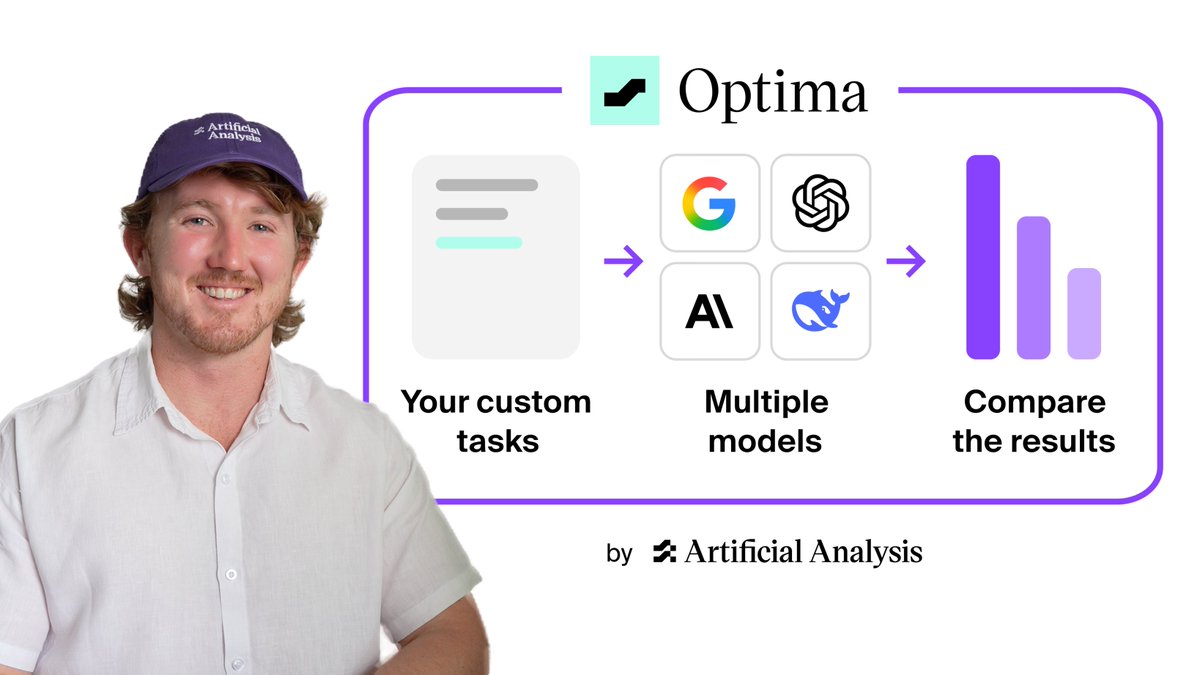
We’re launching Optima. Now anyone can create a custom benchmark for their use case, leveraging Artificial Analysis’ leading research and platform Building and running benchmarks is difficult. We have distilled Artificial Analysis’ research and experience developing benchmarks into Optima, a new platform for benchmarking models on your own workloads...

106,425 次观看 • 1 天前 •via X (Twitter)

0 条评论

暂无评论

原始帖子的评论将显示在这里

相关视频

Today, we’re pushing a major update to Edison Analysis, our data analysis agent, which is tuned for scientific research and SOTA across data analysis benchmarks. In contrast to Kosmos, which runs for 6-12 hours and produces tens of thousands of lines of code, Edison Analysis runs for seconds to minutes and is best for specific, well-defined computational tasks. It is available both on our platform under the Analysis tab, and via API, and costs only one credit per run, so it is available to users on both free and paid tiers. Edison Analysis is a modified version of the data analysis agent Kosmos uses in its trajectories. Try it out! One of the most important improvements over our previous data analysis agents has been the addition of a specialized data retrieval tool. Edison Analysis can either use this tool to access data, or can pull data down directly via API. To evaluate this tool, we ranked the most commonly used public data repositories across recent papers from BioRxiv, and created a new benchmark that measures the ability of a language agent system to retrieve raw data from those sources. Edison Analysis gets 71% on this benchmark, and we’ll be working to increase this over time. You can read more about our benchmarks in the our blog post, link below. Some features worth highlighting: 1. Edison Analysis produces a report on the analysis it runs, along with a Jupyter notebook that you can download to reproduce the analysis yourself. Every figure it produces is linked back to the specific lines of code used to produce the figure, to make it easy to reproduce. 2. It works well with both Python and R. 3. One of the best uses for Edison Analysis is to use it to retrieve datasets that you can then analyze with Kosmos. We have a bunch of major improvements to Edison Analysis coming in the next few months that we’re excited to share. In the meantime, congratulations to the team, especially Ludovico Mitchener, Jon Laurent, Conor Igoe , Alex Andonian, and many more.

Sam Rodriques

61,934 次观看 • 8 个月前

Small Language Models (SML) are the future of AI. "Small" (SML) instead of "Large" (LLM). These small models are highly specialized models with superhuman abilities on specific tasks. Here are two techniques to build these models: • Spectrum • Model Merging I give you a short introduction in the attached video, but here is a quick summary: Spectrum helps us identify the most relevant layers to solve one specific task. We can ignore everything else and focus on fine-tuning these layers. Using Spectrum, we can fine-tune models in a heartbeat. Model Merging combines multiple models into a unique, much better model than any of the individual input models. You can also combine models specialized in different tasks and get a model with multiple abilities. This is the state of the art of productizing models. It's what Arcee.ai's platform does behind the scenes. Arcee collaborated with me on this post and is sponsoring it. There are three main steps to produce a model for your particular use case: 1. You create a dataset by uploading your data. 2. You train a model. At this step, Arcee uses Spectrum and Model Merging to produce a highly specialized model for your task. 3. You can deploy that model to any environment you want. Three important notes: • Training process is 2x faster and 2x cheaper than regular fine-tuning. • Resultant models are smaller and have higher accuracy. • They create these specialized models from open-source models. Check this site so you can fully appreciate how this works: If you want to fine-tune an open-source model, consider Arcee's platform. This is the state of the art.

Santiago

164,162 次观看 • 2 年前

In my past research experience, finding or developing an appropriate simulation environment, dataset, and benchmark has always been a challenge. Missing features, limited support, or unexpected bugs often occupied my days and nights. Moreover, current simulation platforms are relatively fragmented—making it challenging to replicate the success of the RT-X dataset in unifying community efforts. Introducing RoboVerse, we provide a unified platform, dataset, and benchmark for scalable and generalizable robot learning. We hope to build a shared foundation to combine the community efforts. RoboVerse includes: MetaSim: We carefully designed a configuration system and a universal interface to align current robotic simulators. With MetaSim, you can use any simulator with the same code—bringing together the community’s diverse efforts under one framework! RoboVerse Dataset and Benchmark: We unify popular simulation environments and benchmarks into a single cohesive system and introduce the RoboVerse dataset—a large-scale, high-quality synthetic dataset. Additionally, we propose a standardized benchmark across both imitation learning and reinforcement learning. A cool feature enabled by our unified framework: Hybrid Simulation! You can now integrate physics engines and renderers from different simulators—e.g., using MuJoCo precise physics with Isaac photorealistic rendering. This not only elevates simulation fidelity but also significantly enhances real-world transfer performance across complex robotic applications. Hopefully, our team’s efforts could serve the robotic community to thrive vibrantly in the years to come. RoboVerse is open-sourced🥳!!! Project Page: Documentation: Github Repo: Paper:

Haoran Geng

84,318 次观看 • 1 年前

Introducing the new Box Agent. The Box Agent works across your entire Box file system, maintaining all your security and access controls, and is hyper tuned for working with enterprise content. This means you can now ask questions from all your enterprise content, search for files that were impossible to find before, deploy an agent on specific tasks on subsets of documents, analyze complex data sets, and generate or edit documents and spreadsheets via the agent. You can have the Box Agent search across your Box account to prepare for a sales meeting, analyze customer sentiment reports, process a large set of contracts for legal risk, provide insights into product development, leverage existing knowledge to answer RFPs, and thousands of other use-cases. 90% of enterprise data is unstructured data. This means most enterprise knowledge is sitting in inside of research reports, marketing assets, presentations, roadmap files, contracts, HR documents, and more. This is the critical context that agents need to be able to answer questions about a business, automate workflows, or serve up to other agents. We’ve been grinding on this for a quite a bit, and due to recent AI model advancements we’re now ready to release it to customers. Previous model generations had a difficult time knowing when to give up or keep going on a search, when to browse for files vs. use queries, how to rank files appropriately to know which version of content to use, how to handle large amounts of context to comb through, and more. Due to recent breakthroughs from models like GPT-5.4, Opus 4.6, and Gemini 3, we’ve seen major gains in tool calling, code execution, advanced reasoning, and more. Combined with an agent harness tuned to Box context, now it’s finally possible to have an agent that can work across your file system on long running tasks and actually deliver high quality results. Best of all, because the Box Agent works with any leading AI model, you’ll quickly get the gains coming out of the major labs as major new models are released. Further, openness at Box is key, so you’ll be able to call up the Box Agent from Box’s APIs and MCP server, so you can interact with Box intelligently from any other AI system. We know work happens everywhere, and we want to ensure you can access to the content you need from those places. The new Box Agent is available starting today, rolling out now for Enterprise Plus and Enterprise Advanced customers.

Aaron Levie

44,515 次观看 • 4 个月前

Introducing Workshop: cloud + on-device agentic AI. And to celebrate, we're giving away $250k in Google Gemini AI credits. (details below). The future of AI work is neither cloud-based nor local. It's both. In Workshop Cloud, you can use agents powered by frontier models like Claude and/or open source models like Z.ai's GLM-5 to build internal tools, dashboards, and AI web apps. Or, breeze through tasks like managing your Google and Meta Ads. In Workshop Desktop, you can do all the same right on your computer, plus make desktop apps, mobile apps, and 3D creations. Our favorite part? You can power the full agent experience with local models like Qwen 3.5 family on your computer. Fully offline. 2026 is the year in which local models for agentic tasks will become viable for mainstream use. But the setup for tools like OpenClaw is like setting up Linux from scratch on your computer. Workshop Desktop is one-click to install on Windows, Mac, and Linux. It recommends which open source model you should use for your hardware and lets you download and run it right in the app. And its agent harness allows you to chat, create websites, build personal utilities, and analyze data. 100% offline. Or multitask with AI models in the cloud while running other agent threads locally. Start in Workshop Cloud when you want flexibility and speed. Download your project and continue in Workshop Desktop when you want local files, privacy, and/or better performance on large code bases. Publish from either. The agent tooling space is maturing and discerning users have come to expect a lot from their tools. We've packed Workshop with features to help you 10x your productivity. - Native support for skills - Autocompaction for seamless context management - Built-in AI for your apps - Dozens of connectors, like Google Drive, Big Query, and Supabase - dbt integration to ground your dashboards in your semantic layer - Native Github integration - Private app deployment - ... and more (+ we're shipping super fast) To access the free credit offer, RT this post and reply with "Workshop". Make sure you are following us so we can DM you the instructions to redeem. - First 100 to RT + comment get $500 in credits. - Everyone else gets up to $250 And thanks to our partners Modal, Google Gemini, and Z.ai!

Workshop AI

28,745 次观看 • 4 个月前