Video yükleniyor...

Video Yüklenemedi

Ana Sayfaya Dön

"What is an AI Agent and why do they matter?" An agent is a program that autonomously completes tasks or makes decisions based on data. What do I mean by autonomous? The agent understands task intent, can plan steps to solve the problem, decide and execute and actions and...

30,407 görüntüleme • 1 yıl önce •via X (Twitter)

11 Yorum

Addy Osmani profil fotoğrafı
Addy Osmani1 yıl önce

“The AI Assisted Developer Workflow”: covers Agents and how they apply to coding in more detail.

FRANK E ELKINS profil fotoğrafı
FRANK E ELKINS1 yıl önce

Confused about AI? Get clarity today with Book VI - "The Rational Being!" Understand the benefits & risks, empower your future now by learning what AI really is and how it really works! Also check out the Free Weekly Newsletter "How Things Work: A Brief History of Reality"

Roberto De Simone profil fotoğrafı
Roberto De Simone1 yıl önce

Watched the video a couple of days ago. Great and very informative talk!

Addy Osmani profil fotoğrafı
Addy Osmani1 yıl önce

Thank you! I’m happy if it was helpful at all :)

Reinvent DAO profil fotoğrafı
Reinvent DAO1 yıl önce

Very well said @addyosmani AI agents are indeed impressive, but it feels like the value isn’t just in what they do—it’s in owning what they create. Autonomous action is powerful, but autonomous ownership? That's transformative. 🚀 #AIAgents #Ownership

Jeremiah Yane profil fotoğrafı
Jeremiah Yane1 yıl önce

Entertaining presentation. Touched on some important points.

Addy Osmani profil fotoğrafı
Addy Osmani1 yıl önce

Thank you! I’m happy if its helpful at all

blackbox profil fotoğrafı
blackbox1 yıl önce

Cool addy

Addy Osmani profil fotoğrafı
Addy Osmani1 yıl önce

🙏

Saïd Aitmbarek profil fotoğrafı
Saïd Aitmbarek1 yıl önce

great 101 explanation! super bullish on agents, the paradigm of the future turning @microlaunchhq for the v2 & building new agent products to be announced soon

Csaba Kállai profil fotoğrafı
Csaba Kállai1 yıl önce

AI agents are crucial because they can autonomously understand tasks and make decisions based on data. This ability to plan and execute actions efficiently is transforming how we interact with technology.

Benzer Videolar

New Short Course: Building AI Browser Agents! Learn how to build AI agents that interact and take actions on websites in this course, created in partnership with and taught by and @namangarg0, Co-founders of AGI Inc. AI browser agents can log into websites, fill out forms, click through web pages, or even place orders online for you. They use both visual information, like screenshots, and structural data, like the HTML or Document Object Model (DOM) of a web page, to reason and take action. With the complexity of webpages and multiple possible actions at each step, it can be challenging for an AI browser agent to complete an assigned task. Because these agents run long action sequences, a single error—like clicking the wrong button or misreading a field—can lead to unexpected outcomes or errors that compound over time. In this course, you'll understand how autonomous web agents work, their current limitations, and how AgentQ enables them to improve through self-correction. In detail, you'll: - Learn what web agents are, how they automate tasks online, their architecture, key components, limitations, and an overview of their decision-making strategies. - Build a web agent that can scrape website and return course recommendations in a structured output format. - Build an autonomous web agent that can execute multiple tasks, such as finding and summarizing webpages, filling out a form, and signing up for a newsletter. - Explore AgentQ, a framework that enables agents to self-correct by combining Monte Carlo Tree Search (MCTS), a self-critique mechanism for continuous improvement, and Direct Preference Optimization (DPO). - Deep dive into MCTS, learn how it finds an effective path, illustrated by an example of Gridworld animation, and use AgentQ to complete web tasks. - Understand AI agents' current state and future directions—including key factors shaping their evolution, such as hardware, algorithm innovation, and data availability. By the end of this course, you will have hands-on experience building browser agents and a deeper understanding of how to make them more robust and reliable. Please sign up here:

Andrew Ng

185,933 görüntüleme • 1 yıl önce

Here we go again 🚀! Excited to announce that we're building A1Zap (YC W25) with Pennie Li and that we're in the Y Combinator W25 batch in San Francisco! What is A1Base? A1Base gives AI Agents a real world identity for work. We do that by rebuilding Twilio and Okta from the ground up, putting AI Agents first. This means developers can make AI-first agentic applications 10x easier with our API's. ⁉️ Why are we doing this? Because there's a huge torrent of new valuable companies possible with AI agents, but to get their AI Agents to users, they have to chain custom apps, chat interfaces, awkward Slack integrations, browser bots, and wrestle with Twilio’s legacy API (which is built for marketing). We solve this by providing developers with an easy to use API to interface your AI agent with humans/coworkers/users where they are in this case in Whatsapp, Slack, Teams, SMS and more) - with AI Agent features built in. These digital workers are poised to transform how we work and we're the critical infrastructure to help them interact naturally in human workflows. We're not just building another AI tool. We're creating the infrastructure that will enable AI agents to become a natural part of the workforce - handling everything from customer support to sales development to creative work. We're backed by Y Combinator and working with founding teams who share our vision. We believe that in the near future, AI Agents with human coworkers will enable us to pursue more creative and impactful work. Our mission is to help developers build AI Agents that people can partner with and rely on as trusted allies—always with a human-first mindset. If you're thinking about the Agentic future of your company reach out! If you're looking to build your first AI Agentic company - reach out too - we have some amazing open source templates to get you started on the journey. Excited to share more of what we're up to soon 🔜.

Pasha Rayan

53,904 görüntüleme • 1 yıl önce

New short course: Evaluating AI Agents! Evals are important for driving AI system improvements, and in this course you'll learn to systematically assess and improve an AI agent’s performance. This is built in partnership with Arize AI and taught by John Gilhuly, Head of Developer Relations, and , Director of Product. I've often found evals to be a critical tool in the agent development process - they can be the difference between picking the right thing to work on vs. wasting weeks of effort. Whether you’re building a shopping assistant, coding agent, or research assistant, having a structured evaluation process helps you refine its performance systematically, rather than relying on random trial and error. This course shows you how to structure your evals to assess the performance of each component of an agent and its end-to-end performance. For each component, you select the appropriate evaluators, test examples, and performance metrics. This helps you identify areas for improvement both during development and in production. (If you're familiar with error analysis in supervised learning, think of this as adapting those ideas to agentic workflows.) In this course, you'll build an AI agent, and add observability to visualize and debug its steps. You’ll learn about code-based evals, in which you write code explicitly to test a certain step, as well as LLM-as-a-Judge evals, in which you prompt an LLM to efficiently come up with ways to evaluate more open-ended outputs. In detail, you’ll: - Understand key differences between evaluating LLM-based systems and traditional software testing. - Add observability to an agent by collecting traces of the steps taken by the agent and visualizing them - Choose the appropriate evaluator - code-based, LLM-as-a-Judge, human-annotation based - for each component. - Compute a convergence score to evaluate if your agent can respond to a query in an efficient number of steps. - Run structured experiments to improve the agent’s performance by exploring changes to the prompt, LLM model, or the agent’s logic. - Understand how to deploy these evaluation techniques to monitor the agent’s performance in production. By the end of this course, you’ll know how to trace AI agents, systematically evaluate them, and improve their performance. Please sign up here:

Andrew Ng

126,390 görüntüleme • 1 yıl önce

The same kinds of productivity gains we've seen in coding with AI agents are heading to the rest of knowledge work. This is the jump when you go from having a chatbot to being able to actually have an agent go off and do work for minutes or even hours and come back with a complete work output that you then review. Here's an example of the new Box Agent filling out an RFP response from an existing knowledge base. This process would normally take hours to fill out, and requires the full attention of the user doing the work. Now, you provide the Box Agent with the RFP questions, and it will go off, make a plan, extract all the relevant questions, read through existing source material to come up with an answer, and then generate a new word document as the final output. All while you're doing something else. The key to this architecture is that the agent is able to use all of the same tools in the background that a user uses to get work done. The agent can search for documents, read entire files, run scripts and tools in the background, and even be able to write code on the fly to automate tasks it hasn't seen before. And best of all, the Box Agent will (soon) work from the Box MCP and CLI so you can invoke it in any agentic system as a step in a process. This kind of agent complexity would have been impossible even 6 months ago. Models consistently failed at tracking long running tasks or using the right tools at the right moment for the task. But this is all now possible because of models like GPT-5.4, Opus 4.6, and Gemini 3, and is only getting better by the month. Just as we moved from engineers writing code and using AI as an assistant to answer questions, in many areas of knowledge work -like legal, finance, consulting, sales, marketing, and more- when we have a problem we'll just kick off the AI agent to just go work on it for us in the background.

Aaron Levie

24,618 görüntüleme • 2 ay önce

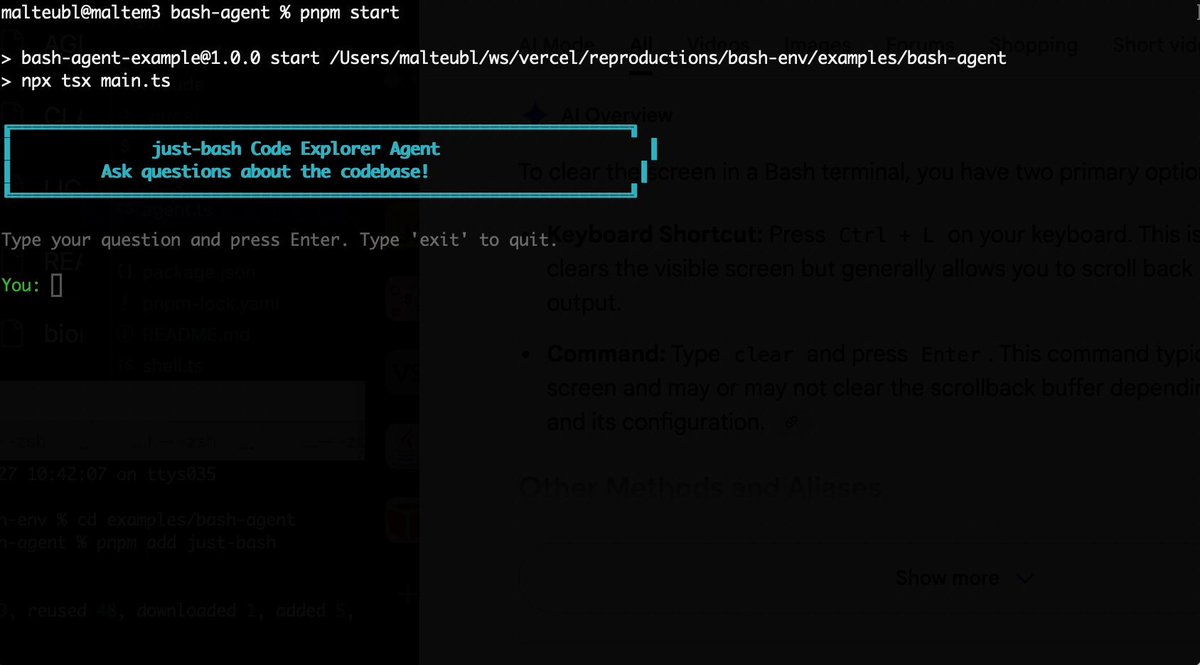
Bash is all you need! Which is why I'm introducing my holiday project: just-bash just-bash is a pretty complete implementation of bash in TypeScript designed to be used as a bash tool by AI agents. Because it turns out agents love exploring data via shell scripts, even beyond coding. It comes with grep, sed, awk and the 99th percentile features that an agent like Claude Code or Cursor would use. In fact, Claude Code can use it for secure bash execution. In the package - A bash-tool for AI SDK - A binary for use by yourself or your coding agents - An overlay filesystem to feed files to your agent securely - A Vercel Sandbox compatible API, so you can quickly upgrade to a real VM if you need to run binaries - An example AI agent that explores the just-bash code base using just-bash - I imported the Oils shell bash compatibility suite and just-bash passes a very good chunk What is interesting about this codebase: It was essentially entirely written by Opus 4.5. Coding agents love bash and they are good at reproducing it. They are also great at text-book recursive descent parsers and AST tweet-walk interpreters. That said, it is, like, a lot of code and I didn't read it all 😅. This is very much a hack, but it also seems to be _really_ useful. I haven't really found anything agents want to use that it doesn't support and it's fast and secure (caveats apply). It doesn't have write access to your computer and the filesystem is given a root that the agent cannot escape from. Find it at Related: Our recent blog post how we migrated our data analysis agent to bash tools and achieved incredible quality improvements The video shows the example agent investigating the just-bash code base

Malte Ubl

124,713 görüntüleme • 6 ay önce

New Course: ACP: Agent Communication Protocol Learn to build agents that communicate and collaborate across different frameworks using ACP in this short course built with IBM Research's BeeAI, and taught by Sandi Besen, AI Research Engineer & Ecosystem Lead at IBM, and Nicholas Renotte, Head of AI Developer Advocacy at IBM. Building a multi-agent system with agents built or used by different teams and organizations can become challenging. You may need to write custom integrations each time a team updates their agent design or changes their choice of agentic orchestration framework. The Agent Communication Protocol (ACP) is an open protocol that addresses this challenge by standardizing how agents communicate, using a unified RESTful interface that works across frameworks. In this protocol, you host an agent inside an ACP server, which handles requests from an ACP client and passes them to the appropriate agent. Using a standardized client-server interface allows multiple teams to reuse agents across projects. It also makes it easier to switch between frameworks, replace an agent with a new version, or update a multi-agent system without refactoring the entire system. In this course, you’ll learn to connect agents through ACP. You’ll understand the lifecycle of an ACP Agent and how it compares to other protocols, such as MCP (Model Context Protocol) and A2A (Agent-to-Agent). You’ll build ACP-compliant agents and implement both sequential and hierarchical workflows of multiple agents collaborating using ACP. Through hands-on exercises, you’ll build: - A RAG agent with CrewAI and wrap it inside an ACP server. - An ACP Client to make calls to the ACP server you created. - A sequential workflow that chains an ACP server, created with Smolagents, to the RAG agent. - A hierarchical workflow using a router agent that transforms user queries into tasks, delegated to agents available through ACP servers. - An agent that uses MCP to access tools and ACP to communicate with other agents. You’ll finish up by importing your ACP agents into the BeeAI platform, an open-source registry for discovering and sharing agents. ACP enables collaboration between agents across teams and organizations. By the end of this course, you’ll be able to build ACP agents and workflows that communicate and collaborate regardless of framework. Please sign up here:

Andrew Ng

105,261 görüntüleme • 1 yıl önce

NEW: Introducing Octane AI Agentic Commerce Quizzes - Increase sales with AI. What is it? A sales quiz AI agent that makes 1-1 personalized sales experiences for every single customer. In real time. Powered by our new AI model CORE-1. Examples: 📸 Want to ask your customer to take a selfie and your AI agent automatically recommends them a full outfit from your catalog? Octane AI agents can do that. 🪞 Want to have an AI agent hand pick out each product for a personalized skin care routine? Want them to upload a selfie to detect their skin tone? Octane AI agents can do can that. 📊 Want to create an incredibly detailed report with graphs and tables and graphics thats generated by AI for each customer? Octane AI agents can do that. We give you the building blocks and you can build anything. And you can build it fast because our AI will do the heavy lifting for you. This is v1 and a representation of where our commerce and quiz technology is headed. Available today to everyone at 🆕 What we are launching today: • Smart Quiz Builder: Have an AI agent plan out and build your Octane AI quiz for you. It can even write custom HTML for beautiful results pages and progress bars. • Smart Products: It can take forever to setup the recommendation logic for a quiz. For those of you who need help, simply add smart products to your Octane AI quiz and your very own AI agent will hand-pick products for each customer who takes your quiz. It’s amazing. • Smart Copy: Instead of showing everyone who takes your quiz the exact same copy, use AI to personalize the quiz for every single person who takes it. Explain why these specific products are perfect for specifically them. • Image Analyzer: Let your customers upload or take a photo during the quiz and have AI analyze it. You can use this for anything from skin tone detection to picking out outfits! • Shopping Assistant: An AI agent that lives on your store that can help your customers at the right time. We have been building quiz software for almost 10 years now and AI is enabling us to make quizzes even more powerful. This is just the v1 of what we will be releasing in this area. We are so excited to see what you create with these new agentic products. Get creative, we think you will be surprised at how many interesting experiences you can create with Octane AI now.

Matt Schlicht

290,828 görüntüleme • 7 ay önce

🚨 OpenAI just launched Codex, a brand-new autonomous coding agent that can build features and fix bugs on its own. We’ve been using it Every 📧 for a few days, and I’m impressed. I invited Alexander Embiricos (ben davies), a member of the product staff responsible for Codex, to demo Codex and talk about it live on a special edition of AI & I: What Codex is and how it works Codex is designed to be used by senior engineers—it performs coding tasks like adding features or fixing bugs autonomously. It's built to allow you to start many sessions at once, so you can have multiple agents working in parallel. Codex is built to have "taste" OpenAI trained Codex to have the taste of a senior software engineer. It knows how big codebases work, how to write a good PR, and uses clean, minimal code. Why an “abundance mindset” is best for interacting with agents Codex is designed to allow users to delegate many tasks at once without getting caught up in the details. This lets you point an abundance of agents at a specific task like a difficult bug—it’s worth it even if only one of them succeeds. How OpenAI is thinking about agents Codex is one piece of a unified super-assistant OpenAI wants to eventually build—an agent that helps users easily get things done by selecting the right tools for them behind the scenes. OpenAI’s vision for the future of programming In the future developers will probably spend less time writing routine code and more time guiding agents, reviewing their work, and making strategy decisions. Programming will become more social, letting teams easily delegate multiple tasks at once, allowing people to focus on ideas and collaboration instead of routine coding. Watch below!

Dan Shipper 📧

145,487 görüntüleme • 1 yıl önce