正在加载视频...

视频加载失败

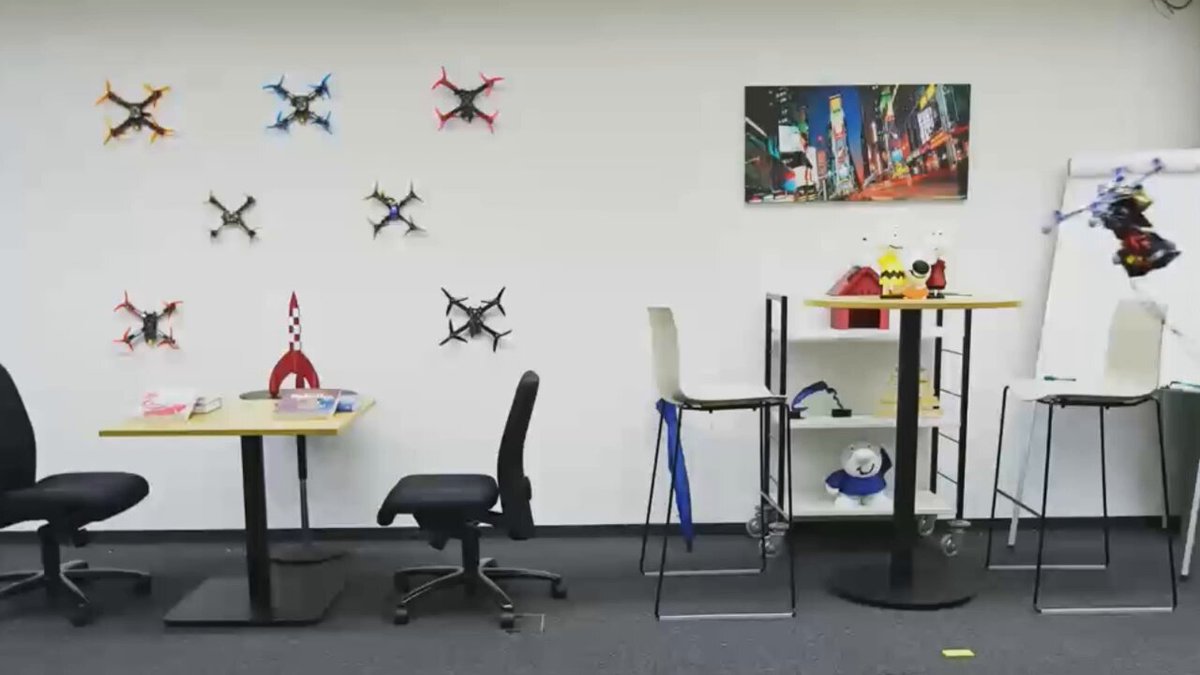
What is missing to bring real-time motion research into AAA games and real-world robotics? We present MotionBricks, a step toward bridging this gap with two key components: - a single generative latent motion backbone covering 350,000+ motion skills, running at 15,000 FPS with 2 ms latency and substantially improved...

154,127 次观看 • 4 个月前 •via X (Twitter)

0 条评论

暂无评论

原始帖子的评论将显示在这里

相关视频

Multi-Track Timeline Control for Text-Driven 3D Human Motion Generation paper page: Recent advances in generative modeling have led to promising progress on synthesizing 3D human motion from text, with methods that can generate character animations from short prompts and specified durations. However, using a single text prompt as input lacks the fine-grained control needed by animators, such as composing multiple actions and defining precise durations for parts of the motion. To address this, we introduce the new problem of timeline control for text-driven motion synthesis, which provides an intuitive, yet fine-grained, input interface for users. Instead of a single prompt, users can specify a multi-track timeline of multiple prompts organized in temporal intervals that may overlap. This enables specifying the exact timings of each action and composing multiple actions in sequence or at overlapping intervals. To generate composite animations from a multi-track timeline, we propose a new test-time denoising method. This method can be integrated with any pre-trained motion diffusion model to synthesize realistic motions that accurately reflect the timeline. At every step of denoising, our method processes each timeline interval (text prompt) individually, subsequently aggregating the predictions with consideration for the specific body parts engaged in each action. Experimental comparisons and ablations validate that our method produces realistic motions that respect the semantics and timing of given text prompts.

AK

126,612 次观看 • 2 年前

We are excited to share our work “Event-Aided Sharp Radiance Field Reconstruction for Fast-Flying Drones” published in IEEE Transactions on Robotics IEEE Transactions on Robotics (T-RO), which tackles sharp radiance field reconstruction under agile drone motion, where RGB frames are heavily motion-blurred and pose priors become unreliable! 4 years in the making! Code & dataset released! PDF: Code & Dataset: Full Narrated Video: High-speed flight is essential for time- and battery-constrained missions (e.g., inspection, exploration, search & rescue). However, fast motion corrupts visual data with severe motion blur and introduces drift/noise in visual-inertial odometry, making NeRF-based 3D reconstruction particularly brittle. We propose a unified framework that leverages asynchronous #EventCamera streams together with motion-blurred frames to reconstruct high-fidelity radiance fields from agile drone flights. Our key idea is to embed event-image fusion directly into radiance field optimization while jointly refining a shared, continuous-time camera trajectory initialized from event-based VIO. This enables us to recover sharp radiance fields and accurate trajectories without ground-truth supervision during training. We validate our method on synthetic data and on real sequences captured by a drone flying up to 2 m/s. Despite severe blur and noisy pose priors, our method preserves fine scene details and achieves a performance gain of over 50% on real-world data compared to state-of-the-art methods. Kudos to Rong Zou and Marco Cannici! Marco Cannici Reference: Rong Zou*, Marco Cannici*, Davide Scaramuzza Event-Aided Sharp Radiance Field Reconstruction for Fast-Flying Drones IEEE Transactions on Robotics (T-RO), 2026 NCCR Robotics European Research Council (ERC) AUTOASSESS UZH IfI University of Zurich UZH Science Prophesee SynSense UZH Space Hub

Davide Scaramuzza

12,028 次观看 • 5 个月前

Everything you love about generative models — now powered by real physics! Announcing the Genesis project — after a 24-month large-scale research collaboration involving over 20 research labs — a generative physics engine able to generate 4D dynamical worlds powered by a physics simulation platform designed for general-purpose robotics and physical AI applications. Genesis's physics engine is developed in pure Python, while being 10-80x faster than existing GPU-accelerated stacks like Isaac Gym and MJX. It delivers a simulation speed ~430,000 faster than in real-time, and takes only 26 seconds to train a robotic locomotion policy transferrable to the real world on a single RTX4090 (see tutorial: The Genesis physics engine and simulation platform is fully open source at We'll gradually roll out access to our generative framework in the near future. Genesis implements a unified simulation framework all from scratch, integrating a wide spectrum of state-of-the-art physics solvers, allowing simulation of the whole physical world in a virtual realm with the highest realism. We aim to build a universal data engine that leverages an upper-level generative framework to autonomously create physical worlds, together with various modes of data, including environments, camera motions, robotic task proposals, reward functions, robot policies, character motions, fully interactive 3D scenes, open-world articulated assets, and more, aiming towards fully automated data generation for robotics, physical AI and other applications. Open Source Code: Project webpage: Documentation: 1/n

Zhou Xian

3,819,890 次观看 • 1 年前

Alibaba presents MIMO Controllable Character Video Synthesis with Spatial Decomposed Modeling Character video synthesis aims to produce realistic videos of animatable characters within lifelike scenes. As a fundamental problem in the computer vision and graphics community, 3D works typically require multi-view captures for per-case training, which severely limits their applicability of modeling arbitrary characters in a short time. Recent 2D methods break this limitation via pre-trained diffusion models, but they struggle for pose generality and scene interaction. To this end, we propose MIMO, a novel framework which can not only synthesize character videos with controllable attributes (i.e., character, motion and scene) provided by simple user inputs, but also simultaneously achieve advanced scalability to arbitrary characters, generality to novel 3D motions, and applicability to interactive real-world scenes in a unified framework. The core idea is to encode the 2D video to compact spatial codes, considering the inherent 3D nature of video occurrence. Concretely, we lift the 2D frame pixels into 3D using monocular depth estimators, and decompose the video clip to three spatial components (i.e., main human, underlying scene, and floating occlusion) in hierarchical layers based on the 3D depth. These components are further encoded to canonical identity code, structured motion code and full scene code, which are utilized as control signals of synthesis process. The design of spatial decomposed modeling enables flexible user control, complex motion expression, as well as 3D-aware synthesis for scene interactions. Experimental results demonstrate effectiveness and robustness of the proposed method.

AK

149,079 次观看 • 1 年前