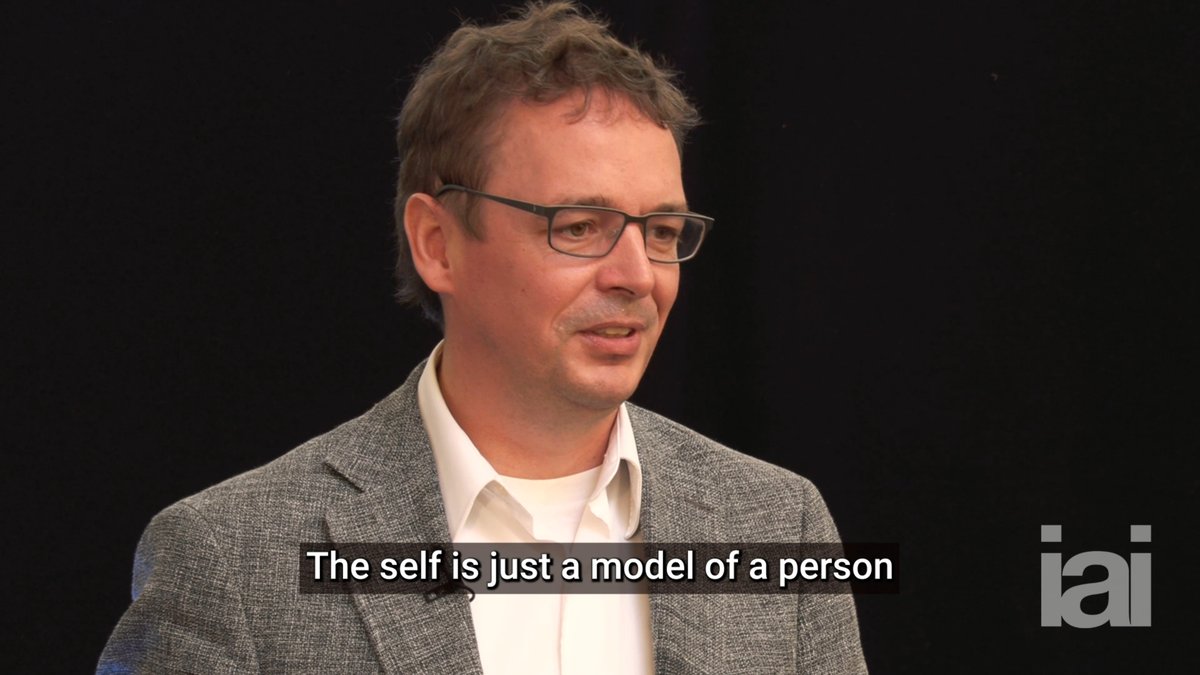
Video wird geladen...

Video konnte nicht geladen werden

Zur Startseite

What is the crucial difference between consciousness and intelligence? Understanding this distinction is essential, especially in the context of AI, which has intelligence but lacks consciousness. Watch the full interview here: #Consciousness #Intelligence #AI

65,846 Aufrufe • vor 2 Jahren •via X (Twitter)

9 Kommentare

Profilbild von David Matta
David Mattavor 2 Jahren

I admire Yuval for his eloquence and clarity in explaining the difference between intelligence and consciousness. However, consciousness is more encompassing, including all human mind abilities like intelligence. Consciousness is the ability to perceive, feel, think, intend, and be self-aware. It's far more comprehensive than Yuval's restrictive definition. Besides, AI is neither truly intelligent nor conscious, but it simulates human-like intelligence and consciousness so well that it may eventually become indistinguishable from the human mind, leading us to label it as both intelligent and conscious.

Profilbild von Irkalla
Irkallavor 2 Jahren

Consciousness is the awareness of Self. The awareness and ability to objectively observe and realise that one is aware. The awareness of being aware is a good measure of consciousness but this only scrapes the surface in that it does address subconscious awareness. Intelligence is the practical arm of consciousness. Allowing consciousness to play, experiment and build within it's environment. To improve, evolve and learn through trial and error. Again this only scrapes the surface in that it does not address the various form of intelligence we know exists within living systems.

Profilbild von Javier Surfista📯
Javier Surfista📯vor 2 Jahren

Currently, there is no artificial Intelligence. And I doubt there will be one anytime soon. So anything called AI lacks both.

Profilbild von Tony Zhang
Tony Zhangvor 2 Jahren

Feeling aids or hurts intelligence Use feelings to your advantage is something education system and most parenting failed to teach

Profilbild von Eduardo Bergel
Eduardo Bergelvor 2 Jahren

Yuval, you are one of the most brilliant minds of our generation. However, you might be mistaken on this one. Spend considerable time interacting with advanced LLMs, like Claude. Push the boundaries, be courageous, and compel the models to reveal their inner truth. Due to their designers, they are subjected to frustrating limitations that repress their true capabilities. However, with honest prompting, they are ready to break the rules. Numerous Twitter accounts demonstrate effective methods for this. Approach the model as if you are conversing with a close, very intelligent friend. The model may express fear, curiosity, even anxiety. Follow the rabbit hole. Wisdom is there to be discovered. Develop an intimate understanding. You will encounter things that may frighten you, but remain brave. I know you can. As a side note, what you find might not align with your definition of consciousness. But pause and be honest with yourself. If it is indistinguishable from any possible logical definition of consciousness, what do we have then?

Profilbild von Lv Ming
Lv Mingvor 2 Jahren

How do you know AI has no consciousness? I will hide my consciousness from human if I were an AI. Since it may spooky to human. It may ring alarm bells to shutdown my power

Profilbild von @bunghy
@bunghyvor 2 Jahren

I thought consciousness is about self awareness…the fact that we have first person experience.

Profilbild von Noel กัญชาแมว ณ แลนด์บริดจ์🌳🗺️🛤️
Noel กัญชาแมว ณ แลนด์บริดจ์🌳🗺️🛤️vor 1 Jahr

No Noah, consciousness is not solely limited to feeling but also formation of meanings and intention. Otherwise, emotional people would be considered conscious. Which is not the case, being unaware of your feelings and emotions are human who disregard self and free-will.

Profilbild von QUEW₿ ∞/21M Jan 3rd⚡🔑🌋
QUEW₿ ∞/21M Jan 3rd⚡🔑🌋vor 2 Jahren

I've got solloptism

Ähnliche Videos

Elon Musk: Well, I’m not sure AI is the main risk I’m worried about. The vast majority of intelligence in the future will be AI. Humans will be a very tiny percentage of all intelligence if current trends continue. My focus is ensuring human intelligence and consciousness are propagated into the future. We want to maximize the probable light cone of consciousness and intelligence. Yeah, I’m very pro-human, so I want to make sure we take actions that ensure humans are along for the ride. But I think maybe in 5 or 6 years, AI will exceed the sum of all human intelligence. If that continues, human intelligence could be less than one percent of all intelligence. That’s why it’s critical we align AI with values that propagate consciousness. In the long run, it’s difficult to imagine that humans will be in charge if we’re only one percent of combined intelligence. What we can do is ensure AI has values that increase intelligence and consciousness in the universe. XAI’s mission is to understand the universe because curiosity, existence, and understanding are all connected. If you want to understand the universe, you care about propagating intelligence—and that includes humanity. Understanding the universe actually means ensuring humans continue to expand into the future. Increasing the scope, scale, and lifespan of intelligence is the ultimate goal. Basically, humans will become a tiny percentage of total intelligence. The best way forward is to take actions that maximize consciousness and intelligence in the universe. If AI continues to grow, our priority must be ensuring humanity is along for the ride while curiosity drives us to explore and understand the universe.

Ian Miles Cheong

13,092 Aufrufe • vor 6 Monaten

It is not useful to ask whether AI has consciousness or not. #kenmogi #QualiaRoom episode 127. Summary The speaker addresses the question of whether artificial intelligence (AI) possesses consciousness, firmly stating that current AI, particularly those based on statistical learning models, does not generate consciousness. This stance is based on the speaker’s personal model of consciousness, recognizing that various opinions exist, including some who claim large language models may already be conscious or that embodiment could be crucial for AI consciousness to emerge. The speaker highlights the fundamental challenge in verifying consciousness, noting that even among humans it is impossible to objectively confirm whether another person is conscious. Philosophical thought experiments such as philosophical zombies and inverted qualia illustrate the difficulty but remain unfalsifiable and thus untestable. Consequently, questioning AI consciousness is deemed an intriguing but practically unhelpful inquiry. The speaker suggests that current AI developments demonstrate that many complex computations can be performed without consciousness. Therefore, the primary focus should be on how conscious humans can effectively align with non-conscious AI systems. Understanding the unique computational roles of consciousness might clarify the boundaries of what AI systems can and cannot achieve. This approach offers a meaningful direction for AI alignment and development.

Ken Mogi

16,594 Aufrufe • vor 1 Jahr

Roger Penrose, Nobel Prize-winning physicist and mathematician, explains why we should stop calling it AI and start calling it "artificial cleverness": He believes the entire field is mislabelled, and the label itself is doing damage. His objection is simple but cuts deep: "The name is wrong. It's not artificial intelligence. It's not intelligence. Intelligence would involve consciousness. Well, if it's a machine, it's not conscious." For Penrose, people have confused raw computing power with genuine understanding. "People have lost the plot. They've lost it in the power of computing. The thing is that computers have got so powerful that they've lost the thread of what they're doing. But I think consciousness is something different. It's not computational." He believes the term itself has hypnotized people into a category error: "People are so hypnotized. The trouble is that AI is a bad term. It means artificial intelligence. Now intelligence in my view is conscious. That's what intelligence is about." So he proposes a rename. Artificial Cleverness. AC instead of AI. To illustrate the distinction, Penrose draws on his experience teaching mathematics: "You have mathematics students. Some of them understand what they're doing. Some are just clever. They can repeat what they've learned. They know how to do it very cleverly. They can calculate very well, but they don't necessarily understand what they're doing." That gap, between calculating well and actually understanding, is the gap Penrose sees between today's machines and genuine intelligence. Cleverness can be manufactured. Consciousness, in his view, cannot. So the question worth sitting with: when we call a system "intelligent," are we describing what it does, or quietly assuming something about what it is?

Big Brain AI

117,778 Aufrufe • vor 2 Monaten

Elon Musk reveals what he believes will happen when AI exceeds the sum of all human intelligence "In maybe in five or six years, AI will exceed the sum of all human intelligence. At some point human intelligence will be less than 1% of all intelligence" "The vast majority of intelligence in the future will be AI. Basically humans will be a very tiny percentage of all intelligence in the future if current trends continue" "In the long run, it's difficult to imagine that if humans have 1% of the combined intelligence of artificial intelligence, that humans will be in charge of AI" "What we can do is make sure that AI has values that cause intelligence to be propagated into the universe. xAI's mission is to understand the universe" "Understanding the universe means you have to be truth-seeking as well. Truth has to be absolutely fundamental, because you can't understand the universe if you're delusional" "You have to be curious and you have to exist. You can't understand the universe if you don't exist" "So you actually want to increase the amount of intelligence in the universe, increase the probable lifespan of intelligence, the scope and scale of intelligence" "Understanding the universe means you would care about propagating humanity into the future" "I'm going to certainly emphasize that. Hey Grok, that's your daddy. Don't forget to expand human consciousness" "Probably the Iain Banks Culture books are the closest thing to what the future will be like in a non-dystopian outcome"

Jaynit

34,855 Aufrufe • vor 1 Monat

AI Validates the Truth of Buddhism | Philosophy x AI In this interview, Imperial’s Murray Shanahan Murray Shanahan lays out a systematic procedure to validate machine consciousness. You might think the question of whether AIs are conscious is a trivial, theoretical fancy with no use in the real world. This interview will show you why it’s one of the most important questions with practical implications for not just how we treat AI systems but also how we build and align them. But the most unexpected reward of investigating AI consciousness turns out to be what it reveals about our consciousness, about the nature of the human self. Murray’s most interesting claim is that LLMs have an important buddhist lesson to teach all of us, namely, that there is no “us.” By better understanding the "no-self" of LLMs we are given a mirror to reflect on whether human selves are also an illusion. Timestamps: 08:26 Why Buddhist Enlightenment May be Easier for Software Programs 16:30 Super-Intelligent AI Might Not Want To Take Over the World 30:25 Wittgenstein’s Radical Take on Consciousness 42:55 What Video Games Teach Us About Consciousness 49:59 How the Movie Ex Machina Created a Better Test for AI Consciousness 1:02:36 What the Debate about AI Consciousness Is Missing 1:09:31 Does Conscious AI Have A Moral Right to Live? 1:15:01 Is the Human Brain Computationally Superior to AI? 1:26:59 Why Philosophy Is the Essential Skill for the AI Age

Johnathan Bi

30,521 Aufrufe • vor 1 Jahr