Загрузка видео...

Не удалось загрузить видео

На главную

What makes ActionFi different from every other incentive platform? Simple. ActionFi rewards real product usage, not vanity metrics. From start to finish, our Browser Extension verifies that real actions are actually completed on partner platforms. That means incentive spend isn't just generating fake engagement. It's generating actual product usage....

13,380 просмотров • 1 день назад •via X (Twitter)

Комментарии: 0

Нет доступных комментариев

Здесь появятся комментарии из оригинального поста

Похожие видео

FriendSpace, Explained Simply. If you’re watching the video, this write-up is just to lock it in. Yoda is a Web3 social platform built for signal, not noise. Not vibes. Not hype. Not fake engagement. Before we continue, here is the link to test the product for yourself; CODES: N8XW7ZW8JN FMAWGG8BJ6 CXPBPSNT3N Now let’s continue: It’s where creators, traders, and communities connect in token-gated rooms, share real insights, and grow together, with real incentives attached. Why it exists: Web3 social today is broken. Too many: •bots •fake experts •recycled content •scammers •engagement farmers •loud people with no results Real builders and real traders get buried. People who want real info don’t know who to trust. FriendSpace fixes this by designing the platform around: •access control •accountability •performance •real value flow So signal rises naturally, and noise dies naturally. How it works (in plain terms) Each FriendSpace room is creator-led and token-gated. But it’s not just “join group chat and talk”. Every room has: •access keys •trading activity •pooled funds from fees So money, value, and performance are linked. If a creator performs → the community benefits If a creator doesn’t perform → the system exposes it No hiding. No fake reputation. No clout games. What users get: •access to real alpha •shared upside •better info •less noise •trusted rooms •clear discovery of good creators What creators get •earn from performance •earn from room activity •real community growth •credibility tied to results •not just followers, real users! Who it’s built for This isn’t for everyone, and that’s intentional. It’s for: •Web3 creators building real communities •traders who want results to speak •FriendTech OGs •Base & Hyperliquid users •people tired of crypto noise •people looking for real signal What makes it different Not “new app” hype. Real differences: •better UX than FriendTech •real community structure •performance-based leaderboards •easy discovery of good creators •built-in incentives •crypto-native design •value > engagement Earning side There’s a live points system: •5% referral rewards •special drops for FriendTech OGs •shared earning models •community-based incentives Not farming. Not clout. Not vanity metrics. Value = reward. What’s coming This isn’t static — it’s evolving: •Polymarket integration •room battles •live competitions •more protocol integrations •better discovery •community-driven updates Creators find their niche. Users find the best people in each niche. Simple truth FriendSpace is building a social layer where: •signal wins •noise loses •value is visible •performance matters •communities grow with creators •and everyone eats together If you watched the video + read this, you get it. This isn’t another Web3 app. It’s a better structure for how crypto communities should work.

10X || Top 1%

14,916 просмотров • 6 месяцев назад

Memes are dead. At least in the way we used to know them. Anything with no utility, no real users, no real economy & revenue is cooked: $PNUT: -96% from ATH $WIF: -92% from ATH $GIGA: -93% from ATH Others: -99% from ATH So what’s the next meta? I think I've figured it out... Right now everyone is bouncing between 2 extremes: a) “Everything is a scam. Utility doesn’t exist.” b) “Memes are dead. Only insiders make money. There will never be another PEPE or DOGE/SHIB level adoption.” In reality, only one type of project will survive this environment: tokens with real revenue, real usage, real communities - e.g. HYPE/PUMP type model. Given this sentiment, 99% of altcoins won’t pump. (at least short/mid term) And the era of pure memes is also finished. But there’s one category that actually makes sense here: Memes with Web2 roots and real communities behind them. It gives memes what they always lacked - real revenue, real distribution, real users, which brings real adoption and goes outside of web3 And this all without pretending to be some fake “utility coin” which nobody believes in rn. And I think I finally found the project that nails this perfectly, and is not yet launched. RaveDAO RaveDAO is the first Meme 2.0 ecosystem that’s actually built on real culture, real users, and real economics. Over 100K people attended their IRL events this year and transacted on-chain. This is exactly the kind of hybrid model that fits the market’s demand: cultural virality + real world revenue + on-chain distribution. - Web2 partnerships with top global artists - Web3 integrations with 50+ major partners - 7-figure revenue - No VC pressure - Real on-chain adoption through ticketing and stablecoin payments That’s why I’m partnering with them - and why I’ll be watching closely.

𝗰𝘆𝗰𝗹𝗼𝗽

75,987 просмотров • 8 месяцев назад

This is bullishh for $SKR holders: Your SKR is starting to get real spending power 📱💰 Seeker users can now: → Buy Amazon / eBay products with $SKR → Pay 0 platform fees → Get free Prime shipping → Earn 2x rewards This is one of the cleanest utilities for $SKR yet 👇 1️⃣ Shopping Layer ✅ Seeker Season Partner - SP3ND 🛍️ → Buy Amazon/eBay products with crypto → Pay using SKR or stablecoins → Directly from your Seeker ✅ Simple User Experience → Paste product link → Pay with crypto → Product gets delivered ✅ Not points-based shopping → Direct crypto spending for "real" products 2️⃣ SKR Utility ✅ SKR now tied to real-world spending → Not just holding or speculating → Actual commerce ✅ Native Solana dApp Store integration → Mobile-first UX → Fast checkout flow ✅ Crypto starts feeling usable day-to-day → Easier for normal users to understand → Less friction between on-chain & IRL spending 3️⃣ Your Seeker Advantage ✅ You get better shopping economics → 0 platform fees → Free Amazon Prime shipping → 2x SP3ND rewards points ✅ Those perks create real savings over time → Crypto payment apps normally charge fees → Shipping costs stack fast → Users often lose money on FX/payment rails ✅ Your Alpha → Lower cost per order → Faster reward accumulation → Better crypto-native commerce UX → More reasons to actually use crypto instead of just holding it

marino

14,291 просмотров • 3 месяцев назад

AI agents are overrunning the internet. Finding real customer opinions is getting harder by the day. You know the feeling. You search for what people actually think about your product. Half the "reviews" are AI-generated. The other half are sponsored. Real opinions are buried somewhere between bots and paid posts. I used to spend hours scrolling Reddit threads and TikTok comments just to find the truth. Then I found Honestly, which launched today on Product Hunt. It cuts through the chaos of social media by discovering verified conversations about your product across Reddit, TikTok, X, YouTube, Instagram, and Facebook - then turns them into insights your team can actually act on. Here's what it does: ➟ Crawls every platform where real shoppers talk ➟ Verifies every opinion, removing anything that isn’t authentic ➟ Identifies customer feedback at the product level (not just brand) ➟ Surfaces trends across domestic and overseas markets ➟ Spots creators already talking about your products (unclaimed affiliates = money left on the table) No more dashboards full of noise, just the signal that matters. What this actually means: ✓ Fix product issues before they go viral ✓ Catch trends before your competitors to maximize social reach ✓ Recover lost revenue by onboarding creators already promoting you 32B "[product] reddit" searches per year. 90% of consumers say authenticity matters. 79% trust unpaid UGC over brand content. The real conversation isn't on your review page anymore. 👉 Stop guessing what your customers are saying. Know it. 📌 See what social media honestly thinks about your product → Honestly is live on ProductHunt right now: 🔄 Repost if you've ever spent an hour scrolling Reddit just to find one honest opinion. — #CustomerInsights #MarketResearch #UGC #AI #Honestly #ProductHunt

Anuj

11,180 просмотров • 2 месяцев назад

Q: How do you decide which customers to listen to? As Superhuman founder & CEO Rahul Vohra puts it: “In a world where you’re drowning in feedback—and most startups are drowning in feedback—you have to filter it down to only the stuff that’s going to increase the number of people who fall in love with your product.” Most startups will listen to all feedback from on-the-fence customers, but this isn’t targeted enough and will often lead to a muddled, incoherent product. As Rahul argues in the clip below, you need to identify the main benefit of your product—for Superhuman this was speed. And then focus on the feedback of on-the-fence users who also view this as the main benefit—there’s often something small holding them back. Users for whom your main benefit does not resonate (e.g. Superhuman users who value offline capabilities rather than speed), are unlikely to ever fall in love with your product. When Superhuman ran this analysis in 2015, they found that the main thing holding back users who viewed speed as the main benefit was their lack of a mobile app. Probing further, they found some less obvious and more interesting requests, such as integrations, attachment handling, calendering, unified inbox and read receipts. With a clear understanding of their main benefit and missing features, they were able to move this cohort of users from on-the-fence into the territory of enthusiastic advocates. As Rahul puts it in his Product Market Fit Engine article: “To increase your product/market fit score, spend half your time doubling down on what users already love and the other half on addressing what’s holding others back.” But make sure you’re focusing on users who love the main benefit of your product. Users who don’t are unlikely to ever fall in love with your product.

Michael McGuiness

89,872 просмотров • 3 лет назад

Web3 should be paying attention to Cash App’s play to earn game. This is literally play to earn CASH 💸 And it exposes a few uncomfortable truths about our industry: - The direction is right. People clearly want games where they can earn. - We have a distribution problem. Cash App has 60M users. Most Web3 games have none. - We have a marketing problem. The idea is good, but we’ve struggled to reach the mainstream. Their model is also different. Cash App already makes money from its digital banking services, and they already have a massive user base. That allows them to redirect part of their marketing budget into a game instead of something like a Super Bowl ad. So in a way, the rewards are simply a different form of marketing spend. New games don’t have that advantage. They first have to build a user base, generate revenue, and then distribute rewards. That’s a much harder path. I also think Web3 has failed to push the boundaries. How is it that no Web3 game has meaningfully partnered with a CEX, DEX, prediction market, or perpetual exchange? I’ve been saying this for a long time: DeFi platforms are the best distribution layer for games. Protocols like Uniswap already have: - millions of users - constant on chain activity - strong fee generating business models That means they can easily fund prize pools or reward systems, the same way Cash App can fund rewards from its banking fees. Instead of relying purely on token emissions, games could plug into existing financial platforms with real revenue and real users. The opportunity has been there for years. Web3 just hasn’t pushed the boundaries enough. Let's stop stealing the VC money and get to work!

cagy | youtube/cagyjan

12,399 просмотров • 5 месяцев назад

We’re creating value every day, often without even realizing it. When you scroll on social media, you’re generating data. That data is sold to advertisers, making big profits for the platform without you as the consumer realizing it. But do you get something in return? When you share something with friends—online or offline—you’re helping a brand grow. But do you see any of that value? No. It might sound a bit harsh to frame our everyday actions as value-generating, but it’s true. And it’s time we rethink how this value should be shared. At Animoca Brands, we believe that every user should benefit from the value they help create. And now, thanks to digital ownership, this vision is now feasible. Imagine a world where: 🌍You own your data, and every time it’s used, you get rewarded. 🌎You own a piece of the IPs you love—your favorite songs, books, or games—and earn rewards whenever you contribute, whether by sharing, streaming, or buying. These are just two examples out of many. The technology already exists. Web3 enables digital ownership at a scale we’ve never seen before. It’s no longer a dream to imagine users owning their data, their contributions, and the products they help grow. The old model of extractive, one-sided value creation is ending. We’re building a future where users are true stakeholders, where they own part of the value they help generate. This is a fundamental shift in how we think about the internet, ownership, and value. The technology is here. Now it’s up to us to build it.

Animoca Brands → Miami #Consensus2026 🇺🇸

15,111 просмотров • 1 год назад

Here is how to build the best possible onboarding experience for B2B There are two parts to this: the onboarding (getting them to value) and the setup (getting them to real usage). Part 1: Onboarding The goal of a good onboarding is 4 things. 1. Get them to the best possible version of your product with zero effort The best version that's achievable without any effort other than clicking a few buttons. No integrations, no calls, no configuration screens. 2. Make them feel your product was built for their use case If you serve different industries, you need to surface logos, testimonials, and integrations that are relevant to them. If you serve different use cases, you need to do only show features and integrations for their use case. You know this by getting their website or asking them in the first step. In our case, once the user inputs their website (post bridge) so I surfaced Firecrawl , Brevo, Sage, PhotoAI (@levelsio), and Postiz (Nevo David) because they're the closest match, and Dolby because it's a big name. 3. Teach the user the value of upgrading to a paid plan While they're onboarding, you need to make them choose features they want to use. In our case: integrations, voice, helpdesk, all gated behind a paywall. Show how these features work to make them understand and to make them interested, then make it clear that they get this stuff if they subscribe. 4. Motivate them to take the next step Make them excited and eager to continue the setup. You do this by having a good aha moment while showing some features that take this further. But they have to continue to the next step to get there. The most important thing You need to reach an aha moment as fast and as smooth as possible. And while getting there, get info from the user about what they care about, so you know how to upsell them. You also need to flex your features as they're going through the onboarding. Then you go to the complete setup step to get to the better version, once they're convinced that this will help them. Part 2: Setup After the user reaches a product they can play around with, they probably still need to continue the setup. Integrations, configuring stuff, etc. The goal here is to have the user build something that they will use/go live with and continue using. In our case they need to: add more data sources add more actions connect to the tools they use You're optimizing to have them go live, get the agent deployed on at least one channel. The metric to measure here is usage. A good onboarding flow gets your user to: Understand your product Understand that it was built for them Understand the value of paying Start using your product in production

Yasser

96,590 просмотров • 6 дней назад

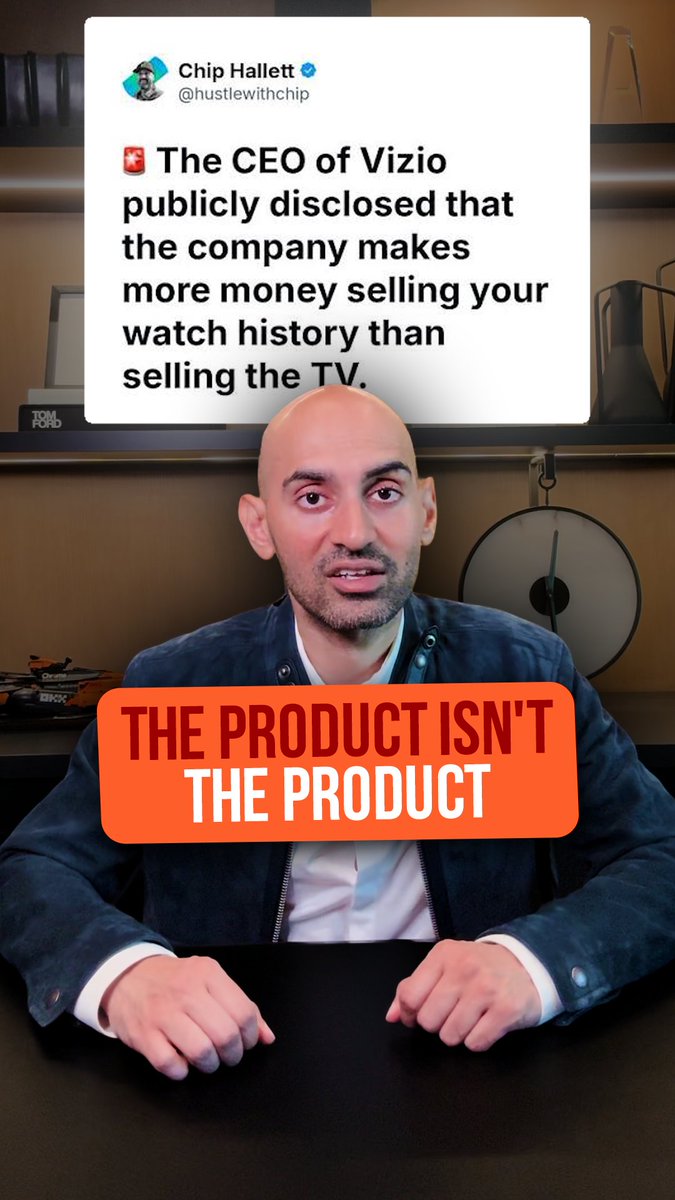
Big-screen TVs used to cost thousands of dollars. But then they got super cheap. Why? It's the same reason social media is free. Vizio doesn't make money selling TVs anymore. Last quarter, they actually lost money on the hardware. But they still made $109 million in profit. How? Their TV is now an ad platform. The ads, the data, the targeted recommendations that's the actual business. And it's not just Vizio. Samsung, TCL, LG, every major brand makes more from ads on your TV than from the TV itself. Here's why this should change how you think about your own business. The product isn't the product anymore. The customer relationship is. Vizio sells a TV. The relationship is the actual business. Tesla sells a car. The software subscriptions are the actual business. HP sells you a printer at a loss. Ink is the actual business. Same pattern across every industry, the first sale is just the entry fee. Smart operators are now willing to lose money on the first sale because they know what comes after. And here's how that plays out online. You run ads or build organic traffic. People land on an offer, a freebie, a guide, something worth their email. They join your list. From that moment on, your job isn't selling. It's nurturing. Email sequences. SMS follow-ups. Automations that keep the relationship warm until they're ready to buy and ready to buy again, and again. That’s what platforms like HighLevel, one of our partners, are built for.. The place where every customer relationship lives, builds, and compounds over time. So if you're still optimizing every transaction for profit, you're playing a game everyone else just stopped playing. Build the relationship layer before the shift hits your industry.

Neil Patel

12,338 просмотров • 1 месяц назад

Yield farming are still one of the most unpopular part of web3 many CT users don’t explore, we are more into yap about this, which memes to buy into for the next 2000x possible But we don’t see the opportunity looking at our with amazing passive income we can get without literally doing anything I explored Virtue today a lending and borrowing platform on iota and why am I bullish on them? IOTA is quietly building the bridge that finally brings the real economy onchain and stablecoins are the foundation. Take $vUSD from Virtue Money as the perfect example, this isn’t just another stablecoin. It’s the reliable, battle tested dollar layer that $IOTA needs to onboard real users, real transactions, and realworld assets at global scale. ⭐️ What makes $vUSD different: • Fully collateralized • Transparent onchain reserves and management • Designed to grow steadily as adoption increases • Engineered for predictable payments and safer lending • Engineered to aid and provide yield opportunity for users When businesses, traders, developers, and even traditional institutions can move value on IOTA without volatility risk, everything changes. Payments become instant and cheap • Borrowing becomes trust minimized and with this RWAs actually start making sense. This is exactly the kind of secure, usable digital infrastructure that TWIN Foundation has been pushing for finance the world can actually rely on. As usual I explored them through LiquidLink, I love how united their platform is for a dashboard uniting both VirtueMoney and Swirl ⭐️ Plug in here: Don’t miss the Vooi with iota they are the global trade ✋🏼😩🤚🏻 #IOTAambassador

Doncurrent 🥶

27,738 просмотров • 8 месяцев назад