Video yükleniyor...

Video Yüklenemedi

Ana Sayfaya Dön

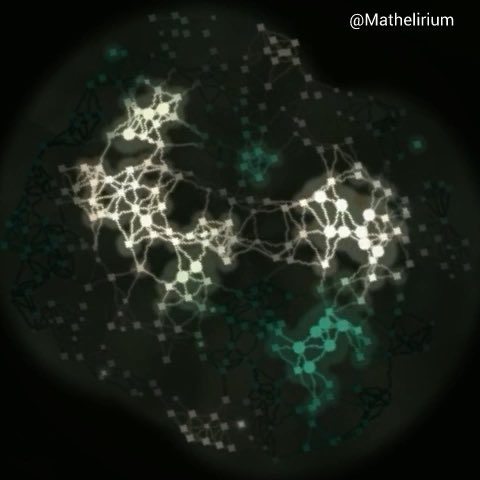
What you're watching here is a torus cycling through its eigenfunctions...the surface's pure standing-wave modes. An eigenfunction is a mode that, when the surface Laplacian operator acts on it, reproduces itself scaled by a constant...that constant fixes the natural frequency. Each mode is indexed by two counts: how many...

54,411 görüntüleme • 6 ay önce •via X (Twitter)

0 Yorum

Yorum bulunmuyor

Orijinal gönderinin yorumları burada görünecek

Benzer Videolar

String Theory Lecture 1 A String Does Not Move Like a Point A point particle traces a line through spacetime. A string traces a surface. This is the first geometric shift in String Theory. Particle mechanics asks where one object is at time t, so its history is a curve. String Theory asks where every point of an extended object is at worldsheet time τ, so we need another coordinate telling us where we are along the string. For a point particle x(t) So, for one input of time we get a position in Spacetime. For a string Xᵘ(τ,σ) Here τ plays the role of time on the worldsheet, while σ labels position along the string. Freeze τ and vary σ, and you see the string at one instant. Let τ move, and that curve sweeps out a two-dimensional surface... the worldsheet. The same comparison appears in the action. For a relativistic point particle, the geometric action measures worldline length S = −m ∫ ds If we parameterize the path by t, the action has one integral, one parameter, and one tangent vector dxᵘ/dt For a string, the same idea grows by one dimension. The action measures area, not length. In Nambu-Goto form, S = −T ∫ dτ dσ √[−det hₐᵦ] Here T is the string tension. It plays a role similar to mass, but for an extended object. It weights the area of a surface rather than the length of a line. The particle action has ∫ dt because the history is one-dimensional. The string action has ∫ dτ dσ because the history is two-dimensional. We are no longer summing along a path, we are summing over a surface. The geometry changes for the same reason. For the particle, one derivative is enough dxᵘ/dt For the string, the geometry is built from two derivatives: ∂τXᵘ and ∂σXᵘ The first tells you how the string changes as worldsheet time flows. The second tells you how the embedding changes as you move along the string. Together they define the induced worldsheet metric hₐᵦ = ∂ₐXᵘ ∂ᵦXᵤ In plain terms, hₐᵦ measures tangent lengths and tangent angles on the worldsheet. From it, the area element is dA = dτ dσ √[−det hₐᵦ] This, the Nambu-Goto action is the direct analogue of the point-particle length action. The point particle extremizes length and the string extremizes area. For calculations, people usually switch to the Polyakov action: S = −(T/2) ∫ dτ dσ √[−γ] γᵃᵇ ∂ₐXᵘ ∂ᵦXᵤ This describes the same classical string dynamics, but the algebra is cleaner. After choosing conformal gauge, varying with respect to Xᵘ gives (∂²/∂τ² − ∂²/∂σ²) Xᵘ = 0 This is the first real dynamical payoff... a two-dimensional wave equation on the worldsheet. For a point particle, the equation of motion tells you how one position evolves along one path. For a string, it tells you how an entire curve evolves, with waves traveling along it. The term ∂²Xᵘ/∂τ² measures acceleration in worldsheet time, while ∂²Xᵘ/∂σ² measures curvature along the string. The time evolution is balanced by how the string bends along its own length. This is why strings have oscillation modes. A point particle has one trajectory. A string has many possible vibration patterns, each one a normal mode of the worldsheet wave equation. For a closed string, σ wraps around the loop Xᵘ(τ, σ + 2π) = Xᵘ(τ, σ) For an open string, one standard free-end condition is ∂σXᵘ = 0 at the endpoints. Solving the wave equation gives waves moving in opposite directions along the string Xᵘ(τ,σ) = Fᵘ(τ + σ) + Gᵘ(τ − σ) A function of τ + σ moves one way. A function of τ − σ moves the other. Therefore, a particle has a worldline, its action measures length, and its geometry uses one tangent. The string has a worldsheet, its action measures area, and its geometry uses two tangent directions. #StringTheory #TheoreticalPhysics #MathematicalPhysics #Physics #Spacetime

Mathelirium

31,560 görüntüleme • 1 ay önce

This isn't VFX visual effects...it's actual freakin physics! 🤯🤩🤗🙌🏾 You're watching the physics of space and matter coevolve...a small window into the kind of world Wolfram Physics Wolfram predicts. Every ripple, collision, and shimmer you see is a causal event in a living hypergraph. Space itself is an active network of nodes and links...springs and diagonals...constantly stretching, relaxing, and rewriting as the system evolves. Each interaction you see...a nutrient diffusing through the medium, a burrower tunneling, a tentacle feeling drag...is a computation of spacetime itself. Every connection that forms or breaks is an update to the causal structure: a new link, a new moment in the unfolding hypergraph universe. Our environment behaves like an adaptive fabric...the lattice tightens where organisms stir it, loosens where they pass. Chemical fields spread through those same links, feeding back into motion and growth. When the cluster pulsates, it's literally reorganizing local causal geometry...matter and space changing together!👌🏾 We even test causal invariance frame by frame, swapping operation orders to ensure that spacetime remains consistent no matter the update path. That's not animation logic...that's a computational physics experiment running live!🥳 Tentacles feel friction, burrowers dig through gradients, and behind them the lattice stiffens, storing history as structure. #Mathematics #Physics #WolframPhysics #Mathelirium

Mathelirium

20,090 görüntüleme • 7 ay önce

The Elusive Concept of Time. Your instincts treat time like a background meter the whole universe shares. Relativity does not take time away, it forces you to earn it operationally. Events are points. Motion is a curve through them. A clock is not a metaphor, it is a worldline with a number attached to it. Two observers can disagree on which distant events are simultaneous, and nothing contradictory happens, because causal structure is still pinned down by light cones and invariants. Even in weak gravity the rule shows up. A clock deeper in a gravitational potential ticks more slowly relative to one far away. Near a compact object the difference becomes hard to ignore. Add rotation and spacetime itself picks up a twist. That twist is frame dragging, not a new force, just geometry telling you that time and angle are coupled in a rotating spacetime. In the animation You are watching a geometry lesson disguised as a black hole scene. The fabric is a visualization of the field shaping clock-rates and the paths light can take. The ripples are driven by local proper time, so their phase visibly slows as you approach the horizon. The accretion disk is lensed through Kerr ray tracing, and its brightness is pushed by redshift and beaming so the approaching side can flare while the receding side dims. Beacon points at different radii pulse at different rates, so you can see time dilation without any labels. The bead ring is a redshift tracer, with intensity scaled by a g³ proxy so deeper emission arrives weaker and shifted. The math breakdown Start with what a clock actually measures. Proper time τ is the accumulated time along an observer’s worldline. In special relativity, the invariant interval is ds² = c² dt² − dx² − dy² − dz² Along a timelike path, dτ = (1/c) √(ds²) = √( dt² − (1/c²)(dx²+dy²+dz²) ) If the observer moves with speed v, so dx²+dy²+dy²+dz² = v² dt², then dτ = dt √(1 − v²/c²) That is time dilation as geometry. The moving clock accumulates less τ between the same pair of events. Now add gravity. General relativity replaces the flat interval with a metric gᵤᵥ that depends on position: ds² = gᵤᵥ dxᵘ dxᵛ For a stationary clock in Schwarzschild geometry (mass M), the time component is g_tt = −(1 − 2GM/(rc²)) If the clock sits at fixed r (no spatial motion), ds² = g_tt c² dt², so dτ = dt √(1 − 2GM/(rc²)) Closer to the mass means a smaller factor, so the clock ticks more slowly relative to a clock far away. That is the rule used to drive the fabric phase in the animation. Now connect time to light. A gravitational field shifts photon frequency. Between an emitter at rₑ and an observer at rₒ, f_obs / f_emit = √( (1 − 2GM/(rₑ c²)) / (1 − 2GM/(rₒ c²)) ) For a far-away observer rₒ → ∞, f_obs / f_emit = √(1 − 2GM/(rₑ c²)) Deeper emission arrives redshifted. Lower frequency. Lower energy per photon. In the render, the disk intensity uses a Kerr-derived redshift factor g (clipped for stability). The bead ring uses a simple radiative proxy I_obs ∝ g³ I_emit to make that effect visible. Finally, why rotation looks like a twist. A rotating black hole is Kerr geometry. The key structural change is a nonzero g_tφ term, which couples time to angle. That coupling is frame dragging in equations. Near the hole, being stationary is not the same notion everywhere, because the local inertial frames are being pulled around the spin axis. So the moral stays clean. Time is not a universal substance flowing everywhere at one rate. It is what clocks accumulate along worldlines. Light cones constrain what can influence what. Invariants are what everyone agrees on. The rest is operational detail that only feels universal because our daily corner of the universe is slow and mild. #GeneralRelativity #Gravity #FrameDragging #BlackHoles #Spacetime

Mathelirium

149,316 görüntüleme • 4 ay önce

String Theory Lecture 2 In Conformal Gauge, the String Becomes a Wave Equation Episode 1 showed the geometric jump point particle -> worldline string -> worldsheet Episode 2 is the dynamical jump. The Nambu-Goto action measures the area of the worldsheet, S = −T ∫ dτ dσ √[−det hₐᵦ] but the square-root determinant is awkward to work with. So we usually rewrite the same classical theory in Polyakov form, S = −(T/2) ∫ dτ dσ √[−γ] γᵃᵇ ∂ₐXᵘ ∂ᵦXᵤ Here Xᵘ(τ,σ) tells us where each point of the string’s worldsheet sits in spacetime, and γₐᵦ is the metric we put on the worldsheet. The power of this form is that we can choose a convenient gauge. In conformal gauge, the equations of motion simplify to (∂²/∂τ² − ∂²/∂σ²) Xᵘ = 0 So the string’s spacetime coordinates behave like waves living on the worldsheet. The τ-derivative measures how the string changes in worldsheet time. The σ-derivative measures how it bends along its own length. For a closed string, σ is periodic Xᵘ(τ, σ + 2π) = Xᵘ(τ,σ) and the wave equation splits into two traveling pieces, Xᵘ(τ,σ) = Fᵘ(τ + σ) + Gᵘ(τ − σ) One family moves one way around the string and the other moves the opposite way. These are the left-moving and right-moving modes. In the render, the bright loop is the string at the present moment. The glowing cylinder behind it is the worldsheet it has swept out. The cyan curves trace one traveling family, and the gold curves trace the other. They are the visual version of τ + σ and τ − σ. Therefore, the theory has an internal wave equation, and its normal modes are the raw material for the string spectrum. #StringTheory #TheoreticalPhysics #ConformalGauge #Worldsheet #WaveEquation #Physics #Mathematics #MathematicalPhysics #QuantumGravity #ScienceVisuals

Mathelirium

15,295 görüntüleme • 1 ay önce

An egregore is not merely a mystical idea; it is a living psychological structure. From a psychoanalytic lens, it can be understood as a shared mental ecosystem. The accumulated thoughts, emotions, fears, and longings of a group that, through repetition, begins to operate as an autonomous force. Just as the personal unconscious stores unresolved experiences and symbolic narratives, the egregore functions as a collective psyche in motion. It sustains itself through belief, emotional investment, ritualized behavior, and constant reinforcement. The more it is fed, the more real it becomes. Its influence is subtle but pervasive. Anyone entering its field begins to feel, think, and behave in alignment with its logic, often mistaking borrowed impulses for personal choice. This is why patterns echo across families, ideologies, and institutions. What appears individual is frequently inherited from the group mind. In clinical work, this emerges when a person carries guilt, obligations, or symptoms that did not originate with them alone, but were transmitted through relational and symbolic networks. The egregore is the architecture through which these imprints are organized and passed on. To recognize an egregore is to abandon the illusion of psychological isolation. Each of us is woven through invisible currents of memory, meaning, and desire. The “self” is not a closed system, but a dialogue; constantly shaped by the collective field speaking through us, even in silence.

𝚃𝙷𝙴 𝚆𝙷𝙸𝚃𝙴 𝚁𝙰𝙱𝙱𝙸𝚃

17,369 görüntüleme • 5 ay önce