Video yükleniyor...

Video Yüklenemedi

Ana Sayfaya Dön

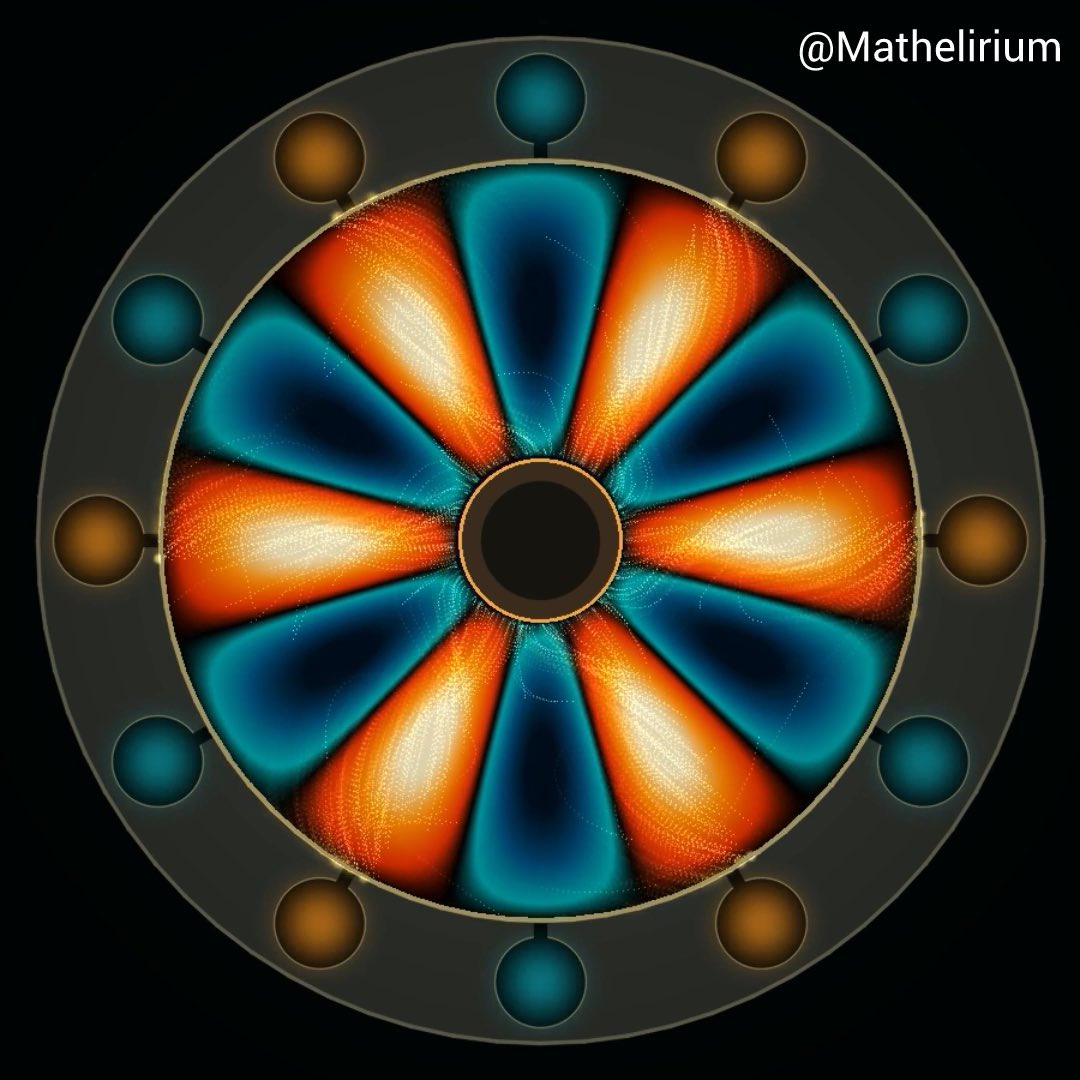
When gravitational potential rotates, it can lock onto an orbit’s phase and start rearranging motion. Order can turn into visible structure, and structure can slide into chaos, without any collisions or extra bodies. This is a toy barred galaxy...a softened central potential plus a rotating bar-shaped overdensity. The bar...

16,103 görüntüleme • 5 ay önce •via X (Twitter)

0 Yorum

Yorum bulunmuyor

Orijinal gönderinin yorumları burada görünecek

Benzer Videolar

When several metronomes are placed on a common movable surface, each begins with its own rhythm. There is no coordinating signal, no external clock, and no instruction for order. Yet their motion converges. The oscillators settle into a shared rhythm that none of them possessed individually. This behavior is not an anomaly but an expression of a general principle: weakly coupled oscillatory systems tend toward phase organization. The phenomenon is known as phase locking, and it appears wherever interacting cyclic processes are allowed to exchange even minimal influence. Its mathematical description was formalized by Kuramoto in the context of chemical oscillations, but the underlying idea is far older: collective order can arise without centralized control. What matters in such systems is not perfect synchrony. More commonly, the system settles into a state of partial synchronization, in which the components maintain a stable phase offset rather than coinciding exactly. The oscillators are neither independent nor identical. They are locked, but imperfectly so. Crucially, such phase-locked states are often metastable. They represent preferred configurations of the system, yet they are separated from large excursions by a finite stability barrier. As long as fluctuations remain small, the system remains confined near its equilibrium phase. But random perturbations, accumulating over time, may eventually push it beyond that barrier. When this occurs, the loss of phase stability is abrupt. The system does not drift gradually into failure; it escapes. This mode of failure is probabilistic rather than deterministic. It is governed by the statistics of noise rather than by intrinsic periodicity. In physical terms, it corresponds to Kramers escape: the thermally or stochastically activated crossing of a potential barrier. Waiting times are irregular, clustering is common, and long intervals of apparent calm coexist with sudden bursts of activity. The relevance of this framework becomes apparent when one turns to the geomagnetic field. [1/3]

Craig Stone

15,212 görüntüleme • 4 ay önce

The Elusive Concept of Time. Your instincts treat time like a background meter the whole universe shares. Relativity does not take time away, it forces you to earn it operationally. Events are points. Motion is a curve through them. A clock is not a metaphor, it is a worldline with a number attached to it. Two observers can disagree on which distant events are simultaneous, and nothing contradictory happens, because causal structure is still pinned down by light cones and invariants. Even in weak gravity the rule shows up. A clock deeper in a gravitational potential ticks more slowly relative to one far away. Near a compact object the difference becomes hard to ignore. Add rotation and spacetime itself picks up a twist. That twist is frame dragging, not a new force, just geometry telling you that time and angle are coupled in a rotating spacetime. In the animation You are watching a geometry lesson disguised as a black hole scene. The fabric is a visualization of the field shaping clock-rates and the paths light can take. The ripples are driven by local proper time, so their phase visibly slows as you approach the horizon. The accretion disk is lensed through Kerr ray tracing, and its brightness is pushed by redshift and beaming so the approaching side can flare while the receding side dims. Beacon points at different radii pulse at different rates, so you can see time dilation without any labels. The bead ring is a redshift tracer, with intensity scaled by a g³ proxy so deeper emission arrives weaker and shifted. The math breakdown Start with what a clock actually measures. Proper time τ is the accumulated time along an observer’s worldline. In special relativity, the invariant interval is ds² = c² dt² − dx² − dy² − dz² Along a timelike path, dτ = (1/c) √(ds²) = √( dt² − (1/c²)(dx²+dy²+dz²) ) If the observer moves with speed v, so dx²+dy²+dy²+dz² = v² dt², then dτ = dt √(1 − v²/c²) That is time dilation as geometry. The moving clock accumulates less τ between the same pair of events. Now add gravity. General relativity replaces the flat interval with a metric gᵤᵥ that depends on position: ds² = gᵤᵥ dxᵘ dxᵛ For a stationary clock in Schwarzschild geometry (mass M), the time component is g_tt = −(1 − 2GM/(rc²)) If the clock sits at fixed r (no spatial motion), ds² = g_tt c² dt², so dτ = dt √(1 − 2GM/(rc²)) Closer to the mass means a smaller factor, so the clock ticks more slowly relative to a clock far away. That is the rule used to drive the fabric phase in the animation. Now connect time to light. A gravitational field shifts photon frequency. Between an emitter at rₑ and an observer at rₒ, f_obs / f_emit = √( (1 − 2GM/(rₑ c²)) / (1 − 2GM/(rₒ c²)) ) For a far-away observer rₒ → ∞, f_obs / f_emit = √(1 − 2GM/(rₑ c²)) Deeper emission arrives redshifted. Lower frequency. Lower energy per photon. In the render, the disk intensity uses a Kerr-derived redshift factor g (clipped for stability). The bead ring uses a simple radiative proxy I_obs ∝ g³ I_emit to make that effect visible. Finally, why rotation looks like a twist. A rotating black hole is Kerr geometry. The key structural change is a nonzero g_tφ term, which couples time to angle. That coupling is frame dragging in equations. Near the hole, being stationary is not the same notion everywhere, because the local inertial frames are being pulled around the spin axis. So the moral stays clean. Time is not a universal substance flowing everywhere at one rate. It is what clocks accumulate along worldlines. Light cones constrain what can influence what. Invariants are what everyone agrees on. The rest is operational detail that only feels universal because our daily corner of the universe is slow and mild. #GeneralRelativity #Gravity #FrameDragging #BlackHoles #Spacetime

Mathelirium

149,346 görüntüleme • 5 ay önce

Today we introduce Stochastic Differential Equations (SDEs), and the main thing to watch for is this: We’ll use Brownian motion as the basic noise source, then see how well-known SDEs drop out of it naturally, without guessing. I still think the best way into these concepts is through an application. We look at the theory behind electromagnetic scattering and radar clutter, which leads straight into anomaly detection on scattering statistics. When a narrowband wave scatters off a messy cloud of particles, the complex field at your receiver is a random phasor sum. At time t you can write the electric field as E_N(t) = Σⱼ₌₁ᴺ e^{iθⱼ(t)}, each term a unit arrow in the complex plane from scatterer j. This is exactly where Brownian motion shows up in the most reasonable way. Think of all the microscopic chaos: tiny motions, index fluctuations, path jitters, Doppler shifts. Over short times, all of that shows up as small random kicks to the phases θⱼ(t). If you made θⱼ(t) random in an ad-hoc way, like resampling a fresh independent angle at every instant, the field would jump around unrealistically with no physical time structure. Brownian motion is what you get when each phase takes the continuous-time limit of many tiny, independent kicks. It’s continuous in t, its variance grows the right way, and it carries just enough temporal structure to look physical. So we model each phase as a Brownian walk, θⱼ(t) = θⱼ⁰ + σ_θ Bⱼ(t), with independent Brownian motions Bⱼ(t) and a phase-diffusion rate σ_θ. Brownian motion here isn’t window dressing. It’s the clean way to compress all the small random stuff into a single process that actually matches how phases wander in time. This is called Rayleigh Scattering, but the same sum of many tiny coherent echoes shows up in lots of places...e.g. wireless multipath fading (phones/Wi-Fi), laser/optical links through atmospheric turbulence, ultrasound speckle in tissue, and sonar/underwater acoustics in rough or bubbly water. #StochasticProcesses #BrownianMotion #ItoCalculus #RadarClutter #RayleighScattering #SignalProcessing

Mathelirium

31,182 görüntüleme • 4 ay önce

Warmup to Statistical Mechanics What Exactly is a Hamiltonian A System? In ordinary Mechanics, you might begin with position and velocity. Hamiltonian Mechanics rewrites the same motion in a different language. Instead of position and velocity, it uses position and momentum. We write the position variables as q and the momentum variables as p. Then the full state of the system at one instant is (q, p) That pair is one point in phase space. Why do we do this? Because in these variables, the equations of motion take a remarkably clean form. Everything is generated by one single function, the Hamiltonian H(q, p) and in the simplest cases this Hamiltonian is just the total energy written in terms of position and momentum. So if you know H, you know the dynamics. You might wonder, but how can one function generate motion? The rule is dqᵢ/dt = ∂H/∂pᵢ dpᵢ/dt = −∂H/∂qᵢ These are Hamilton’s equations. Now read them slowly 😄 The rate of change of position comes from differentiating H with respect to momentum. The rate of change of momentum comes from differentiating H with respect to position, with a minus sign. This constitutes the whole engine. A simple example makes this less abstract: Take one particle of mass m moving in a potential V(q). Then the Hamiltonian is H(q, p) = p²/(2m) + V(q) The first term is kinetic energy. The second term is potential energy. Now apply Hamilton’s equations. First, dq/dt = ∂H/∂p = p/m So momentum tells you how position changes. Second, dp/dt = −∂H/∂q = −dV/dq Thus, momentum changes because of force. If you now combine these two equations, you recover ordinary Newtonian mechanics. Since p = m dq/dt, we get m d²q/dt² = −dV/dq So, Hamiltonian mechanics is not a different theory. It is the same mechanics, written in a form that exposes its geometric structure much more clearly. The animation The full 3D surface is the Hamiltonian itself, the energy landscape H(q, p). The floor underneath is phase space, marked by energy contours and the local flow field. The bright moving point is one actual state (q(t), p(t)) evolving under Hamilton’s equations. Its trail shows that the motion is not arbitrary. It is guided everywhere by the geometry of the same single function H. The render is doing more than illustrating a particle moving, it is showing how one function organizes the whole phase-space motion. The math breakdown: Start with one degree of freedom. The state is described by position q and momentum p. So the system lives in a two-dimensional phase space with coordinates (q, p) Now choose a Hamiltonian H(q, p) Think of H as the energy function. In many standard systems, H(q, p) = kinetic energy + potential energy For a particle of mass m in a potential V(q), this becomes H(q, p) = p²/(2m) + V(q) Hamilton’s equations say dq/dt = ∂H/∂p dp/dt = −∂H/∂q Now substitute this specific H. First compute the p derivative: ∂H/∂p = ∂/∂p (p²/(2m) + V(q)) = p/m So dq/dt = p/m Now compute the q derivative: ∂H/∂q = ∂/∂q (p²/(2m) + V(q)) = dV/dq So dp/dt = −dV/dq These two first-order equations completely determine the motion. Now, connect this back to Newton’s law. From dq/dt = p/m we get p = m dq/dt Differentiate both sides with respect to time: dp/dt = m d²q/dt² But Hamilton’s second equation gives dp/dt = −dV/dq So , together they imply m d²q/dt² = −dV/dq This is exactly Newton’s second law for motion in the potential V(q). Thus, Hamilton’s equations do not replace mechanic, they reorganize it. #HamiltonianMechanics #PhaseSpace #ClassicalMechanics #MathematicalPhysics #DifferentialEquations #Mathematics #Physics

Mathelirium

50,370 görüntüleme • 2 ay önce