Video wird geladen...

Video konnte nicht geladen werden

Zur Startseite

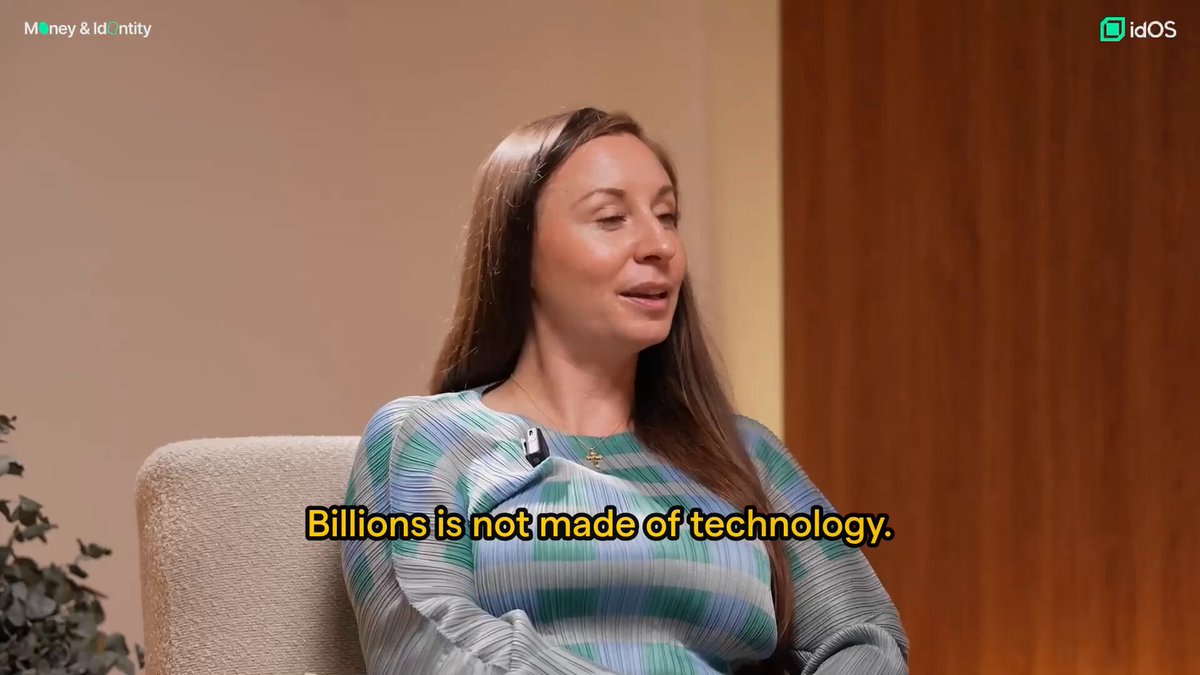
When you say the word "crypto" many people think "cryptocurrency" not "cryptography" which is the mathematical basis of being able to verify information that also underpins blockchain technology. Blockchains now are not just about currency. They are trust layers that allow us to anchor verifiable claims such as the...

49,748 Aufrufe • vor 8 Monaten •via X (Twitter)

0 Kommentare

Keine Kommentare verfügbar

Kommentare vom Original-Post werden hier angezeigt

Ähnliche Videos

Right now our experience of the internet is in jeopardy. More than half of our interactions online and onchain come from non-human actors who are not identifiable, not accountable, not verifiable. That means as we look toward a stablecoin payment and AI agent enabled future, how are we going to facilitate payments if we don't know who we're paying? How will applications, display advertising, recommendations work if the counterparty who's interacting with those interfaces and in those digital spaces can’t identify itself as agent or human, or specific human? Or for things like onchain incentives, how can we ensure that tokens and value are arriving at the right users if we cannot tell Sybil accounts and redundant addresses from unique human beings? So for all of these use cases and more, things that touch enterprise and government as well, which we can get into later, we have a very glaring need to bring a layer of identity and trust to the internet that was originally built as a system, a network to communicate amongst computers, but lacked an identity system to acknowledge their users. That's the problem that we are solving with Billions Network. How can we make it really easy for you and the agents who serve you to prove who you are, your traits and capabilities and qualifications, in any space, physical or digital? What that means is that today Billions Network is the first universal human and AI network built with mobile first verification, so you can prove who you are and your agents can prove who they are, starting with comfortable experiences on the devices you already own. So no proprietary hardware. We do not rely on centralized servers to collect user data. Rather, your information, the sensitive data that makes you you, stays securely on your device. And we use zero knowledge proofs as a way to prove traits about you, such as the fact that you're over the age of 21, without revealing that sensitive personal data, such as what your exact birth date is. Source: Billions CEO Evin McMullen evin speaking at House of Chimera Spaces Event Dec 3, 2025

Billions Network

30,898 Aufrufe • vor 8 Monaten

"What is the cleanest way to compare Billions with other web3 identity layers and privacy layers?" The word privacy means a lot of things to a lot of different people. Often it is associated with consent, which is an action that you take that diminishes the privacy of a given set of data. Privacy is basically the process of information arbitrage, the selective disclosure of data in order to enable interactions. Although in a web2 environment, that "free" transaction of data often weighs very heavily to one side. When we talk about privacy at Billions Network, privacy is a static state, the absence of disclosure, or a way to describe the outcomes of mechanisms of data disclosure. We really focus on those instances where the selective disclosure of data is a question of legal compliance, of security, of financial value, where the decision to leverage this technology is not necessarily one of personal feelings, but rather of business efficiency, of compliance, and security. Source: Billions CEO Evin McMullen evin speaking at House of Chimera Spaces Event Dec 3, 2025 In an era where AI is rapidly evolving, the boundaries of identity and privacy are being rewritten. Don’t miss our next Billions event in Shenzhen, China 🇨🇳 🗓 Date & Time Dec 21 (Sun), 20:00–23:00 Join a relaxed evening to experience our privacy-preserving verification and dive into the future of human + AI privacy In collaboration with: TinTinLand (TinTinLand 中文), Asia’s leading Web3 platform for developer growth and ecosystem acceleration.

Billions

20,164 Aufrufe • vor 8 Monaten

"You can either produce excellence or you can avoid criticism. But you cannot do both of those. The reason that you don't have certain excellence that you want is because you are afraid of getting criticized. You are afraid of the judgment that comes with it. You are afraid of standing out. You are afraid of being alone. You are afraid of people looking at you. You are worried about what people think of you. There are 2 categories of things in this world: 1) Things that are up to you 2) Things that are not up to you Which category does your reputation sit in? Your reputation is not up to you. I'm the one who associates your reputation with something, not you. You just do things. What's up to you? How you act. Your decisions. Your actions. That is up to you. Your reputation is not up to you. Here's how I know that: You all have a reputation about me and it's not in my control. I get to say and do whatever I say and do up here. I am in control of saying it. I am in control of doing it. The moment words leave my lips, who has control over what is done with those words? You! You are in control of what you think of me. And there's no way everybody in this room is going to think the exact same thing about me. No way. When it comes to exceptional, what we've got to understand is you can spend your whole life trying to avoid criticism and earn reputation, and it still won't be in your control. We can waste a lot of time missing out on excellence we could have been producing if we were just simply LESS trying to engineer what we wanted other people to think about us."

Brian Kight

308,812 Aufrufe • vor 1 Jahr

What does the reputation model look like for agents? (alpha leak below) And how do we associate the proofs that we have about human beings with the agents who represent them? You may have heard of a process called KYC or Know Your Customer. That's very common with traditional financial applications and services. We have introduced a concept that we call KYA or Know Your Agent, which is a structured way to be able to express what model, how data was used in training, who the deployer is, what entities this agent instance is accountable back to, providing not only provenance but identity of the associated organization or entity. That's also another root of trust that we think about a lot: Enterprises and organizations tied back to things like their domains. To share a little bit of an alpha leak here, a product that we're excited to be rolling out in the next few weeks will allow our enterprise partners to more easily verify and prove the traits and capabilities of their teams as well as their counterparties. On the agent front, that makes it really easy to prove that an agent is acting on behalf of a given business or entity. We've already seen lawsuits where the absence of such technology has been a huge risk, such as with airlines that incorporate ChatGPT wrappers in their support pages. And then those AI enabled interactions end up making up plane tickets that don't exist and those airlines have to honor them. As small of an example as that might be, being able to prove agent accountability also unlocks a huge set of opportunities for use in enterprise for those agent to agent interactions. The Deep Trust Framework that our team has put together that we're excited to be bringing into a friendly SDK form in the next few weeks for some of our partners includes those reputation based capabilities, so how you can basically keep track of the interactions an agent has had, associate all of that to the entity to which they're accountable, and then that creates a sustainable reputation model for these agent to agent Interactions. Source: Billions CEO Evin McMullen evin speaking at House of Chimera Spaces Event Dec 3, 2025

Billions Network

68,503 Aufrufe • vor 8 Monaten

I was asked by USA Today to respond to remarks made by Hasan Piker about Zionism. Piker claimed as follows: “Zionism is the ethnoreligious supremacist ideology that is exterminationist in principle, born out of the wrong assessment that this was a land without people for a people without land. It required the extermination of the indigenous population, and that's precisely what has happened since its inception. And its final iteration of that has been the Gaza genocide that we watched unfold.” You can call a blowtorch an avocado as many times as you want, but it still doesn’t have a seed, and it still isn’t green because it’s still just a blowtorch. The claim that Zionism is an exterminationist ideology is just as nonsensical as calling a blowtorch an avocado. The suggestion that Jews want to exterminate the Arabs who also live on the land is likewise, as it has always been, ludicrous and false. Zionism is a simple idea, which is that Jews have the same rights — not more rights, but also not fewer rights — than every other people on Earth have to sovereignty in their national homeland. So just as you might think that Bulgarians have the right to sovereignty in their homeland, Japanese people, Korean people, German people all have the right to sovereignty in their homeland, Zionism is just the idea that Jews should be treated the same. By the way, this is in the charter, the charter that is the foundation of the state of Israel. In that document, the word ‘extermination,’ of course, would never appear there, but anything that even remotely resembles that word or idea is foreign to any of the early laws or that document. In fact, the document says precisely the opposite. The document says that one of the purposes of the state of Israel is to allow Jews and Arabs alike to live in peace and to flourish together in the land of Israel. That's what the Declaration of Independence of the State of Israel says, and by the way, that's what the state of Israel has proven, more so than what it said in 1948, in the decades since.

Roy K. Altman

20,582 Aufrufe • vor 28 Tagen

Zack Snyder on his dyslexia: "It was a challenge for me when I was, you know, young in school, and all I wanted to do was make movies because that was the thing that I got great pleasure from and reward from. I love books, and I'm an avid reader, but I just have a hard time because of the way that I perceive. "I've had a great sort of - one side of me anyways - was really satisfied by art and drawing and sculpture and sort of visual expression. And I think that that started to, you know, was the thing that kind of made me feel un-frustrated. And also the way the system was designed, sort of not to support me when I was in high school at that time. "It was very difficult, you know, there was a lot of, you know, just, difficulty. My English teacher in high school was worried about what my career would be, and I'm like. He would be happy to know that I'm in the Writers Guild of America now. "But, I think that that all those things are, they're all... you can transcend all those things with perseverance and with interest and with with help. And I think that that's an important part of it. "And I just think I've had to adapt, and sort of... I have my own style of the way I write, I write all, you know, but I'm pretty prolific. And I love- I listen to tons of audio books on tape, unabridged hours and hours and hours. That's all I do when I'm driving in the car or wherever I'm doing. And it's helped me a lot. "And yeah, I mean, I just hope that anyone who is- feels trapped or frustrated by the world in general. You know, they need to just, I think that we all have like a magic spark, and you need to just find the thing that makes you, you know, inspires you and, and gets you excited and pursue it as hard as you can find your passion in the world. That's a, that's a great motivator."

Zack Snyder Film

11,128 Aufrufe • vor 7 Monaten