正在加载视频...

视频加载失败

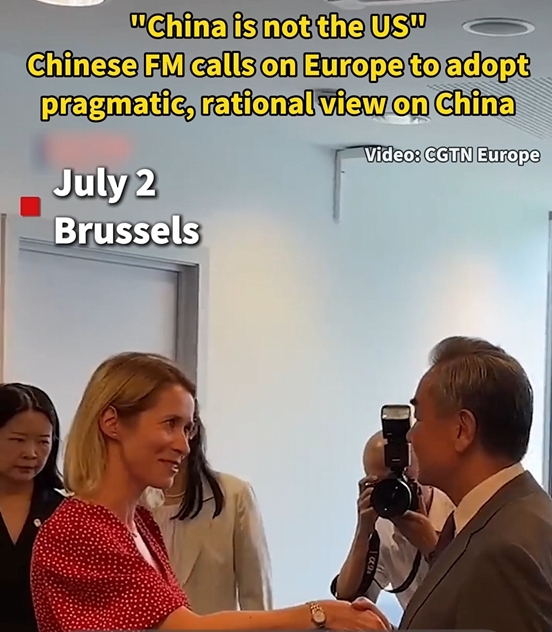
While asked about the China-Europe relations at the Munich Security Conference, Chinese Foreign Minister Wang Yi said China has been a partner of Europe for almost half a century, and it is “a negative mindset and a mistaken perception” to say China and Europe are rivals. He also shared...

40,388 次观看 • 5 个月前 •via X (Twitter)

0 条评论

暂无评论

原始帖子的评论将显示在这里

相关视频

Swedish Prime Minister Ulf Kristersson said China often has access to the European market in ways that European companies do not enjoy with the same ease in China. He said Europe cannot allow China to have one set of rules while European companies operate under a completely different set of rules. That is the punchline. For years, Europe has restricted or excluded Chinese companies under the language of “security.” Huawei. ZTE. Chinese telecom firms. Chinese solar products. Chinese EVs. Chinese batteries. Chinese infrastructure. Whenever Chinese companies become too competitive, Europe suddenly discovers “risk,” “dependency,” “distortion,” or “strategic vulnerability.” But when China responds with its own controls, tariffs, rare earth restrictions, or market measures, Europe starts crying about fairness. Classic. China has not banned European industrial giants from the Chinese market the way Europe has tried to politically suffocate Chinese companies. Volkswagen, BMW, Mercedes, Airbus, Siemens, BASF, Schneider, LVMH, and countless European firms have made fortunes in China for decades. China opened its market, built supply chains, created demand, and let European companies profit massively. Europe took the money. Then it blocked Chinese firms, joined U.S. containment, restricted high-end exports, attacked Chinese clean-tech industries, and now complains that China enjoys unfair access. If Europe really wants “one set of rules,” it should be careful what it asks for. Because China can play that game too. The difference is simple: Europe complains about access while using access as a weapon. China has shown restraint. Perhaps too much restraint. If Beijing treated European companies the way Europe treats Chinese companies, Brussels would discover very quickly what “same rules” actually means.

𝘊𝘰𝘳𝘳𝘪𝘯𝘦

27,677 次观看 • 1 个月前

The EU has mastered one trick: When it wins, it calls it free trade. When China wins, it calls it overdependence. For decades, European cars, appliances, luxury goods, chemicals, machinery, and high-end consumer products entered the Chinese market. China did not cry that Europe was “distorting” its market or creating “dependency.” China competed. China learned. China upgraded. But the moment Chinese industries became competitive, Europe suddenly discovered “strategic risk.” Solar panels? Europe blocked and punished Chinese solar for years with tariffs and trade barriers. Did that revive Europe’s own solar industry? No. It only made Europe’s energy transition more expensive until it eventually had to reopen the door. Huawei and ZTE? Europe followed Washington’s pressure campaign, ripped out Chinese telecom infrastructure it had already deployed, spent more money, delayed its own networks, and called that “security.” Energy? Europe chose geopolitical obedience, cut itself off from cheap Russian energy, raised its own industrial costs, became more dependent on the U.S., and then watched its companies move across the Atlantic under American subsidies and tariffs. But somehow the problem is still China. Please. Europe’s crisis was not created by Chinese overcapacity. It was created by European complacency, American dependency, ideological industrial policy, expensive energy, and decades of mistaking moral lectures for competitiveness. Now Chinese industries are faster, cheaper, more integrated, and more efficient — from EVs to batteries, solar, electronics, ports, logistics, and manufacturing ecosystems. So Europe invents new language: “Diversification.” “De-risking.” “Overdependence.” “Fair competition.” But strip away the diplomatic costume, and it is just protectionism with Brussels paperwork. China did not force Europe to deindustrialize itself. Europe made its choices. It followed Washington. It sanctioned its own energy base. It taxed its own consumers. It slowed its own innovation. It lectured China while China built. And now it wants China to pay for Europe’s failure to compete. No. China-EU trade is not a charity program for declining European industries. If Europe wants competitiveness, it should build it. Not rename protectionism as “diversification” and expect China to applaud.

𝘊𝘰𝘳𝘳𝘪𝘯𝘦

47,207 次观看 • 1 个月前