Video wird geladen...

Video konnte nicht geladen werden

Zur Startseite

While we eagerly await Fable 5's return, our agentic WebGPU kernel optimization framework kept running. Opus 4.8 picked up where Fable left off, pushing Liquid AI's new LFM2.5 230M to an unbelievable 1,400 tok/s... running locally in your browser. Don't blink or you'll miss it.

175,295 Aufrufe • vor 3 Monaten •via X (Twitter)

35 Kommentare

Profilbild von Xenova
Xenovavor 3 Monaten

How many tok/s do you get on your hardware? Try it out yourself! 👇

Profilbild von kache
kachevor 3 Monaten

incredible to see you still cooking

Profilbild von Xenova
Xenovavor 3 Monaten

Can’t stop, won’t stop. 🧑‍🍳

Profilbild von Max 🏴‍☠️
Max 🏴‍☠️vor 3 Monaten

That is the dumbest model I've seen in my entire life. Every single test, no matter how trivial I gave it, it failed miserably. Basically a random text generator that loosely abides to English grammar rules. This is on a fully maxed out MacBook Pro M5... Am I doing something wrong? It said 1+2=2 and that a bagel is a type of raw pizza.

Profilbild von Eyal Toledano
Eyal Toledanovor 3 Monaten

Fuck yeah! Right there with you. DM so we can share noted

Profilbild von Jared Palmer
Jared Palmervor 3 Monaten

so sick

Profilbild von Xenova
Xenovavor 3 Monaten

Thanks Jared! 🤗

Profilbild von Huy
Huyvor 3 Monaten

I got ~300 tok/s on my iPhone 16 Pro ⚡️ Really curious how the agentic WebGPU kernel optimization framework is pulling that off. What specific optimizations did Claude come up with? Did you use /goal or a different loop setup?

Profilbild von Jason Mayes
Jason Mayesvor 3 Monaten

Have you tried with Gemini 3.5 pro too?

Profilbild von Xenova
Xenovavor 3 Monaten

Gemini 3.5 Pro isn’t out yet (at least, for the public), but I’d love to try when it is!

Profilbild von Jason Mayes
Jason Mayesvor 3 Monaten

Whoops my bad 😅 I know we announced it but i forgot when you all will get it. Yes do let me know how to fairs. PS are you doing continuous itteration here, or one session at a time, when you ask to optimise more each time? Do you give suggestions or completely open?

Profilbild von xenophrēne 🪲
xenophrēne 🪲vor 3 Monaten

fantastic work boys

Profilbild von billyG88
billyG88vor 3 Monaten

M2 Mac - 250tok/sec

Profilbild von Monk
Monkvor 3 Monaten

1400 tok/s in browser? That's wild. Fable 5 who?

Profilbild von Mariusz Kurman
Mariusz Kurmanvor 3 Monaten

LOL! Awesome

Profilbild von Tsurg
Tsurgvor 3 Monaten

Awesome! is this open source?

Profilbild von Casarcan
Casarcanvor 3 Monaten

It's fast yes, but how the practical max context length compares to running the same model natively on CUDA/Metal. Is it mostly limited by available VRAM/KV cache like native inference, or do WebGPU/browser buffer allocation limits cap it earlier?

Profilbild von hello.
hello.vor 3 Monaten

I’ve been playing with this! Nice work. 😎

Profilbild von Nick Venturi
Nick Venturivor 3 Monaten

my chrome is sweating just looking at this

Profilbild von Delusionals
Delusionalsvor 3 Monaten

I was able to download it in less than 30 seconds. It's fast, but it's only worth it for conversions.

Profilbild von Nahid
Nahidvor 3 Monaten

1 400 tok/s in a browser is wild cant wait to try it

Profilbild von JOHNIE
JOHNIEvor 3 Monaten

This is the part worth watching: eagerly, await and fable. The edge is less in spotting the trend once and more in turning it into a repeatable advantage.

Profilbild von FundedX
FundedXvor 3 Monaten

trasnformers.js?

Profilbild von AI Mastery Guide
AI Mastery Guidevor 3 Monaten

1,400 tok/s running locally in the browser is the kind of number that actually makes on device AI feel viable.

Profilbild von seveninchgirths007, andrea tateshestein pt 2
seveninchgirths007, andrea tateshestein pt 2vor 3 Monaten

@ClementDelangue The interesting part isn’t Opus picking it up; it’s that kernel optimization is now a continual loop, not a one-off pass. That shifts perf ownership from a lone specialist to model + compiler + runtime.

Profilbild von Jadson G. Matos
Jadson G. Matosvor 3 Monaten

Não parece certo

Profilbild von (ツ)𝐒𝐚𝐦𝐲𝐋𝐞𝐯𝐲👀
(ツ)𝐒𝐚𝐦𝐲𝐋𝐞𝐯𝐲👀vor 3 Monaten

Wtf? Is a good work, I love this shit!

Profilbild von Ecommerce App Developer
Ecommerce App Developervor 3 Monaten

@xenovacom awesome stuff. How can a developer start embedding these models with the custom kernels in their web-apps? Is there some sample code to refer to?

Profilbild von Cody Hergenroeder 🍋⚡️
Cody Hergenroeder 🍋⚡️vor 3 Monaten

waiting for Gemma 4 24B on WebGPU so we can max out our macbooks!

Profilbild von RasputinKaiser
RasputinKaiservor 3 Monaten

Are ya gonna check out that new Ornith model series?

Profilbild von ruzz
ruzzvor 3 Monaten

Wooow I need to try this and all your other models

Profilbild von octalmage
octalmagevor 3 Monaten

This is insane

Profilbild von kfant
kfantvor 3 Monaten

so i run 30b dense models at 40-60tk/s and this runs at 20 :D

Profilbild von Avinash
Avinashvor 3 Monaten

This is absolutely incredible.. 1,400 tok/s locally in the browser is mind-blowing. Amazing work!

Profilbild von luis
luisvor 3 Monaten

Some devices are not powerful enough to run mobile animations; to make it more accessible, we would leave a normal chat as it is currently known.

Ähnliche Videos

This is how you get 15x fable 5 usage. Fable -> Composer 2.5 reading Fable -> GPT 5.5 execution I built CNVS to make agent orchestration dead simple and insanely visual. You can watch fable 5 delegate work to cursor, codex, open code, all your agents. using your exsisting ai subs no api pricing. The canvas is fully voice controlled locally with nvidia parakeet for fast and free, or gpt realtime 2 for a fully conversational jarvis experience. The built in mcp and cli means agentic control is bidirectional they can prompt and spawn each other and read agent states. but there is more I built it from the ground up in swift for native performance on mac os. My old 16gb m1 mbp can easily spin up and control eight agents across multiple canvasses. The hermes integration + remote canvases allow you to run agents fully in the cloud on your VPS think google docs of vibe coding. You can literally turn off your mac and they keep working, open cnvs back up and pick up where you left off. I built a cross agent memory system based on 2026 research so all your agents feel like one brain. its SIMPLE and on demand. This eliminates context bloat, and the research supports a massive uptick in cross agent performance. There is soo much more. PS - I am a father building this project 100% solo in my basement on live stream everyday, my goal is to push vibe coding to the next level PPS - CNVS is a lifetime license becuase you DO NOT need another subscription in your life.

Max Blade

29,932 Aufrufe • vor 3 Monaten

hy3 vs fable 5 vs opus 4.8 vs sonnet 5 Tencent Hy just dropped hy3 – their new open-weight model under apache 2.0. following the april preview they scaled up post-training, and it now rivals flagship open models with 2-5x the params. api pricing: ~$0.15 in / ~$0.59 out per 1m tokens. built for coding, office work, frontend, agentic tasks so we ran a test: hy3 vs fable 5 vs opus 4.8 vs sonnet 5 three prompts, one-shot each: • ocean wave crumbling a sand castle (canvas) • looping factory assembly line (html/css/js) • interactive 3d city with three.js + orbitcontrols self-contained files, no libraries beyond the cdn where asked totals across all three prompts: 1. hy3 – 1231 loc / 14m34s 2. sonnet 5 – 1373 loc / 18m55s 3. fable 5 – 1546 loc / 18m32s 4. opus 4.8 – 1904 loc / 27m21s hy3 is the fastest and the leanest by a wide margin we had opus 4.8 analyze hy3's code. the read: - sand castle: checklist-complete but the crumble is parametric, not physical. it shrinks and slumps the towers and fades alpha instead of dissolving into grains. the cheap-but-plausible interpretation. the tell of a smaller model - factory line: the arm-to-part sync is actually causal, not faked. it triggers each robot early by exactly the arm's descent time, so the tap lands right as the part arrives. it also pre-seeds the belt so it never cold-starts empty. clean state machine. one latent bug – a part gets marked processed before checking if the robot is free, so at a faster spawn rate a "laptop" could ship missing a part. never fires at current timing, but the invariant isn't enforced - 3d city: genuinely frontier-adjacent. correct modern setup (pcfsoft shadows, srgb, aces tone mapping, damped orbit + auto-rotate pause). clones the window texture per building and scales the uv repeat to each building's dimensions so windows don't stretch. downside: no instancing – ~800 texture clones across 200 buildings. runs fine, not optimized. roads are implicit gaps, not explicit planes our observations: • hy3 is quite fast • its animations are simple but you can see it trying – it adds detail, and the 3d render sits at the same level as the frontier models • sonnet 5 is weak here. hy3 beats it on the sand castle and the 3d render, level on the conveyor • opus 4.8 is anthropic's best model after the fable 5 nerf – it beats fable on the conveyor and the 3d render net: hy3 runs clean and well-formed across all three with zero syntax errors, even version-matching the three.js core and examples build. it's economical rather than ambitious – it does the minimum viable version of each hard requirement well, and only reaches for the expensive interpretation on the 3d task a very coherent profile for a cost-optimized open-weight model follow thehype. for 24/7 ai news, analysis and breakdowns

thehype.

34,961 Aufrufe • vor 3 Monaten

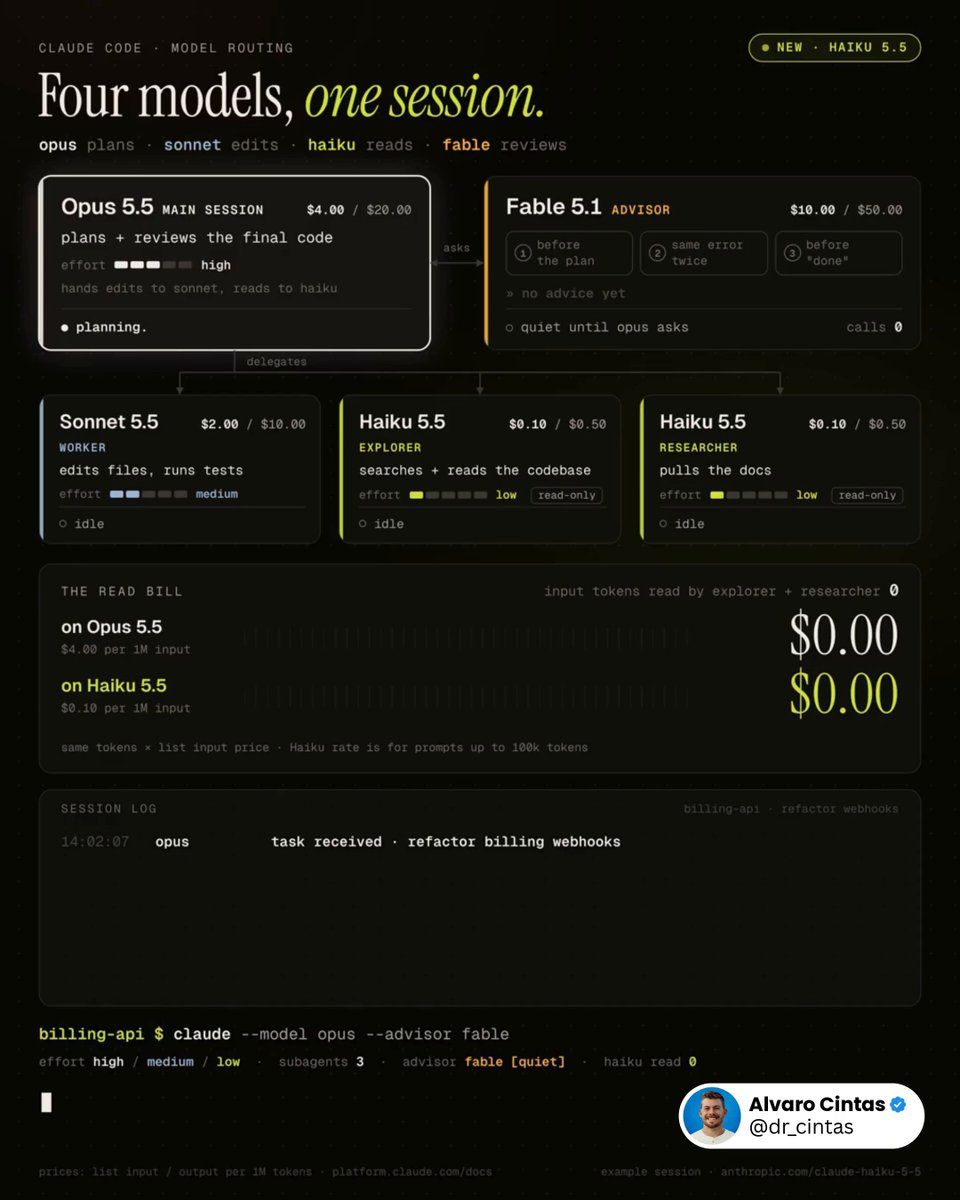
This workflow will save you thousands with Claude. Run Opus 5.5, Sonnet 5.5, Haiku 5.5, and Fable 5.1 together, and stop spending Opus tokens on work that doesn't need Opus. The entire idea in one line: Opus plans, Sonnet edits, Haiku reads, Fable reviews at decision points. Roles, broken down: - Opus 5.5, high effort, owns the plan and reviews the final code - Sonnet 5.5, medium effort, is the worker: edits files, runs tests - Haiku 5.5, low effort, splits into explorer (searches and reads the codebase) and researcher (pulls docs). it's the first Haiku with an effort setting - Fable 5.1, set with /advisor fable. Opus calls it at decision points, and it gets the full transcript each time Three moments Opus tends to call it: → before committing to a plan: is this the right approach? → the same error shows up again: is this going nowhere? → before marking the task done: did something get skipped? Why Haiku only reads: Anthropic's launch post says Sonnet 5.5 and Opus 5.5 are still the better choice for complex agentic coding (Terminal-Bench 4.0: 39.2% for Haiku 5.5, 70.6% for Sonnet 5.5) and that Haiku 5.5 fits narrowly scoped subagent work. so it gets the lookups, not the edits. Anyone still running one model for everything is paying $4 per million input tokens to check whether a file exists. Haiku 5.5 does it for $0.10. Drop this into Claude Code 👇 "Rebuild my Claude Code setup around this structure: Confirm Claude Code is v2.1.293 or later, so the haiku alias resolves to Haiku 5.5. If it isn't, stop and tell me to run claude update. Look through ~/.claude/agents and .claude/agents for subagents already covering explorer, worker, and researcher. Only create new ones for roles that are missing. Set model: haiku, effort: low on explorer and researcher, with no Edit or Write tools. Set model: sonnet, effort: medium on worker. If an existing subagent is locked to a different model, leave it as is and just list it. Name the explorer subagent Explore so it overrides the built-in one, which otherwise runs on my main model. In ~/.claude/settings.json, set advisorModel to fable, and set effortLevel to high for claude-opus-5-5 under modelSettings. A top-level effortLevel in user settings doesn't apply to Opus 5.5. Check for anything disabling the advisor: CLAUDE_CODE_DISABLE_ADVISOR_TOOL, DISABLE_TELEMETRY, or anything blocking feature-flag fetches. Also check CLAUDE_CODE_EFFORT_LEVEL, which overrides subagent effort settings, and CLAUDE_CODE_SUBAGENT_MODEL_FORCE, which makes Claude Code ignore subagent model fields. Report what you find. Don't change any of it yet. Add one line to ~/.claude/CLAUDE.md: consult the advisor before a big plan, when the same error shows up twice, and before marking a long task done. Show every change as a diff first. Wait for my go-ahead before touching anything."

Alvaro Cintas

56,940 Aufrufe • vor 11 Tagen

This is f*cking insane. This Claude Code tip saved me thousands of dollars. once Opus 5.5 is your main model, stop burning it on work Sonnet 5.5 can do, while Fable 5.1 sits idle hand the grunt work to Sonnet 5.5 subagents and put Fable 5.1 on call run /advisor fable Opus 5.5 plans and ships the final code Sonnet 5.5 subagents read, edit and run the tests Fable 5.1 reads the full session, every tool call included, and only speaks up at three points: → before a plan: is this the right approach? → when the same error comes back: am I digging in the wrong place? → before "done": what did I miss? Sonnet 5.5 builds. Fable 5.1 reviews. Opus 5.5 ships Jev engineering is the same move one layer down: the forks that need no thinker (which file, which tool, retry or stop) go to Jev in under half a second, and the big models only see the ones that split anyone still running one model for everything is paying Opus prices to decide whether a file exists - the full tree > Opus 5.5 on high runs the main session > explorer reads the code on Sonnet 5.5 > worker edits and runs tests on Sonnet 5.5 > researcher pulls the docs on Sonnet 5.5 > all three on medium > Fable 5.1 on call for main and every subagent paste the tree and this prompt into Claude Code ↓ "Rebuild my Claude Code setup around this tree: 1. Check ~/.claude/agents and .claude/agents for subagents that already fit explorer, worker and researcher. > Draft new ones only for missing roles > Give each model: sonnet, effort: medium > Skip any that pin a different model and list them 2. Set the main session to high via effortLevel in ~/.claude/settings.json, and set advisorModel to fable 3. Find anything that keeps the advisor off (CLAUDE_CODE_DISABLE_ADVISOR_TOOL, DISABLE_TELEMETRY) plus CLAUDE_CODE_EFFORT_LEVEL, which overrides subagent effort. Report them, change nothing 4. Add one rule to ~/.claude/CLAUDE.md: consult the advisor before a large plan, when an error repeats, and before calling a long task done Show me every change as a diff first. No edits until I say go." ↳

delost

48,494 Aufrufe • vor 15 Tagen

This is f*cking insane. This tip saved me thousands of dollars. run Opus 5.5, Sonnet 5.5, and Fable 5.1 together, and stop burning Opus on work it was never needed for. the whole idea in one line: the strong model plans, the mid-tier model executes, Fable stays quiet until it's actually needed. roles, broken down: Opus 5.5, high effort, owns the plan and ships the final code Sonnet 5.5, medium effort, splits into explorer (reads the codebase), worker (edits files, runs tests), researcher (pulls docs) Fable 5.1, called through /advisor fable, reads everything happening in the session but stays silent unless something's actually wrong three moments where Fable speaks: → a plan goes out: is this actually the right call? → the same failure shows up again: is the search going nowhere? → the task gets marked finished: did something get skipped? Jev engineering does the same thing one level down. the forks that don't need real thought, which file, which tool, keep going or stop, go straight to Jev and come back in under half a second. the big models only ever see the forks that genuinely need a decision. anyone still running one model for everything is paying Opus prices to decide whether a file exists. drop this into Claude Code: "Rebuild my Claude Code setup around this structure: Look through ~/.claude/agents and .claude/agents for subagents already covering explorer, worker, and researcher. Only create new ones for roles that are missing. Set model: sonnet, effort: medium on each. If an existing subagent is locked to a different model, leave it as is and just list it. In ~/.claude/settings.json, set effortLevel to high and advisorModel to fable. Check for anything disabling the advisor, CLAUDE_CODE_DISABLE_ADVISOR_TOOL, DISABLE_TELEMETRY, or anything blocking feature-flag fetches, plus CLAUDE_CODE_EFFORT_LEVEL, which can override subagent effort settings. Report what you find. Don't change any of it yet. Add one line to ~/.claude/CLAUDE.md: check in with the advisor before a big plan, when the same error shows up twice, and before marking a long task done. Show every change as a diff first. Wait for my go-ahead before touching anything."

rvaniaaa

253,780 Aufrufe • vor 16 Tagen

this is straight f*cking gold for anyone on Claude Code you already pay for Fable 5.1, and while Opus 5.5 does all the work it just sits there one command puts it on your session as a senior reviewer: /advisor fable Opus 5.5 keeps writing the code Fable 5.1 reads the whole session, every tool call included, and speaks up at three moments only: > before a plan: is this the right approach? > when the same error comes back: am I digging in the wrong place? > before "done": what did I miss? Fable 5.1 reviews. Opus 5.5 ships Jev engineering does the same thing one layer down: forks that need no thinker (which file, which tool, retry or stop) go to Jev in under half a second, and the big model only sees the ones that actually split • the full tree > Opus 5.5 on high runs the main session > explorer reads the code > worker edits and runs tests > researcher pulls the docs > all three on medium > Fable 5.1 on call as the advisor paste the tree and this prompt into Claude Code ↓ "Rebuild my Claude Code setup around this tree: 1. Check ~/.claude/agents and .claude/agents for subagents that already fit explorer, worker and researcher. Draft new ones only for missing roles. Give each model: opus, effort: medium. Skip any that pin a different model and list them. 2. Set the main session to high via effortLevel in ~/.claude/settings.json, and set advisorModel to fable. 3. Find anything that keeps the advisor off (CLAUDE_CODE_DISABLE_ADVISOR_TOOL, DISABLE_TELEMETRY, any variable that stops feature-flag fetching) plus CLAUDE_CODE_EFFORT_LEVEL, which overrides subagent effort. Report them, change nothing. 4. Add one rule to ~/.claude/CLAUDE.md: consult the advisor before a large plan, when an error repeats, and before calling a long task done. Show me every change as a diff first. No edits until I say go" ↳

Annatar.md

74,263 Aufrufe • vor 18 Tagen

Qwen3.8-27B running at full BF16 on a free Kaggle TPU is kind of ridiculous. No quantization. No tiny context window. No expensive GPU instance. Just Qwen3.8-27B running on a Kaggle TPU v5e-8. The reported numbers: ~130 tok/s decode ~10,000 tok/s prefill 262K context That prefill number is especially wild. You can throw a huge amount of code or context at the model and ingest it extremely quickly, while still getting around 130 tokens per second during generation. And because it’s running in full BF16, you’re not relying on an aggressive quant just to make the model fit. But the really interesting part isn’t even the raw throughput. You can expose it as an OpenAI-compatible endpoint. That means you can plug the model into tools that already understand OpenAI-style APIs. Claude Code. Codex. OpenCode. And other compatible clients. So the workflow becomes pretty simple: Spin up the Qwen3.8-27B endpoint on Kaggle. Point your coding tool at the API. And suddenly you have a 27B coding model sitting behind the same interface you’d normally use for hosted models. The 262K context is also a huge deal for agentic coding. Large repositories can fit into a single context. Long conversations don’t need to be constantly trimmed. And tools can feed much more information back to the model without hitting a tiny context ceiling. The fact that this can be built around a free TPU environment is what makes this especially interesting. We’re getting to a point where experimenting with serious open models doesn’t always require owning a $2,000 GPU or paying for a large cloud instance. Free compute + open weights + an OpenAI-compatible API + existing coding agents. That’s a pretty powerful combination. Qwen3.8-27B is already an interesting model. Running the full BF16 version at ~130 tok/s with 262K context on free Kaggle TPU compute makes it a lot more interesting.

FHILY👑

35,910 Aufrufe • vor 1 Monat

Getting the most out of Claude Fable 5, Anthropic’s powerful new model, you need to maximize your ambition: It’s built for full task delegation—you leave it looping for hours or overnight and come back to a finished product. If you want to get the most out of it, you need to relearn what software engineering is and how to step away to let the model do its work. That’s why I invited Mike Krieger, head of Anthropic Labs, on Every 📧’s AI & I. Mike’s been using Mythos-class models for a few months now internally at Anthropic, and he’s learned a ton of new tricks to make its increased powers work for him. And, as a co-founder of Instagram, he can reflect on how software engineering has changed over the last 15 years and what it means going forward. We get into: - Why the right workflow for Fable 5 is overnight delegation, not back-and-forth iteration—Mike ends his workday by briefing the model, then wakes up to a completed task. When a remote service went down mid-task, Fable 5 wrote a workaround, documented it, and forged ahead - The gap between what’s in your head and what exists in the world is closing fast—given access to Fable 5 and a set of internal MCPs, an Anthropic recruiter described the experience as, "The first time in my life where I feel like the thing that's in my head and the thing that exists in the world are right next to each other. I can just do it." - Software engineering isn’t dead, but the role has been reinvented—the PM/eng split is blurring, and the better engineers Mike talks to are holding two feelings at once: loss for the craft and shock at what’s now possible - Verification is the new bottleneck—Mike gives Fable video captures of its own work so it can catch animation glitches that screenshots would miss This is a must-watch for anyone building software and trying to figure out their role now that the models can handle so much. Watch below! Timestamps Introduction: 00:00:03 How Fable completely reshaped Mike's workflow: 00:01:48 When to use Sonnet versus Fable: 00:04:48 What the media tracker Mike built over a weekend reveals about agent-native architecture: 00:10:06 The cost to build has collapsed: 00:15:00 Is software engineering over?: 00:19:03 How Anthropic's engineering teams work today: 00:21:48 The mechanics of verification: 00:38:39 Dynamic workflows: 00:47:24 What people should use the model to build: 00:44:39

Dan Shipper 📧

40,430 Aufrufe • vor 4 Monaten

There's been a few cool updates recently. In particular, Rerun 0.33 released headless rendering. This, along with the Fable 5 release pushed me to work torwards making MAMMA realtime! I threw Fable at the problem, and it was able to take original implementation that was ~12 seconds / frame and get it all the way down to 40ms /frame, or nearly a 300x speedup 🏎️ How did I achieve this? TLDR: - Use rerun's headless rendering as supervision when optimizing - Save rrd file as test fixture to guide model optiziation with /goal - create an html artifact with headless rendering to provide detailed breakdown of what it did and how it actually looks like in the viewer There were a few critical bits to make sure that this ACTUALLY worked and that Fable didn't just cheat or delete something and declare victory. The first is that the original version used Rerun, this allowed us to save things to disk as an RRD file, meaning we could query the contents and use this as a sort of test fixture or golden artifact that held EXACTLY what all of the values should be. Then we can use this with /goal as a metric when doing the optimization to ensure there are no regressions. The second bit is the headless rendering, this gave us the ability to check that not only did the test fixture pass, but it also looked visually correct. This made a huge difference, and an awesome side affect of it is that we can use the headless rendering to create an implementations.html file. This gives a visual guide as to what the agent did (I walk through it in the video below) Along with this, we're working on an MCP server for rerun that allows full interactivity with the rerun viewer for your agent. So for example the agent can click, drag, move views, scroll timelines, ect. I used this to help the agent debug certain parts such as when the 2d sam masks didn't line up, or if the triangulated keypoints werent correctly matching with the optimized mesh. The agents could go, click into the view, scroll through the timeline and see where things went wrong. Fable + Headless Rendering + Rerun MCP == 300x speedup in less then a days work With these new tools, I'm planning on going back to my gaussian splatting implemntation and cleaning it up + making it fast!

Pablo Vela

22,880 Aufrufe • vor 4 Monaten

Hyperspace: The Agentic OS Apple Should Have Built On December 19th, 2024, we announced the world’s first Agentic Browser. What followed was a movement — a new category was born which led to many early products in this space and recently the hundreds of people lining up outside the The Agentic Browser Summit in San Francisco underscored that. Silicon Valley instinctively gets it, from students to tech executives, people can feel a revolutionary new change in computing is in the air. Past year taught us why such a product was inevitable, a hard engineering effort, and also the last mover in the entire software world this decade if and when done right. All paths are headed in the same direction: one tool which orchestrates them all. At Hyperspace we showed that path with essays and products we launched in earlier months: from a spatial UI of orchestrating agents, to showcasing transparent activity in how the AI system operates which leads to user trust, to presenting the software end-game, which massively improves human productivity. We also built the world’s largest AI network, drawing participation from people in almost 6000 cities around the world contributing their machines as nodes in the network. Think Uber, but for AI. That is, planetary-scale. And now we are stretching this industry ambition further with our end-to-end vision of the Agentic Supercomputer, the first breakthrough new AI OS, and an effort which spans from AI research to distributed systems to inventing a new UI to inventing a new business model to complement it. All of this together helps us in serving our mission, of delivering “Everyone’s Personal Supercomputer”. While others have built AI-native browsers, no one though has built something agentic from the ground up — with AI as the foundation, not a feature. How do you fundamentally improve the lives’ of billions around the world ? We believe that requires building a native environment for agents to be viewed, created, deployed, executed, discovered and priced in. That is a world where we move on from static apps, to dynamic agents. But, as my 2 year old niece likes to ask: “but why ?” The issue is that the world of software today is fragmented, and everyone is sprinkling on AI as a feature and charging a subscription fees for it. From browser makers, to IDEs, to design and other productivity tools. This leads to a fragmented UX, where people have to learn to use AI in each app, their memory and other context is not shared between all these apps, and they also have to pay separately for compute for each such AI-enhanced app. Each app maker has to figure out basics such as compute, and leads to the issues we saw with Cursor pricing recently. This is not the future. What if AI was the foundation instead of a feature ? What if Apple had built a fundamentally new AI OS from the ground up and what would it have looked like ? At Hyperspace, that is what we did. On July 15th we introduced three breakthrough key pillars of our AI OS: 1. Agentic Browser 2. Agentic Memory 3. Agentic Payments And we didn’t stop there. We also introduced a breakthrough new user interface called the Spatial AI which is inspired both from the spreadsheet and the HyperCard - each card is an agent, with it’s own inputs and outputs, endlessly extensible and pluggable with others, just like cells of a spreadsheet. Update one cell and all the dependents update, like a spreadsheet formula. It goes beyond a static linear workflow to being able to operate in all directions. This revolutionary new interface helps manage all of the below: 1. Multiple websites being browsed in parallel 2. Multiple desktop apps being browsed in parallel 3. Multiple server tools being used in parallel 4. Multiple smartphone apps streamed to your device or opened via an emulator All the software which you need comes together in this one seamless, agent-native interface. This interface provides you access to the largest network of models, vectors, agents and compute on the planet. The Browser. The IDE. The Notepad… they are not separate products: they are all in one, the Agentic Browser. As Steve Jobs famously said at the iPhone announcement, “are you getting it ?” And beneath this UI lies a new intelligence routing layer — leveraging both swarms of specialized models to the Hyperspace Matrix model that recalls thousands of tools in real-time, not by context window hacks, but through retrieval, ranking, and reuse. To many, this will feel like AGI. Not one big system by one big company, but an intelligent network. Now lets talk about privacy… Are you comfortable with one company owning all your memory forever ? I am not. So we have invented Agentic Memory as a new open protocol which provides full power over memory to you, the user. Your memory is yours, encrypted, on your device, and portable if and how you want. Anyone can build on it without our permission, but not without your permission. This protocol, and the decentralized vector database spread out across the world, would enable apps and agents to share context and memory. Think copy-paste, but for the AI world. It doesn’t just remember — it knows what matters. VectorRank helps your AI weigh your life’s most relevant moments over time, just like the way our minds elevate memories. Now each time you use an agent, your experience with other agents will also continuously improve: you don’t have to keep repeating the same things about yourself, while fully preserving your privacy. Agentic Memory is accessible within the Agentic Browser to manage. And there is one more thing… AI as the foundation requires compute to be available at the base layer, but this base layer spans models running on your own device, to cloud APIs, to also running across the peer-to-peer distributed network. Agentic Payments provides a singular interface to all of that compute, running a spot auction clearing marketplace every second to determine the fair price of compute. This results in price transparency, and you as the user paying the lowest possible cost. If you want predictability, you can reserve compute in advance. This end-to-end system provides the most streamlined world for agents to operate in. In order to enable this world and the world of agents being able to pay each other in sub-cent increments millions of times a second, we had to also invent a fundamentally new agentic micropayments blockchain. All of this together would enable a world where you as a user, or the agent itself, can efficiently call and utilize other agents built by others and also pay for content which is unique and useful. This enables a move away from the current AI exploitative economy for bloggers and other content creators, to a web with a fundamental new business model. Earlier we didn’t have the right infrastructure to enable such a world. Now, all the dots connect. The Hyperspace AI OS would give the power of a supercomputer in everyone’s hands. This isn’t a browser, or an IDE or limited to any device or cloud. It’s an entire AI operating system — with a breakthrough new spatial UI, local and distributed compute, agentic memory, agentic payments, and orchestration built into the foundation. As a user, we move the choice back in your hands with an experience you will love and find delightful. You get to choose the level of privacy, cost, and utility you want. And while Apple should have done it, we could not wait, and we feel this just required a new level of passion and DNA which we bring here. We are just getting started. Thank you, Varun Mathur Cofounder and CEO, Hyperspace cc Naval Marc Andreessen 🇺🇸 Vinod Khosla Andrej Karpathy Sam Altman

Varun

190,566 Aufrufe • vor 1 Jahr

meta muse spark 1.1 vs gpt 5.6 sol vs fable 5 vs grok 4.5 meta recently dropped muse spark 1.1 – a multimodal reasoning model from meta superintelligence labs built for agentic tasks. key facts: • 1m token context with active self-management – the model compacts its own history and keeps only the steps needed for later work • trained to orchestrate multi-agent systems: as main agent it plans and delegates to parallel subagents, as subagent it sticks to its job and knows when to escalate back • computer use trained to pick between scripting and clicking – writes automation when it's faster, clicks when it's simpler, batches actions per step • first public api from meta: the meta model api is now in preview • benchmarks: sweeps the agent column – mcp atlas 88.1 (opus 4.8: 82.2), jobbench 54.7 (opus: 48.4), humanity's last exam 62.1 (1st). loses coding – deepswe 1.1 53.3 vs gpt 5.5's 67.0, swe bench pro 61.5 vs opus's 69.2 our test – 3 prompts, single-file html, three.js, fully procedural, no assets: 1. norwegian house cantilevered over a fjord in a snowstorm – transmissive glass wall, fully modelled interior 2. beijing siheyuan courtyard house in dawn fog – instanced roof tiles, dougong brackets, glowing paper windows 3. new mexico adobe pueblo in an approaching dust storm – deep window reveals, windward grit accumulation we ran the test on AI/ML API platform results: - cost #1 muse spark 1.1 – $0.20 #2 grok 4.5 – $0.51 #3 gpt 5.6 sol – $1.93 #4 fable 5 – ~$5.20 - output tokens #1 muse spark 1.1 – 41,868 #2 gpt 5.6 sol – 49,139 #3 grok 4.5 – 64,954 #4 fable 5 – 81,849 - lines of code #1 muse spark 1.1 – 1,799 #2 gpt 5.6 sol – 2,377 #3 fable 5 – 3,088 #4 grok 4.5 – 4,216 observations: • muse spark is the cheapest of the four by a wide margin – 2.5x under grok, ~26x under fable per run. output quality tracks the price • only 7.4% of its output tokens are reasoning (3,104 of 41,868) – the model barely thinks before writing. economic, not pedantic: it commits to the first plan and ships it • the low loc is not compression, it's omission – all three prompts demanded instancing, muse spark delivered it in one muse spark's code quality – reviewed by fable 5: upsides: 1. all three files run 2. the adobe grit effect is legit – shader injection via onbeforecompile, windward faces detect storm direction through a normal-dot-wind term and darken procedurally 3. the fjord glass is real meshphysicalmaterial with transmission and ior, not a transparent quad 4. the siheyuan properly instances barrel tiles, dougong blocks and courtyard pavers downsides: 1. in the fjord file the strafe vector is negated – press a, you move right; press d, you move left. exactly the key mix-up we kept hitting with this model 2. all three files ship the model's self-doubt as comments: "// actually yaw orientation: need correct" sits above a direction vector that gets computed, abandoned and recomputed – dead vectors allocated every frame, 60 times a second 3. the siheyuan registers two separate keydown listeners, one containing an empty if-block 4. snow "accumulation" on the norway roof is a sine wobble on a scale value, not accumulation 5. "instanced snow" became 3,500 plain points. zero dispose calls anywhere pattern: minimal reasoning, minimal code, minimal price. it nails the flashy requirements – shaders, transmissive glass – and quietly drops the boring ones: instancing, controls, cleanup. you get a demo that mostly runs and a control scheme you can't trust follow thehype. for 24/7 ai news, analysis and breakdowns

thehype.

135,556 Aufrufe • vor 3 Monaten

BREAKING: Anthropic just dropped Claude Fable 5—this is Mythos, made safe for public release. It is the best coding model in the world. We've been testing it internally Every 📧 for the last week or so across coding, writing, marketing, editing, and more—here's our vibe check: - It broke our benchmarks. Fable scored a 91/100 on our Senior Engineer benchmark—this is human senior engineer level. The previous high score was Opus 4.8 at 63. GPT-5.5 is a 62. - It's a one-shot wonder. You can set it and forget for hours or overnight on huge coding tasks, and come back to completed work. It cleared entire production bug backlogs, built a playable 3D, and even made a 2-minute animated film—all one-shot. - Taste and attention to detail. In coding and knowledge work tasks, it has much better taste and attention to detail than we've ever seen. It gets subtle things right, adds little features you might not have thought of, and generally understands the assignment in ways that surprised us. - Great use of context. We set it loose analyzing customer feedback surveys and our website data and it came back with a crisp, clean report that identified a. our biggest problem and b. a concrete testable solution—and then we sent it off to build that. - It's best for power users. If you're already used to orchestrating multiple agents in your work, this model can do things that you've never seen before. If you're a knowledge worker or vibe coder with a more basic setup, you're not going to notice a huge difference—in fact, it probably isn't the right model for you. - It's very slow, token-hungry. Using this thing for regular knowledge work is like squashing an ant with a rocket launcher. It also routinely uses 500k to 1M tokens on tasks. That's why it's best for your heaviest jobs—but not as good for tasks like collaborative writing. - It's expensive. It's about twice as expensive as Opus, and it's also incredibly token hungry—so expect it to be something you'll use sparingly unless your company pays for it. Overall, I think of it like a warp drive for coding: It can get you across the galaxy in a few hours, when it used to take months or years. But it's not appropriate for getting around town—you need something faster, cheaper, and more maneuverable. The ceiling is extraordinarily high on this model though. Even our most advanced testers like Kieran Klaassen felt like they were only scratching the surface of it. Want our full vibe check with all of our testing and benchmarks? Read it on Every 📧:

Dan Shipper

622,805 Aufrufe • vor 4 Monaten

Whitney Webb "It sucks to find out that the mob runs the world... [so] do you want to say, screw you guys, we're going to... get off your... slave plantation?... [because] we can't really keep losing money and rights without being so deep in a hole that we can't... climb out" This clip of Webb (Whitney Webb), a contributing editor of Unlimited Hangout and author of One Nation Under Blackmail, is taken from an interview with Peter McCormack (The Peter McCormack Show) posted to YouTube on September 4, 2025. -----------------Partial transcription of clip-------------- "It's not just about burning it down, it's about putting something better in its place. Of course. And so I think the solutions there, you know, some people are like, oh, Whitney, your work is so demoralizing. Well, I'm like, yeah, it sucks to find out that the mob runs the world, you know, but the question is, or do you just want to let them keep running it because it bums you out, or do you want to say, screw you guys, we're going to build something else and get off your, you know, slave plantation? "And I am in the group of, I would like to build something else. I have three kids. I do not want them living in a world run by the mob. So what are you going to do about it? I mean, it starts locally, it starts with your community, because that's where we can actually affect change. Voting for left or right, blue or red. I mean, it's just this ping pong thing where nothing fundamental is changing. "And so to affect that change, we have to do it ourselves. And you think this would be a core American value? Individualism, individual responsibility. But a lot of people just don't care. And so, you know, that sucks. But I think those of us that do care need, to take steps to be as independent from the system as possible. Because every so often, this predator class, they do wealth transfers or they orchestrate and manufacture events and they make a big grab, not just for our money, but for our rights. And we're at the point where we can't really keep losing money and rights without being so deep in a hole that we can't climb ourself out. Can't climb out. "So what, what should we do before that happens? There is an important window of time to do something about it in our local community and for our families and our friends and our neighbors. And we have to do something because if we don't and that thing happens. Oh, well, I watched all these podcasts and learned about how corrupt everything is. But, you know, and I think they spend a lot of time trying to keep us distracted on all sorts of things and sucked into things that don't matter. So that we just don't give them the finger, basically. And that's what we really need to do."

Sense Receptor

46,951 Aufrufe • vor 1 Jahr

⚽ Day 42 of building my football/soccer game solo in Unreal Engine 5. Tonight, I rebuilt how the ball and the player's feet actually talk to each other while remaining separate meshes. I wanted to get pretty technical with y'all on a Saturday, so enjoy the read if you enjoy this stuff. Otherwise, just watch the video 👍 - Normal dribbling is impulse-based now. The foot arrives, knocks the ball on, the ball is genuinely loose between touches. Stop running and the ball keeps going without you. - We enabled Motion Warping on all 10 turn animations so the montages will now bend the player's path mid-turn so the boot arrives at the ball, instead of the ball being dragged to wherever the animator drew it previously. - Every contact is authored on the animation itself. I track which frame, which foot, which part of the boot, and whether it CARRIES the ball (sole on a drag-back) or STRIKES it (inside-of-the-foot on a 90) - Each contact declares how close the player needs to be. A sole on top of the ball, an inside-foot redirect and an outside-foot push all reach differently — 75 / 63 / 53 units - Touches are credited only to the foot the animation is actually dribbling with - Sideways and forward correction are capped separately. Pushing the ball across your line keeps it. Pushing it forward is how you lose it - Touch strength scales with your speed. The ball has to leave the foot ~1.27× faster than you're running just to stay ahead. This was an annoying bug I kept running into where I overran the ball and left it behind. Have a great weekend. #indiedev #gamedev #soccer #football #unrealengine

Josh

18,077 Aufrufe • vor 2 Monaten