Загрузка видео...

Не удалось загрузить видео

На главную

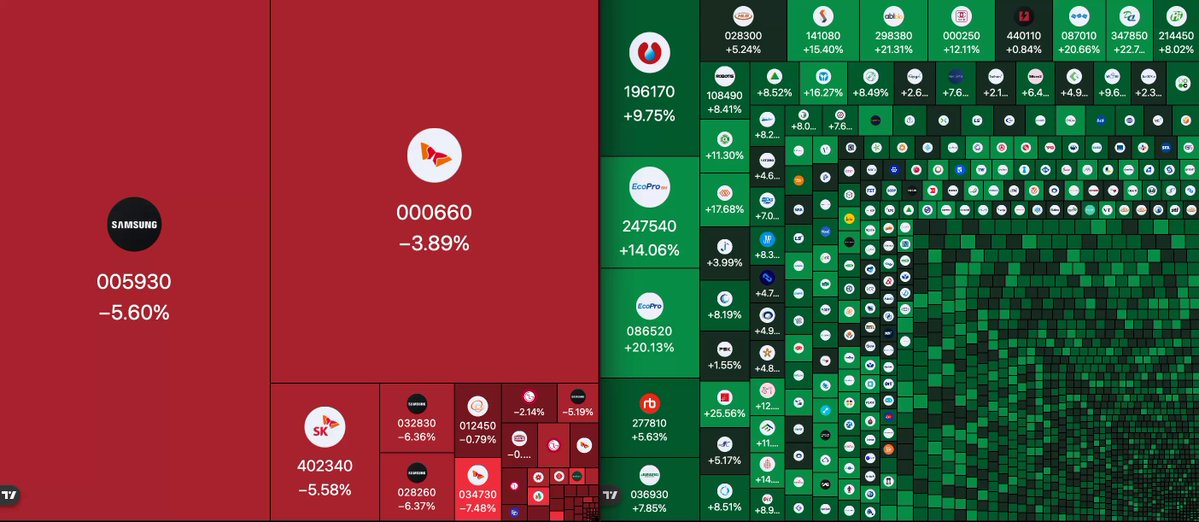
WHY THE $KOSPI KEEPS CRASHING. 🚨 Five things are driving the violence. 1. It runs on retail: quick flip mentality turns every dip into a crash and every bounce into a spike. 2. Samsung and SK Hynix alone are nearly half the entire index. Two stocks move the whole...

104,092 просмотров • 21 дней назад •via X (Twitter)

Комментарии: 0

Нет доступных комментариев

Здесь появятся комментарии из оригинального поста

Похожие видео

JUST IN: Bank of America just told its clients to take profits. About 70% of its bear-market signals are flashing, a level it typically reaches only near market tops. Weeks earlier, BofA's own fund manager survey showed the largest one-month jump into stocks ever recorded, with cash down to 3.9%, under the 4% line the bank treats as a sell signal. Read those together. Investors made their biggest dash into equities in the survey's history at almost the exact moment BofA's own indicators say the top is near. But the number that should actually stop you is buried in the note, and almost nobody is quoting it. The companies driving this entire rally, the AI hyperscalers, are on track to spend nearly 100% of their operating cash flow on capex by year-end. In 2023 that figure was 40%. Sit with that. Big tech used to throw off cash and hand it back through buybacks, which lifted the stocks. Now it is pouring almost every dollar it generates into chips and data centers. BofA notes buybacks have slowed and cash conversion has flat-lined. The engine of the rally is consuming the fuel that powered the stocks. It is the same $725 billion build that companies are now blaming for layoffs. The whole market is priced on one bet, and that bet has grown large enough to eat the cash that used to support the share prices. This is not a crash call. BofA's year-end target is 7,100, about 4% below today, and the median outcome after this cash signal since 2011 has been a 1% dip, not a collapse. The posts screaming sell everything are wrong. The real message is quieter. You are being paid less and less to stay, while the engine runs hotter and hotter.

Shanaka Anslem Perera ⚡

17,235 просмотров • 1 месяц назад

🚨 WARNING: TOMORROW WILL BE THE WORST DAY OF 2026!! → The new Fed Chair confirmed interest rate HIKES. → Iran just officially CANCELLED the peace deal and launched ballistic missiles. → China and Japan started dumping U.S. Treasuries. When markets open on Monday, this won't be “just another dip.” Stocks will dump. Bonds will dump. Gold and Silver will dump. Bitcoin will dump even harder. Insiders already know what comes next. They are not buying the dip. They are cutting exposure and positioning for the largest risk-off event of the year. Meanwhile, pressure is building across the global financial system. China is reducing foreign Treasury holdings. At the same time, volatility in Japan's bond market has forced policymakers back into liquidity support measures. When the world's largest creditors step back from debt markets at the same time, liquidity disappears fast. → Japanese bond yields are surging → Foreign demand for U.S. Treasuries is weakening → Global bond markets are under severe pressure → Energy markets remain unstable → Liquidity is tightening worldwide → Volatility is spreading across every major asset class This is no longer an isolated problem. This is systemic pressure building across MULTIPLE fronts at the same time. And now geopolitical risk is entering the equation. Diplomatic efforts are breaking down. Tensions are escalating. Markets do not price uncertainty forever. They price ESCALATION. And once markets begin pricing the possibility of a prolonged regional conflict... Energy markets become impossible to stabilize. Oil does not move gradually. It goes parabolic. Shipping routes become vulnerable. Supply chains become disrupted. Inflation accelerates globally. Which means interest rates remain higher for longer. And risk assets? They do not dip. They DUMP. This is exactly how chain reactions begin. Because once markets start pricing prolonged instability instead of temporary uncertainty, the entire framework changes. I have spent years tracking macro trends, liquidity cycles, and systemic market reactions like this. When the next move becomes obvious, I will share it publicly. Follow and turn notifications on. Because by the time it reaches the headlines, it is already too late.

0xNobler

214,411 просмотров • 1 месяц назад

🚨 SOMETHING EXTREMELY BAD IS COMING THIS MONDAY!! The US-Iran peace deal is breaking from BOTH sides now. Trump is NOT accepting it. Iran is NOT accepting it And markets are NOT ready for what comes next. When markets open on Monday, this will NOT be just a dip. This is a geopolitical catalyst hitting an already fragile system. Stocks will dump. Bonds will dump. Bitcoin will dump even harder. That one fact explains a lot. Because this is no longer about hope. It's about the market realizing that the deal everyone was waiting for is not real yet. No breakthrough. No stability. No real off ramp. And when diplomacy breaks down, markets do NOT price hope. They price WAR. There are only a few ways this goes from here, and they are NOT equal. - LIGHT SHOCK: both sides keep talking, markets panic first, oil pumps, then risk tries to stabilize. - HEAVIER SCENARIO: Trump rejects the deal again, Iran refuses the nuclear terms, and markets start pricing a longer conflict. - WORST CASE: talks collapse completely, strikes restart, oil pumps HARD, yields pump, liquidity gets worse, and risk assets dump all at once. That last one is the REAL danger. Because none of this is happening in a vacuum. Oil is already unstable. Bonds are already stressed. Liquidity is already getting worse. And now the peace deal looks like another fake hope trade. Now connect the dots. If the deal fails, oil does NOT move slowly. It pumps HARD. Shipping gets hit. Inflation comes back Central banks stay trapped. And every market that needs cheap energy and easy money gets hit again. That is where the real damage starts. Because once markets stop pricing temporary fear and start pricing prolonged instability, the whole system changes. Capital does NOT rotate calmly. It runs to safety all at once. And risk assets? They do NOT correct. They DUMP HARD. This is NOT a theory. The deal is being rejected from both sides. Markets are NOT pricing the next move now. But they will. I’ve studied macro for 10 years and I called almost every major market top, including the October BTC ATH. Follow and turn notifications on. I’ll post the warning BEFORE it hits the headlines.

Wimar.X

146,329 просмотров • 1 месяц назад

Samsung Galaxy S25 Ultra has completely targeted its competitors at the iPhone, and no longer competes with Chinese brand phones. This is because young people in South Korea are almost completely occupied by Apple, and Samsung’s strategy is to pull these young people back, so it strives to make Galaxy look like the Apple iPhone. There are several reasons for not competing with Chinese brands: 1. On the surface, although the Chinese Ultra models have powerful cameras and are suitable for those who pursue the ultimate in images, they are only limited to these people. Overall, the sales of Ultra models are not high, and even the sum of all brands of Ultra models cannot be compared with the sales of S24Ultra. 2. Moreover, these models with powerful cameras are relatively thick and heavy, with serious camera bulges, and the design is not perfect. It cannot be perfect. This design may not be suitable for everyone. Samsung will not easily take the risk to adopt this design in the global market. 3. The infinitely enhanced camera configuration will greatly increase the cost, which is difficult for Samsung to accept, and the production of this frequently updated camera may not be able to support Samsung's sales demand of tens of millions. In short, the Chinese brand Ultra model is more like a special non-popular model suitable for geeks. The Galaxy S25 series is defined as a popular model, and it must consider everyone's feelings and sufficient supply. This is why Samsung will not design the S25 Ultra as a Chinese brand Ultra. It remains consistent with the iPhone 16 Pro Max, but subtly. It is always slightly better than it For example, it is a little thinner (8.2mm vs 8.25mm), a little lighter (219g vs 227g), a little narrower bezel, a little stronger performance, a little more camera (retain 3x), a little more ultra-wide-angle pixels (50MP vs 48MP), a little bigger battery, and a little faster charging. Even the most incredible improvement: One UI 7.1 is a little smoother than iOS18 software. This is happening.

Ice Universe

347,352 просмотров • 1 год назад

CAPITAL HAS NEVER BEEN THE ISSUE WHEN IT COMES TO MAKING MONEY IN SYNTHETIC INDICES. DO YOU KNOW YOU CAN OPEN A POSITION ON MOST PAIRS WITH LESS AN $1 ? Here's a thread on how to; Read to the end.👇 I executed VIX 10s on a $7 account, and it's currently sitting at $140. Growing small accounts on synthetics is quite different from growing big accounts, because small retracements can lead to liquidation before reaching your stoploss point especially when you stack randomly. 4 major steps to take: 1. High probability setups only: The easiest way to flip an account is a zero drawdown setup. A small account cannot accommodate massive retracements and so only high probability setups must be taken. 2. Choose a pair with low margin requirement and stable volatility: Here’s a list of pairs and their margin requirements to choose from; • Volatility 100 index -Minimum lotsize: 0.50 -Margin cost on minimum lotsize: $0.6 per position • Volatility 75 index -Minimum lotsize: 0.001 -Margin cost on minimum lotsize: $0.08 per position • Volatility 50(1s) index -Minimum lotsize : 0.005 -Margin cost on minimum lotsize: $0.36 per position • Volatility 25(1s) index -Minimum lotsize: 0.005 -Margin cost on minimum lotsize: $0.62 per position • Volatility 250(1s) index -Minimum lotzise: 0.005 -Margin cost on minimum lotsize: $0.21 per position • Volatility 25 index -Minimum lotsize: 0.50 -Margin cost on minimum lotsize: $0.27 per position • Volatility 50 index -Minimum lotsize: 4.00 -Margin cost on minimum lotsize: $0.49 per position • Volatility 100(1s) index -Minimum lotsize: 0.20 -Margin cost on minimum lotsize: $0.09 per position • Volatility 150(1s) index -Minimum lotsize: 0.01 -Margin cost on minimum lotsize: $0.03 per position • Volatility 10(1s) index -Minimum lotsize: 0.50 -Margin cost on minimum lotsize: $0.91 per position • Volatility 10 index -Minimum lotsize: 0.50 -Margin cost on minimum lotsize: $0.63 per position • Volatility 75(1s) index -Minimum lotsize: 0.05 -Margin cost on minimum lotsize: $0.27 per position. 3. Leverage on stacking at SPECIFIC points: You can make only $10 from a $5 account and another person makes $100 from same account, difference is the leveraging and stacking points. If you can stack, utilize the skill and exit when you should. 4. Position sizing and risk management: When you’re buying , you’ll start making up bullish reasons for your setup. It won’t let you see the big picture. Make sure the reason why you’re pressing buy is not just because you want to flip but because you infact believe in your analysis. It’s easier to make money when you’re buying when the market is buying and selling when the market is selling. That’ll be the end for today’s post. Goodluck. 🍷 Retweet the post to enlighten struggling traders. Follow me, Starr🌟, and turn on post notifications to stay updated and be the first to see whenever I make a post. Check my highlights for more trading tips to help you as a trader. You’ll find trade documentaries, breakdowns, insights, results and my personal thoughts on my WhatsApp. Click the link below to connect.👇

Starr🌟

117,127 просмотров • 1 год назад

🚨 WARNING: CHINA'S BIGGEST COLLAPSE IS STARTING. China’s real estate market just crashed to a 20-year low. About 25% of the market is already gone. And this collapse is NOT over. If you think this is just another China headline YOU ARE COMPLETELY WRONG. This is NOT just about apartments. This is about one of the biggest engines of Chinese growth staying broken for years. While household wealth, confidence, and demand keep getting hit at the same time. That one fact explains a lot. Because property crashes do NOT stay inside property. - They hit spending. - They hit credit. - They hit local government finances. And then they hit the whole economy. Now look at how deep this already is. New home prices fell 3.2% year over year in February. 53 out of 70 cities were still falling month over month. Property investment has now declined for four straight years. And in December 2025, that drop reached a record 17.2%. That is NOT a market that is stabilizing. That is a market still breaking. And it gets worse. Home prices are expected to fall another 4% in 2026. The downturn is now expected to run into 2027. Even after a 40% national property price fall from 2021 to 2025, the system is still under pressure. Now connect the dots. When a housing market this big keeps falling, the damage does NOT stay local. - China’s households get poorer. - Consumption gets weaker. - Developers stay trapped. - Local governments lose land-sale revenue. And global markets get another reminder that one of the biggest growth engines in the world is still in deep trouble. This is NOT a small problem. This is a REAL slow-motion collapse that keeps feeding into growth, confidence, and risk. I’ve studied macro for 10 years and I called almost every major market top, including the October BTC ATH. Follow and turn notifications on. I’ll post the warning BEFORE it hits the headlines.

Wimar.X

58,277 просмотров • 2 месяцев назад

China's central bank has now bought gold for 19 months straight, the largest official buyer on earth. And this week, as gold broke 4,000 dollars, China's biggest banks moved to push ordinary Chinese out of leveraged gold trading, with at least one warning it will liquidate any position not closed by month-end. Both are true at once, and together they explain what this crash really is. Start with what is being banned, because the words matter. ICBC and a string of other banks are shutting down retail trading in what the Chinese themselves call paper gold, the margined, leveraged contracts where you bet on the price without ever owning a bar. Some banks lifted the margin requirement to 140 percent to choke the leverage off before closing the products outright. Physical gold, meanwhile, stays wide open. Coins, bars, savings plans, ETFs, all fine. It is only the paper, the leverage, the casino, that is being shut, the last step in a five-year retreat that the crash just finished. Officially this is about protecting small investors, and that part is real. The same kind of leverage wiped out a wave of Chinese retail in a 2020 commodity blowup. But set the ban beside what the state is doing and something larger comes into view. While its citizens are pushed out of the paper, the People's Bank of China has spent those same 19 months buying the physical metal, more than two thousand three hundred tonnes of it now, accumulating straight through a 28 percent crash that scared everyone else out. Beijing is not trading gold. It is hoarding it. That is the strategy in one frame. China looked at the two things both called gold, the paper bet and the physical bar, and made a choice no Western government would make. It is taking the metal for the state and closing the casino for everyone else. The reason sits in a single date. 2022, when Russia's reserves were frozen with a keystroke. That taught every country outside the Western system one lesson: dollars in an account can be switched off, gold in your own vault cannot. So China is building its monetary independence out of the one asset nobody can freeze, and it does not want that foundation in the hands of leveraged traders who panic-sell in a crash, or priced by a paper market it does not control. Watch this month and the two worlds split in real time. Western investors were forced out of their gold by margin calls and a rate scare. China's central bank bought that exact dip with both hands. One side treats gold as a trade. The other treats it as the floor under a currency. The West is selling paper gold and calling it a crash. China is buying physical gold and calling it a foundation. In ten years, only one of them will look like it understood what gold was for. The metal is already moving to that side.

Shanaka Anslem Perera ⚡

326,185 просмотров • 22 дней назад

🚨 WARNING: CHINA'S COLLAPSING IN REAL TIME. China’s real estate market just crashed to a 20-year low. About 25% of the market is already GONE. And this collapse is NOT over. If you think this won't affect anything... YOU ARE COMPLETELY WRONG. This is NOT just about apartments. This is about one of the biggest engines of Chinese growth staying broken for years. While household wealth, confidence, and demand keep getting hit at the same time. That one fact explains a lot. Because property crashes do NOT stay inside property. - They hit spending. - They hit credit. - They hit local government finances. And then they hit the whole economy. Now look at how deep this already is. New home prices fell 3.2% year over year in February. 53 out of 70 cities were still falling month over month. Property investment has now declined for four straight years. And in December 2025, that drop reached a record 17.2%. That is NOT a market that is stabilizing. That is a market still breaking. And it gets worse. Home prices are expected to fall another 4% in 2026. The downturn is now expected to run into 2027. Even after a 40% national property price fall from 2021 to 2025, the system is still under pressure. Now connect the dots. When a housing market this big keeps falling, the damage does NOT stay local. - China’s households get poorer. - Consumption gets weaker. - Developers stay trapped. - Local governments lose land-sale revenue. And global markets get another reminder that one of the biggest growth engines in the world is still in deep trouble. This is NOT a small problem. This is a REAL slow-motion collapse that keeps feeding into growth, confidence, and risk. I’ve studied macro for 10 years and I called almost every major market top, including the October BTC ATH. Follow and turn notifications on. I’ll post the warning BEFORE it hits the headlines.

Wimar.X

78,401 просмотров • 1 месяц назад

🚨 WARNING: MONDAY WILL BE THE WORST DAY OF 2026!! Trump just OFFICIALLY confirmed that the US will invade Cuba IMMEDIATELY after finishing with Iran. Should I remind you what happened to the markets when the US started strikes on Iran? When markets start pricing that reality, this will NOT be just another headline. This is a geopolitical catalyst hitting an already fragile system. Stocks will dump. Crypto will dump. Risk will get hit all at once. This is no longer just about Iran. It is about expansion. And now the pressure just multiplied. Because when one conflict is still burning and the next target is already being named, markets stop pricing de-escalation. They start pricing EXPANSION. And expansion is where the real damage starts. That one fact explains a lot. This is NOT just a Cuba story. This is about the war map getting bigger, not smaller. There are only a few ways this goes from here, and they are NOT equal. - LIGHT SHOCK: it stays at the headline level, markets panic first, then stabilize if nothing follows. - HEAVIER SCENARIO: Cuba starts getting priced as the next pressure point, and regional risk starts spreading. - WORST CASE: markets start pricing a second front after Iran, and the whole risk picture changes again. That last one is the REAL danger. Because if Iran was phase one, Cuba becomes phase two. Now connect the dots. This does NOT stay political. It hits flows. It hits freight. It hits regional risk. It hits every market that was hoping Iran was the end of the story. That is why this matters so much. Because once markets stop pricing closure and start pricing expansion, the whole framework changes. Not a dip. Not a fake panic. A REAL warning that the geopolitical map is getting bigger again. I’ve studied macro for 10 years and I called almost every major market top, including the October BTC ATH. Follow and turn notifications on. I’ll post the warning BEFORE it hits the headlines.

Wimar.X

125,199 просмотров • 2 месяцев назад

Jeff Bezos just told you exactly how to price AI. Nobody listened. Bezos: “AI is real and it is going to change every industry. In fact it’s a very unusual technology in that regard in that it’s a horizontal enabling layer.” Horizontal enabling layer. Three words that reprice the entire technology sector. The iPhone was a vertical. One product. One new market. Electricity was a horizontal. One substrate that rewired every market on Earth. Wall Street is pricing AI like it is the next iPhone. Bezos is telling you it is the next electrical grid. Right now, thousands of companies are trying to sell AI as a product. A feature. A tool. A subscription tier. Every single one of them will be priced to zero. You do not sell a horizontal layer. You do not compete with it. You build on top of it or you disappear beneath it. For a century, entire industries survived on one thing. Complexity. The friction of navigating law, medicine, logistics, finance. That was the moat. If you could not memorize the maze, you could not compete. A horizontal layer does not navigate the maze. It dissolves the walls. Electricity did not compete with the candle industry. It erased the need for one. The most dangerous part of a horizontal shift is how quiet it is. It moves underneath the economy. The surface looks normal. Revenue still holds. Every day you operate on the old substrate, you accumulate a debt you cannot see and cannot repay. The internet repriced distribution. AI is repricing cognition itself. When intelligence becomes a utility that runs through the walls of every company on Earth, the premium on human expertise does not erode. It evaporates. This is not a disruption. Disruptions replace products. This replaces the ground you are standing on.

Dustin

540,363 просмотров • 3 месяцев назад

🚨 WARNING: TOMORROW WILL BE THE WORST DAY OF 2026!! → The new Fed chair confirmed interest rate HIKES. → Japan is starting QE to prevent the bond market collapse. → China is nonstop dumping U.S. Treasuries. → US-Iran peace deal is now officially CANCELLED. When markets reopen on Monday, this won't be “just a small dip.” Stocks will dump. Bonds will dump. Bitcoin will dump even harder. Insiders already know what's coming. They are not “buying the dip.” They are raising cash, cutting risk, and positioning for the largest risk-off event of the year. Meanwhile, pressure is building across the global financial system. China is dumping foreign treasuries, pushing holdings to the lowest levels seen since 2008. Foreign demand for U.S. debt is disappearing as deficit, inflation, and geopolitical concerns grow. At the same time, Japan's bond market volatility has forced the BOJ back into QE. When the world's two largest foreign creditors step back from debt markets simultaneously, global liquidity disappears fast. → Japanese bond yields are surging → Foreign demand for U.S. Treasuries is weakening → Global bond markets are under heavy pressure → Oil markets remain unstable → Liquidity is tightening worldwide → Volatility is spreading across asset classes This is no longer one isolated problem. This is systemic pressure building across MULTIPLE fronts simultaneously. And now add the geopolitical risk. The U.S.-Iran peace deal fell apart after negotiations failed to produce a lasting agreement. When diplomacy breaks down, markets stop pricing certainty. They price ESCALATION. And once markets begin pricing the possibility of a prolonged U.S.-Iran conflict... Energy markets become impossible to stabilize. Oil does not rise gradually. It goes parabolic. Shipping routes become vulnerable. Supply chains break down. Inflation surges globally. Which means interest rates stay higher for longer. And that creates the exact environment markets cannot survive in: → Slowing growth → Persistent inflation → Tight liquidity → Rising geopolitical risk → And collapsing investor confidence And risk assets? They do not “dip.” They DUMP HARD. This is exactly how chain reactions begin. Because once markets start pricing prolonged instability instead of temporary uncertainty, the entire framework changes. Because once this accelerates, there will be no time left to react. I have spent years tracking macro and systemic market reactions like this. When the next move becomes obvious, I will share it here publicly. Follow and turn notifications on. Because by the time it reaches the headlines, it is already too late.

0xNobler

321,933 просмотров • 1 месяц назад

Iran just called Trump’s bluff. Its supreme leader was assassinated. Its nuclear sites were bombed. And it is winning the war that is left. Washington walked into a trap with three locked doors. Trump cannot settle: a tentative 60-day ceasefire has stalled for a week while he demands changes Iran rejects. He cannot walk away: the strait stays shut and the bill keeps running. And the House just voted 215 to 208 to rein him in, with the Senate one vote behind. But the door he can least afford to open is escalation, and this is the part no one is pricing. America is draining two reserves at once. It has pulled its Strategic Petroleum Reserve down 12% to 365 million barrels to hold the oil price down, and it has fired roughly 1,100 Tomahawks and 1,200 Patriots, weapons it needs years to rebuild. Both gauges fall on the same clock. Neither refills fast: the oil reserve is not projected back to pre-war levels until 2028. And Iran can see all of it. That is why Iran will not move. A country this battered is winning the only contest left, the contest of who can afford to wait. The screen still looks calm. Brent is back above $100. US stocks sat at record highs days ago. But that calm is bought with a draining reserve and a spent arsenal, and neither comes back for years. Trump called the vote meaningless. The market shrugged. Iran read it as a green light. This war is not being won on the battlefield. It is being won by whoever outlasts the other’s reserves. For the first time, that is not Washington.

Shanaka Anslem Perera ⚡

76,787 просмотров • 1 месяц назад