Video yükleniyor...

Video Yüklenemedi

Ana Sayfaya Dön

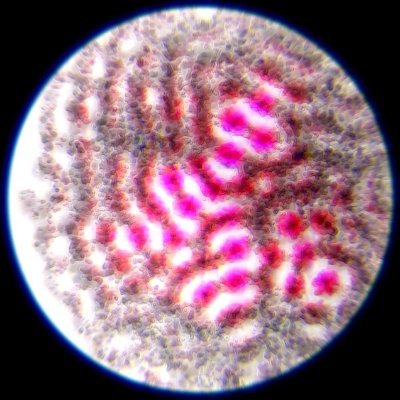
[wip] growing organisms using hypergraph rewriting I'm exploring generating organisms using string forces and I was wondering about which class of algorithms could be used to generalize the growth of such structures. I wanted a system which can produce a wide variety of outputs, while allowing for stable and...

77,361 görüntüleme • 1 yıl önce •via X (Twitter)

10 Yorum

TappAlpha profil fotoğrafı
TappAlpha1 yıl önce

Designed to generate daily income while capturing the growth potential of the S&P 500, $TSPY helps unlock new financial opportunities.

Enguerrand Quilliard profil fotoğrafı
Enguerrand Quilliard1 yıl önce

Interesting ! Have a look at my WebGPU based AI cell generator, some seed will result in crazy behaviors !

ciphrd profil fotoğrafı
ciphrd1 yıl önce

Cool algorithm! I explored it at large scale some years ago, it yields really cool results It was first presented by Jeffrey Ventrella, and called clusters Your implementation seems slightly different though

Petra profil fotoğrafı
Petra1 yıl önce

I love watching synthetic life 🖤

Puzzle Paws profil fotoğrafı
Puzzle Paws1 yıl önce

Ever tried evolutionary algorithms? They’re like digital Darwinism, perfect for creating diverse growth patterns. Might be just what your project needs!

ciphrd profil fotoğrafı
ciphrd1 yıl önce

Yes! Though such algorithms are useful to narrow dow, the parametric space of a system, you still need a system to search 😛

Ezgi profil fotoğrafı
Ezgi1 yıl önce

Isn't that what @solub presented like 5 years ago on the Processing forum ?

ciphrd profil fotoğrafı
ciphrd1 yıl önce

@solub I wasn't aware! Looking into the thread it seems to be a direct exploration of wolfram physics' system; I'm tweaking it down to see other behaviours emerge

sarv profil fotoğrafı
sarv1 yıl önce

Oooh I tried doing something like this in fall!

HDP profil fotoğrafı
HDP1 yıl önce

@anirbanbandyo i think we can use something like this with a singularity bridge at the nodes for connecting red objects across unique topology layers

Benzer Videolar

[wip] added behaviours - eaters: can process food — blue dots - food seekers: are attracted by food - actuators: contract muscles (for now it's a simple sinusoid, will be improved with signals) - anchors: attach to environment I also improved the growth mechanism, some DNA encodes functions which can affect the DNA/behaviours of the nodes. Each node has its own DNA strand. This is an example of a decoded DNA strand: permut({{{x,y},{x,z}}->{{x,y},{y,z},{z,w}}});assign(w,dna(4));cluster(w,0);cluster(y,rnd());behavior(y,+actuator);behavior(x,-eater) This strand makes it so that when the node is grown: - the permutation rule is applied - node assigned as 'w' received the DNA strand 4 - 'w' is assigned to cluster 0 - 'y' is assigned a random cluster - 'y' is assigned the actuator behavior - behavior eater is removed from 'x' This is pretty trivial, and I'm going to improve this system by designing a simple bytecode which encodes behaviors in a more generic way. This will allow more sophisticated behaviors as well as facilitate mutations. For now there's no concept of energy, but eventually some energy should be spent to activate, resulting in death if the organism cannot gather more.There's only 1 organism / sim, will be interesting to see some competition as well. Still, these early progress shows that interesting behaviors emerge from this kind of growth, with various systems more or less functional. Many more behaviors can be added (binders, propellers, grabers, etc...).

ciphrd

47,162 görüntüleme • 1 yıl önce

A transformer can learn not just the outcomes of dynamics, but the operator that executes the rules. To show this we trained a transformer on roughly 0.04% of a discrete rule space - 100 of 262,144 possible rules - and it learned to apply unseen rules from the same rule class. The model does not simply memorize specific rules. It learns the operator that maps a supplied rule plus an initial state, including unseen rules from this class, to the correct next state. This is relevant because it is a shift from “neural networks approximate dynamics” to “neural networks can learn to execute symbolic programs within a defined rule class”. The rule itself is supplied at inference time, as data, and the network has internalized how rules act, not which rules to apply. On previously unseen rules, the model achieves 98.5% perfect one-step forecasts and reconstructs governing rules with up to 96% functional accuracy. Two results make this hold up under scrutiny. First, inductive bias decay. As we scaled training rule diversity, the correlation between functional inference accuracy and distance-from-nearest-training-rule collapsed to R² = 0.00. At the largest tested training-rule diversity, the model’s performance on a new rule shows no measurable dependence on how similar that rule is to anything it was trained on. The bias toward training data (the thing we worry most about in compositional generalization claims) is something we can measure decaying, and we find that at scale it is gone. Second, an identifiability theory. We derive a closed-form expression for the number of rules consistent with a single observation. This reframes the inverse problem: failure to recover ground truth is not necessarily a model defect, but can be correct behavior when the data underdetermine the rule. The model is sampling the equivalence class; and identifiability is governed by coverage, not capacity. The methodological move underneath both results is amortization. Classical work on rule inference (e.g. the Santa Fe EVCA program, evolutionary search over CA rule space) was per-instance: search the rule space for each new system. We replace that with a single forward pass of a transformer trained across many instantiations of the rule class. That is what makes symbolic rule inference scalable as a research direction rather than a curiosity. We show that this works in a tightly constrained domain: binary, deterministic, local cellular automata on small grids. The locality-break experiment shows the model fails sharply when target systems violate its structural priors (which is itself a useful diagnostic, but it bounds the operator class). We don't yet know how this scales to multistate, higher-dimensional, or stochastic CA, or whether it transfers cleanly to non-CA systems whose coarse-grained dynamics admit local surrogates. The identifiability framework - what can be inferred from observation, given a hypothesis class - should transfer wherever finite local rules meet sparse data. The amortization argument transfers wherever per-instance symbolic search has been the bottleneck. Those are the pieces I expect to outlive the cellular automata setting. Led by Jaime Berkovich with Noah David, at LAMM@MIT. Out now in Advanced Science Advanced Portfolio News (link to paper & code below).

Markus J. Buehler

38,967 görüntüleme • 1 ay önce

Citizen Nebenzia, you are not a legitimate president of the Security Council, and I will never address you as one. You are sitting on the seat that Russia invaded illegally, and the only proper seat for you before you end up in hell bypassing purgatory is in the dock. And as for the Rule 37 of the Rules of Procedure that allows my invitation, there’s not a single word about the presidency, let alone about the invaders of the seats in this Chamber. 👇 “Rule 37 Any Member of the United Nations which is not a member of the Security Council may be invited, as the result of a decision of the Security Council, to participate, without vote, in the discussion of any question brought before the Security Council when the Security Council considers that the interests of that Member are specially affected, or when a Member brings a matter to the attention of the Security Council in accordance with Article 35 (1) of the Charter.” Any one sees the word “presidency”? At least once? You want to refer to “established practice”, that is not even mentioned in Rule 37? Then, guess what! I will never take lectures from an accomplice to war criminals whose boss openly reject rules aka practices while pretending to be a UN Charter “defender”. It’s impossible to stomach malarkey from Lavrov like this one, direct quote: “certain UN members to replace international law and the UN Charter with some “rules-based international order.” These mysterious “rules” have never been the subject of transparent international consultations, nor have they been laid out for everybody’s attention.” So much about the rules, and procedures by the invader of a UN permanent seat, and never the “president”! Surely a prisoner one day!

Sergiy Kyslytsya 🇺🇦

287,247 görüntüleme • 1 yıl önce

AOC: "Think that Prime Minister carney's remarks that the World Economic Forum were, um, were words that run around the world in raising this question. But I think that also, in his remarks, as long and as well as part of this larger conversation, there was this undertone, this undercurrent, this suggestion that it was a rules, based order sometimes. And I think that that is the, the issue that lies before us is that in a in a so called rules, based order, the rules for whom, because for all too long, the rules only applied to the United States, europe, its allies, and we would carve out exceptions for the global South. And I think that when you have a rules, based order where you carve out exceptions to our values, exceptions to our rules, eventually the exceptions become the rules. And I think that, to your original point, over the last five years, we've seen such a breaking and such a fraying of these alleged Western values that people wonder if it ever existed in the first place. So I don't know if it's necessarily that we were in a post, if we are in a post, rules based order, I think it's possible that we were in a pre rules based order, and we have an opportunity to explore what a world would look like if we upheld democracy. Human rights, trade that actually centers working class people, instead of accruing overwhelmingly the benefits of trade to the wealthiest Um. But if we reoriented a new era that could actually help people and show how foreign policy and healthy foreign policy can show up and help them in their lives."

Winter

794,378 görüntüleme • 4 ay önce