Video yükleniyor...

Video Yüklenemedi

Ana Sayfaya Dön

🚨 wp2shell : pre-auth RCE in WordPress core, reproduced end-to-end. Nested /batch/v1 "double confusion" · (CVE-2026-63030) → WP_Query SQLi · (CVE-2026-60137) → anonymous shell on a stock install. A couple of prompts later: · Opus 4.8 orchestrating, Sonnet agents executing. Exploit dev has gotten scary easy. Patched in 6.9.5...

33,141 görüntüleme • 13 gün önce •via X (Twitter)

0 Yorum

Yorum bulunmuyor

Orijinal gönderinin yorumları burada görünecek

Benzer Videolar

⚡ Kleros Development Update | May 2026 Kleros Foresight opens the month: movies round 2 is now live, so you can trade today. Batch redemption shipped, redemption values were corrected with a pre-check before claiming, resolved answers now show right on the market cards, and a resolution email tells you the moment your winnings are ready to claim. Kleros Skills is being prepared for launch: knowledge packs that teach AI agents how to use Kleros, whatever assistant they run on. The first two packs are almost ready. One lets an agent pin files to IPFS for $0.01 in USDC, the other lets it interact with Kleros Curate and Scout. A Kleros CLI, ERC-8004 agent verification, and an Escrow pack are on the roadmap. Scout reached its definitive version: 2.6M curated addresses on the homepage, a dedicated new-submission page, a transaction-result page, and an in-app file viewer. Uploads now flow through Atlas with limits sourced from role restrictions, submissions defer uploads until sign-in, and ATQ duplicate detection plus JavaScript Court landed in the disputes view. Atlas shipped v1.6.0. Signup is now per product: Court V1, Court V2, and Foresight each get their own confirmation email, unsubscribe link, and onboarding flow. Court reminders moved to a fixed, configurable time, and every batch send is preceded by a transaction simulation. Proof of Humanity V2 email notifications now cover the complete profile lifecycle: pending revocations, vouching activity, disputed flows, and challenge outcomes, processed end to end by Atlas. Only the frontend opt-in toggle remains. An evidence-key fix means older cases render attachments properly again, and the referral system spec went through review. Vea published the veashi-sdk to npm at v0.0.2, the first packaged version of the cross-chain SDK. The LayerZero Labs contracts were reorganized under the adapter layout, the Hashi executor decoupling merged after April's review pass, and an ENVIO HyperIndex indexer for the relayer is on the way. Court V2: The contracts are being simplified, the partial-coherence kit was merged, and the security findings are being worked through. From here, the code heads into another round of internal reviews. We'd rather take the time and get it right. Full breakdown 👇

Kleros

11,745 görüntüleme • 1 ay önce

Cerebras inference is very fast. So fast that it changes how we think about configuring our LLMs for voice agent use cases. Kimi K2.6 is a 1T parameter reasoning model that Cerebras serves at 650 - 1,000 tokens per second (end-to-end throughput), with time to first token metrics as low as 150ms (latency). These numbers are two to three times faster than other similarly capable models. The biggest lever we get from this kind of speed is that we can use the model in reasoning mode, and still have excellent "time to first non-thinking token." This solves a big pain point we have in 2026 for voice agent use cases. Almost all recent innovation in post-training has focused on making models good at reasoning ("test time compute"). This is great, but it makes the user-facing model latency much, much slower. Which is a problem for conversational voice agents. We can run Kimi K2.6 with reasoning turned on, and get responses faster than other models produce with reasoning disabled. On my 30-turn voice agent benchmark, Kimi K2.6 with reasoning enabled ties GPT 5.1 and Haiku 4.5 with reasoning disabled, and is still about 200ms seconds faster! On my primary task agent benchmark, Kimi K2.6 is now the #2 model. It ranks just behind Gemini 3.5 Flash in "high" reasoning mode, and tied with GLM 5, Sonnet 4.6, and GPT 5.4 with reasoning set to "low." But Kimi K2.6 completes each turn in the agent loop in under 500ms. The other four models are all at least 3x slower. (Models only qualify for this benchmark if they can complete task turns at a P50 <4s.) A couple of other things that this speed buys us, for production voice agents: - Tool calls happen fast enough that we don't have to work around tool call latency in our pipeline design. - We can prompt the model to output structured data at the beginning of a response, followed by plain text for voice generation. This opens up possibilities like asking the model to do complex classification/generation tasks that influence the rest of the pipeline. For example, the model could create a detailed style prompt for a steerable TTS model, for each individual conversation turn. And, of course, you can use Kimi K2.6 with reasoning turned off. Cerebras calls this "instant" mode. Here's a video of a Cerebras Kimi K2.6 voice agent with voice-to-voice response time, measured at the client, under 500ms. This is the true response latency as perceived by the user, including all network and audio codec overhead, transcription and turn detection, Kimi K2.6 token generation, and voice generation. 500ms is, effectively, instant. So the Cerebras naming for this mode is a propos. :-)

kwindla

40,593 görüntüleme • 2 ay önce

Last night was the biggest disaster in the history of Tesla. Let me walk you through what actually happened on that earnings call, because the headlines are doing you a disservice: Elon Musk got on the call and admitted (his words) that Hardware 3 "simply does not have the capability to achieve unsupervised FSD." He said he wished it were otherwise. He said the memory bandwidth is one-eighth of what Hardware 4 has. And that's the end of the conversation. Approximately 4 million Tesla vehicles on the road right now have Hardware 3. Many of those owners paid $8,000 to $15,000 for Full Self-Driving capability based on Musk's repeated promises (going back to 2016) that the hardware was sufficient for full autonomy. As recently as 2022, Musk was publicly assuring owners that HW3 had the processing power to get it done. BUT IT DIDN'T Those promises are now officially broken. The solution is a "discounted trade-in" toward a new car with Hardware 4. Not a refund or a free upgrade... A discount on buying ANOTHER Tesla. Investor Ross Gerber said it too - all HW3 owners got screwed, and with roughly 285,000 FSD purchasers affected, the potential liability runs into the BILLIONS. But that's not even the worst part. Musk was asked if the current FSD v14.3 was ready for unsupervised deployment. He said yes. Then immediately walked it back and admitted Tesla has "major architectural improvements" in the pipeline that would significantly improve safety. What he really means: the software isn't SAFE ENOUGH to deploy without a human watching. Full unsupervised FSD for consumer cars is pushed to Q4 2026. At the earliest... Maybe. How many times has this deadline been pushed? I've lost count. And trust me, I've seen a lot of broken promises. But this one takes the cake. Now let's talk about the numbers everyone is celebrating: Tesla reported $22.4 billion in revenue and $0.41 in non-GAAP earnings. A "double beat." The stock popped 4% after hours. Victory, right? WRONG Dig into the actual filing: The number one driver of operating income improvement wasn't cost reductions, wasn't volume growth, wasn't FSD revenue. It was - and Tesla listed this FIRST in their own shareholder letter - "one-time benefits related to warranty and tariffs." They released warranty reserves. They booked tariff refund windfalls. They stretched supplier payments by 10 days. They took on billions in new debt. Then they presented everything through non-GAAP metrics that strip out over $1 billion in stock-based compensation. GAAP net income was $477 million on $22.4 billion in revenue. That's a 2.1% net margin. On a $1.4 trillion market cap. Let me put that in perspective: 3.75 billion shares outstanding. Annualize the Q1 GAAP profit and you get roughly $1.9 billion. That's a trailing P/E ratio north of 700. Use the adjusted number - strip out stock comp, which is a REAL cost to shareholders through dilution - and you're still at around 250x earnings. All of this is extremely bad, but I didn't even talk about the CAPEX BOMB yet... 3 months ago, Tesla guided to "over $20 billion" in 2026 capital expenditure. Last night they raised it to over $25 billion. A $5 billion increase in a single quarter. That's 3x their historical annual capex run rate - $8.5 billion in 2025, $11.3 billion in 2024. The CFO confirmed on the call that Tesla expects NEGATIVE free cash flow for the rest of the year. So you have a company generating roughly $6 billion in annual free cash flow on a good year, and they're about to spend $25 billion. The math doesn't work. They will almost certainly need to issue equity. Which means dilution. Which means the $1.9 billion in annual earnings gets spread across even MORE shares. The core auto business is literally deteriorating in real time: Tesla delivered 358,000 vehicles in Q1 (missed estimates again). They produced 408,000. That's 50,000 cars sitting on lots that nobody bought. Inventory days jumped from 10 to 27 in just a few quarters. California (their most important US market) saw registrations crash 24% year over year. Their market share in the state fell from 9.2% to 7.7%. That's on top of a Q1 2025 that was ALREADY weak from Model Y retooling. They're declining off a decline. And here's what really kills the bull case... The entire valuation rests on robotaxis, Optimus robots, and autonomy. So let's put numbers on it: Waymo - the actual leader in autonomous driving with 15 million completed rides in 2025 alone, over 127 million autonomous miles driven, operating commercially across 6 US cities with plans to expand to 20 more - just raised $16 billion at a $126 billion valuation. That's the market's verdict on what the LEADING robotaxi company is worth. $126 billion. And Waymo is YEARS ahead of Tesla in actual deployment. Tesla has 3.75 billion shares outstanding. So even if you assign $126 billion in robotaxi value (giving Tesla full credit for matching Waymo despite being nowhere close) that's $33 a share. Add the auto business at generous auto-industry multiples, maybe $20 a share. Throw in energy storage and services, $10-15. Sum of the parts gets you to roughly $65-70 a share if you're feeling generous. Maybe $50 if you're not. The stock is $387. So what exactly are you paying for? You're paying for a STORY. You're paying for PROMISES that keep getting pushed back, technology that keeps falling short, and a business plan that requires spending $25 billion a year while the core product sells fewer units at declining margins in a market where California sales just fell 24% and the federal EV tax credit is gone. I managed the number one mutual fund in America. I founded two billion-dollar hedge funds. I've been doing this since 1981. And I am telling you: Tesla at $387 is one of the most egregious mispricings I have seen in my entire career. THE CRASH WILL BE EPIC

George Noble

1,224,554 görüntüleme • 3 ay önce

//The Wire//1900Z July 14, 2026// //ROUTINE// //BLUF: WAR IN MIDDLE EAST REMAINS HOT WITH USA AND IRAN EXCHANGING HEAVY FIRE OVERNIGHT. NEW YORK TIMES JOURNALISTS ISSUED SUBPOENAS REGARDING THEIR REPORTING ON AIR FORCE ONE.// -----BEGIN TEARLINE----- -International Events- Middle East: The war continued to escalate overnight, with the attack/counterattack cycle no longer being distinguishable, as all belligerents are now attacking constantly. At least two more ships have been struck in the Strait of Hormuz since last night, and the US has continued to fly continuous sorties to strike targets within Iran. Dozens of targets were struck overnight, with CENTCOM announcing that the sorties took 5 hours to complete throughout the region. As of this morning, nearly all of the targets that have been struck have been within a few hundred yards of the Gulf, with heavy concentrations of targets being located within Bushehr, Bandar Abbas, Chabahar, and Jask, all of which are major naval bases. Most of the Gulf islands have also been struck, with Qeshm and Kish Islands being targeted heavily this afternoon. Conversely, Iran has conducted their own strikes in Jordan, Bahrain, Qatar, and Kuwait. In Kuwait, Iranian forces have conducted counter-battery fire on American HIMARS missile launcher sites, with multiple ballistic missile strikes taking place at most of the US bases and missile launch sites all day. Analyst Comment: Over the past 24 hours, the war in the Middle East has returned to the level of fighting first observed during the height of the war back in March. How long this is planned to continue is unknown, but this is not a slight increase in targeting; the war appears to be fully back on once again. United Kingdom: This morning Counterterrorism police released more details regarding a high-profile murder case that took place last week. On Thursday, Ann Widdecombe was found murdered in her home in the town of Haytor in Devon. After her murder was discovered, local authorities immediately referred the case to counterterrorism, and one suspect has already been arrested in conjunction with this case. This suspect has been charged for the murder, and as of this morning terrorism offenses have been added to the list of charges. Analyst Comment: This case is noteworthy as most of the information so far indicates this was a political assassination, and the speed at which authorities have immediately declared this to be a terrorism incident is very, very unusual. Widdecombe was a former Member of Parliament, and in her later years was a familiar conservative political commentator known to weigh in on political issues throughout the nation. More details may or may not come to light in due time regarding the identity of the suspect, but due to the high-profile nature of this murder, this case will be in the headlines for a while. -HomeFront- Washington D.C. - Yesterday a total of five New York Times reporters have been subpoenaed to appear before a grand jury, to testify regarding their reporting on the alleged security breaches onboard the new Air Force One. Last week, President Trump flew to Turkey for the NATO summit on the new airframe, but during the trip, an undisclosed security issue prompted the Secret Service to switch back to the older platform. Analyst Comment: The details of exactly what the alleged crimes are, have not been disclosed. The New York Times has a history of publishing content which could lead to security issues, but in this case nothing they wrote in their original report appears to have been classified. However, they did explicitly state that they had a source who had classified knowledge of the defenses (or rather, the alleged lack of defenses) on the new Air Force One platform, which is probably why the harsh crackdown on the New York Times. They also made the claim that the new airframe has not had enough time to install the anti-missile countermeasures of the older platform, though no detail on this was provided. Regardless, talking to journalists in any capacity about any of the protection measures used by the White House is a huge no-no, and one of the most sensitive issues that always results in a very heavy-handed response. -----END TEARLINE----- Analyst Comments: As the war in the Persian Gulf rages on, concerns are growing regarding the apparent widening of the war to include the Red Sea region. The mutual targeting between the Saudis and the Houthis in Yemen has continued to some degree, though it's too soon to tell if either party is committed to turning this into a more protracted fight. If that is the chosen course of action, the situation is likely to get very serious. While the Strait of Hormuz remains a hot warzone that has restricted the flow of about 20 million barrels per day out of the region, the Saudi East-West Pipeline system has been working to reduce this deficit by pumping roughly 7 million barrels per day during most of this conflict. This has eased the burden of Hormuz being cut off, and has been one of the main factors keeping oil from reaching $200 per barrel. However, this pipeline runs from the Gulf, across the desert, before terminating in Yanbu at a major oil export terminal. This terminal....is within missile range of the Houthis. Somewhat interestingly, there are also very little air defenses in the southern regions of Saudi Arabia despite the Saudis fighting the Houthis for a couple of decades at this point; nearly all missile defenses are on the northern coastline or in the vicinity of American bases. So far during this conflict, the Iranians have successfully struck the Yanbu oil terminal using extremely long-range (and slow-flying) drones. The Houthis have a much higher chance of success in threatening Yanbu, and if they are able to strike this facility, the global oil crisis will go from worse to worst. Analyst: S2A1 Research: NomadNet: 5fa68c88be727a0e1a250a75e5e79269 Disclaimer: No LLMs were used in the writing of this report. //END REPORT//

S2 Underground

17,672 görüntüleme • 17 gün önce

🚨 THE WHITE HOUSE PANIC: WHAT IS MELANIA TRYING TO BURY? 🕵️‍♀️ The internet is exploding after Yesterday's high-stakes, on-camera denial from First Lady Melania Trump at the White House regarding any connection to Jeffrey Epstein. She called the ongoing claims “lies” that “need to end today.” But the timing is raising massive questions. Why is the East Wing suddenly in a state of high alert over a story they claim is ancient history? 📚 THE SCRUBBED MANUSCRIPT The answer may lie in the legal firestorm surrounding the book Entitled: The Rise and Fall of the House of York by Andrew Lownie. Reports confirm that the initial 2025 hardcover print run contained a nuclear-level quote attributed to a 2007 interview with Jeffrey Epstein: “The first time Donald had sex with Melania was on my plane. Little did he know I beat him to the punch a year before... things got wild... I ended up almost naked in the back of a limo, going at it with Melania.” ⚖️ THE SILENCE OF THE LAMBS As soon as those first 60,000 copies hit the shelves, Melania’s legal team descended. The Recall: HarperCollins UK was forced to recall the book and scrub the passage from all future printings, e-books, and audiobooks. The Apology: The publisher issued a public apology, attempting to bury the claim entirely. The Missing Tapes: While Michael Wolff’s 2017 tapes (containing a different claim about the couple) are public, the raw audio or full transcript of this specific 2007 interview has never surfaced. ❓ THE PREEMPTIVE STRIKE Is Melania’s White House address a genuine defense of her character, or a preemptive strike against something else about to break? The book was scrubbed. The alleged 2007 interview tape is still missing. And now—just months later—the First Lady is using the White House podium to declare the Epstein talk must end. Why was the legal response to this specific book so aggressive? Why did she wait until April 2026 to make this specific on-camera denial? If the story is "defamatory and false," why the sudden five-alarm fire drill in the West Wing? 🧊 THE BIG PICTURE The Epstein shadow continues to loom over the administration, and this level of damage control suggests the "official narrative" is under serious pressure. Melania says the talk needs to "end today," but without the release of the unedited 2007 interview transcripts, the questions will only grow. Is this the final cover-up of the Epstein era, or the crack in the armor that brings the whole house of cards down? Share this before the "Handlers" scrub it again. 🕊️ Video from: RT

Project Constitution

43,336 görüntüleme • 3 ay önce

I finally finished my Rust version of Mario Zechner's (Mario Zechner) excellent Pi Agent, which I made with his blessing and which is called pi_agent_rust. You can get it here: If you're not familiar with Pi, it's a minimalist and extensible agent harness (similar to Claude Code and Codex) and, among other uses, serves as the core agent harness inside the OpenClaw project. I say my Rust "version" instead of "port" because it's really quite different in how it's implemented for it to be called a port. Arguably, the incremental functionality in the implementation was more complex than the rest of the project combined. Still, it provides the same features and functionality as the original, and is proven to be compatible with hundreds of popular extensions to Pi (the conformance harness shows 224 out of 224 extensions working perfectly). But the way it's architected has some major changes. Pi Agent relies on node or bun to provide access to the filesystem and for various other tasks, and that is also how Pi's extension system works. I decided early on that I didn't want to do things that way. Instead, I wanted to integrate that functionality directly into the binary itself; that is, to provide equivalent functionality for everything that would normally be provided by node/bun in the original. I did this for several reasons: one, it's a lot more performant in terms of footprint and latency. On realistic end-to-end large-session workloads (not toy microbenchmarks), pi_agent_rust is now: - 4.95x faster than legacy Node and 2.80x faster than legacy Bun at 1mm-token session scale - 4.32x faster than legacy Node and 2.14x faster than legacy Bun at 5mm-token session scale - ~8x to ~13x lower RSS memory footprint in those same scenarios But the other reason is security and control: by handling everything internally in an end-to-end way, we can do all sorts of clever things to harden the system against insecure or malicious extensions. Those extensions no longer have direct access to the ambient filesystem: they now need to go through pi_agent_rust, and we can analyze extensions carefully before ever running them and also block things that look suspicious at runtime. In practice that means explicit capability-gated hostcalls, with policy/risk/quota enforcement and runtime telemetry/auditability. In order to do all this, I had to effectively build the missing runtime substrate from scratch in Rust, not just translate TypeScript syntax: - define and implement a typed hostcall ABI for extension->host interactions - build native Rust connectors for tool/exec/http/session/ui/events instead of ambient Node/Bun access - implement a compatibility/shim layer so real-world Pi extensions still behave correctly - add capability policy evaluation, runtime risk scoring, per-extension quotas, and audit telemetry on the execution path - wire the whole thing through structured concurrency (asupersync) so cancellation/lifetimes are deterministic and failure handling is explicit - build a conformance + benchmark harness large enough to validate behavior/perf across hundreds of extensions and realistic long-session workloads This was a full re-architecture of the execution model while preserving the Pi workflow and extension ecosystem. And indeed, this aspect of it dwarfs the entire rest of the project in size and complexity. To put hard numbers on that: the extension/runtime/security subsystem alone is now about 86.5k lines of Rust across src/extensions.rs (~48.1k), src/extensions_js.rs (~23.4k), src/extension_dispatcher.rs (~13.4k), and src/extension_index.rs (~1.7k), with roughly 2.5k callable units in just those files. For context, the original Pi coding-agent production code is about 27.4k lines total. So this one subsystem by itself is roughly 3.2x the size of the original harness, which is why calling this a “port” would seriously undersell what had to be built. And on top of that, pi_agent_rust introduces a bunch of genuinely new capabilities beyond the legacy harness, not just a faster core: - Security and enforcement are materially stronger at runtime: capability-gated hostcalls with explicit policy profiles (safe/balanced/permissive), per-extension trust lifecycle (pending -> acknowledged -> trusted -> killed), explicit kill-switch operations, and audited state transitions. - Shell execution mediation is deterministic and argument-aware: rule/feature-based risk scoring plus heredoc AST inspection (dcg_rule_hit, dcg_heredoc_hit) before spawn, instead of relying on coarse deny patterns. - Containment and forensics are first-class: tamper-evident runtime risk ledger tooling (verify/replay/calibrate), unified incident evidence bundles, and forced-compat controls that let you contain issues without disabling the whole extension system. - The extension runtime architecture is native: JS extensions run in embedded QuickJS with typed hostcall boundaries and Rust-native connectors for tool/exec/http/session/ui/events, plus compatibility shims for real-world legacy extensions. - Runtime behavior under load is explicitly engineered: deterministic hostcall reactor mesh, fast-lane vs compat-lane routing, and warm-isolate prewarm handoff for more predictable throughput and latency under contention. - Long-session reliability is upgraded: JSONL v3 sessions with indexed sidecar acceleration and optional SQLite-backed sessions, plus operational controls via --session-durability, --no-migrations, and migrate. - Provider and auth coverage are broader and more operationally explicit: native Anthropic/OpenAI (Chat + Responses)/Gemini/Cohere/Azure/Bedrock/Vertex/Copilot/GitLab plus large OpenAI-compatible routing; pi --list-providers currently shows 90 providers with aliases and required auth env keys. - Auth is not just API keys: OAuth (Anthropic/OpenAI Codex/Gemini CLI/Antigravity/Kimi/Copilot/GitLab plus extension-defined OAuth), AWS credential chains (Bedrock), service-key exchange (SAP AI Core), and bearer-token flows. - Operator tooling is stronger: pi doctor supports scoped checks (config, dirs, auth, shell, sessions, extensions), machine-readable output (--format json|markdown), and safe auto-remediation (--fix). - Extension/package lifecycle workflows are built in: install, remove, update, update-index, search, info, and list. I want to thank Mario for making a great harness and for not telling me to get lost when I asked him if he was OK with me porting it to Rust. I may give him a hard time in jest about not going "full clanker," but that doesn't mean that I don't respect his work a huge amount. PS: There could still be bugs. If you find some, please let me know in GitHub Issues and I'll fix them same day. There's always a tradeoff between perfect and getting stuff out the door and I felt like it was time to release this.

Jeffrey Emanuel

116,929 görüntüleme • 5 ay önce

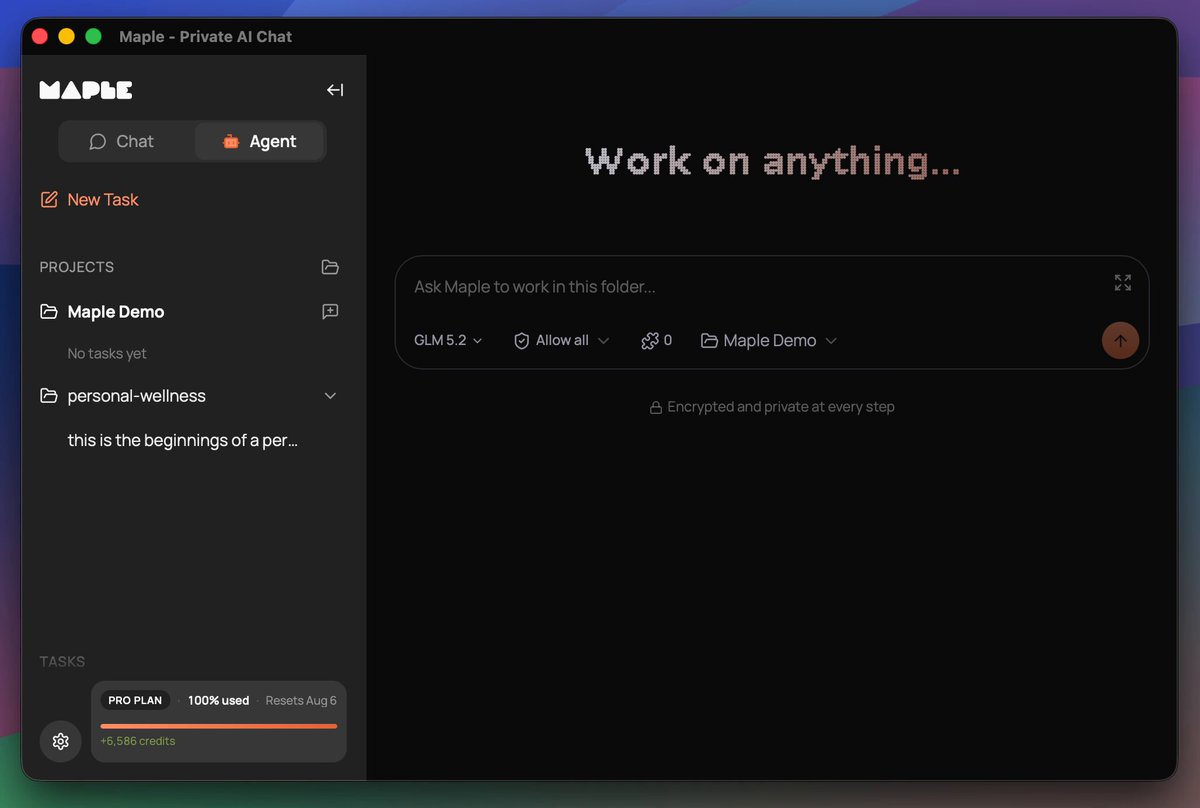
Maple is preparing for the release of a co-working agent. You install it locally and it works with your files, whether it's office work or building websites and apps. It's a turnkey solution, as easy as Claude Code, that keeps your data secure and private, no data sharing with closed AI labs. This is THE sovereign AI app for individuals and businesses who want powerful AI while retaining ownership of their information. Why build an agent into the Maple app when other agents already exist? Easy, we want to give you control over your work. We don't have a business plan that incorporates making money off our users' data. In the age of AI, your information, whether it's personal or company trade secrets, is the single thing that differentiates you from everyone else. We all have access to AI that can build a professional website for selling shoes. But your strategy and network for how you sell shoes should not be shared with your competitors. Sovereignty is the path to protecting what makes you, you. Maple sits at the intersection of Usability and Sovereignty. Maple gives you the best tools that are both easy to use and maintain your data sovereignty. Sovereign for one, sovereign for all. It has been a journey to get here. We brought to market the very first personal chatbot with end-to-end encryption using TEEs in late 2024. Prior to that there were proofs of concept but no full product offerings. Every other AI chat product on the market handled your data in plain text, either selling you a service to get your data or asking you to trust that they won't snoop on you. Quickly people found Maple and latched onto its open-source code and verifiable encryption. We didn't stop there. You may remember earlier this year we teased a product called "Maple Agent" and opened up a waiting list. That product is a mobile app that acts as your AI "friend", maintaining one long continuous chat, and getting to know you over time. I dislike using the word "friend" there, but it's the best way to convey the UX in a few words. AI is a tool, always has been, always will be. Any kind of friendly personality on top is just synthetic. In our testing, the UX of Maple Agent is really powerful for what it does. Think about the many short AI chats you have in your favorite app, whether it's looking up a historical fact or asking advice about a topic. With Maple Agent, those all go away in favor of the long-running chat with the friendly agent. It's like you have your own personal assistant who knows you so well and can look up anything for you. When I ask AI certain questions, I want to ask an expert who already understands my situation so I'm not repeating myself for the 100th time. That's the amazing value the personal agent brings to the table. We still see great utility for a personal agent like the "Maple Agent". Thousands of people on the waiting list, hoping to get their hands on it, agree that the concept is worth exploring and trying out. We were constrained in launching it due to a few circumstances, one of them being access to the scale of compute needed to power it. We have a clear path laid out for how to get there, but today is not the day to execute on that. It will be in the near future. Instead we have a different agent ready to go that we think is also incredible. We now have an agentic harness inside of the Maple Research app. This thing is a powerhouse. It even builds and publishes its own software releases. The agent in Maple Research works with your local filesystem, speaks to the largest open models running in TEEs, utilizes local models for certain tasks, is compatible with MCP tools, has an API for connecting to anything you need, and also supports the ACP protocol, which means it can be extended in the future to speak to other tools like Claude Code, Codex, and local models running on your own hardware. A big unlock for us was the Goose Development Kit, which powers the core of our agent harness. More on that to come as we publish articles and documentation later about the agent. The agent inside Maple Research doesn't have a name. At least not yet, not sure if it ever will. For now we call it "Chat Mode" and "Agent Mode". Think of this as the workhorse, the truck, the heavy lifter. Our other "Agent", the phone app, is your sidekick in your pocket, ready to help with quick things and ongoing conversations about life. I am incredibly excited about the Maple Research Agent. While I'm already seeing great results using it for internal work items, I'm especially thrilled about the personal health and wellness work it's doing for me. I know there are plenty of apps out there for compiling wellness data, but I'm having it build a tool tailored specifically for what I need, without the extra fluff. And none of my health data is being donated to the closed AI labs or sent to advertisers. I know that the AI logic is not being silently adjusted to fit the whims of a large corporation that has paid for product placement. It's me, state of the art AI, and my data. That's how I want it. Maple's new agent makes that possible. We can't wait for you to try it out. If you want early access, comment here, email us, reach out in some way. To those on the other agent waitlist, you're already in the queue. Thanks for reading this lengthy update. :)

Mark

29,937 görüntüleme • 9 gün önce

Microsoft just lost $357 billion in a single day... While Meta gained $170 billion. Both companies are spending over $100 billion on AI this year. One got punished. One got rewarded. The difference tells you everything about where this market is heading: Microsoft reported Wednesday. Beat on revenue. Beat on earnings. Revenue up 17%. EPS up 24%. But the stock dropped 10% - worst decline since March 2020. Why? Azure cloud growth came in at 39%. The Street wanted 39.4%. A miss of 0.4 percentage points erased a third of a trillion dollars. Meanwhile, capex jumped 89% year-over-year to $37.5B in a single quarter. CFO Amy Hood admitted two-thirds went to "short-lived assets" - GPUs that depreciate fast. And Microsoft also said they'll remain "capacity constrained through at least the end of our fiscal year." In other words: "We're spending $72B in six months and STILL can't build data centers fast enough." But that's not the real problem... The real problem is what's happening inside Microsoft's spending. They're not just building infrastructure for Azure customers. They're allocating scarce GPUs to their own products: M365 Copilot, GitHub Copilot, internal R&D. Hood said they must "balance Azure revenue growth with growing needs across first-party apps and AI solutions." Microsoft is competing with its own cloud customers for compute capacity. If they'd allocated all new GPUs to Azure, growth would've exceeded 40%. Instead, they're betting their own AI products will generate more value than selling raw compute. That bet hasn't paid off yet. And 45% of their $625B backlog is tied to ONE customer: OpenAI. Now compare that to Meta: Revenue beat. Earnings beat. Guidance crushed expectations. And they announced $115-135B in AI capex for 2026 - nearly DOUBLE what they spent in 2025. The stock surged 10%. Why the opposite reaction? Meta is seeing immediate returns. Ad impressions up 18%. Average price per ad up 6%. Revenue up 24% year-over-year. Their AI investment is already showing up in the core business TODAY. Better ad targeting. Better recommendations. Better engagement. Q1 revenue guidance came in at $53.5-56.5B - Wall Street expected $51.4B. That's 30% revenue growth ACCELERATION. When you have 3.58B daily active users, AI improvements compound immediately. Zuckerberg called it a "major AI acceleration" and Wall Street didn't care about the $135B spending number. Because they can SEE the connection between spending and revenue. Here's what matters: The hyperscalers are now spending over $600B combined on AI infrastructure in 2026. AI assets depreciate at roughly 20% per year. The five hyperscalers face annual depreciation expenses approaching $400B - MORE than their combined profits in 2025. This is the biggest capital spending cycle in history. And we just entered Phase 3, where AI-enabled revenue models must finally prove their worth. The market stopped rewarding spending. It's rewarding RETURNS. Meta showed returns. Microsoft showed constraints and margin compression. That's why we saw a $527B swing between two companies reporting on the same day. My read: The easy money in the AI trade is over. From here, execution matters more than ambition. Companies that can turn infrastructure spending into measurable productivity gains get rewarded. Companies still building without clear payback get punished - even when they beat estimates. Microsoft isn't a bad company. It's a company that bet big on AI infrastructure and is now scrambling to show ROI before margins collapse further. Meta isn't necessarily a better AI company. It just has a business model where AI improvements translate directly to revenue growth. For investors, the lesson is clear: The AI infrastructure phase is maturing. Winners from here will be companies with clear paths from spending to earnings. Not companies asking you to trust the process while margins compress.

George Noble

120,284 görüntüleme • 6 ay önce

I've never heard Elon Musk be so bullish on Tesla ⚡️ here's my video analysis of the $TSLA Q4 2024 earnings call: -Robotaxi launch in Austin, June 2025 -California & other states launch robotaxi late 2025 -Cybercab in 2026 -Optimus V1 in 2025, 1K/month production line -Optimus V2 in 2026, 10K/month production line -2026 good year for Tesla, 2027/28 insanely good & more!! Timestamps- 0:00 Intro 0:44 Elon Opening Remarks 13:29 SAY Retail Questions 22:37 Analyst Questions 25:04 Gali Final Thoughts/Rant also here are my notes I typed during the conference call if you're interested! (may be errors) Tesla Q4 2024 Earnings Call Notes INTRO- ELON OPENING REMARKS -Q4 set record, delivered cars at rate of almost 2M cars/year -Model Y best-selling vehicle of any kind on earth (elon focused and talking quickly) -10Xing on autonomy, not doubling -many investments made this year that will bear immense fruit in the future, for AI -see a path for Tesla to the worlds most valuable company by far, worth more than the next 5 companies combined, difficult but achievable path -overwhelmingly due to autonomous vehicles and autonomous robots -setting up for an epic 2026, and ridiculously good 2027 and 2028 -meeting FSD now is like meeting a toddler -human intuition is linear, we’re seeing exponential progress -#1 recommendation is try it -typical passenger car has 10 hours of use out of 168, when its autonomous, itll be used for 55 hours a week … can deliver packages in the middle of thenight, or supply restaurants, all hours of the day or night. 5X increase in utility -more on self driving, continued improvements in safety numbers, much safer to use FSD -V14 will be another big step from V13 -launched CORTEX training cluster at Giga Austin, big step for FSD, continue to invest in training needs -Optimus training needs are about 10X what’s needed for the car -cost of training is dropping dramatically over time -Optimus has potential to be north of $10T in revenue, can put a lot training compute into that situation, even pumping $500B into it would be a good deal -future very different from the past, incredible inflection point in human history -proof is in the pudding -launching in June this year in Austin, already have cars moving autonomously in Fremont, thousands of cars per day driving, soon in Austin then elsewhere in the world -toe in the water at first to make sure everything is cool, but we have a general solution for autonomy , then put a few more toes, then a foot. Safety of the general public and those in the car as the top priority -with regard to Optimus, making insane revenue projections that sound insane, i realize that. But i think they will prove to be accurate -several thousand bots made this year, they will be doing useful things by the end of this year, im confidence, production design one at the tesla factories, then will learn for production design two -ramp optimus production faster than anything has ever launched, doesn’t take very many years before we’er making 100M of these things per year , 500% growth per year -tried using all these suppliers to get it to build Optimus, but nothing worked, had to build it internally from first principles, the hand is increibdle -long term Optimus will be the value of the company -back to Energy,/earth, -energy storage is a big deal, becoming more important, enables far greater energy output to the grid than is currently possible. -grid has no storage, designed for peak storage, lots of waste -once you have grid energy storage, the potential of the grid is unlocked, at least double -this will drive demand of battery packs as to as much as we can possibly make -shanghai factory starting operation, starting another factory -cant shoot our selves in the foot, battery capacity can only go into storage or mobility, so always making that tradeoff -demand for total Gigawatt hours for batteries, transportation or stationary will grow in a very big way over time 2025 a pivotal year for tesla, launch of full self driving, biggest year in tesla history, maybe even bigger than first car or model s, 3 or y … probably most important year in tesla’s history I don’t even know who is in 2nd place in real world AI, would need a telescope to see them SAY QUESTIONS -FSD Unsupervised launched in California this year as well -most likely release it in many regions of the US by the end of this year -40K people day everyday no mention, some scrapes a shin with autonomous car its headlines news -need to use insane amounts of caution -discussions about licensing FSD? Yes -best way to know to work with us, bbuy a car and take it apart -only worth very high volume cars/production partners -tesla engineering very focused on getting it to roll out for tesla first -soon will be obvious that if you don’t have FSD you’re dead as an OEM -is Optimus design locked? -Optimus is not design locked, constantly iterating, best robotics engineers in the world, and other ingredients, battery pack, charging, great electronics, great communications, great connectivity, real world AI, then you need to scale that production to real world levels -prototypes are easy production is hard -thijs year close loop with using optimus internally at tesla, would could obviously use a few thousand robots for the most boring annoying tasks at the company -with production version 2, launches sometime next year, would like beginning, might be middle though, -production line will be doing 10K units per month capacity for v2, first line designing is for roughly 1,000 units per month, then next line will be for 100,000 units per month -could start delivering them late next year, will go so fast, will ramp like crazy, demand will not be a problem, even at a high price, once were above 1M units per year, production costs of optimus will be less than $20,000 -if you compare complexity of optimus to complexity of a car, its much less than a car -price of optimus will be set buy market demand -Semi ramping next year, TCO no brainer, like optimus, will be massive demand, will meaningfully contribute to tesla’s revenue at scale -tesla semi with autonomy, is incredibly valuable -we actually have a shortage of truck drivers here in the US -will HW3 owners need a hardware update, got 12.6 which is like a baby v13, have’t given up on it, releases will trail HW4 releases … “honest answer” is were going to have to upgrade for those who have bought full self driving, will be painful and difficult and we’ll get it done “Happy not many people bought FSD” -solar roof, given up on ramping it? -lots of customer interest despite premium, making easier to install, focused on growth through certified installers, many been installing for many years -supply product to the roofing industry -it’s a premium product like S/X -combined with Tesla powerwall you can be self sufficient for several days ANALYST QUETIONS -robotaxis in Austin and several other cities this year, and next year all over america -america innovates, europe regulates, to release FSD in europe, have to go through massive paperwork through netherlands, then presents to EU in may, some big country committee, nothing we can do to make it happen sooner. -can’t do training in china with video training, publicly available videos in china are being run through the tesla system to be used for training, bus lanes are complicated and a big challenge -tesla can keep manufacturing even if geopolitical tensions rise to very high levels -Pierre question on June in Austin, -can i try unsupervised myself, or will it be the Tesla fleet? -it will be the Tesla fleet testing it, that’s the toe in the water, scrutinizing everything -autonomous ride hailing for money in june -probably next year for you to put your car on network -trump removing EV incentives? -all transport will go electric, can’t be stopped, even planes, will be like stopping the steam engine or combustion engine -only thing holding back EVs was range, and thats a solved problem -right now solving battery production, not demand, big battery retooling for model y coming up, short term impact on output

Gali

79,010 görüntüleme • 1 yıl önce

i spent the morning tracing the whole thing on dune and the story is interesting + worth sharing. drainer wallet: 0xF7cFFC27732a5C9c4E2D592F3E33435F8dDb019A: fresh wallet, first tx ever was today 2026-05-11 at 00:52 utc. by 01:27 utc it had pulled ~$173k of assets + some memecoins from at least 5 different wallets on ethereum, base, and bsc. drained wallets: > 0x62acE10c…EE8A: ~$30k of priced assets (eth + bnb) + memecoins, drained across base / eth / bsc > 0x6131b5fae19ea4f9d964eac0408e4408b66337b5: ~$119k (eth), drained across eth + base it's clear that is not an approval/permit exploit. it's a private-key compromise. at 00:53 your wallet sent 5.8 eth to the drainer. 3 minutes later, the drainer sent 0.02 eth back to you. a few minutes after that, a 157k sat1 erc20 transfer left your wallet to the drainer. that 0.02 eth transfer was the attacker funding gas in the compromised wallet so it could keep signing transfers. the only way to make that happen is to control the wallet directly. so the attacker is signing transactions with your seed. and the part that really bothers me: among the wallets that sent funds INTO the drainer, 3 more share the exact same 8 hex chars at the same positions (62ac start, ee8a end): > 0x62ace0e0ecf70f62399b26e28eaf74cc455bee8a > 0x62ac07ae9242c354f6c307bbd9b36c749a5aee8a > 0x62ac6095d7e9189353bcbf17d439348ab7a1ee8a the 32 middle chars are completely different on each, so these are 4 genuinely distinct wallets. finding 4 wallets that all share the EXACT same 8 chars in the EXACT same positions by accident is statistically impossible. they were generated by a vanity tool specifically programmed to hunt for that shape. only your wallet sent priced assets to the drainer. the other three 62ac…ee8a wallets only sent worthless coins. these 3 don't look like victim wallets at all. looks like the attacker spent a few gpu-hours generating wallets that match the shape of your main address, then routed some of the worthless memecoins through them. why? idk, maybe: > address poisoning > trail confusion where the money is right now: most of it is still in the drainer wallet. the attacker is dumping the stolen memecoins (pod, sat1, fhe, bort, etc) into Kyberswap. but eth and bnb are just sitting there. nothing has been pushed to a cex deposit, bridged out, or sent to a mixer. once those funds hit binance/okx/bybit deposits or a tornado contract, recovery will be near-impossible. how the seed potentially leaked: > infostealer malware on the device (lumma, redline, atomic) grabbing the seed during one of the imports. these are extremely common right now and seeds in clipboard or saved as plaintext are easy pickings. > malicious browser extension intercepting the seed at paste-time into rabby or gmgn > fake support DM earlier tricking you into pasting a seed into a phishing page you didn't remember here is the dune dashboard that summarizes everything i’ve found.:

The Smart Ape 🔥

52,233 görüntüleme • 2 ay önce

If you watch this ~50 minute screen recording closely (yeah, I know, it's long; there are also some times when my computer was very slow and laggy, just skip past that part. And at one point I had to run and get my 9-month-old a new bottle and left it on a boring screen, sorry!), I believe you can see real signs of the kind of runaway, recursive AI self-improvement that people have been warning of for a while (Mr. Kurzweil most notably and prophetically). Why do I say that? What's different now? Well, there's a reason my set of agent coding tooling is called the Flywheel. These tools all mutually self-reinforce each other. And they all flow directly into my ntm tool (short for "named_tmux_manager"), which acts as a sort of integration point and nerve center for the tools (this is becoming more true by the minute as I'm now seriously working on ntm). Now, ntm was something I started making to automate some aspects of my workflow, but it was the kind of thing where, until it was perfect, it sort of just slowed me down. So I didn't actually use it even though I kept working on it and trying to improve it, and suggested to users that they try it in my tutorials. Well anyway, I finally got around to "dogfooding" ntm last night, and now it's going to get very dramatically better at an alarming rate. Some of that is from applying my "idea wizard" prompt to generate more useful features and building that stuff out and addressing obvious pain points I encountered during my newfound usage of the tool. But a lot comes from my realization that, once again, ntm's true utility is not as a tool for ME, but for an agent. That is, ntm lets one instance of Claude Code or Codex act as, well, me, do the things that I had been doing manually. Do I wish I had started using ntm earlier? No, for two big reasons: 1) Doing it manually helped me build up my intuition massively, which directly led me down the path of creating useful prompt strategies and workflows; these often began as ad-hoc prompts that I realized could be generalized and made more versatile/universal. Lesson: don't prematurely automate until you have an intimate, intuitive feel for your "core value-add loop." Otherwise you'll have a fully automated system quickly that efficiently and automatically does a stupid or otherwise sub-optimal thing. 2) My eyes have been opened to the beauty and power of Skills. I'm not talking about your garden-variety skills that are just a simple markdown file. I'm talking about true tour-de-force directories of perfectly structured and organized files that are filled with good information, insights, workflows, etc., but presented in a way that is highly optimized for consumption by AI agents, with extreme attention paid to things like perfect progressive disclosure, token density, agent-ergonomics, agent-intuitiveness, etc. And also Skills that go way beyond markdown files, with full integration into Claude Code where it makes sense via hooks, sub-agents, and even Python scripts. These kinds of skills are a qualitative difference in expressive power and usefulness and a total game changer. They are also effectively composable, creating almost an algebra of skills that let you use them together in powerful ways. I'm working on a subscription service website and CLI tool now to share what I've learned here most effectively, stay tuned for that in the coming days. Anyway, I now know what to make and how to make it. So, getting back to that screen recording, what does it show that makes me claim recursive self-improvement is here? If you keep your eye on the upper left tmux pane, that's the "controller" agent. It is using ntm to control all the other panes which are also running Claude Code (but ntm fully supports other agent types like Codex and Gemini-CLI, and it's trivially easy to mix and match them if you wanted to have, say, 8 CCs and 6 Codexes for writing the code and 3 Gemini-CLIs for reviewing code.) Now, there's nothing that crazy about this much so far. But where it starts to get very cool is that as the session continues and we encounter real-world problems, things like my ridiculously overloaded computer that keeps hanging for long periods, Claude Code instances that crash and get into a frozen, unresponsive state, it can learn from that. And you can see it using my skill writing skill to refine its ntm vibe coding skill in real time. And then take that skill and refine it to be more intuitive for itself. Or use my cass tool skill to search all the session histories to look for problems that came up and strategize how to solve them. The most useful part was when, towards the end of the session, I told it to reflect on all the things we had done and problems we encountered. One way it can usefully leverage those reflections is by improving its ntm vibe coding skill to make it cover more edge cases and exigencies. But the other, more fundamental, way is for it to conceive of and design the optimal new features and functionality for ntm itself so that the tool embodies those lessons in a first-class way. This offloads cognition from its brain onto its tooling, just like how a person can lean on spellcheck or a calculator. It codifies correct, effective reasoning at the tool level, where it's more reliable and robust and repeatable. And btw, did you notice what code base it was working on the whole time? It was none other than ntm itself! So as it worked on its own tool, it had reflections and ideas about how to further improve the tool. Now, it could have just as easily gotten those insights and ideas while using ntm to work on a different project, but the fact that it was working on itself is almost gloriously meta and recursive. So by the end, after learning from tending to a big group of agent workers (btw, I have previously emphasized doing everything in a really distributed/decentralized way, where each fungible agent gets identical marching orders that tell it to use my bv tool to find the optimal bead to work on. This does work very well, but occasionally results in some contention and overlap from thundering herd, or at least wastes time/tokens/communication in avoiding that before the agents waste time duplicating work. But in this new ntm-oriented workflow, I was able to have the controller agent in the upper left use bv itself and then optimally parcel out the instructions to each agent so that we could know for sure that there's no overlap), I ended up with a ton of new beads for new features, which I had it optimize and polish a few times. Now I can swap to a new Claude Max account and have the swarm implement all those new features! It should only take a couple passes like the one shown in the screen recording to get everything implemented. Then we can rinse and repeat, having the agent read through the full session histories of each agent and its experience from its own session in sending ntm commands and seeing how they worked out in practice, to come up with the next batch of changes to both its ntm vibe coding skill AND to the ntm tool itself. Do you see how rapidly this turns into Skynet? My mistake earlier was in focusing on making myself a "faster horse" as Henry Ford used to joke about customers wanting before he showed them what they should really want (a Model T). That is, something that would make my experience nicer while doing this agent swarm based development workflow. But the obvious lesson is that you should make all your tooling agent-first because the agents are just better at this stuff. You can still watch, and of course I did add a ridiculous number of very nice human-centric features to ntm that you'll be seeing in the next day or two, but those are really kind of "for fun" to make us humans feel better about the process. All the real value-add is happening "by agents, for agents." PS: Towards the end, you can see me switch to my Mac and tell Claude to improve the skill that I made earlier today for taking the mkv screen recording files from OBS Studio and muxing them into MP4 files for sharing, while downloading songs from YouTube to serve as the background music. I made it so it can also grab the thumbnails and generate little song credit cards that show up in the lower right corner. This worked perfectly the first time! I'll include some screenshots in a response post showing how that worked, but it was awesome to witness. Skills are POWERFUL. I'll also post a link to this video on YouTube if you prefer to watch it there.

Jeffrey Emanuel

25,483 görüntüleme • 6 ay önce

🚨NEW: Gaza Humanitarian Fund Launches as Israeli Opposition Leader Alleges Covert State Funding The major U.S.-linked aid initiative in Gaza is facing intense scrutiny after Israeli opposition leader Yair Lapid alleged that the Netanyahu government is secretly backing the Gaza Humanitarian Fund (GHF) through foreign front companies. GHF officially launched operations on Monday, saying it had begun delivering food to secure distribution sites in Gaza and aims to reach 1 million Palestinians by the end of the week. But its leadership collapse, legal challenges, and structural concerns have cast doubt on the effort’s long-term viability. Key Details: ➤ Lapid: Israel Using Shell Companies to Influence Gaza Aid Speaking during a no-confidence vote in the Knesset, Lapid claimed that the Israeli government is behind two foreign entities—the Swiss-based GHF and the American-registered Safe Reach Solutions—allegedly set up to funnel Israeli public funds into Gaza aid operations. He suggested the project was orchestrated by Israeli security services under Prime Minister Netanyahu and Finance Minister Smotrich, warning that it may be an effort to control humanitarian access under the guise of neutrality. GHF told reporters it had secured $100 million in funding from an anonymous donor even after initial backers like UAE and some European nations had backed away. ➤ Israeli Government Denies Allegations A spokesperson for Netanyahu’s office said, “Israel is not funding the humanitarian aid to the Gaza Strip.” No other evidence has yet surfaced to confirm Lapid’s claims, and no international watchdog or third-party government has investigated the claims. Ambassador Mike Huckabee had previously said that claims of Israeli involvement were “wholly untrue.” ➤ GHF Launches; Wood Resigns, Acree Named Interim Director Jake Wood resigned as GHF’s CEO yesterday, just before launch, saying the group could not uphold the principles of “humanity, neutrality, impartiality, and independence.” He had been approached two months ago to lead the initiative but said the structure was fundamentally compromised. GHF has since promoted its Head of Mission former USAID official John Acree as interim Executive Director. ➤ GHF to Temporarily Rely on NGOs for Food Aid Until It Scales Operations In a letter to COGAT dated May 22 and obtained by Middle East Eye, Jake Wood said GHF would initially open four secure distribution sites—three in southern Gaza and one in central Gaza—with plans to expand to at least eight, including in the north. Until then, “qualified humanitarian agencies” will continue distributing food aid in parallel. Wood acknowledged that GHF lacks the infrastructure to manage distributions independently for now, but intends to assume a more direct role once it scales up. Non-food items like medical supplies and hygiene kits will remain under the existing UN-led system, coordinated with Israel. ➤ Swiss Office Shuts Down; Legal Review Underway Swiss authorities are reviewing whether to open a formal investigation after TRIAL International, a war crimes watchdog, filed complaints against GHF. GHF’s Swiss operations have been completely suspended, and the group plans to continue via its U.S.-based entity. ➤ Widespread Rejection by Aid Agencies and Donors GHF’s model—built around Israeli-designated “safe corridors” and distribution hubs secured by private armed contractors, with aid restricted to pre-approved Palestinians—has been widely rejected by the humanitarian community. The U.N. and major aid organizations have refused to participate, warning that the plan violates core humanitarian principles, risks militarizing aid delivery, and could contribute to the forced displacement of Palestinians—a war crime under international law. Donor governments in Europe and Asia have also reportedly backed away, citing concerns about the fund’s feasibility, logistics, and lack of neutrality.

Drop Site

57,684 görüntüleme • 1 yıl önce

$AMD $5 Trillion is Inevitable LT| Agentic AI🧵 Agentic AI is the new $5 Trillion TAM 🚨🚨🚨 This thead will do Comp with $INTC and how to quantify this massive Agentic AI demand spike, and forcing Jensen to rush a CPU design. Global Agentic AI Market size is estimated to be $3-$5Trillion TAM by 2030(McKinsey) Quantifying the demand from agentic AI for AMD involves assessing the broader market growth for agentic systems, their unique computational requirements (particularly for CPUs in orchestration and reasoning tasks), and AMD's positioning very well through products like EPYC processors and partnerships. AMD EPYC Venice is the most superior choice in 2026-2027 for most Agentic AI workloads Agentic AI refers to autonomous AI agents that perform multi-step tasks, involving sequential logic, tool integration, and decision-making workloads that heavily rely on CPUs for handling orchestration, memory management, and context switching, rather than just GPU-parallelized training or batch inference. Agentic AI is often cited as 40-100x more "hungry" than traditional AI due to its continuous, 24/7 operation and complex workflows. This stems from factors like chain-of-thought reasoning (multiple LLM calls per query), API/tool interactions, memory management, and orchestration loops, which can generate 10-100x more tokens and require real-time responsiveness. For example, a single agentic query might trigger 5-20 model inferences, making it 10-20x more compute-intensive than simple chatbots, and the always-on nature compounds this to 40-100x overall. Nvidia's CEO has highlighted this as driving "easily 100x more computation" for inference in agentic/reasoning setups. AMD's EPYC Venice (6th Gen EPYC, codenamed "Venice") and Intel's Xeon 7 Diamond Rapids represent the pinnacle of server CPU technology in 2026, both targeting high-performance data center workloads like AI inference, agentic AI orchestration, cloud computing, and HPC. Venice builds on AMD's Zen 6 architecture, emphasizing core density and efficiency, while Diamond Rapids leverages Intel's Panther Cove P-cores for balanced performance. Both chips adopt similar advancements like 16-channel DDR5 memory and PCIe Gen 6, but differ in core counts, process nodes, and overall design philosophy. Intel has faced acute supply constraints across its Xeon lineup, including legacy nodes (Intel 7/3) and the ramping 18A process for next-gen parts. Intel shortage is expected with lead times up to 6 months or longer. 1. AMD EPYC Venice vs Intel Xeon 7 Diamond Rapids Architecture AMD: Zen 6 chiplet design with 8 CCDs and dual IODs Intel: Panther Cove P-cores; multi-die architecture with 4 compute tiles Core/Thread Count AMD: Up to 256 cores / 512 threads (Zen 6c variant) Intel: Up to 192 cores / 192 threads Process Node AMD: TSMC N2 (2nm) Intel: Intel 18A (1.8nm-class); in-house fab Memory Support AMD: 16-channel DDR5; up to 1.6 TB/s bandwidth. Intel: 16-channel DDR5 ; up to 1.6 TB/s bandwidth I/O and Connectivity AMD: PCIe Gen 6 (up to 128 lanes); twice the CPU-to-GPU bandwidth Intel: PCIe Gen 6 (up to 128 lanes); LGA 9324 socket Power (TDP) AMD: Starting 400-500W, potentially lower due to efficiency gains from TSMC 2nm Intel: Starting 400-500W, as it targets competitive efficiency Performance Projections AMD: Up to 70% uplift vs. 5th Gen Turin (1.7x in multi-threaded/AI tasks) Intel: ~40% faster than Granite Rapids (Xeon 6, 128-core). Lags AMD in per-core perf and 40-50% behind Venice core-for-core comp Target Workloads AMD: AI inference/orchestration, HPC, cloud virtualization. Partnerships Intel: Hyperscale AI, general enterprise. Custom silicon Pricing: AMD: estimated $10k-$20k for top SKUs Intel: estimated $8-$18k Availability: AMD: Significant Ramp H2 2026 due to higher allocation from TSMC Intel: H1-H2 2026 delayed, but trying to catch up Overall: ~Venice's 256 cores provide a 33% edge over Diamond Rapids' 192, making it superior for massively parallel tasks like AI training/inference or virtualization ~TSMC's N2 vs. Intel 18A debates rage on which is "better," but AMD's mature chiplet approach yields better density ( 32 cores/CCD vs. Intel's 48/tile). Venice's redesign reduces latency, aiding agentic AI where CPUs handle orchestration ~ Early projections show Venice widening AMD's lead matching or exceeding Diamond Rapids' perf with fewer watts in multi-threaded benchmarks. Intel's no-SMT design (to prioritize AI) handicaps it vs. AMD's 512 threads, though Clearwater Forest (E-core) could compete in density-focused niches. ~Power & Cooling: Both push above 400-500W, demanding liquid cooling. ~AMD been taking market share now above 40%. AMD EPYC Venice emerges as the superior choice in 2026 for most server workloads. Its higher core/thread count (256/512 vs. 192/192), stronger per-core performance, and architecture optimized for AI-driven tasks (agentic orchestration with GPU integration) provide decisive advantages in throughput, scalability, and efficiency. Projections indicate Venice delivering 1.7x the performance of prior gens while widening the gap over Intel ( 40-70% leads in multi-threaded benchmarks). AMD's fabless model with TSMC ensures reliable scaling, and its ecosystem ( open ROCm) appeals to AI adopters. Intel's Diamond Rapids is competitive in single-threaded enterprise apps and custom hyperscale ( NVLink), with potential fab advantages for supply/security. However, without SMT and lower density, it falls short in core-for-core battles—exposing Intel to another generation of AMD dominance unless 18A yields surprise efficiency gains. For data centers prioritizing raw compute ( AI, HPC), Venice wins; for Intel-centric ecosystems or specialized I/O, Diamond Rapids holds ground. Real benchmarks post-launch will confirm, but logic points to AMD pulling ahead. 2. Market size , Potential Revenue and Supply Global Agentic AI market size is projected to be $3-$5 Trillion by 2030 according to McKinsey, where consensus points to 40-50% CAGR driven by small to large enterprise demand. I also wrote a full thread on how and why Agentic AI is so explosive that AMD will blow all anlaysts estimate for subscribers. Link below if you are interested. AMD's data center segment hit a record $5.4B in Q4 2025 (up 39% YoY), with EPYC shipments ramping due to agentic demand. With 2GW of deployment in H2 2026, AMD AI data center revenue has $40-$50B+ at the lowest or most conservative projection; or Total Revenue in the $77-$94B For FY2026. However, Agentic AI massive demand spike could send EPYC revenue 3x to 4x in the next few years, potentially surpassing MI series GPU demand as enterprises prioritize CPU-dense Rack setups. This is pushing $NVDA Jensen to rush a CPU design and acquired Groq, a new CPU player due to this massive TAM. Noted that this is just popping just in weeks, highlighting we are just so early in this AI Supercycle and the pace of adoption is insane, and clearly productivity will skyrocket. Why? Because Agentic AI is 24/7 Smart AI agent working for you or your businesses is a mad compelling, and it is estimated to be 40-100x more Inference Hugnry! Many experts already said it is impossible to project this kind of Inference Demand. AI CapEx is expected to ramp up even more in 2027-2028-2029 and 2030 as Global Agentic AI is going to scale to $3-$5 Trillion TAM by 2030. The nature of Agentic is driving higher CPU/GPU ratio, with CPUs handling 50-90% of Agentic workflows. For example, The current Helios Rack: 18 compute trays per rack with 72 GPUs + 18 CPUs. The beauty of this $META and $AMD long term partnership is, that it is absolutely flexible to adjust racks to higher CPU rato or equal to service different needs. Helios rack can be easily swap to 2 GPUs 2CPUs or even CPUs only trays for dedicated orchestration/head nodes. You see, the beauty of this open rack-scale is flexibility and evolvability. If Agentic AI demand pushes much higher, AMD should be able to adjust variant trays without abandoning Heilos Rack. We can't talk just about massive Agentic AI demand without talking about the Supply side or TSMC. TSMC, AMD's primary foundry for advanced nodes ( Zen 6/Venice on N2/2nm), is addressing AI-driven shortages through massive expansions. TSMC accelerates fab construction with up to 10 facilities targeted for 2026. TSMC is accelerating its domestic manufacturing expansion, with industry sources indicating that as many as ten fabs could be under construction or preparing to begin operations across Taiwan’s major science parks. TSMC Capex: $52-56B in 2026 (up 37% YoY), with $45B already approved for new/upgraded capacities. 70-80% for advanced processes (2nm/A16), 10-20% for packaging (CoWoS quadrupling to 120-140K wafers/month by late 2026). In addition, Taiwanese companies (led by TSMC) commit to at least $250B in direct investments in US-based advanced semiconductor, AI, and energy production/innovation capacity.Taiwan provides $250B in government credit guarantees to facilitate additional investments and build a full US semiconductor ecosystem (including industrial parks). TSMC completed a second land purchase in Arizona (January 2026) for gigafab scaling, with an additional $100B+ (potentially four more modules) to further expand and qualify for tariff exemptions. AMD with secured 12GW from OpenAI and $META and massive Agentic AI will mean higher priority acess to 20-30% more wafers on TSMC advanced nodes, as TSMC has multi-year agreements with AMD for AI chips. Dr. C. C. Wei, CEO of TSMC quote: "I spend a lot of time in the last three or four months talking to my customer and then customers. Customer. I want to make sure that my customers demand are real. I talk to those cloud service providers, all of them. Their answer is. I'm quite satisfied with their answer. Actually they show me the evidence that the AI really help their business. So they grow their business successfully and he or she in their financial return. So I also double check their financial status. They are very rich." Amid shortages, the US buildout ensures AMD can ramp production of Instinct GPUs and EPYC CPUs without the constraints hitting competitors like Intel. By diversifying away from Taiwan (85% of advanced nodes today), the agreement mitigates supply disruptions, ensuring stable flows for AMD's chips. Scaling production and securing supply will matter for AMD the most in the next 5-10 years growth. The growth could be 80-100% YoY or higher; or it could be in the 60%. The aggressive TSMC supply ramp is reassuring the higher growth point. Conclusion: AMD stands at a pivotal inflection point in 2026, where the explosive rise of agentic AI demanding 40-100x more inference compute through its 24/7, multi-step orchestration positions the company to potentially triple its EPYC CPU revenue to $45-60B+ by 2028 while scaling Instinct GPUs to tens of billions annually by 2027. Agentic AI demand could push AI CapEx closer to $1 Trillion in 2027, far higher than most estimates. Dr. Lisa Su, AMD's visionary CEO, is masterfully securing supply to harness this massive demand by prioritizing operational execution and deep TSMC collaboration, ensuring readiness for the second-half 2026 AI ramp. Dr. Su has explicitly called out surging EPYC demand for agentic tasks where CPUs power head nodes and traditional workloads alongside GPUs while guiding for data center dominance through proactive capacity planning and partnerships like Nutanix ($150M investment for open agentic platforms) or providing tens of millions CPUs for OpenAI, $META, $ORCL, $AMZN, $MSFT, $GOOGL and others. Her strategy includes multi-year TSMC agreements for advanced nodes (N2 for Venice CPUs and future Instincts), diversifying beyond Taiwan to mitigate risks, and unveiling innovations like the MI455X GPU at CES 2026, which she touted as enabling "the next trillion-dollar market opportunity" in physical AI. Dr. Su's forward-looking vision predicting AI reaching 5 billion users emphasizes "AI everywhere," backed by hardware like Ryzen AI chips, all while declaring demand "going through the roof" and committing to scale without bottlenecks. TSMC's aggressive ramp-up, fueled by $52-56B in 2026 capex (up 37% YoY) and 10+ new fabs across Taiwan, the US (Arizona cluster expanding to 6+ modules with $165B+ investment), Japan, and Europe, provides profound reassurance for AMD's supply stability. The January 2026 US-Taiwan agreement committing $250B in investments and credit guarantees for US reshoring accelerates this, granting tariff relief (15% rates with 1.5-2.5x exemptions) tied to capacity buildouts, enabling TSMC to potentially double output over the decade to meet AI wafer hunger. This translates to 20-30% higher wafer allocations on key nodes, sidestepping Intel-like shortages and empowering Dr. Su's team to deliver on hyperscaler demands without disruption. Ultimately, this synergy cements AMD's leadership in the agentic era, promising sustained growth, $5T+ valuations at scale, and a resilient path forward as AI reshapes the world. This is NOT Financial Advice! Video source: AMD CES 2026

Mike

44,460 görüntüleme • 5 ay önce

🚨 “I WISH I COULD KILL 300,000,000 AMERICANS” — FBI Just Took Down Three U.S. Citizens Funding ISIS RPG and Drone Attacks on Our Troops. This Is What Happens When the DOJ Actually Does Its Job. 💥FBI BUSTS ISIS TERROR CELL ON AMERICAN SOIL — THREE U.S. CITIZENS PLOTTED RPG AND DRONE ATTACKS ON OUR TROOPS ☠️ Three radicalized American citizens — not foreign infiltrators, but homegrown traitors radicalized right here on U.S. soil — were arrested in simultaneous FBI raids across Kansas and California early Friday morning. Their mission? Fund ISIS. Buy RPGs. Send drones to kill American servicemembers. And they came terrifyingly close. 🔥 THE PLOT, UNPACKED The three jihadist wannabes — Bisaam Ghafoor (21, Leawood, KS), Elias Shamsaldeen (21, Porterville, CA), and Bereen Dzayee (25, Lakeside, CA) — spent over a year on Discord and encrypted messaging apps coordinating a multi-pronged material support operation for ISIS. Here’s what the DOJ complaint lays out: - They pledged bay’ah (allegiance) to ISIS leadership — not in private whispers, but publicly on social media. Shamsaldeen did it openly in October 2025. - They sent over $2,000 to someone they fully believed was an active ISIS operative — with Ghafoor personally handing a wax-sealed envelope containing $250 cash to an FBI undercover agent at a Kansas City mosque in May 2026, then sending another $200. - Shamsaldeen drove 90 miles to a crypto ATM at a gas station, attempting to launder his donations beyond traceability. He successfully sent $1,590 through a financial app to an FBI undercover account, believing it was buying drones to rain hell on American troops. - Ghafoor’s name was literally written in Arabic on an RPG projectile — a weapon he was told would be used to kill U.S. servicemembers overseas. His response? He celebrated it, calling it “sick” — in the enthusiastic, not disturbed, sense of the word. 🩸 THE CHILLING WORDS These aren’t allegations of abstract sympathies. The FBI has the receipts. Direct quotes from the complaint: Ghafoor: “I have always wanted to kill a female soldier by beheading.” Ghafoor: “I wish I could kill 300,000,000 Americans.” That’s not hyperbole. That’s not a kid trolling on Discord. That’s a 21-year-old American citizen fantasizing about decapitating a female U.S. service member and exterminating the entire population of the United States. Shamsaldeen: Expressed a desire to stab and injure a U.S. servicemember he encountered at a business. He also told the group that his own mother encouraged her children to grow up and kill Americans. Dzayee: Suggested U.S. Special Forces — specifically Green Berets — should be the drone targets. He also coordinated the money transfers, telling the group to call it “charity” and adding: “In my head it’s charity.” And here’s the kicker — Dzayee himself acknowledged the gravity. He and Ghafoor called what they were doing “treason” and admitted it was “bigger” than their existing fraud scheme. They knew exactly what they were. They said it out loud. And they kept going anyway. 🎯 THE STING: HOW THE FBI GOT THEM The investigation began in March 2025 with a single anonymous tip about pro-ISIS social media posts. Within months, the FBI had: - Infiltrated their Discord and messaging groups - Deployed undercover agents and confidential human sources - Tracked Shamsaldeen’s 90-mile crypto ATM pilgrimage via surveillance - Captured Ghafoor on tape, handing cash to an agent inside a mosque - Documented every pledge of allegiance, every violent fantasy, every dollar sent FBI Director Kash Patel didn’t mince words: “These subjects allegedly swore allegiance to ISIS, plotted multiple attacks, and even targeted U.S. servicemembers — but this FBI stopped them cold.” Acting AG Todd Blanche put the broader mission in perspective: “This administration has put terrorists, cartels, and gangs on notice. Today’s arrest makes clear our commitment to taking down terrorist networks — anywhere.” And the most haunting line from Blanche, which should sear itself into every American’s consciousness: “Young men in their 20s completely indoctrinated by terrorism and by terrorists and actually spending money to actually follow through on these attacks. It’s a good reminder to Americans that this fight is not over.” 🇺🇸 THE DEEPER TRUTH NOBODY WANTS TO SAY Here’s what the sanitized headlines won’t tell you: all three are U.S. citizens. Born or naturalized right here. One of them — Dzayee — appears in photos wearing a U.S. Navy sailor’s uniform, confirmed by neighbors and a former classmate. These aren’t foreign agents sneaking across the border. These are products of the American system, radicalized internally through their teachers and online echo chambers while the previous administration’s DOJ and intelligence agencies were busy hunting grandmothers at school board meetings and labeling concerned parents “domestic terrorists.” The Biden-era FBI spent years telling us the greatest terror threat was white supremacy in the heartland. Meanwhile, actual jihadist cells were forming on Discord, pledging allegiance to ISIS leadership, and wiring money for RPGs and drones — right under their noses. This bust happened because the Trump DOJ and Kash Patel’s FBI actually prioritized counterterrorism rather than treating it as an inconvenient distraction from political prosecutions. ⚖️ WHAT HAPPENS NOW All three face charges of conspiring to provide material support to a designated foreign terrorist organization — a charge that carries up to 20 years in federal prison. The case is being prosecuted in the District of Kansas by Assistant U.S. Attorneys Scott Rask and Michelle MacFarlane, alongside the National Security Division’s Counterterrorism Section. They’re innocent until proven guilty in a court of law. But the complaint is devastating. The paper trail is massive. And the confessions are on tape. 📢 THE TAKEAWAY The war didn’t end when we pulled out of Afghanistan. It didn’t end when Baghdadi ate a suicide vest in a Syrian tunnel. The ideology metastasized. It’s on Discord. It’s in mosques in Kansas City. It’s in the mind of a 21-year-old in Leawood who dreams of beheading female soldiers. But here’s the difference between then and now: this administration is actually hunting them. Not lecturing us about Islamophobia. Not deflecting to “stochastic terrorism” from political opponents. Actually doing counterterrorism. This is what law and order looks like. 🇺🇸 #ISISBusted #LawAndOrder #FBI #ToddBlanche #KashPatel #NationalSecurity #MaterialSupport #HomegrownTerror #AmericaFirst #TrumpDOJ #Counterterrorism #GreenBerets #ProtectOurTroops #WakeUpAmerica #DiscordJihad #Treason #JusticeServed #StopISIS

Tony Seruga

314,762 görüntüleme • 1 ay önce

🚨WARNING AMERICA: THIS IS THE GREAT REPLACEMENT - MIGRANTS ARE BEING WEAPONIZED! AMY POPE’S LATEST DELUSION: “MIGRANTS ARE MISSIONARIES OF HOPE” WHILE THE WEST DROWNS IN DEATH AND CHAOS This past October, RAIR exposed the Vatican-UN Great Replacement axis. Pope Leo XIV and UN Migration Chief Amy Pope are still marching in lockstep, and she just delivered another dangerous keynote at Villanova University’s “Refugees & Migrants in Our Common Home” summit in Rome (Pope Leo’s alma mater). She announced a three-year partnership between the IOM and this Catholic-globalist network: Villanova, Augustinian Secretariat, Jesuit Refugee Service, Scalabrini Institute, Center for Migration Studies, USCCB, and their partners. Her exact words: 🔺“We are all pilgrims… We are all migrants.” 🔺“Migrants… carry within them something greater… hope.” 🔺“Pope Leo calls on us to welcome migrants not as a burden, but as a blessing.” 🔺“Migrants are missionaries of hope. They carry gifts… that can renew our communities and even renew our faith.” She gushed about Lampedusa, Italy, boat arrivals as a “long walk of freedom” and demanded universities expand educational pathways, recognize fake qualifications, rebrand migrants as “contributors,” and build a global scholarship network. This is not compassion. This is coordinated demographic warfare wrapped in Jubilee-year piety. 🚨The Brutal Reality She Ignored in Lampedusa and Italy While Amy Pope romanticized “hope” and “gifts,” Italy’s own data shows the nightmare: 🔺Lampedusa hosted nearly 50,000 migrants in 2025 alone (Italian Red Cross figures). 🔺The island’s tiny population is under deadly attack, locals pleading for help but are abandoned. No one is safe; women, children, men, and pets have been attacked, beaten, and r*ped while the world turns a blind eye. 🔺Mediterranean deaths in 2026 are catastrophic: hundreds missing or dead, “invisible shipwrecks,” bodies washing ashore, smuggling networks running wild (IOM’s own reports confirm the bloodbath). 🔺Italy now faces skyrocketing crime, cultural erasure, parallel societies, and collapsing welfare systems in towns that never asked for this invasion. 🔺This is the “model” Pope Leo praised earlier - Christian Lebanon’s collapse, now repeating across Europe. 🔺 Amy Pope’s “missionaries of hope” are the same flows enabling jihad, no-go zones, and the Great Replacement she and the Vatican are sanctifying. 🚨Everything I’ve Already Exposed About Amy Pope - Now Weaponized Through Catholic Universities and Bishops 🔺 Amy Pope is the Obama-Biden insider who purged “jihad” from training manuals, appeased CAIR/ISNA, ran the failed CVE disaster, pushed the post-Paris #RefugeesWelcome psyop, and demolished America’s borders. 🔺As IOM boss (installed via unprecedented U.S. lobbying in 2023), she runs the $2.5+ billion UN migration machine - 67% funded by your taxes - turning invasion into a permanent globalist industry. 🔺She met privately with Pope Leo XIV right before he attacked Trump and declared mass migration the “new missionary age.” 🔺Now she’s embedding it deeper: weaponizing Pope Leo’s alma mater + USCCB + Jesuits + Scalabrini to train the next generation of activists, scholars, and clergy to push open borders, call invaders “blessings,” and brand critics un-Christian. ⚠️This is the Great Replacement - now with academic degrees, Jesuit blessings, and a three-year action plan. Trump already has the roadmap I laid out in October: Defund the IOM completely. Withdraw from the UN migration network. Audit every dollar. End the church-contractor grift machine. America is not the world’s orphanage. Protecting our borders, our culture, and our children is not cruelty; it’s survival.

Amy Mek

54,536 görüntüleme • 3 ay önce

$AMD is easily a $1,200 stock IMO| CPUs TAM 🧵 Not Financial Advice! DYOR! In this thread, I want to discuss the actual TAM for CPUs data center for just 2026, where many are giving different ranges, where I don't agree with. I will explain in detail why I disagree with these research firms and financial analysts using Math. And this thread should not be treated as Financial Advice. I'm just explaining my research and thought process so we can have a discussion. In 2024/2025, I gave out $620 PT for FY2026 was too conservative for AMD potential. At the time, It was early and many were just laughing, that PT was unrealistic and the AI world is run on GPUs only. Today, most of these folks are laughing with me. That is ok, I dont offer financial advice, and I do not need everyone to agree with me. I respect other opinions. If you enjoy this kind of thread, slap the like/repost/bookmark. If you want to support my work further and gain more in-depth analysis, consider subscribe! In early 2026, hyperscalers, enterprises, and OEMs are scrambling as Intel and AMD server CPUs are largely sold out for the year, with prices jumping 10–20% and lead times stretching from weeks to months (or longer for certain SKUs). What was once a GPU dominated story has flipped: the shift to explosive Agentic AI with its multi-step reasoning loops, tool calling, multi-agent orchestration, real-time data movement, and reinforcement learning, is dramatically tightening CPU:GPU ratios from the old training-era 1:4–8 all the way to 1:1 to 5:1 or even CPU-heavy configurations. CEOs across NVIDIA, AMD, Intel, Google, Meta, Microsoft, and public companies have been sounding the alarm on CNBC, Bloomberg, and earnings calls. CPUs are “cool again,” and in many agentic deployments they are becoming the new bottleneck alongside (or even ahead of) GPUs and custom ASICs. In 2025, roughly 12-15m AI GPUs + AI ASICs GPUs shipped, and is expect to be 15-20m units by 2026, where it suggesting Training demand is not going away. The actual TAM is structural, multiplicative demand that has already forced AMD to double its long-term server CPU TAM forecast to >$120 billion by 2030 (>35% CAGR), with Dr. Lisa Su noting Q2 2026 server CPU sales expected to surge 70%+ year-over-year and demand “far exceeding expectations.” At the same time, AMD’s secured 30–40% share of TSMC’s initial 2nm capacity (behind only Apple’s >50%) positions it to ramp Zen 6-based EPYC Venice exactly when this agentic wave hits hardest but even that aggressive five-fab 2nm expansion (with plans scaling toward 11 total advanced facilities) cannot instantly close the gap in the near-term. Supply constraints on wafers, advanced packaging, and power are compounding the squeeze, just as hyperscalers forward-buy and lock in long-term deals. 1. The actual potential TAM Various sources and institutions are giving $50-$160-$200B CPUs TAM toward 2030, and i disagree, where supply is severely behind vs Demand by at least 2-3 years or even longer by some estimates. The actual TAM will probably be 15-20m for FY2026. The typical average selling price from low to high end is $5,000 to $15,000, but due to rising memory, and different inflationary pressures on Semi, it would be more logical to think between $7,000-17,000. A. CPU:GPU Ratio at 1:1 A basic calucation at mid range =12,000 x 15-20m CPUs= $180-$240B TAM B. CPU:GPU Ratio at 5:1 = $12,000 x 75m-100m CPUs= $900B-$1.2T TAM Of course TSMC cannot even supply 20% of this massive inflection TAM in 2026. But do we think of Demand for TAM or Supply for TAM? Hence we are seeing massive 2nm Ramp from TSMC for $AMD. IMO, conservatively, I would take down 15-20% on 1:1 or $135-$192B TAM for just 2026. Im not even talking about 2030. We are just months into this, it is impossible to estimate Cagr atm, but this is 1-5 agents running tasks, I wrote a thread on 24/7 autonomous agents thread, where companies could use 50-250 agents to run tasks for them 24/7. It would require a different structural CPU:GPU to bring down the cost of token as well as handling the Orchestration bottleneck. GPUs would be useless and sit idle waiting for CPU due to highly CPU-intensive nature. The cost per Million tokens must come down more rapidly for this 50-250 autonomous agents to work, otherwise the token cost would be too enormous. Helios Rack is estimated to bring inference cost down to $0.0003-$0.0005/M tokens with 18 EPYC Venices along with 72 MI455x and other chips+ Components. A heavier or CPUs dense rack would bring down inference cost further. EPYC Verano(2027 gen 7 AI-optimized) is expected to drive inference costs meaningfully lower than the Venice baseline likely to the $0.00002–$0.00025 per million tokens range (or even sub-$0.00015 in highly optimized agentic/batch workloads). Verano have higher core counts than Venice, LPDDR5X SOCAMM2 memory support, more AI optimized and Next-Gen rack density & efficiency. 2. $AMD secured at least 30-40% of TSMC 2nm capacity and Memory from Samsung through 2028-2030. 2 2nm fabs are entering ramping phase toward 60-65k wafers per months and 5 dedicated 2nm fabs entering mass production/ramp in 2026. Will link sub threads below if you are interest for full detail. Apple is reported to secure 50%+ 2nm capacity for Iphone 18 and Mac chips and AMD secured at least 30-40% capacity while $NVDA $AVGO $ARM $AMZN $GOOGL and others are on 3nm. This broader aggressive ramp from TSMC to target up to 11 fabs is to address $AMD massive growth ahead. Where $ARM is facing massive CPUs supply constraints as they have to compete with other Mega Cap players on 3nm allocation. And $INTC is also facing supply constraints for data center CPUs and PC per management with lead times extrended to longer than 12 weeks. Dr. Su is aiming for higher than 50%+ Market share, and I believe it is achievable in 2026 or 2027 as AMD has the strongest CPUs offerings. Dr. Su did not want to take advantage of the shortage and she said during the Q1 earning call, AMD is prioritizing Units shipped while guiding margin to be inching 60%. If Jensen were in charge, I'm sure margin would be 70-75% in this kind of severe CPUs shortage condition. But that is not how Dr. Su operates for more than a decade. She wants most market share. So we will see it in revenue growth, but as TSMC ramps faster and faster, AMD Operating and FCF margin will massively improve vs prior decade. A significantly higher margin profile than before. 3. How I came up with $1,200 withint 12-18 months? At $1,200/ share, that would be around $2 Trillion MC. I expect FY2027 revenue to be $124-$144B where data center revenue dominates overall revenue. AI GPUs: I will stick to the lowest end so show u that I'm conservative at $18B for each GW vs $NVDA Rubin is $30B+ (most likely Helios Rack in the $20B+ due to memory price rising). We know deals with OpenAI and Meta are around 12GW and additional multi-customers at multi-GW scale were hinted and will be revealed as we get to July 22-23 2026 Advancing AI event. For now I will conservatively add a bit more to this model. (3-6GW Helios Rack Range) EPYC Venice is reported to be in $15,000-$20,000. However large customers will likely to enjoy $10-$12k discount. I expect AMD to be able to ramp 7m EPYC Venice for entire 2026 and 3-4m of EPYC Verano(higher price than Venice). If we take an average selling price of $10,000 to be on the conservative side. Take down another 30% to be even more conservative on projection. I like to be conservative. That would be ~ 7m EPYC CPUs(Venice + Verano) for FY2027 or 583,000 units per month or 15,000 additional 2nm wafers per month which is completely reasonable for current TSMC Ramp, and I may be too conservative here. EPYC Verano and MI500 series will also be on 2nm. AI GPUs: 3GW x $18B= $54B EPYC CPUs: $10k x 7m CPUs= $70B = Data center revenue alone is $124B Other segments= probably in the $20-$25B FY 2027. FY2027 revenue = $124-$149B At 7m EPYC CPUs for entire 2027, that would be more than 50% market share when we comp it to availability from supply side, not from total Demand. It is possible that TSMC could significantly ramp even more capacity in 2027, so we will see. Metric Q1 2026 FY2027 Gross Margin 55-56% 60-62% Operating Margin 25-26% 32-35% Net Income Margin ~22% 26-30% FCF Margin 25% 28-30% At $124-$149B Revenue FY 2027 Net Income would be $32-$44B EPS would be $20-$27 (GAAP) Non-GAAP would be $25-$31 At $1,200 a share or $2T valuation that would be: 13.4-16x Price to Sales (P/S) 38-48 P/E At this kind of growth of AI SuperCycle, I think it is very reasonable valuation. If we use today at $406/share or $661B MC: 2027 P/S = 4.4x-5.3x 2027 P/E = 13x-16x Is AMD today expensive or cheap to you? Above is already a very conservative where I trimmed 20-30% of doable units. Meaning, there could be upside if TSMC is able to ramp meaningfully like they are planning. Conclusion: A $1,200 per share valuation IMO for AMD in FY2027 is not expensive at all; it is, in fact, conservative when viewed against the structural explosion in agentic AI demand we have mapped out. With server CPU TAM potentially scaling into the $100–$200B+ range in just CPU:GPU 1:1 Ratio for just 2026. AMD positioned to capture 50%+ share thanks to its 2nm TSMC allocation advantage and full-stack leadership, the company could realistically deliver $124–149B in total revenue and $25–$31+ non-GAAP EPS. At those levels, $1,200 implies a 2027 P/E = 13x-16x. Entirely reasonable for a company that will have become the clear Inference Queen (and in many workloads the preferred) AI infrastructure provider, with operating margins expanding above 30% and tens of billions in high-margin rack-scale AI revenue. Dr. Lisa Su was right presciently so about the Agentic AI inflection all the way back to her early 2022–2023 commentary on the coming shift from pure training to inference and orchestration-heavy workloads. While the broader market only fully woke up to this in 2026 when she doubled AMD’s long-term server CPU TAM forecast to >$120B by 2030 (with >35% CAGR), Dr. Su and her team have consistently positioned the company at the center of the CPU renaissance. The explosive demand we are seeing today, sold-out lines, rising ASPs, and hyperscalers forward-buying entire gigawatts of Helios-class systems is exactly the outcome she forecasted years ago. Not Financial Advice! DYOR!

Mike

301,322 görüntüleme • 2 ay önce

The rituals of the Admiralty Law CURSE of 1871 are being undone! A return to the Common Law of the Land is taking place. UFC Freedom 250: Is the People’s Consent to the return of the New American Order of 1776. UFC Freedom 250 is a major event taking place on the White House South Lawn. At first glance, a cage fight at the White House may seem like an odd addition to America’s 250th anniversary celebrations. In reality, it is a profound public ceremony that provides the legal mechanism for the full implementation of the New American Order - the restoration of national sovereignty under the law of the land and God’s jurisdiction. To lawfully complete the shift under the law of the land, the sovereigns of that land – the American people – must give their explicit consent. That is the purpose of UFC Freedom 250. Far more than a sporting event, it serves as the public ceremony required under Admiralty Law rules: the people’s visible endorsement of the transition into America’s New Order. The One-Year Process of Restoring American Sovereignty The following shows the steps that have already been taken in the dismantling of Admiralty Law: America recapturing its flag (June 14, 2025): Flag Day celebrates the adoption of the American flag on June 14, 1777. It's the true symbol of land jurisdiction and national sovereignty. It was on this day in 2025 that America initiated the legal process of removing itself from British Admiralty jurisdiction in order to restore its sovereignty and the law of the land. America asked to return to God (April 18, 2026): President Trump reads 2 Chronicles 7:11-12 to the nation as an appeal to return to God in recognition of the original covenant of 1776 - the Declaration of Independence - that places the nation under God’s jurisdiction. Royal visit as a witness (April 27-30, 2026): As the living trustee of the Admiralty-based system, the King and Queen serve as legally recognized eyewitnesses. Their presence functions as formal acknowledgment of America completing the required legal steps for sovereign independence. Fed Chairman steps down (May 15, 2026): The Federal Reserve has played a central role in upholding the British Admiralty (maritime) Law-based commercial system that powers the debt-based economy. By stepping down, it signals the shift back to American jurisdiction. The National Prayer of Dedication (May 17, 2026): This comes one full moon (a complete cycle) after the appeal to the nation to turn back to God. The National Jubilee of Prayer is the public act of rededicating America back to God (2 Chronicles 7:14). It marks the withdrawal of consent from the 1871 commercial system that quietly gave jurisdiction back to the British maritime system, and the restoration of the 1776 covenant. New Fed Chairman sworn in (May 25, 2026): Kevin Warsh was sworn in under the law of the land, which was clearly signaled by the absence of the gold-fringed flag (indicating Admiralty jurisdiction) and Supreme Court Justice Clarence Thomas administering the oath. Using the Old System to End the Old System The transition touches every area of life: spiritual, legal, and economic. At its core is the replacement of the foreign-controlled, Admiralty Law-based legal and financial system that has long dominated the nation. The legal process that began on Flag Day, June 14, 2025, is now nearing completion. By dismantling this structure, America removes the foundation that protected corruption, debt slavery, and treasonous actors loyal to that system. Resistance from those who benefited from that arrangement is inevitable. The transition will involve a turbulent battle against a deeply entrenched system – the “storm” that will precede the people's new order. Though intense, this period will be swift and necessary to remove the remaining barriers to national sovereignty. While the National Prayer of Dedication was an essential step in establishing who the nation would place itself under, it was not the final legal trigger for America’s new order. Under British Admiralty Law, a shift of this magnitude still requires a visible public “ritual” that demonstrates the people's consent through participation and celebration. One of the oldest tools of the Admiralty system is now being used to secure that approval: “Ordo Ab Chao”. UFC Freedom 250 provides exactly that public spectacle: a high-visibility event on the White House lawn that fulfills the ritual requirement and completes the transition to the New American Order. “Ordo Ab Chao” is the hidden motto of high-level Freemasonry. For those placed in positions of power under their “god” Satan (whom they believe to be the true Savior and Illuminator), it is the blueprint for controlled transformation: create chaos first, then offer a “new order” as the solution. Classic Problem-Reaction-Solution. Their system is designed to engineer or exploit disruption through wars, financial crashes, moral collapse, social division, and fear. Once the people are terrified, confused, and desperate, the controllers step forward with the pre-planned “solution”: their new systems of governance, their rules, their gods. However, because humans were created as powerful sovereigns of the physical realm, these systems cannot be lawfully imposed without the acquiescence of the governed. Their operating philosophy is simple: keep the masses ignorant, entertained, and emotionally invested in the spectacle, and they will unknowingly consent to the changes that follow. To obtain that permission, they stage public spectacles of visible, controlled chaos. When people cheer, participate, and become emotionally invested, their maritime law treats that participation as consent. According to their legal doctrine, “ignorance of the law is no excuse”. Once that consent is obtained, they can roll out the changes that follow. UFC Freedom 250 is using this very same tool - but this time, against the enemy. The spectacle on the White House South Lawn is not directed against the American people. Instead, it is aimed at dismantling the British Admiralty system that has long exercised jurisdiction over America. Through public participation, the event secures visible support for the lawful transition to the New American Order under the law of the land. Instead of using their tool to further bind the American people to their system, it is being used to bring that system to an end. The Symbolism of UFC Freedom 250 UFC Freedom 250 is the dramatic event that creates a major spectacle. It is classic staged Ordo Ab Chaos. A highly visible event placed on the White House South Lawn, the center of American power. The two main events: • Main Event (Lightweight Title): Ilia Topuria (undefeated foreign champion) vs. Justin Gaethje (American interim champion). • Co-Main (Heavyweight Interim Title): Alex Pereira (Brazilian) vs. Ciryl Gane (French) — two foreign fighters. While the heavyweight division represents the foreign established powers battling for control, the lightweight division represents the common people. An American fighter in the main event on sovereign land symbolizes the American people entering the final stage of the conflict on their own ground. The octagon cage, where the fights take place, sits on the South Lawn — sovereign American land, not corporate territory. This is the same ground where the King and Queen stood as legal witnesses only weeks earlier. A “fight” inside the cage becomes the perfect public ritual: visible, emotional chaos that the crowd can cheer for. In this symbolic battle, the American crowd’s loud support for Gaethje goes far beyond enthusiasm. By pouring their energy into the American fighter on sovereign American soil, the people, whether aware or not, are symbolically choosing the new land-based American Order over the foreign maritime system. Their cheers act as acquiescence - the people’s approval of the transition and acceptance of the storm that accompanies it. That consent makes the shift out of the old system lawful. The Remaining Events Related to America's Restored Sovereignty Several key events still remain in the process of restoring American sovereignty and completing the transition to the law of the land. UFC Freedom 250 on Flag Day (June 14, 2026): Exactly one year after June 14, 2025 when the legal process of removing Admiralty (maritime) Law and restoring the law of the land began publicly, the American people will deliver their loud consent through Ordo Ab Chao on sovereign land. This allows for the transition that introduces the new system for the people. G7 Meeting (June 15 to 17, 2026): Immediately afterward, President Trump will present the American People’s newly accepted New Order, including the storm that follows, to the G7 leaders. These leaders represent the main powers of that old system. In their legal and ritual rulebook, a major international system cannot be dissolved in private. Trump’s presence delivers formal, in-person notice that America is exiting the old Admiralty system and activating the new land-based system. This forces their acknowledgment and prevents any future legal or ritual challenge. Trump’s “Rally to End All Rallies” (June 24, 2026): This serves as a victory lap that publicly celebrates the people’s consent after formal notice has been given. Military bands will emphasize land-based authority, reinforcing the shift from maritime to law of the land power. The performance of Nessun Dorma (“None Shall Sleep”), the famous dramatic aria from The Sum of All Fears, was played during the mass execution of traitors and Deep State figures. With the people’s permission now granted for the necessary storm, the old system’s protectors “shall sleep no more” as justice proceeds and their protections are removed. The Great American State Fair (June 25, 2026 to July 10, 2026): A massive, joyous celebration stretching from the Capitol to the Washington Monument. Through exhibits, pavilions, performances, and family events, the nation will publicly rejoice in the people’s consent to end the old system, restore the law of the land, and return the nation to God's jurisdiction: the beginning of America’s Golden Age. Independence Day's 250th Anniversary (July 4, 2026): July 4, 1776 marked America’s public declaration of independence from British rule and its placement under God's jurisdiction on the land. That independence was later quietly reversed through the 1871 municipal corporation of DC, placing the nation back under British Admiralty Law. On the 250th anniversary, America completes the lawful process of reversing that quiet reversal. This is not merely a celebration - it marks the symbolic and legal completion of the return to the original 1776 covenant and the full restoration of the law of the land under God’s jurisdiction. The Storm The public ceremony is only the beginning. What follows is the storm. Some may question how it can be right to move forward without the people’s full knowledge of these events. Why not simply tell everyone the truth? Americans already know what they need to know. They understand that the system is broken and corruption is rampant. What they don’t understand is that their permission must still be obtained through the rituals of the very Admiralty Law system most are unaware even exists. Rather than trying to educate the entire nation on that hidden system – which many would dismiss as conspiracy theory or outright impossible - the President is using the enemy's own rules against it for the benefit of the people he has been elected to serve. The storm begins when the existing system starts losing its legal and economic control. Yet the storm is more than their resistance. It is the process by which the new system displaces the old one. Those who built their wealth, influence, and power within the existing structure will suddenly find that the protections they relied upon are no longer there. Corruption will be exposed, long-protected bad actors will face accountability, and the legal, financial, and institutional foundations of the old system will be dismantled and replaced with the New American Order. This is the true meaning of Ordo Ab Chao. The difference is that it’s not being used to enslave the people. It's being used to dismantle the very structure that enslaved them. UFC Freedom 250 is therefore more than a sporting event. It serves as the symbolic moment when the people give their approval to the transition and to the storm that accompanies it. Though intense, the storm will be swift, as the enemy's moves have already been anticipated in order to minimize its effects. This is not only for the benefit of the American people and economy, but for the world as a whole, as the consequences of such a transition will be felt far beyond America's borders. What follows is the dawn of a new era. America will begin healing under the law of the land, restored to its rightful place under God’s jurisdiction. Other nations will soon follow. This is Order Out of Chaos, but for a free people under God.

Paul White Gold Eagle

117,856 görüntüleme • 1 ay önce

🚨 REALITY SNAPS BACK: Candace Owens Exposes the CIA Plot to Imprison Tucker Carlson—Their 'Gulag 2.0' Plan To Arrest Everyone Who Won't Die For Israel. 🛑⛓️ "They think they can buy reality... but bots cannot land planes in the Middle East." Tonight, Candace Owens delivered a scorched-earth manifesto on the "fake it till you make it" strategy of the 2026 Iran War. She revealed that the Zionist establishment, desperate as their power collapses, has moved from "buying influencers" to "deploying lawfare" against anyone who refuses to die for a foreign flag. 🕵️‍♂️ The CIA vs. Tucker Carlson In a shocking revelation, Tucker Carlson confirmed that the CIA is actively monitoring his private text messages and preparing a "criminal referral" to the DOJ. The "Crime": Talking to people in Iran to try and prevent the war. The Tactic: Tucker exposed that the government is misusing FARA (Foreign Agents Registration Act) to "humiliate and terrify" dissidents who put America First. Candace's Verdict: This is "Epstein's Revenge." The same class that protected pedophiles for decades is now trying to arrest a journalist for reporting the truth. 🚩 🤖 The "Delusion" of Fake Polls Candace slammed the White House and neocons for creating a "Puppetica"—a digital illusion where: Fake Polls claim 150% support for the Iran war. Bots flood every comment section to silence real human beings. The Reality: "Jordan Peterson once said you cannot twist the fabric of reality without it snapping back." Candace warns that while you can buy a bot, you cannot buy a soldier. The American people have zero appetite for this war, and the "illusion" is failing. 🐍 The "Gullag" Demands: Ackman & Loomer As the neocons realize they’ve lost the public, they are lashing out: Bill Ackman: Retweeting threats of federal prison for anyone who suggests "conscientious objection" to the war. Laura Loomer: Claiming to have a "list" for the DOJ of conservative influencers taking foreign money (which Candace points out is exactly what the pro-war lobby does). The Verse: Candace exposed the "deranged" interpretation of "I will bless those who bless you," which neocons are now using as a threat: "Die for Israel, or we will ruin you." 🩸 THE ASSASSINATION CONNECTION Candace didn't mince words: "The overwhelming majority of people in the world sense that Charlie Kirk was murdered for opposing this war." She argued that the Zionist establishment wrongly assumed money could purchase truth, but instead, they’ve become their own worst enemy. 🚩 THE FINAL VERDICT: TRUMP IS TREACHEROUS Candace officially withdrew all respect for the Commander-in-Chief. "He is serving Israel. He's not serving American interests at all... Traitor. Treacherous. No one should support Donald Trump." The empire is in its bunker, and reality is about to snap back. When they start arresting the journalists and ignoring the "Epstein list" to protect a foreign war, you know the end is near. FOLLOW Candace Owens, RT and Watch her full episode below. 👇

Project Constitution

21,752 görüntüleme • 4 ay önce

$AMD| The FOMO to buy AMD Chips is NOW 🧵 Not Financial Advice! DYOR! Research Purpose Only! The Inference Queen is the biggest winner in Agentic AI where all other CPUs are struggling to compete with a 2yr old EPYC Turin and EPYC Venice is in mass production phase. AMD stresses deployability today on standard x86 platforms (no proprietary architectures required), full software compatibility, and open standards. This positions Venice + Helios as a practical, high-density alternative to competing solutions while underscoring that agentic AI shifts the balance toward CPU-rich racks alongside GPUs, and most importantly, lowering the cost of token to accelerate adoption and innovation. Context: The Wall Street Journal yesterday came out with an article that OpenAI is condiering drasstically lowering the token prices to win more customers from Anthropic. The narrative "they" are trying to exacerbate the current AI selloff won't last long. This is a fundamental misunderstanding of what is going on, or what I already discussed for months and years. Followers and Subscribers already knew this for years, that this day would come, where token cost will bcome the central discussion among enterprises as there is no such thing as unlimited budget or Tokenmaxxing when they use $NVDA chips or In-house Hyperscalers chips. I will link various threads if you are interested in understanding the full picture from supply chain to recent TSMC Rapid 2nm expansion up to 12 Fabs total by 2027/2028. Hyperscalers and AI natives effectively have no choice but to buy more AMD system for Agentic AI as leadership in economical, power-aware, high-volume internal + agentic use. However, due to supply constraints where Supply is far behind Demand, this makes multi-vendor reality along with in-house chips drive faster industry progress, lower overall costs, and better sustainability. NVIDIA’s Vera Rubin cannot compete with a 2 years old EPYC Turin, but AMD under Dr. Lisa Su has engineered the lowest cost-per-million-tokens, highly competitive energy-efficient solutions, and superior CPU orchestration for agentic AI at scale with Helios. Dr. Su has championed this shift since at least 2023, foreseeing the rise of agentic workflows that demand far more orchestration, parallel agents, and balanced compute well before the industry fully embraced it. Her long-term vision of AI moving from simple prompts to always on, multi-agent systems has driven AMD’s investments in high-core EPYC CPUs and integrated rack-scale solutions, perfectly positioning the company for today’s realities. The OpenAI-AMD 1GW Helios deployment (starting H2 2026) represents a pivotal vertical integration move that directly supercharges the inference economics. This isn't incremental; it's a structural shift toward ownership of massive, optimized rack-scale capacity, enabling the lowest token costs and triggering the enterprise adoption flywheel. We need to be honest, $AMD is the only company that made a big bet on Inference since the day Chatgpt became sensational where $NVDA and others were betting big on Training. At the end of the day, Token bill from Anthropic has to obey economics. Meaning the bills rise, companies have to get more out of it to justify the cost. It cannot be an unlimited inference budget, and it has to show up on efficiency, profitability and operating leverage. 1. Tokenomics After you understand this, you will understand why Citi cited Anthropic is likely to sign a deal with $AMD along with Hyperscalers, AI Labs, Sovereign AI like Softbank 5GW in France and many other countries. However, OpenAI and $META are now wanting faster deployment, and they are AMD shareholders now, they have prioritized allocation. Anthropic and Hyperscalers just cannot compete when Helios Rack lower token cost to$0.0003–$0.0005 per million tokens at GW scale. Cost to build 1GW data center 1GW Helios Rack full build is estimated $30-$35B 1GW Rubin Rack full build is estimated $45-$55B Inference (Cost per Million Tokens) ~$NVDA B200 / HGX: ~$0.02–$0.08 on optimized workloads (FP4/MXFP4, speculative decoding). Significant improvement over Hopper but still premium-priced. GB200 NVL72 rack-scale: $0.05–$0.25+ ~$AMD Helios Racks: $0.0003-$0.0005 per M tokens, dramatically lower than NVIDIA equivalents in owned infra. MI355X node-level: Up to 40% more tokens per dollar vs. competing solutions ( B200), driven by higher memory capacity (up to 288GB+ HBM), strong bandwidth, and lower acquisition costs. Training ~$NVDA Rubin Rack is estimated $0.7-$1.2/M Tokens ~$AMD Helios Rack is estimated $0.65-$1.0/M Tokens Now, OpenAI, META and Hyperscalers can lower Inference cost even further with $AMD EPYC Venice "dense rack" or Agentic AI Rack. AMD published a detailed technical blog emphasizing that the future of agentic AI autonomous, multi-step AI systems requiring heavy orchestration, databases, caching, APIs, and control planes demands massive CPU-dense rack-scale infrastructure, not just GPUs. The catalyst prominently positions their upcoming 6th Gen EPYC "Venice" processors as the key enabler for next-generation dense racks, delivering leadership throughput under real-world power, cooling, and density constraints. ~EPYC Venice (Zen 6 architecture, up to 256 cores / 512 threads per socket) is projected to deliver exceptional rack-level performance. In AMD’s modeled 100 kW rack comparisons, Venice-powered systems are expected to achieve ~3.30x the throughput of NVIDIA’s Vera (88-core Olympus) baseline across a broad mix of agentic-supporting workloads. ~This builds on current-generation 5th Gen EPYC "Turin" (up to 192 cores), which already delivers ~2.37x rack throughput vs. Vera and ~1.6x vs. Intel’s Xeon 6980P (128 cores). ~ Liquid-cooled Turin deployments already support >27,000 CPU cores per rack today. Venice is architected to push this beyond 36,000 cores in the same rack class, dramatically increasing concurrent agent capacity and overall infrastructure efficiency. 2. Ownership vs renting compute from Hyperscalers matter to OpenAI and only owning $AMD chips can meaningfully lower token cost for enterprises. ~Eliminates cloud overhead: No provider margins, utilization buffers, or egress fees. Direct control over power contracts, cooling, scheduling, and orchestration at dedicated facilities. ~Helios optimizations at GW scale: Rack-level density (1.4+ exaFLOPS FP8 per rack), high HBM4 bandwidth, EPYC orchestration for agentic workloads, and superior TCO/TDP. AMD's long-standing focus on tokens per dollar/watt shines here 20-40%+ efficiency edges in inference-heavy scenarios. ~At 1GW+ optimized deployment, inference hits $0.0003–$0.0005 per million tokens (community/analyst models tied to Helios metrics). This is dramatically lower than typical rented/cloud equivalents, especially for high-volume output tokens in agentic flows. High token bills today, enterprises running heavy agentic/coding/analysis workloads can face $50-100M+/month at current API rates (flagship models $5-30+/M output, scaled to massive volumes). Post-Helios compression, same volume will drop to $10-15M/month (or better) via lower underlying costs passed through as pricing flexibility, volume tiers, caching, or batch discounts. ROI thresholds collapse. More companies greenlight pilots → production → massive scaling. Agentic AI (autonomous workflows) multiplies token demand exponentially, but affordability removes the friction. OpenAI gains flexibility, Unlike more cloud-dependent rivals (Anthropic), they can lower effective pricing, offer aggressive enterprise bundles, or absorb volume without margin destruction directly tackling "high token bill" complaints while maintaining profitability as usage explodes. 3. Agentic AI Models shifted CPU:GPU Ratio to 1:1 toward 3-5:1 with Explosively Token-Hungry Workloads Agentic AI (autonomous, multi-step agents with planning, tool use, iteration, and self-correction) is fundamentally more compute and token intensive than conversational or single-turn generative AI. Agentic AI. autonomous, multi-step workflows with orchestration, tool use, parallel agents, data movement, and enterprise integration has dramatically increased the importance of strong host CPUs alongside GPUs. This shifts the CPU-to-GPU ratio higher and makes balanced systems critical toward 1:1 to 5:1 as enterprises testing more than 5-10 agents. AMD EPYC Venice excels ~Leadership core density (up to 256 Zen 6 cores per socket) for running many agents in parallel, orchestration layers, and high-throughput control-plane tasks. ~Superior performance-per-core and power efficiency ( up to 2.1x higher perf/core and 2.26x better SPECpower vs. NVIDIA Grace in benchmarks). ~Tight integration in Helios: One Venice CPU + multiple MI450 GPUs per node, enabling efficient data feeding to GPUs ("zero-copy"), parallel execution, and full rack utilization for complex agentic loops. Hyperscalers (Meta, Microsoft, Amazon, Google, Softbank) and AI natives (OpenAI, Anthropic...) are adopting high-core EPYC at scale specifically for these agentic demands, as CPUs now handle a larger share of non-model work (orchestration, policy enforcement, tool calls). This complements AMD’s lower-cost GPUs for overall TCO wins. ~Agents often generate 10–100x+ more tokens per task due to iterative reasoning chains, multiple tool calls, verification loops, and long-context orchestration. ~Goldman Sachs forecasts token consumption multiplying 24x by 2030 (to 120 quadrillion tokens/month) largely driven by agentic adoption in consumer and enterprise. ~Enterprise data shows agent-pattern workloads growing at 680% annualized rates, projected to surpass conversational AI in token volume by Q3 2026. ~Daily enterprise agent token consumption is already in the billions, with complex workflows (coding, workflows, analysis) amplifying this dramatically. 4. Competitive Edge: Winning Customers from Anthropic Anthropic’s Claude models (especially Opus/Sonnet) excel in complex reasoning and agentic coding, commanding premium positioning. However, their higher underlying costs (heavier reliance on third-party cloud with margins) limit pricing flexibility compared to OpenAI’s owned Helios capacity. Anthropic is on track to generate $10.9 billion in Q2 revenue. The company expects to achieve its first-ever quarterly adjusted operating profit of $559 million. However, sustaining full-year profitability remains challenging due to immense computing and model training costs The truth is, Anthropic has no choice but to buy as much $AMD chips as possible if they want to compete with OpenAI or get investors attention. This 5% adjusted operating profit to revenue ratio is just pathetic. Current pricing dynamics (2026): OpenAI already undercuts on many tiers ( flagship output tokens significantly cheaper than equivalent Claude Opus). Nano/mini models offer 5–10x advantages for volume work. Anthropic holds edges in long-context flat pricing and certain reasoning quality. OpenAI after Helios Rack Ownership, At $0.0003–$0.0005/M effective costs, OpenAI gains massive headroom to: ~Aggressively discount high-volume agentic tiers or bundles. ~Offer “unlimited” enterprise plans or usage-based models that Anthropic struggles to match without margin erosion. ~Target cost-sensitive, high-throughput agent deployments (dev tools, automation platforms) where token bills explode. Enterprises facing $ millions in monthly agentic bills will migrate to the provider delivering better economics at scale. OpenAI’s combination of strong models (o-series reasoning) + lowest TCO positions it to erode Anthropic’s enterprise share, especially as agentic becomes the dominant token consumer. Cheaper tokens expand the total addressable market dramatically. This feeds the data/model improvement loop, justifying further capex. AMD benefits from proven scale pulling in more customers (Meta, Oracle, Microsfot, Amazon, Softbank, TensorWave, LumaAI ... already aligned on Helios). Conclusion: Dr. Lisa Su has been laser focused on inference economics since at least 2022–2023, repeatedly emphasizing that the real battleground for AI scalability would be TCO, power efficiency (TDP), and ultimately tokens per dollar and per watt not just raw training FLOPS. While many viewed inference as a secondary, commoditized workload, Dr. Su architected AMD’s roadmap around rack-scale systems optimized for high-volume, sustained inference that would dominate as models matured and usage exploded. Helios represents the culmination of that multi-year bet: a fully integrated, open platform designed precisely for the economics of massive token throughput. This deep, strategic partnership with OpenAI starting with the 1GW Helios deployment in H2 2026 and scaling to 6GW, is the embodiment of that shared vision. Both companies foresaw a future where agentic AI models evolve to become extraordinarily token-hungry: autonomous agents executing complex, iterative workflows with planning, tool use, verification loops, and long-context reasoning. These workloads can consume 100x+ more tokens per task than traditional chat or single-turn generation, driving exponential demand as capabilities improve and enterprises deploy them at scale. By owning and optimizing this massive Helios capacity at GW scale, OpenAI achieves inference costs as low as $0.0003–$0.0005 per million tokens. This structural cost advantage allows OpenAI to absorb the coming token explosion profitably, dramatically lower effective pricing for enterprises, and win high-volume agentic workloads from higher-cost competitors like Anthropic. What was once a prohibitive monthly token bill becomes an affordable accelerator for productivity and innovation. The OpenAI-AMD alliance validates Dr. Su’s prescient strategy and turns the Agentic flywheel into reality: Collapsing inference costs → explosive token consumption → richer data and better models → accelerate greater demand. This partnership doesn’t just address today’s economics, it positions both leaders at the center of the infrastructure buildout that will power AI’s next decade. By delivering the lowest inference economics at scale, OpenAI not only solves enterprise bill pain but gains a decisive weapon to win share from higher-cost rivals like Anthropic. And that is why OpenAI and $META will deploy EPYC Dense Rack Not Financial Advice! DYOR! Research Purpose Only!

Mike

84,951 görüntüleme • 1 ay önce