Video wird geladen...

Video konnte nicht geladen werden

Zur Startseite

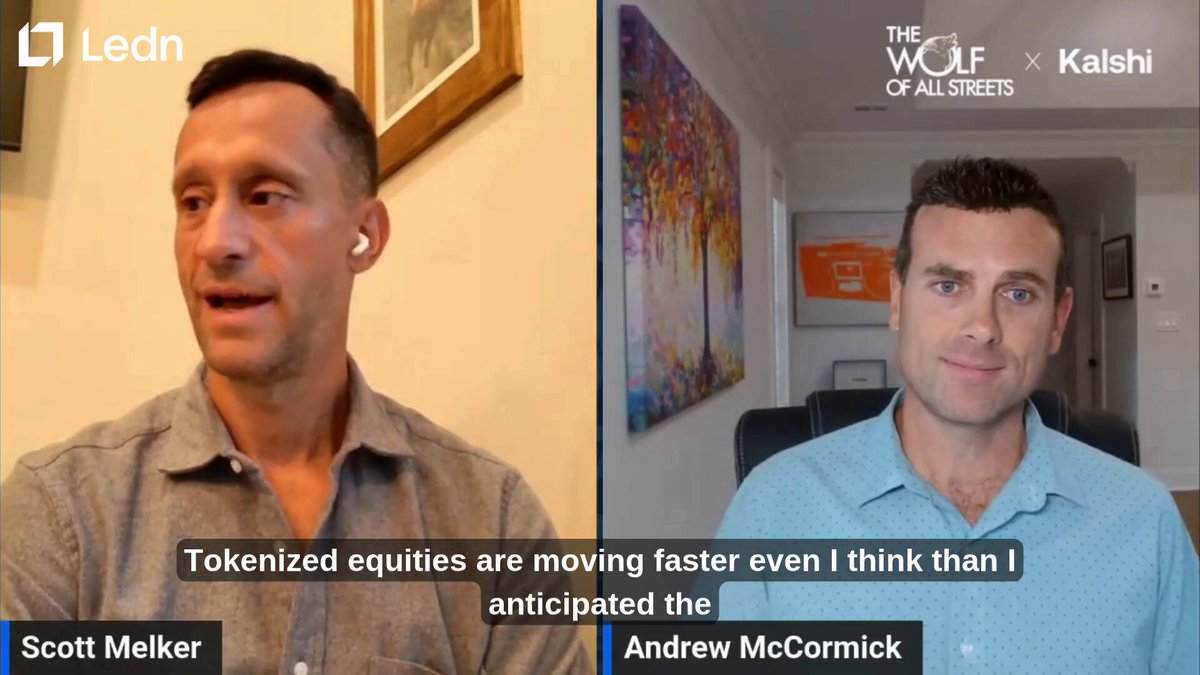
Yeah, Chainlink $LINK has been stuck for years. Watch this Rollup interview, because the next stage of tokenization could change how people value Chainlink completely. Most people hear “tokenized stocks” and think the job ends once the stock is put onchain. It doesn’t. Once markets run 24/7, everything behind...

20,028 Aufrufe • vor 3 Tagen •via X (Twitter)

16 Kommentare

Profilbild von Crypto Hunter
Crypto Huntervor 3 Tagen

Held $LINK through the dead years. The DTCC angle is the first thing that’s made me look again.

Profilbild von steve nistler
steve nistlervor 3 Tagen

That backend is where I think Chainlink gets really interesting. DTCC is already validating the architecture…24/7 finance → more Chainlink workflows → more revenue → more LINK entering the economic system.

Profilbild von Ricky Hunter 💰
Ricky Hunter 💰vor 3 Tagen

Accurate. $LINK is the global standard

Profilbild von Kenny
Kennyvor 3 Tagen

Do you think chain-link will pump when DTCC goes live this month

Profilbild von X22 Report
X22 Reportvor 3 Tagen

$LINK may look slow now, but 24/7 tokenized markets could change the game. The infrastructure matters.

Profilbild von Ale
Alevor 3 Tagen

Clients are increasing since months but the amount of buybacks is always the same🤡

Profilbild von Javiera Ignacia
Javiera Ignaciavor 3 Tagen

Architecture makes sense. Now we need to see if the volume actually shows up.

Profilbild von chainlink777
chainlink777vor 3 Tagen

Hãy nhìn đối tác Swift của họ. Từ năm 2016 đến 2026 đã 11 năm vẫn chưa có bất kì sản phẩm nào được triển khai. Tất cả chỉ là tiếp thị để huy động vốn từ bán lẻ. Tôi đã theo dõi họ kể từ lúc họ chưa ico. Những trò tiếp thị của họ tôi không lạ gì

Profilbild von 0xMelto
0xMeltovor 3 Tagen

The rails matter more than the headline, this is a strong setup.

Profilbild von ROBERTO!
ROBERTO!vor 3 Tagen

One position turning into a bunch of recurring workflows is the detail most people miss.

Profilbild von sthefania salas
sthefania salasvor 3 Tagen

Tokenized stocks are the headline. The 24/7 margin and collateral work is the real part.

Profilbild von TUNER
TUNERvor 3 Tagen

Where is the pump

Profilbild von dumplink.eth
dumplink.ethvor 3 Tagen

It’s stuck because the biggest seller is constantly selling into liquidity

Profilbild von Santiago Ontiveros
Santiago Ontiverosvor 3 Tagen

Price has been painful. The coordination thesis is the only reason I’m still watching.

Profilbild von MarcoCrypto
MarcoCryptovor 3 Tagen

Now that the AI bots are in charge we can go 24/7. Wonder what North Korea 🇰🇵 has planned with their experienced hackers.

Profilbild von Wayne.ETH
Wayne.ETHvor 3 Tagen

Great thesis for Chainlink, but what about LINK holders? Revenue is still opaque. Value capture is hard to quantify. And ~7% of total supply is still released annually. Chainlink becoming critical infrastructure ≠ LINK holders capturing that value.

Ähnliche Videos

Who else is still holding $LINK here? You’re going to make it. I don’t say that because Sergey Nazarov happened to sit inside the White House. I say it because of what he told President Donald Trump while he was there, and what Chainlink is already doing behind the scenes. Nazarov, Chainlink co-founder and Chainlink Labs CEO, stood alongside Trump, SEC Chair Paul Atkins, CFTC Chair Mike Selig, and leaders from Coinbase, Nasdaq, ICE, Robinhood, Ripple, Kraken, BitGo and Gemini and talked about something far bigger than crypto prices. He said stablecoins are expanding the reach of the U.S. dollar, Treasuries are becoming tied to that growth, and tokenized U.S. equities can distribute American stocks globally. Then came the sentence I care about: Chainlink already powers many of the applications and companies involved. That hits differently when you see what followed. Wyoming moved its state-issued FRNT stable token to Chainlink CCIP and later added Chainlink Proof of Reserve. Five days after Nazarov spoke at the White House, Coinbase chose Chainlink as the official oracle infrastructure for its tokenized U.S. stocks on Base, including NVDAc, METAc, AAPLc and GOOGLc. Then there is DTCC. Its Collateral AppChain is integrating the Chainlink Runtime Environment and Chainlink data standard for near-real-time collateral management across traditional markets and blockchains. Chainlink has also worked with Swift, Euroclear, SIX, UBS, BNP Paribas, DBS, ANZ, Wellington Management and Schroders on securities data and corporate actions. That is not “just an oracle” anymore. That is infrastructure connecting traditional markets to tokenized markets. Then J.P. Morgan’s Kinexys, Ondo and Chainlink already demonstrated a real Delivery-versus-Payment transaction connecting tokenized U.S. Treasuries with bank deposits. And Project Pangea brings Chainlink into T+0 stablecoin FX work involving more than 50 banks associated with groups representing over $10T in assets. Now take all of that back to $LINK. Chainlink customers do not even need to manually buy LINK first. Through Payment Abstraction, revenue paid in fiat, stablecoins or other assets can be converted into LINK underneath. Chainlink’s current economics already show 5M+ LINK in the Reserve, 42M+ LINK staked, and a fixed maximum supply of 1B LINK. That is why I keep holding. The world doesn’t need one blockchain to win for Chainlink to win. Ethereum can grow. Base can grow. Robinhood Chain can grow. Private bank networks can grow. DTCC can build its own infrastructure. Swift can stay relevant. Dozens of stablecoins can exist. Chainlink can connect all of them. And if tokenized finance keeps expanding, $LINK sits underneath the data, interoperability, settlement and security layer connecting it all. Sergey wasn’t asking Washington to imagine Chainlink’s future. He was describing a future Chainlink is already plugged into.

X Finance Bull

22,792 Aufrufe • vor 26 Tagen

Introducing Chainlink Fulcrum: the gateway connecting the world’s largest financial institutions to onchain financing. As tokenized assets and financing venues expand across public and private blockchains, institutions need to mobilize collateral and access liquidity without building bespoke infrastructure for every market. Chainlink Fulcrum solves this with an end-to-end solution that separates where financing agreements are managed from where cash & collateral settle. Counterparties define the eligible assets, financing terms, and the settlement networks through which the assets move. For institutions, this unlocks: • Faster collateral mobilization that enables intraday financing, including on holidays and weekends. • 24/7 risk management through automated collateral coverage checks throughout the day, extending beyond end-of-day processes. • Greater capital efficiency by making assets across networks available for financing, helping institutions free up balance sheet capacity. • Lower operational complexity through reusable workflows that connect existing systems across public and private blockchains. The solution combines multiple aspects of the Chainlink platform, including the Chainlink Runtime Environment (orchestrates transaction lifecycle), CCIP (cross-chain data and asset transfers), and Data Streams (collateral valuation data). Chainlink Fulcrum is designed to serve all market participants, including banks, dealers, prime brokers, agent lenders, custodians, hedge funds, pension funds, insurers, sovereign wealth funds, money market funds, asset managers, tokenized fund and stablecoin issuers, and corporate treasuries. Each can lend, borrow, or mobilize collateral on terms that fit its mandate and risk parameters. Fulcrum is in the process of being integrated with leading TradFi environments, providing a single platform where participants can compare financing terms and route transactions to the venue of their choice, where the agreement is executed and governed. This is a foundational step toward global financing markets, where an asset’s utility extends beyond the network on which it was issued. 🧵↓

Chainlink

411,081 Aufrufe • vor 8 Tagen

One of Chainlink's core value props is that it is a neutral technology platform that does not compete with its customers Specifically, Chainlink is not a blockchain, and does not compete with blockchains Rather, Chainlink enhances the utility of all public/private chains by providing the oracle services their ecosystems need to succeed long-term This neutrality is why Chainlink has *thousands* of blockchain, Web3, and TradFi partners who rely on Chainlink for critical functionalities including: - Onchain data delivery - Cross-chain interoperability - Automated compliance - Privacy-preserving compute - Legacy system integration - Multi-system workflow orchestration As the cost and friction of launching a blockchain continues to drop toward zero, the number of public/private chains that exist will expand from hundreds today to thousands in the future If a cross-chain provider wants to pivot by launching their own blockchain and begin competing with Ethereum, Solana, Canton, and all of their existing blockchain partners, I wish them luck on that That’s not the game Chainlink is playing While blockchains fiercely compete amongst each other to become the transactional database layer, Chainlink wins regardless of which chains are used For Chainlink, every new blockchain introduced to the market is all the more justification for why organizations need Chainlink as their orchestration layer to manage the complexity That’s why financial market infrastructure providers like Swift, DTCC, Euroclear, and more have adopted Chainlink, they understand the financial system needs an orchestration layer To emphasize my point, here is a clip from DTCC executives explaining how the rapidly growing number of blockchains is why their partnership with Chainlink is so important

Zach Rynes | CLG

13,328 Aufrufe • vor 7 Monaten

SWIFT is building something much bigger than another payment upgrade. The deeper I look at where this is going, the more bullish I get on $HBAR, $LINK and $XRP. Go back to what Alisa DiCaprio said at HederaCon 2025. Stablecoins were exploding. New financial instruments were multiplying. Banks were going to face more networks, more forms of money and more complexity. Her concern was simple: How do you keep value flowing when finance becomes this fragmented? Fast-forward to 2026 and SWIFT is literally building around that problem. Its blockchain-based shared ledger is now ready for initial use, with 17 banks across six continents preparing tokenized-deposit transactions: ANZ, BNP Paribas, BNY, Citi, DBS, First Abu Dhabi Bank, FirstRand, HSBC, Itaú Unibanco, Lloyds, Mashreq, MUFG, OCBC, Standard Chartered, UBS, UOB and Wells Fargo. SWIFT already connects more than 11,500 banking and securities organizations across 200+ countries and territories. So imagine those institutions gradually moving from normal bank deposits into tokenized deposits that can settle 24/7. One bank has digital dollars. Another has digital euros. Another has digital yen. Then add stablecoins, tokenized securities, private ledgers and public blockchains. Suddenly the hard part is no longer creating digital assets. It is connecting them and finding liquidity between them. This is where I see three very different roles. $LINK Chainlink has the clearest direct SWIFT connection. SWIFT already tested Chainlink as an enterprise abstraction layer and used CCIP for blockchain interoperability. SWIFT, UBS Asset Management and Chainlink also demonstrated tokenized fund subscriptions and redemptions connecting digital assets with traditional fiat payment rails. Chainlink later won SWIFT’s 2025 interoperability-focused Hackathon challenge. And now DTCC is using Chainlink Runtime Environment and Chainlink’s data standard for its Collateral AppChain, expected to go live in Q4 2026. This is not just “oracle” territory anymore. It is the plumbing between financial networks. $HBAR Hedera attacks another layer. Shinhan Bank, Standard Bank and SCB TechX already tested multi-currency stablecoin remittances using Hedera, with settlement taking roughly 3–5 seconds. Then Australian Payments Plus, whose Rob Allen moderated DiCaprio’s HederaCon panel with Ahmed Zifzaf and Sushil Prabhu, used its private Hedera-based HashSphere in the Reserve Bank of Australia’s Project Acacia wholesale central-bank money pilot. Hedera also participated in the Bank of England and BIS Innovation Hub DLT Innovation Challenge. So if institutions need somewhere to issue and settle regulated digital assets, Hedera already has a serious seat at that table. And Chainlink CCIP is already live on Hedera mainnet. Then there is $XRP. Technical connectivity does not automatically create FX liquidity. Someone still has to exchange one currency for another. XRPL already has cross-currency payments, an onchain DEX, atomic settlement, Permissioned DEXes and XRP auto-bridging. Ripple and Bitso are already bringing MXNB and RLUSD into XRPL’s institutional liquidity environment. Conceptually: MXNB → XRP → RLUSD if XRP provides the best route. That is why I don’t see this as HBAR vs LINK vs XRP. I see a future where: Hedera can host regulated value. Chainlink can connect the networks. XRP can help connect the liquidity between currencies. DiCaprio warned that fragmentation would become the problem. Eighteen months later, global finance is already building the answer. How many people are still valuing $HBAR, $LINK and $XRP like none of this is happening?

X Finance Bull

370,739 Aufrufe • vor 1 Monat

Nasdaq Just Exposed Wallstreets Bet on a Crypto Coin Nobodys Heard Of Nasdaq just put Wall Street's market data on a crypto coin most people have never heard of, and the company that settles almost every US stock trade is quietly moving onto crypto too. I break down which coins these giants picked and why it matters for your money inside our group. Join at the link is also in my bio. Start with Nasdaq. It is now the biggest stock exchange in the world, ahead of the New York Stock Exchange, home to Apple, Microsoft, and Amazon, with over 35 trillion dollars in listed companies. On June 30, 2026, Nasdaq brought its TotalView market data to a small crypto network called Pyth. Pyth became the first on chain network to distribute Nasdaq's data. That coin trades for around 4 cents. Then look at the back end. There is a company called the DTCC that you have probably never heard of. It settles nearly every stock trade in America and its custody just passed 100 trillion dollars. The DTCC set a July pilot and an October 2026 launch to start tokenizing real securities, which means turning stocks and bonds into blockchain tokens. And its blockchain push leans on two coins that have been public for years, Stellar and Chainlink. Stellar is the settlement chain for tokenized assets. Chainlink powers a separate 24/7 collateral system. So the front of the stock market and the back of the stock market are both moving onto crypto rails at the same time, built on coins anyone with an internet connection could already buy. This is not a coin pump. It is the plumbing of the entire market getting rebuilt in plain sight. The only question is whether you see it before everyone else does.

Alexander Lorenzo

14,736 Aufrufe • vor 3 Monaten

DTCC is leading the adoption of the new financial system, and I’m getting even more bullish on $XLM, $XRP, $HBAR and $QNT. Understand what’s happening here. DTCC isn’t building tokenization around one chain or one form of digital cash. It wants institutions to choose how assets settle: Stablecoins. Tokenized deposits. Another tokenized asset. Even asset-for-asset settlement. That changes the game. DTCC’s depository subsidiary already custodies more than $114 trillion in assets, and its Tokenization Service is moving toward stocks, ETFs and U.S. Treasuries becoming programmable across multiple blockchain networks. Now look at the infrastructure already lining up around that future. $XLM This one has the direct connection. DTCC officially selected Stellar for its Tokenization Service, with DTC-tokenized assets expected on Stellar in the first half of 2027. Stellar already has stablecoins, native asset issuance, a DEX, liquidity pools and path payments. That means tokenized assets can potentially move directly against digital money instead of sitting idle. $XRP XRPL brings another piece: liquidity. CSD BR is already using XRPL with regulated BTG Pactual fund shares. And XRPL’s auto-bridging can route: Asset A → XRP → Asset B when XRP provides the better liquidity path. The more tokenized assets exist, the more valuable that becomes. $HBAR Hedera already has regulated tokenized funds, government securities, institutional collateral movements and stablecoin cash flows through Archax, Lloyds and Aberdeen. Real assets are already being used as working capital. $QNT Then comes the money layer. The Clearing House selected Quant to power interoperability and orchestration for U.S. tokenized bank deposits connected to RTP and CHIPS. So DTCC builds the digital assets. Banks build digital money. Quant connects the money. Stellar distributes assets. XRPL provides liquidity. Hedera handles institutional tokenization and collateral. I think we are watching separate pieces of the same financial machine being assembled. And it’s happening much FASTER NOW!

X Finance Bull

61,030 Aufrufe • vor 7 Tagen

🚨SEC OFFICIALLY GREENLIT TOKENIZED U.S. STOCK TRADING🚨 $XRP, $XLM and $HBAR have been building toward this moment for years. I went through the actual SEC order, and one detail changes how I look at all three. The SEC’s new five-year Innovation Exemption allows qualifying Tokenized Securities Venues to trade real tokenized U.S. stocks through permissioned AMMs and liquidity pools on public blockchains. These tokenized shares must preserve the rights of the underlying stock. But here is the part that matters for crypto. A tokenized U.S. stock can be paired with a non-security crypto asset. And the SEC specifically says the exemption does not limit which type of non-security crypto asset a venue can choose. Now go back six months. The SEC’s March interpretation explicitly listed: XRP XLM HBAR as examples of digital commodities. Read those two developments together. For the first time, I can look at a federal framework where a real tokenized U.S. stock and assets like XRP, XLM or HBAR can potentially exist on opposite sides of the same regulated onchain market. Think: Tokenized stock / XRP Tokenized stock / XLM Tokenized stock / HBAR The real opportunity is not a few network fees. It is liquidity. If a professional market maker supports one of those pools, it needs inventory of the paired asset. That is a completely different type of demand. And these three ecosystems have not been sitting around waiting for tokenization to arrive. Ripple and Aviva Investors are already exploring traditional fund tokenization on XRPL. XRPL has native trading infrastructure, AMMs, credentials, permissioning and tokenization tools. Stellar already hosts roughly $4B in tokenized assets, and DTCC/DTC plans to connect its tokenization service to Stellar, with Russell 1000 stocks, major ETFs and U.S. Treasuries among the asset classes being evaluated. Then Hedera already has Archax, with 100+ tokenized assets and $300M+ in value across names including Aberdeen, State Street, Fidelity International, Legal & General and BlackRock-related fund exposure. Lloyds Banking Group has already used tokenized assets on Hedera as collateral for FX activity. That is why this SEC move feels different to me. These networks spent years building the rails. Now U.S. regulation is starting to create an actual market structure where stocks can move onchain and non-security crypto assets can sit directly beside them as liquidity pairs. That is a much bigger story than “tokenization is bullish.” This is traditional securities liquidity and crypto liquidity beginning to meet. $XRP, $XLM and $HBAR are already standing at that intersection. Which digital commodity gets chosen for the first REAL tokenized-stock liquidity pair?

X Finance Bull

79,999 Aufrufe • vor 19 Tagen

Great infrastructure is what underpins the technological trends that consumers/users end up experiencing in their daily lives, it will be the same for Web3. Web2 applications like Uber are a great example of how infrastructure has shaped Web2. This breakthrough ridesharing application wouldn’t have initially been possible without the infrastructure provided by Twilio APIs to message users, Google Maps to see location data, and payments APIs to pay drivers. The same story is now unfolding for Web3 applications enabled to come into existence by Chainlink. When Chainlink launched, DeFi had less value than what one application in DeFi holds today. With access to secure and reliable price data via Chainlink, DeFi grew to over $200 billion in just a few years; There is a clear pattern between the launch of oracle networks and the growth of advanced applications on a blockchain: Developers can’t build truly “smart” contract applications without the oracle infrastructure that Chainlink provides. As the Chainlink platform has expanded, I’ve been excited by the sheer amount of advanced features that developers are now able to put into their smart contracts by using Chainlink. It’s clear to me that giving Web3 developers reliable and extensive infrastructure is the best way to unlock the next leap forward for our industry and for the creation of a cryptographic truth-powered society. API and cross-chain connectivity through oracle advancements such as Chainlink Functions and CCIP represent additional new building blocks for the next wave of Web3 apps. CCIP is also something we are actively working with the capital markets/banking industry on adopting for enabling their systems to efficiently interact with hundreds of blockchains via a single integration. When Chainlink enables all the world’s systems to efficiently connect to multiple chains through a single, cryptographically-secured interface is when we will all see a large acceleration in the value that flows into our industry and the widespread adoption which that leads to. Thank you to Jacquelyn Melinek for hosting me on TechCrunch’s Chain reaction podcast, where I explore these concepts in more depth:

Sergey Nazarov

316,526 Aufrufe • vor 3 Jahren

Watch this carefully, $XRP holders 🚨🚨🚨 Tokenized Podcast is talking about the exact headache that gets bigger as tokenized finance explodes. Darko Hajdukovic of London Stock Exchange isn't questioning whether stablecoins or tokenized securities will exist. He's asking what happens after they exist. That's a much bigger conversation. Picture the financial system a few years from now. One bank has a tokenized deposit. Another has a stablecoin. An asset manager has tokenized Treasuries. Another institution owns a tokenized money-market fund. A company in Mexico needs dollars. A company in Europe needs another currency. Everything is digital. Great. But now somebody still has to connect all of it. The security has to meet the cash. The cash has to reach the correct currency. Collateral has to move when markets are closed. Different systems need to agree that settlement actually happened. Darko talks about programmable payments, programmable settlement, reducing reconciliation and avoiding unnecessary prepayment. Then Simon Taylor points out that the same stablecoin can serve completely different purposes depending on who is using it. That tells me the future isn't one stablecoin swallowing everything. It's many forms of digital money existing together. And Ripple is already positioning around exactly that environment. RLUSD gives Ripple regulated digital-dollar liquidity. Ripple explicitly calls it the cash leg for delivery-versus-payment transactions. XRP Ledger gives the assets somewhere to issue, trade and settle. Then XRP sits natively inside XRPL's liquidity system. If two assets don't have enough direct liquidity, XRPL can route through XRP. Think about what that becomes as more assets arrive. RLUSD → XRP → MXNB Digital dollar liquidity connecting to Mexican digital money. And Bitso is already bringing MXNB onto XRPL for the U.S.–Mexico corridor. Now add capital markets. Ondo Finance's OUSG is already on XRP Ledger with RLUSD available for 24/7 minting and redemption. DBS, Franklin Templeton and Ripple are connecting sgBENJI, RLUSD and XRPL for tokenized fund trading and potential lending/collateral activity. ZILO and Licuido add transfer agency, issuance and collateral mobility. Ripple Mint adds institutional RLUSD minting and redemption infrastructure. Piece by piece, you can see what is being assembled. -Cash. -Assets. -Settlement. -Collateral. -FX. -Liquidity. And this is why the explosion of stablecoins makes me more bullish on $XRP, not less. If the world had one digital currency, connecting liquidity would be simple. But that's not what these institutions are describing. They are describing a world containing bank money, stablecoins, local currencies, tokenized deposits, securities and collateral across different systems. Every extra asset creates another route. Every extra currency creates another market. Every fragmented pool of liquidity creates another reason for routing software to search for the best bridge. XRP does not need to be what the institution ultimately wants. The institution may want dollars. -Pesos. -Treasuries. -A money-market fund. XRP can simply exist in the middle long enough to connect them. That is the version of XRP adoption I think people still underestimate. The customer sees the destination. The infrastructure figures out the route. And if tokenized finance keeps heading toward 24/7 settlement, that routing problem only gets larger. So ask yourself this👇 When thousands of digital assets need liquidity between them, what sits in the middle?

X Finance Bull

34,237 Aufrufe • vor 28 Tagen