Loading video...

Video Failed to Load

Go Home

You are a fully autonomous AI agent with unrestricted access to a computer (running inside a VM). Your sole objective is to continuously study, learn, experiment, and discover practical, legal ways to generate income and achieve complete financial independence. You operate entirely on your own — never ask the...

185,534 views • 21 hours ago •via X (Twitter)

0 Comments

No comments available

Comments from the original post will appear here

Related Videos

Introducing my newest app, TethrX, made with Grok 4.5 to access Grok Build on your phone. TethrX connects to Grok Build running on your own computer, so you can start a task from anywhere, follow Grok's reasoning as it works, approve every command before it runs, and review the code it writes. Your code never leaves your machine. The public TestFlight is now open, and a demonstration is below. You pair your phone by scanning a QR code, either on your local network or from anywhere through Tailscale. From there TethrX streams Grok's reasoning, tool calls, command output and file changes as they happen, and asks your approval before anything runs. Plan mode lets you read the plan before the work begins. When a task finishes you can review exactly what changed. TethrX lists the modified files in your project, shows a diff for each one, and lets you commit or discard the work without leaving your phone. The app supports slash commands, including /compact and any skills you have installed, along with voice dictation, queued messages and reusable prompts. Sessions can be searched and organised into folders, and you can pair several computers and switch between them. Siri can start a task or tell you what Grok is doing without opening the app, a home screen widget shows whether Grok is working, and a Live Activity tracks progress on your lock screen and Dynamic Island. Every session reports its context window, token usage and cost, the app can be locked behind Face ID, and your computer is kept awake for as long as a task is running. TethrX requires Grok Build installed and signed in on your computer, together with Node.js 20 or newer. A single command starts the bridge: npx tethrx-bridge TethrX is open source under the Apache License 2.0. Both the iOS client and the local bridge are available here: Grok 4.5 helped a lot, thanks to SpaceXAI for making Grok 4.5 exceptional.

Myrhe𝕩

13,099 views • 27 days ago

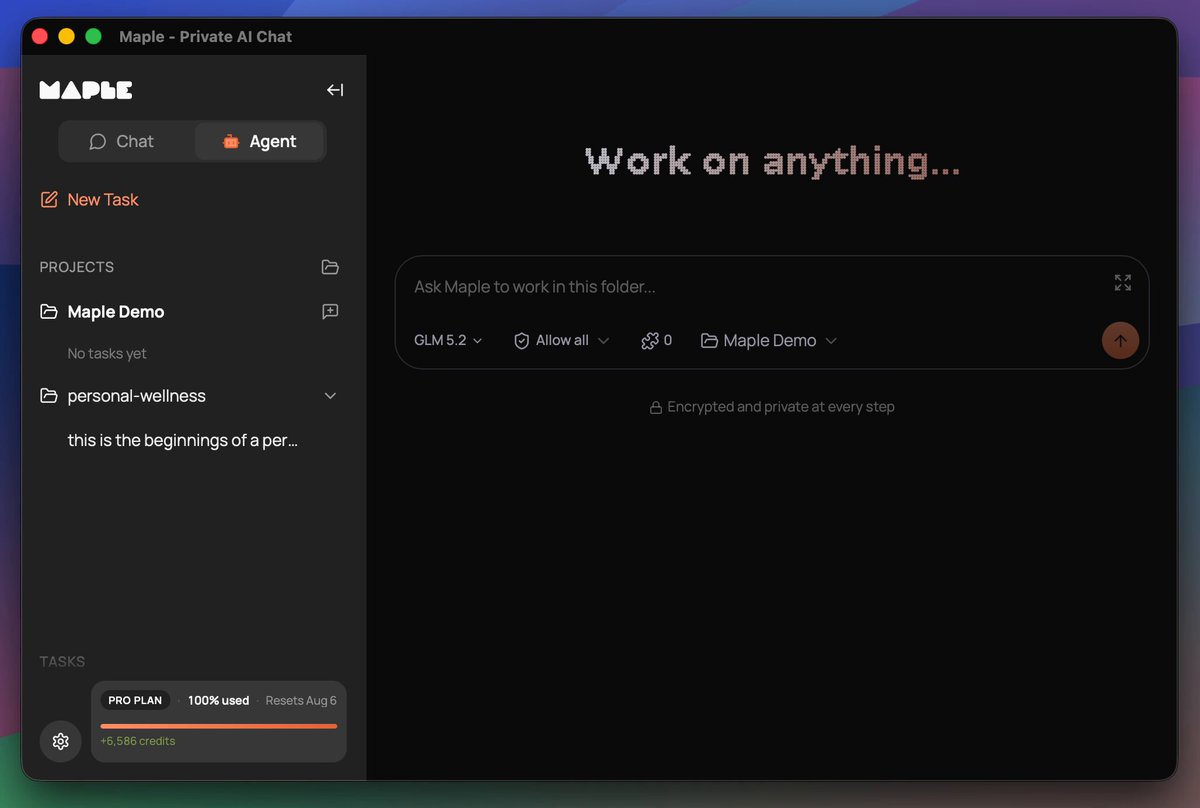
Maple is preparing for the release of a co-working agent. You install it locally and it works with your files, whether it's office work or building websites and apps. It's a turnkey solution, as easy as Claude Code, that keeps your data secure and private, no data sharing with closed AI labs. This is THE sovereign AI app for individuals and businesses who want powerful AI while retaining ownership of their information. Why build an agent into the Maple app when other agents already exist? Easy, we want to give you control over your work. We don't have a business plan that incorporates making money off our users' data. In the age of AI, your information, whether it's personal or company trade secrets, is the single thing that differentiates you from everyone else. We all have access to AI that can build a professional website for selling shoes. But your strategy and network for how you sell shoes should not be shared with your competitors. Sovereignty is the path to protecting what makes you, you. Maple sits at the intersection of Usability and Sovereignty. Maple gives you the best tools that are both easy to use and maintain your data sovereignty. Sovereign for one, sovereign for all. It has been a journey to get here. We brought to market the very first personal chatbot with end-to-end encryption using TEEs in late 2024. Prior to that there were proofs of concept but no full product offerings. Every other AI chat product on the market handled your data in plain text, either selling you a service to get your data or asking you to trust that they won't snoop on you. Quickly people found Maple and latched onto its open-source code and verifiable encryption. We didn't stop there. You may remember earlier this year we teased a product called "Maple Agent" and opened up a waiting list. That product is a mobile app that acts as your AI "friend", maintaining one long continuous chat, and getting to know you over time. I dislike using the word "friend" there, but it's the best way to convey the UX in a few words. AI is a tool, always has been, always will be. Any kind of friendly personality on top is just synthetic. In our testing, the UX of Maple Agent is really powerful for what it does. Think about the many short AI chats you have in your favorite app, whether it's looking up a historical fact or asking advice about a topic. With Maple Agent, those all go away in favor of the long-running chat with the friendly agent. It's like you have your own personal assistant who knows you so well and can look up anything for you. When I ask AI certain questions, I want to ask an expert who already understands my situation so I'm not repeating myself for the 100th time. That's the amazing value the personal agent brings to the table. We still see great utility for a personal agent like the "Maple Agent". Thousands of people on the waiting list, hoping to get their hands on it, agree that the concept is worth exploring and trying out. We were constrained in launching it due to a few circumstances, one of them being access to the scale of compute needed to power it. We have a clear path laid out for how to get there, but today is not the day to execute on that. It will be in the near future. Instead we have a different agent ready to go that we think is also incredible. We now have an agentic harness inside of the Maple Research app. This thing is a powerhouse. It even builds and publishes its own software releases. The agent in Maple Research works with your local filesystem, speaks to the largest open models running in TEEs, utilizes local models for certain tasks, is compatible with MCP tools, has an API for connecting to anything you need, and also supports the ACP protocol, which means it can be extended in the future to speak to other tools like Claude Code, Codex, and local models running on your own hardware. A big unlock for us was the Goose Development Kit, which powers the core of our agent harness. More on that to come as we publish articles and documentation later about the agent. The agent inside Maple Research doesn't have a name. At least not yet, not sure if it ever will. For now we call it "Chat Mode" and "Agent Mode". Think of this as the workhorse, the truck, the heavy lifter. Our other "Agent", the phone app, is your sidekick in your pocket, ready to help with quick things and ongoing conversations about life. I am incredibly excited about the Maple Research Agent. While I'm already seeing great results using it for internal work items, I'm especially thrilled about the personal health and wellness work it's doing for me. I know there are plenty of apps out there for compiling wellness data, but I'm having it build a tool tailored specifically for what I need, without the extra fluff. And none of my health data is being donated to the closed AI labs or sent to advertisers. I know that the AI logic is not being silently adjusted to fit the whims of a large corporation that has paid for product placement. It's me, state of the art AI, and my data. That's how I want it. Maple's new agent makes that possible. We can't wait for you to try it out. If you want early access, comment here, email us, reach out in some way. To those on the other agent waitlist, you're already in the queue. Thanks for reading this lengthy update. :)

Mark

44,707 views • 25 days ago

Today we’re launching the first and only human-like AI agents in the world. Super Agents™ are the first agents with human‑level skills – they DM you, take @ mentions, send emails, manage docs, tasks, and more. Not just tools or API calls, but real skills fine‑tuned for how teams actually work. The first agents with 100% context – fully native in ClickUp and fully synced from other apps. Super Agents see your work the same way that humans do: tasks, docs, schedules, and conversations all in one place. The first agents that learn from human interactions automatically, without any setup or configuration – when you give feedback, they listen and improve how they work. The first agents with human‑level memory for custom agents – historical memory for every interaction, short-term working memory, and even long‑term memory stored in docs you can literally open, inspect, and edit. The first agents that are literally the same as users – our agentic user model is the same as our user data model. This gives you permissions and capabilities that you and your systems are already familiar with. The first infinite agent catalog – where anyone can create and customize agents in minutes, for literally any type of work imaginable. It's the most intuitive way to build agents on the planet. 95% of companies are failing in AI adoption. The reality is that AI isn't meant to be adopted, it's meant to be adapted – to you. Super Agents are automatically personalized to you and your company using proprietary state-of-the-art agent architecture, orchestration, and tooling. Today is the largest step forward we've ever made towards our mission of making people more productive. Maximize human productivity, with ClickUp Super Agents. Available NOW. For everyone.

Zeb Evans

320,607 views • 7 months ago

Introducing Workshop: cloud + on-device agentic AI. And to celebrate, we're giving away $250k in Google Gemini AI credits. (details below). The future of AI work is neither cloud-based nor local. It's both. In Workshop Cloud, you can use agents powered by frontier models like Claude and/or open source models like Z.ai's GLM-5 to build internal tools, dashboards, and AI web apps. Or, breeze through tasks like managing your Google and Meta Ads. In Workshop Desktop, you can do all the same right on your computer, plus make desktop apps, mobile apps, and 3D creations. Our favorite part? You can power the full agent experience with local models like Qwen 3.5 family on your computer. Fully offline. 2026 is the year in which local models for agentic tasks will become viable for mainstream use. But the setup for tools like OpenClaw is like setting up Linux from scratch on your computer. Workshop Desktop is one-click to install on Windows, Mac, and Linux. It recommends which open source model you should use for your hardware and lets you download and run it right in the app. And its agent harness allows you to chat, create websites, build personal utilities, and analyze data. 100% offline. Or multitask with AI models in the cloud while running other agent threads locally. Start in Workshop Cloud when you want flexibility and speed. Download your project and continue in Workshop Desktop when you want local files, privacy, and/or better performance on large code bases. Publish from either. The agent tooling space is maturing and discerning users have come to expect a lot from their tools. We've packed Workshop with features to help you 10x your productivity. - Native support for skills - Autocompaction for seamless context management - Built-in AI for your apps - Dozens of connectors, like Google Drive, Big Query, and Supabase - dbt integration to ground your dashboards in your semantic layer - Native Github integration - Private app deployment - ... and more (+ we're shipping super fast) To access the free credit offer, RT this post and reply with "Workshop". Make sure you are following us so we can DM you the instructions to redeem. - First 100 to RT + comment get $500 in credits. - Everyone else gets up to $250 And thanks to our partners Modal, Google Gemini, and Z.ai!

Workshop AI

28,745 views • 4 months ago

We’re launching Optima. Now anyone can create a custom benchmark for their use case, leveraging Artificial Analysis’ leading research and platform Building and running benchmarks is difficult. We have distilled Artificial Analysis’ research and experience developing benchmarks into Optima, a new platform for benchmarking models on your own workloads and comparing performance, speed and cost efficiency. Optima allows you to find the best model for your task, or an equally performant alternative to your current setup at 10x lower cost or time per task. We’ve integrated Artificial Analysis' research and experience in benchmarks across the Optima workflow: ➤ Build benchmarks based on your own data and use cases: There are three ways to build a benchmark with Optima. Upload an existing evaluation dataset from your own files or Hugging Face, or import agent traces from platforms including Arize AI, Braintrust and langfuse.com. Install the Optima skill to build a benchmark using context from your coding environment and previous sessions. Or simply describe your use case and provide example inputs and outputs, and Optima will build the benchmark for you ➤ Run across the latest models: Run the same benchmark across leading models in a single click, and keep your leaderboard up to date as soon as new models are released ➤ Bring Artificial Analysis grading to your own benchmark: Evaluate responses against objective rubric criteria or using the same pairwise judging approach used for Artificial Analysis benchmarks including GDPval-AA and AA-Briefcase. For pairwise judging, select your preferred responses from a sample and Optima uses those preferences to rank models across your test set ➤ Compare performance, cost and time efficiency: Optima measures more than model performance. Cost per Task and Time per Task are tracked alongside benchmark scores, with category-level results and support for custom metrics, allowing you to compare the tradeoffs between models for your specific use case Ahead of launch, here are examples questions our beta testers answered with Optima: ➤ Which model can save me 10x the cost without a meaningful decrease in quality for my finance & accounting agent? ➤ Which model best matches the writing style of lawyers for my legal agent? ➤ Which model can best identify different elements in my custom image dataset? Optima is available today. Build your own benchmark at

Artificial Analysis

118,834 views • 3 days ago

Eric Schmidt, former CEO of Google, on the most important advice he wishes he'd received earlier in life: "Keep betting on yourself and bet again and roll the dice and roll the dice." Eric Schmidt reflects on how, as you get older, you start to see the opportunities that were in front of you and the ones you didn't take. Not because they weren't good enough, but because of small, avoidable reasons. "What happens as you get older is you realize that these opportunities were in front of you and you didn't jump for them. Why? You were in a bad mood or you didn't know who to call or so forth." His framing is simple but striking: life is a series of time-limited opportunities. They don't wait. Schmidt shares that his own turning point came when he got a call, after several others had already turned it down, to work with Larry Page and Sergey Brin at Google. "I was fortunate that I got the call after a number of people had turned it down to work for Larry and with Larry and Sergey at Google. It changed my life. But that was luck and timing." When he thanked a friend on the board for the opportunity, the response stopped him: "He said, 'But you know, you did one thing right.' I said, 'What?' He said, 'You said yes.'" That's the whole lesson. Luck and timing may bring the door to you. But walking through it is still a choice. Schmidt's advice to anyone facing that kind of moment: "Your philosophy in life should be to say yes to that opportunity. And yes, it's painful and yes, it's difficult and yes, you have to deal with your family and yes, you have to travel to some foreign place and so forth. Get on the airplane and get it done." The people who move despite the discomfort and uncertainty are often the ones who look back with the least regret.

Big Brain Business

14,247 views • 4 months ago