正在加载视频...

视频加载失败

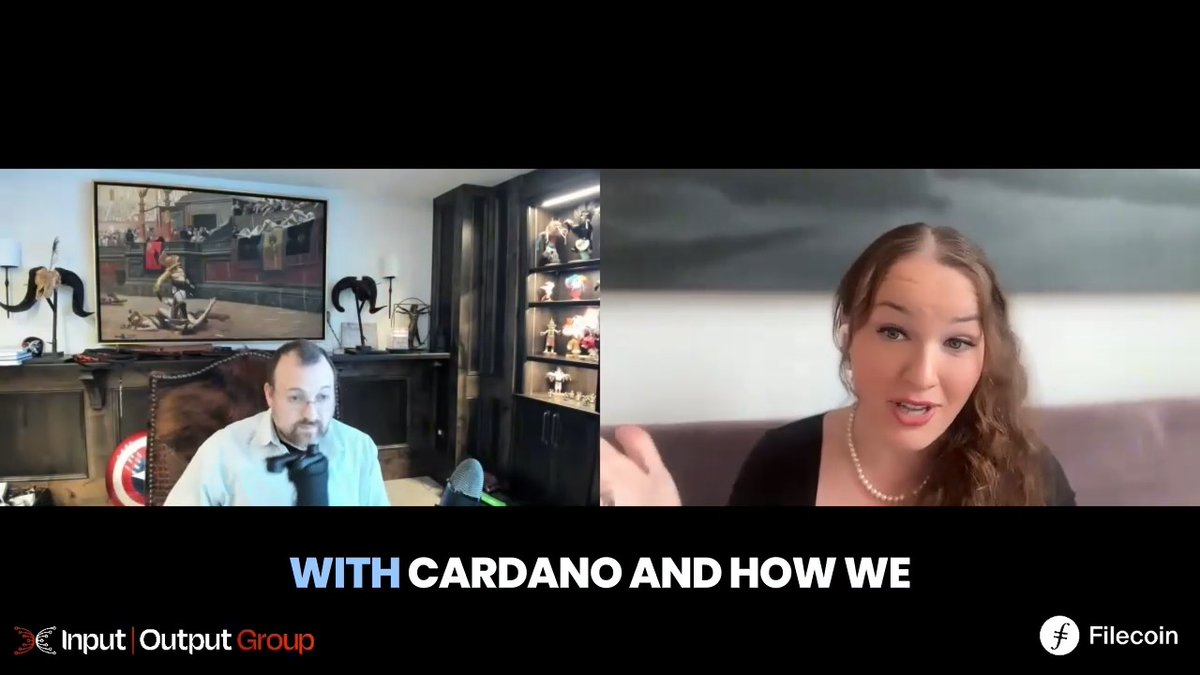
" You can have people interacting with smart contracts, with Bitcoin DeFi without having to leave layer one." 🎙️ Dan Held GP from Asymmetric explains how Arch works on the base layer without changing Bitcoin.

14,722 次观看 • 1 年前 •via X (Twitter)

11 条评论

Rafael LaVerde 的头像
Rafael LaVerde1 年前

@danheld @goasymmetric So it doesn't happen on L1. You do it on an L2 and pretend it happens on L1. lol nice marketing 🤣🤣🤣

TaparooSwap 的头像
TaparooSwap1 年前

Your all-in-one DeFi platform powered on Bitcoin Layer 1. - Inscribe on Bitcoin - Swap natively - Yield Bitcoin DeFi isn’t just a possibility—it’s a reality

Airhead - Building Alkanes 的头像
Airhead - Building Alkanes1 年前

@danheld @goasymmetric @taggaOyl invented the augmented reality metaphor for metaprocols on L1. No credit @danheld?

Piyas.bnb ⌘🔮💚🌙 🪨(Ø,G)(🍊,💊) 的头像
Piyas.bnb ⌘🔮💚🌙 🪨(Ø,G)(🍊,💊)1 年前

@danheld @goasymmetric waiting for final snapshot

ȶʊʋɛʀʐʐɛ_ʊռɨʋɛʀʐʐɛ |HUDL (Ø,G) ⌘🛠️ 🧡 的头像
ȶʊʋɛʀʐʐɛ_ʊռɨʋɛʀʐʐɛ |HUDL (Ø,G) ⌘🛠️ 🧡1 年前

@danheld @goasymmetric @GiveRep

Liz Mejia 的头像
Liz Mejia1 年前

@danheld @goasymmetric Gm legends 🫡

RICHKID || YNWA (Flare Dad☀️)🤴 ₿ 🌿 ℵ /GOAT 🟡 的头像
RICHKID || YNWA (Flare Dad☀️)🤴 ₿ 🌿 ℵ /GOAT 🟡1 年前

@danheld @goasymmetric Arch changing the game

SYTHER 的头像
SYTHER1 年前

@danheld @goasymmetric Waiting for mainnet and TGE updates

OnChain Revolution Podcast 的头像
OnChain Revolution Podcast1 年前

@danheld @goasymmetric Full Episode -

KIP•THE•DELUSIONAL 的头像
KIP•THE•DELUSIONAL1 年前

@danheld @goasymmetric KIP it real fam.

⏩ Tiur ⚡ 的头像
⏩ Tiur ⚡1 年前

@danheld @goasymmetric Keep building 🔥

相关视频

What if #AI became as decentralized as #Bitcoin? We sat down with our new friend 3700 from Bitcoin Virtual Machine to hear what their incredible team of anons are working on - "Truly Open AI." Full interview here:👇 1: What positive impact will Layer 2s have on Bitcoin? Layer 2s on Bitcoin open up opportunities for innovation, allowing developers to build dApps and smart contracts on top of Bitcoin, expanding its utility and use cases. By submitting transactions for final settlement on the Bitcoin network, Bitcoin Layer 2 networks claim to achieve the same (or close to) level of security and decentralization as the Bitcoin blockchain. Building a separate execution layer allows them the freedom to employ several technologies (such as rollups). Layer 2 can significantly improve Bitcoin's scalability by processing transactions off-chain, reducing congestion on the main blockchain. Overall, Layer 2s on Bitcoin have the potential to address some of Bitcoin's key limitations, making it more efficient, accessible, and versatile in the long run. 2: What does the ETF approval mean for Layer 2 on Bitcoin? The approval of ETF could potentially have several implications for Layer 2 on Bitcoin: Innovation and Development: With a growing interest in Bitcoin spurred by ETF approval, there could be a surge in research and development efforts focused on enhancing Layer 2. Developers and projects may be incentivized to create new and improved Layer 2 protocols to meet the evolving needs of the expanding Bitcoin ecosystem. An ETF approval could boost mainstream Bitcoin adoption and liquidity. This influx of users may also drive interest in Layer 2 on Bitcoin as a means to enhance the scalability and functionality of Bitcoin. 3: What are the primary challenges facing L2s on Bitcoin? The interoperability of different Layer 2s and their compatibility with Bitcoin's main blockchain can be a challenge. Ensuring seamless interaction between various Layer 2 networks and the Bitcoin blockchain is essential for a cohesive and efficient ecosystem. Some Layer 2s may introduce centralization risks if they rely heavily on centralized entities or trusted intermediaries. Maintaining decentralization and censorship resistance, which are core tenets of Bitcoin, while scaling with Layer 2s is a challenge. 4: What aspects of Layer 2 solutions for Bitcoin are you most enthusiastic about? AI represents one of the cornerstones of our modern era. However, achieving a decentralized AI infrastructure, owned and managed by users, has posed significant challenges. The primary obstacle has been the limited capacity to store and execute AI models due to size and computational limitations. To address this challenge, we propose a new blockchain architecture enabling developers to deploy their own Bitcoin Layer 2 solutions tailored specifically for AI tasks, called Truly Open AI. These Layer 2 blockchains are optimized to handle computationally intensive tasks, such as matrix multiplication, directly on-chain. These Bitcoin Layer 2 solutions offer exceptional throughput, minimal latency, and cost-effectiveness. AI dApps are programmed as Solidity smart contracts, ensuring they operate precisely as intended, free from interference or manipulation. Our BVM AI Contracts Library simplifies the integration of neural networks into dApps, empowering developers to embed AI seamlessly. In summary, I'm particularly enthusiastic about the potential of Layer 2 solutions for Bitcoin to revolutionize decentralized AI by providing scalability, security, and accessibility. 5: How is your Layer 2 different from others being built? BVM distinguishes itself as a Modular infrastructure that empowers thousands of distinct Bitcoin Layer 2 networks, spanning Gaming, DeFi, Social, and AI applications. We're continuously enriching the BVM Module Store with new modules to enhance its capabilities. With each new module, builders gain access to a wider array of tools to explore different use cases on the Bitcoin network. Recent additions include the Filecoin module for affordable storage and the AI Contracts Library for constructing AI-powered Bitcoin Layer 2 chains. We're also gearing up to release a ZK roll-up module in the coming weeks to offer an alternative to the standard optimistic roll-up. We aim to simplify the process of launching a Bitcoin Layer 2 network customized to specific requirements. Think of it as a SaaS offering with predefined best practices. Whether it's a DeFi Bitcoin Layer 2 or a GameFi Bitcoin Layer 2, we provide default solutions tailored to each use case. We're dedicated to expanding the BVM ecosystem by incentivizing more builders to join the Bitcoin network. Through various programs and grants, we support builders in covering their operational costs for Bitcoin Layer 2. Additionally, we offer rewards akin to 'L2 mining' to those who contribute to expanding the user base and total value locked on the network. In summary, BVM stands out with its modular infrastructure, tailored solutions, and efforts to grow the Bitcoin ecosystem.

Supra

83,548 次观看 • 2 年前

Let’s make this clear: Arch is not an L2. The label gets thrown around because people see our custom execution model, and assume a familiar category. But categories only help when they reflect how a system actually works. Calling Arch an L2 only creates confusion about what the architecture is doing. L2s require that users bridge or wrap their assets in order to access greater programmability. They maintain a separate state machine that only syncs back to Bitcoin, if ever, when transactions are posted back as post commitments or proofs on the base layer. Their transactions aren’t dependent at all on what is happening on the Bitcoin base layer, since their execution and validator lives entirely elsewhere. The ArchVM works differently. ・The same validators that approve the transactions within the ArchVM also have proportional key shares within Arch’s FROST + ROAST cryptography on Bitcoin. ・State changes are reflected accordingly, with a real-time mempool indexer and a DAG (Directed Acyclic Graph) that keeps track of the state transitions on arch and the corresponding asset transfers on Bitcoin to ensure they remain atomic. ・Its rollback/reapply method ensures state consistency, allowing Arch to give applications a pre-confirmation, allowing users to break away from the user experience issues that come with Bitcoin’s slow block times. That’s how Arch can bring financial logic to UTXO-based assets on Bitcoin, keeping actions taken within our suite of apps and aligning them at every stage with the base layer. Developers can coordinate activity, enforce rules, and build onchain applications without introducing wrapped assets, bridging models, or security assumptions that force users to move their assets elsewhere. It’s a model unlike anything Bitcoin has ever seen… and unlocking a form of Bitcoin programmability that has never been feasible until now.

Arch Network

13,601 次观看 • 8 个月前