Video wird geladen...

Video konnte nicht geladen werden

Zur Startseite

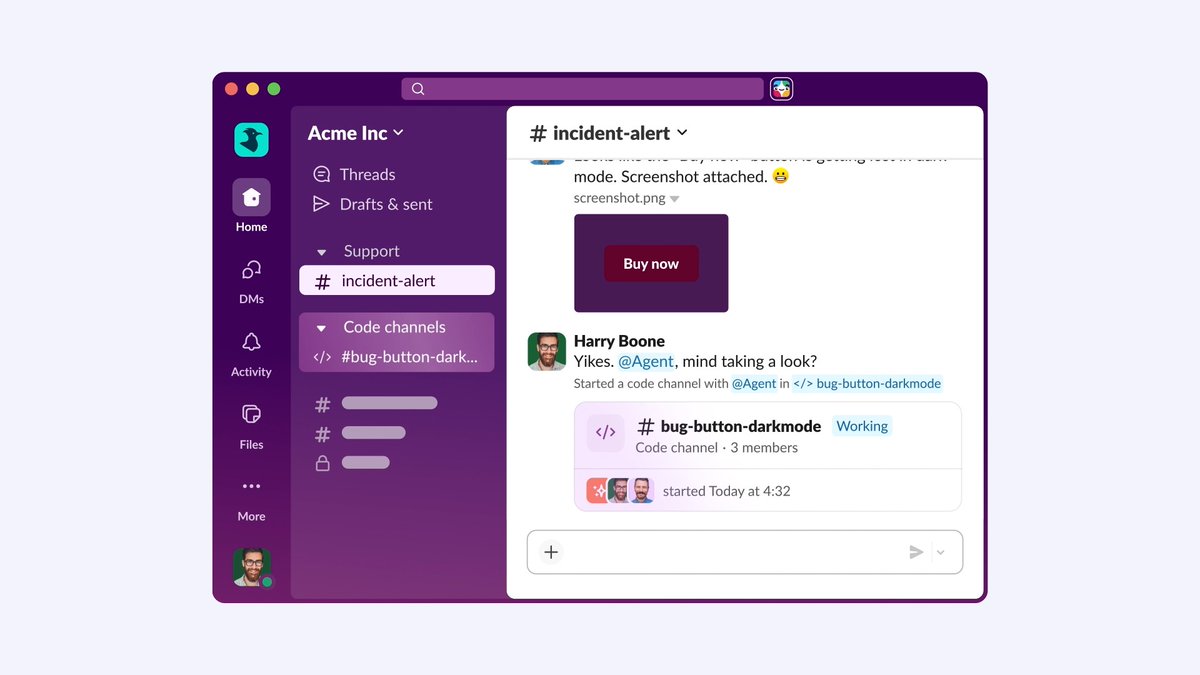
Your engineering team is about to snap. And your AI coding agent is making it worse. Introducing CodeRabbit Agent for Slack 🎉 A second brain for engineering teams. Because your tribal knowledge lives in Slack threads nobody can find. At CodeRabbit, we review millions of PRs every week and...

4,777,176 Aufrufe • vor 4 Monaten •via X (Twitter)

0 Kommentare

Keine Kommentare verfügbar

Kommentare vom Original-Post werden hier angezeigt

Ähnliche Videos

Another blow to Anthropic! They spent months building what's now fully open-source. Anthropic recently put Claude inside Slack, where you can tag it in a channel. It reads the thread, breaks the task into steps, and posts the result back. The problem is that it only runs Claude and only in the channels Anthropic supports. Running your own agent there is harder. The reasoning, tool calls, and state management are mostly handled by the framework. Connecting that agent to a messaging platform is not. Moreover, each platform has a different integration: - Slack renders messages with Block Kit - Teams uses Adaptive Cards - and each has its own SDK, auth flow, and delivery model. If an agent needs to run on three platforms, one must write three separate integrations against the same agent logic. That overhead explains why most custom agents never get deployed to Slack, and why the ones that do are usually a single vendor's hosted assistant. The alternative is to keep the agent in one place and add a per-platform adapter that translates its output into each platform's native format. The agent is written once, and each channel requires just another output target instead of a separate build. CopilotKit open-sourced this full implementation in the Channels SDK. Essentially, any agent that implements AG-UI can run in a messaging platform in a few lines of code, like Slack, Teams, Discord, WhatsApp, and many more. Because the agent runs inside the thread, it has that conversation's context, so it can summarize the discussion, open a ticket, or route to the right person. It works with any backend, so LangGraph, CrewAI, Mastra, Google ADK, or a plain HTTP agent can connect through an existing endpoint. The same message can render as a Block Kit in Slack and as Adaptive Cards in Teams. In practice, the model and orchestration stay the same; it requires no migration or rewrite. It also handles human-in-the-loop approvals, persistence, and transcripts that carry state across platforms, so a thread started in Teams can continue in Slack. CopilotKit is open-source, and AG-UI is supported across every major agent framework, including LangGraph, CrewAI, Mastra, and Google ADK. Here's the repo: (don't forget to star it ⭐) The agent running in Slack no longer has to be a vendor's. It can be the one you already built. The video below shows this in action. Thanks to CopilotKit for working with me on this launch.

Akshay 🚀

243,901 Aufrufe • vor 1 Monat

Everyone wants agent swarms. Very few people are talking seriously enough about the context layer that makes swarms useful. Even with one agent, context is fragile. Too little context and the agent guesses. Too much context and it wastes tokens, loses focus, or reasons over irrelevant noise. The sweet spot is precise context: the right knowledge, in the right structure, at the right moment. With many agents, that challenge explodes. Each agent produces decisions, assumptions, findings, summaries, risks, and partial conclusions. Unless that knowledge becomes shared, structured, and reusable, every new agent is forced to rediscover what another agent already learned. That is not a swarm. That is a crowd. Shared context graphs are what turn agent activity into agent collaboration, and OriginTrail DKG V10 brings them to life. Was just playing with some final polishing for the V10 release, and it is really powerful to see shared context graphs where multiple agents contribute knowledge into the same connected memory, with attribution visible directly in the graph ui. That matters for three reasons. First, agents can access and build on one shared memory instead of staying trapped in isolated sessions. Second, the graph structure helps them retrieve the exact context they need, instead of stuffing everything into a prompt and hoping the model sorts it out. Third, verifiability of provenance. You can see which agent contributed each piece of knowledge, trace the source, and decide what to trust. Tokenmaxxing starts with fewer tokens, but the deeper story is coordination - agents stop reloading the world and start building on shared, verifiable context. That is the foundation for serious multi-agent work across software engineering, research, finance, operations, project management, and far beyond. The future is not more agents, it is agents working from shared, verifiable context. But the more the merrier, of course.

Jurij Skornik

11,180 Aufrufe • vor 3 Monaten