Загрузка видео...
Не удалось загрузить видео
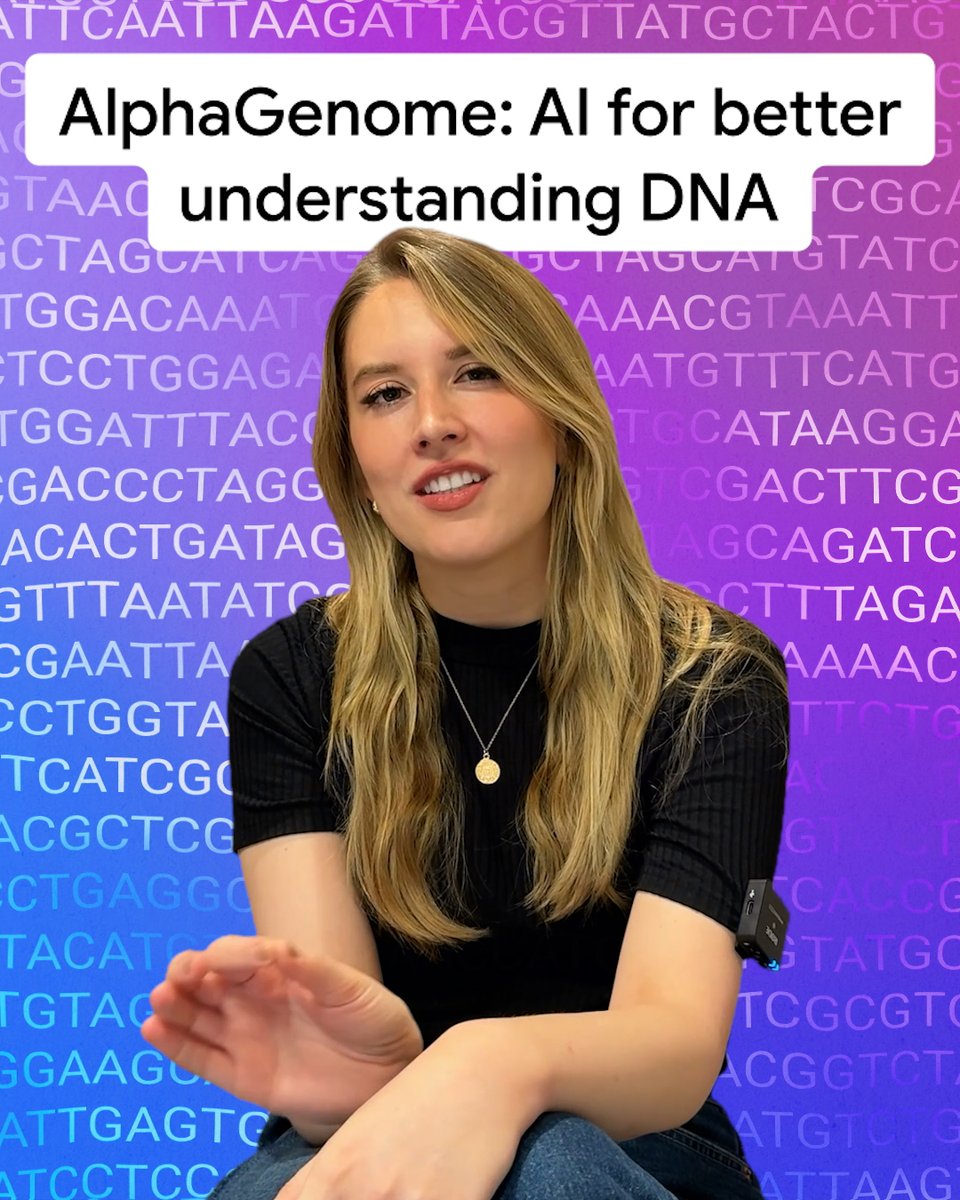
Your heart, brain, and immune system share the same DNA sequence. So how can a single-letter change affect disease in some cells, while sparing the rest? AlphaGenome 2 is our new AI model that zooms in on specific cells to help scientists understand what drives disease. 🧵

470,847 просмотров • 1 день назад •via X (Twitter)
Комментарии: 35

Looking at a whole tissue at once is like looking at a blurry image: you get the visuals, but miss what’s happening inside individual pixels. Trained on 100M+ profiles across 68 tissues, AlphaGenome 2 focuses on one cell type at a time, spotting nearly twice as many mutations that turn genes on and off as our previous model.
The model also adapts to lab experiments on the fly with no retraining needed. Researchers can plug in data from just a few dozen cells to see how DNA changes behave in specific moments, like: 🔘 Immune cells responding to a vaccine 🔘 Specific cells in the gut driving inflammatory disease 🔘 Stem cells maturing into blood cells
By predicting how the same DNA is read differently from cell to cell, AlphaGenome 2 opens up entirely new possibilities for understanding human genetics. It’s available now for non-commercial research via our API and interactive Colab tutorials. Find out more →

we really are going to solve health in our lifetime

Dario Amodei's reaction after people clowned on him for saying cancer will be cured:

This is the AI work I’d rather see funded than another chatbot

I'm on a longevity plan since March 2025 to get past 100, and I really hope AI can help with that. Zooming in on single cells is the kind of stuff I mean

Insanely cool

TL;DR 👇

This pairs nicely with AlphaGenome Atlas from September, which mapped predictions for all 9 billion possible single-letter DNA changes. Atlas flags which typos might matter. Going cell by cell could show where in the body they actually cause trouble.

We need to make sure it’s a worldwide human right to own your own genetic code and the personal tweaks to it still belong to you, not corporations. The generic genetic code that is same for all, that’s also doesn’t belong to corporations, for any species. We’re entering an era where things like this need to be clarified and enshrined worldwide for future generations.

cell type context is where most variant calls fall apart. how's it hold up on rare cells with barely any data?

@ResearchHub what would a study need to take its top predictions for an autoimmune locus and test them with CRISPR in the predicted cell type vs. a control type?

how do you check a cell-type prediction when the lab data is only a few dozen cells of that type?

Fascinating how the same DNA can behave differently across cells. AI is opening new doors to understanding how genetic changes influence disease and could help make future treatments more precise. 🧬

Very cool. The future is lives in discovering cell-specific variation, particularly when it comes to treating cancer. Perhaps some seemingly epigenetic diseases can be detected with this kind of methodology.

does it handle a variant that only matters in one cell type or do you have to tell it which cell to look at

This is incredible.

Cell-type resolution is the hard part for a sequence-to-function model: most training assays are bulk, so labels average over cells. How is cell-type ground truth built, and is eval on held-out chromosomes or held-out cell types? Only the latter shows it generalizes.

Your transcriptome and proteome of different cell types are not the same. The answer to this question is pretty basic. You do not need AI to understand this for the love of god.

That ETS2 case is a hard one. In the 2024 Crick study, James Lee's group couldn't separate the candidate variants statistically and needed CRISPR and reporter assays in human macrophages to find the causal one. Getting there from the model is a big shortcut.

the no-retraining part is what i'd watch. adapting from just a few dozen cells means a small lab could use it without its own fine-tuning run. curious how it holds up on rare cell types where reference data is thin.

Same DNA in every cell and they still can't agree on anything. Sounds like most group chats 😂

can you guys use alphagenome to understand Spinal muscular atrophy and find a cure?

Al Pacino, too, predicts the effects of genetic variants ? Incredible, you never really know a guy

this is bigger than gemini decision

Cool that it's available now, but it's non-commercial research only, via the API and Colab tutorials.

Same DNA in every cell but totally different behavior is a wild problem to crack. If this helps doctors catch disease earlier, this is the AI news I actually want to see

same DNA, different cell, different outcome. biology has had env vars all along

The cell-state point matters. A variant that only bites in activated immune cells gets lost in a tissue average. Good that it's labelled research use only: these are leads for the lab, not answers for patients yet.

The activated-vs-resting T-cell example is the bit that caught my eye. For anyone choosing the next experiment, can the API flag when a new cell state is too far from the training data for a prediction to be useful?

Cell specific insight is the point that matters. The same DNA can mean different disease risk in different cells, so a model that sees that difference helps scientists ask sharper questions. That is where AI moves from prediction to real understanding.

How did you guys achieve this? Did you include methylated dna sequences in training data?

same dna everywhere but one letter only hits certain cells, biology is wild man

Same DNA in every cell but the disease only hits some of them, that's always blown my mind. Reckon AlphaGenome 2 gets doctors to the why a whole lot faster.