Загрузка видео...

Не удалось загрузить видео

На главную

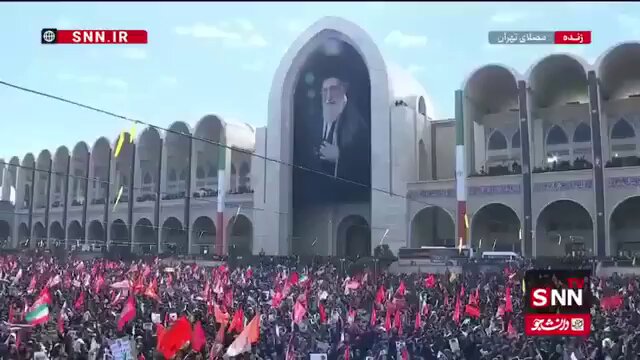
#رصد نتائج الزيارة الإيرانية تظهر يوماً بعد يوم، وهذا يؤكد ما نردده دائماً: أن النظام السياسي الحالي في بغداد لا يمتلك زمام الأمور، وأن قرار نزع سلاح الفصائل وحصره بيد الدولة لا يُتخذ في بغداد، بل يُبحث ويُحسم في إيران. والأهم من ذلك أن هذا التصريح صدر عن المتحدث...

24,060 просмотров • 11 дней назад •via X (Twitter)

Комментарии: 0

Нет доступных комментариев

Здесь появятся комментарии из оригинального поста

Похожие видео

"Today, we can see the futility of the political route and the bankruptcy of the political system writ large." "Scotland is annexed, a dominion under the English crown. And it is the English crown, not the fictional UK crown, that we're all told about. "Not a partner, not of any kind. In fact, the whole partnership story is a concoction fashioned to convince the world that Scots are part of a joint state and to disguise the fact that Scotland is, in reality, nothing other than a colony. "It's not a partner in a marriage, but a kidnap victim. And you do not escape from a kidnapper by filing for divorce from a fictional marriage. "Second, even if it were possible to break free through a referendum or an election, or to propose any other route that would be approved as lawful by the kidnapping state, the political system in Scotland would not guarantee any of the things that sing in our bones as Scots. We dream of justice, compassion, equality, prosperity and care for all without preference or privilege. "But what we have is an english system of concentrated power and privilege, which those Scots who enjoy it will not give up easily. Where the government sits in authority over the people, and the people surrender their hopes, their ambitions and their human and civil rights to the whims of their elected representatives. Where all that we hold dear, all that we depend on for decency, fairness and security, depends on the honor, honesty and good faith of those elected. "Because once it is elected, we have no means of curbing, challenging or preventing anything a government may choose to do, whether or not that's lawful, just, rational or humane. "Today, we can see the futility of the political route and the bankruptcy of the political system writ large. Our helplessness in the face of the state marching side by side with destitution and despair. "This is why liberation was born. Because the route to the Scotland we dream of neither can nor will come through the present political system, but through the restoration of the political, territorial and judicial rights, the constitutional provisions that belong to the people of this nation, in law and in justice, even under the terms of this fraudulent union, and certainly under international law. "They mean that we, the people, are sovereign, in fact, not in sound bite, the ultimate authority of this nation of Scotland. "They mean that the interests of the people, collectively known as the common good, are not only the primary purpose of government, but the only condition on which it's permitted to exist. "They mean that we are entitled to overrule, remove or replace a government that violates that condition of its existence, that fails to honour its promises, to consult the people or to act according to their wishes and welfare. "And in the modern world, that means the right to all the mechanisms that we see in a nation like Switzerland, which will make that sovereign power a reality. "All this is part of what we call decolonization, true Scottish self determination. And it is the soul and purpose of liberation Scotland. "Impossible? Other nations have trodden the path to decolonisation. Not one has bowed to the kidnapper and asked for permission. "We know now that we can gain our independence as a state by first gaining independence from a colonizing power. So that instead of waiting to reclaim real sovereignty of the people after independence, we gain our independence by first reclaiming our sovereign Scottish rights. "The next step on this road is establishing the committee of the Scottish Liberation Movement. This committee will be elected from the membership of Liberation and will operate under a ratified constitution. "And it will register Scotland's Liberation Movement with the United Nations." Sara Salyers @TheScotCongress Iain.lawson27 Salvo.Scot Colette Walker

ScotNews

20,333 просмотров • 2 лет назад

The speaker argues that the current student protests over exam paper leaks should not be limited to demanding the resignation of the Education Minister. Instead, he claims the root cause lies with the central government, alleging that institutions such as the Election Commission and the electoral system have been compromised. Key themes include: Criticism of the Prime Minister, the BJP, RSS, and the Union government. Allegations that repeated exam paper leaks reflect systemic governance failures. Calls for a broader political movement rather than a single-issue protest. Strong criticism of EVMs and advocacy for a return to paper ballots. Claims that democratic institutions have been weakened. Criticism of India's foreign policy, particularly regarding the US, Israel, Iran, China, and oil imports. Appeals for youth and citizens to participate in peaceful, sustained democratic movements. The video primarily expresses political opinions and allegations, many of which are disputed or not established as fact. For example: Claims that elections cannot be won unless permitted by the Prime Minister are political assertions, not proven facts. Statements about the Election Commission being completely controlled or elections being predetermined remain matters of political debate rather than judicially established conclusions. References to exam paper leaks are grounded in real incidents, but the attribution of responsibility to specific political actors is the speaker's interpretation. This video is less a news report and more a political speech. It mixes genuine public concerns—such as exam paper leaks, unemployment, and institutional accountability—with strong political accusations and personal opinions. Some criticisms are based on real events, while many broader conclusions are contested and should not be accepted as established facts without independent evidence. A healthy democracy allows criticism of governments, but it also requires citizens to distinguish between verified facts, political opinion, and rhetorical claims.

Ashok Dadhwal

14,868 просмотров • 1 месяц назад

No religious organisation, political party, or powerful institution—regardless of its influence or following— has the right to dictate how the Republic administers justice. The rule of law belongs to the Filipino people, not to any organisation that believes its political weight entitles it to special treatment. By publicly rallying behind Senator Rodante Marcoleta while the Ombudsman and the Department of Justice move towards filing plunder and indirect bribery charges, the Iglesia ni Cristo has chosen institutional loyalty over accountability. Instead of affirming that the law should take its course, it has created the unmistakable impression that one of its own should be shielded from the full force of the justice system. This is not an isolated matter. Senator Marcoleta has repeatedly attracted controversy—from his conduct during the Senate’s flood control inquiry, where he was accused of diverting scrutiny from key personalities and relying on discredited testimony, to serious questions surrounding undeclared campaign funds and other matters now under official investigation and an impending indictment for plunder and bribery. These allegations deserve to be tested in court, free from political or religious pressure. That is why the INC’s intervention is so troubling. A religious institution that deploys its influence to defend a politician facing grave criminal allegations, rather than insisting that justice be allowed to run its course, abandons the moral ground from which it claims to speak. It ceases to be merely a religious body and becomes a political actor seeking to influence the administration of justice. Where was this moral outrage when thousands of Filipinos died during the previous administration’s bloody drug war? Where was the INC when the Vice President was accused, replete with evidences, of corruption in office and threatened the life of a sitting President and his family? Where was this uncompromising defence of righteousness when corruption, abuse of power, and the erosion of democratic institutions demanded moral courage? Silence then, followed by political mobilisation now, is not righteousness. It is selective morality. If the INC truly believes in justice, it should welcome an independent investigation, not to resist it. Senator Marcoleta deserves due process—not immunity. He deserves a fair trial— not institutional protection. No one is above the law. Not a senator. Not a religious organisation. Not anyone who believes influence is a substitute for accountability. The rule of law must prevail over political pressure, religious influence, and institutional loyalty—every single time. Should the INC be allowed to dictate upon the government under threat of weaponising its people if their capricious objectives are not met? The INC was gifted with free expression and was put under no obligations to pay taxes for the exercise of its purpose. But the same INC is now threatening to rupture the nation into another decade of chaos and destruction. Let the INC and its leaders be warned— you have the right to choose what you want to do, but you have no right to choose the consequences of those actions.

The King

10,699 просмотров • 2 месяцев назад

🇹🇷 🤝🇸🇴Efforts to externally divide Somalia are moving in clear opposition to the social and political realities on the ground. The clashes that previously occurred in Las Anod did not bring stability to the former administration. Instead, they resulted in governance weaknesses, a loss of legitimacy, and political failure. Continuing a similar discourse today in Hargeisa would amount to nothing more than repeating the same mistake. Las Anod’s decision to separate from Somaliland and declare its affiliation with the Federal Republic of Somalia is not merely a local decision. It constitutes a strategic response by the Somali people in favor of unity rather than fragmentation. Similar messages emerging from Awdal further demonstrate that this trend is structural rather than temporary. While external actors seeking to fragment Somalia remain active, the emergence of a strong willingness among significant segments of the Somali population to integrate into the central federal structure is noteworthy. What we are witnessing in Somalia today is the reversal of the classic “divide-and-rule” approach: divide, fragment, and reunify. In this context, the presence of the Somali President and Prime Minister, alongside Türkiye, Saudi Arabia, and Sudan, standing with the Somali people in Las Anod was not merely symbolic. It conveyed a clear message in support of Somalia’s sovereignty, territorial integrity, and political unity. As it has in the past, Türkiye will continue to stand by the will, unity, and sovereignty of the Somali people.

Tunç Demirtaş

22,913 просмотров • 7 месяцев назад

The Circle (2000, Panahi)/ Iran "Political movies have limited time. After that time, it doesn’t say anything anymore. But if the whole thing is said in an artistic way, then it doesn’t have an expiration date." --- Jafar Panahi Full Excerpt: "Interviewer: The subject matter of 'The Circle' (2000) is controversial. You mentioned that the film is still banned in Iran. In fact, when I was watching the film, I realized that through the characters, there’s a lot of fear about the system, the establishment, the police. The women can’t smoke; they have to wear the chador; they seem to want to hide every time. This is all very clear from watching the film. Did you deliberately want to make a statement about the political situation in Iran? Panahi: I have to tell you again that I’m not a political person. I don’t like political movies. But I take every opportunity to comment on the social issues. I talk about the current issues. To me it’s not important what is the reason for what has happened. Whether it’s political reasons or geographical reasons: these are not important—but the condition, the social issues. It is important to me to talk about the plight of humanity at that time. I don’t want to give a political view, or start a political war. I think that the artist should rise above this. Political movies have limited time. After that time, it doesn’t say anything anymore. But if the whole thing is said in an artistic way, then it doesn’t have an expiration date. So it doesn’t really serve a political purpose. Then it can be everlasting, for always, and it could be for anywhere. But I know that politically, with the film authorities, with any kind of film that has some political background in it, they would take issue with it. And for this reason, that is what the problem is. Interviewer: Still, your film makes a very strong statement about the problems that women face in Iran. Panahi: Yes, I agree with that. Interviewer: So that is humanitarian, of course, but it’s also political. Panahi: Yes, I agree with that. It has the elements. It all depends on how you look at it. If a person has only political views, then he will only see the political. But if you are a poet or an artist, then you see other things as well in the movie. If you are a socialist, you see political or economic or whatever different points of view. You mustn’t look at a film with only one point of view. If you want to see 'The Circle' (2000) as political, then it is one of the most political movies in Iran. By political, I mean partisan politics. But even the police, I didn’t want to show them as bad. In the first instance, you are afraid of the police. Because you are looking at them from the point of view of someone who is now in prison. And normally you see him in a long shot, but when they come nearer and you see them in a medium shot, you can see their human faces. Then it comes down to, “Do you need any help?” But he goes back again and becomes frightening. If I were being political, then I would always show the police as dangerous or bad persons." (Jafar Panahi's interview with Stephen Teo, Senses of Cinema, 2001)

DepressedBergman

43,871 просмотров • 7 месяцев назад

The Funeral as Statecraft What Khamenei’s Funeral Reveals About Iran’s Political Imagination By Abdulhameed Al-Ghobain States are rarely understood by listening to their rulers speak from podiums. Official language has its own duties: to reassure allies, confuse adversaries, discipline society, and preserve the appearance of control. The deeper life of a state is found elsewhere — in its arguments, its institutions, its old fears, its strategic habits, and in the rituals through which it turns defeat, victory, and even death into political meaning. Ali Khamenei’s funeral should be read in that light. In politics, a funeral is never only a funeral. It is a stage of continuity, a test of succession, a rehearsal of loyalty, and sometimes a declaration that the system intends to outlive the man who embodied it. Iran is not simply burying a leader. It is showing, once again, its ability to turn mourning into mobilization, grief into legitimacy, and a body into a political message. Many outside observers still misread Iran because they reduce it to what is easiest to see. In Washington, Iran is usually discussed through a familiar triad: the nuclear file, armed proxies, and clerical rule. In Arab capitals, the vocabulary is often narrower still: militias, sectarian expansion, and interference. None of this is false. It is simply not enough. It describes what Iran does, not how Iran thinks. Iran is not merely “a state of mullahs.” That phrase may work on television; it fails as analysis. The Islamic Republic is religious, Persian, revolutionary, bureaucratic, and pragmatic at the same time. It speaks in the language of Shiite political theology while carrying the memory of Persian statehood. It claims revolutionary purity while practicing careful regional patience. It can denounce the West in the morning, negotiate with it in the afternoon, and leave the evening sermon to make the two-sound consistent. This mixture is one of Iran’s political strengths. The Islamic Republic has learned how to turn sect into language, nationalism into structure, and negotiation into a room where time, pressure, and ambiguity can be managed. Time, for Tehran, is not empty duration. It is an asset. Many Arab political systems have not kept up with that rhythm. Too often, strategy begins only when the crisis becomes visible. The event arrives, settles in, builds networks, acquires allies, and only then does the commentary begin. Officials warn that the moment is “critical.” Analysts announce that the region is “volatile.” Television studios rediscover history just after it has entered the room. Iran does not operate with that lateness. It does not look at its Arab neighborhood as a collection of borders and formal sovereignties. It looks for openings: social fractures, sectarian vocabularies, weak institutions, anxious minorities, neglected peripheries, failed states, and elites willing to bargain with their own vulnerability. This is not praise. It is description. To understand Iran is not to admire it. It is to stop being surprised by it. Khamenei’s funeral therefore raises a question larger than succession. The issue is not only who follows him, which faction gains ground, or how the crowd behaves in the public square. Those questions matter, but they do not go far enough. The deeper question is whether the idea that sustained his rule can adjust after him. Can the Islamic Republic reproduce legitimacy without the man who served as its central symbol? Will it harden in the name of continuity, or become more flexible in the name of survival? Iran’s modern history suggests that rigidity and pragmatism are not opposites in Tehran’s political vocabulary. They are often paired instruments. When escalation is useful, Iran escalates in the name of principle. When compromise is useful, it compromises in the name of higher interest. The language can always be revised later. States that survive decades of pressure do not survive because they are pure. They survive because they know when to turn purity into posture and necessity into doctrine. Machiavelli understood that power is not managed by good intentions, but by a cold reading of fear, interest, ambition, and human weakness. Ibn Khaldun, writing from another civilizational world, understood that rule is not built by sermons alone, but by solidarity, coercive capacity, organization, and the ability to bind people into a durable political order. Iran’s ruling system has absorbed both lessons in its own way. It preaches, but it also organizes. It invokes heaven, but it studies the terrain. It speaks of martyrdom, but it counts leverage. This is why Abdolkarim Soroush matters for anyone trying to understand Iran beyond its security architecture. Soroush did not matter because he held power. He mattered because he exposed the point at which every religious state becomes vulnerable: the moment religion is converted into an instrument of rule. His central distinction is simple and dangerous. Religion is one thing; religious knowledge is another. Religion belongs to the realm of the sacred. Religious knowledge, however, is human, historical, fallible, and changeable. It is shaped by language, philosophy, science, politics, and by the limits of those who interpret. This does not attack faith. It attacks the monopoly over faith’s interpretation. For a clerical state, that is not a seminar-room argument. It is a political earthquake moving slowly beneath the floor. If religious knowledge is human, no cleric, institution, or state can claim final ownership of divine meaning. Revelation may remain sacred, but the apparatus speaking in its name loses immunity. The jurist becomes an interpreter, not the owner of truth. The state can no longer turn its preferred interpretation into political destiny without being questioned. That is why Soroush matters in the post-Khamenei moment. His thought shows that Iran’s struggle is not only over succession, sanctions, regional influence, or the nuclear file. It is also over who has the right to define religion politically. The Islamic Republic’s most serious vulnerability may not be a foreign army or a protest movement alone. It may be the slow erosion of the claim that the state’s interpretation of religion is indistinguishable from religion itself. Here Soroush approaches Michel Foucault in effect, if not in method. Power does not always need a prison when it controls the definition of truth. It is enough to decide what counts as religion, patriotism, treason, loyalty, and betrayal, then allow bureaucracy to do the rest. Hannah Arendt’s “banality of evil” was not a theory about monsters alone. It was about ordinary functionaries performing their duties with clean paperwork and a quiet conscience. In an ideological state, coercion often arrives well dressed: a stamped order, a solemn sermon, a classified file, and an archive that never apologizes. Still, Iran should not be mistaken for a frozen theocracy. It is a conflicted society with competing memories and ambitions: clerics, guards, merchants, reformists, nationalists, technocrats, students, exiles, and ordinary citizens who live between exhaustion and pride. Its state is repressive, but its society is not intellectually dead. Its official ideology is rigid, but its political practice is often tactical. Its revolutionary language is old, but its institutions have learned how to survive in a hostile environment. That combination makes Iran difficult to read and dangerous to underestimate. It is neither as invincible as its supporters imagine nor as brittle as its enemies often hope. It makes mistakes. It overreaches. It miscalculates. It provokes resistance. It pays heavy prices. But it learns inside a project. Too many of its rivals learn inside regret. This distinction matters for Western policymakers as much as for Arab governments. Counting missiles is not the same as understanding strategy. Mapping militias is not the same as understanding the political theology and historical imagination that make those militias useful. Tracking negotiations is not the same as understanding why Tehran often treats negotiation less as a conclusion than as a room in which time can be managed. The Arab world, in particular, has paid a high price for reading Iran mainly through the smoke of conflict. When Iran moves in Iraq, it is called interference. In Lebanon, influence. In Yemen, danger. All of this is true, but it is the vocabulary of outcomes. It does not explain the machine. The machine is deeper: Iran knows how to turn an idea into an apparatus, an apparatus into a state, and a state into a network of influence. Many Arab states have too often done the reverse. They turn the state into a speech, the speech into a ceremony, the ceremony into an image, and then ask, years later, where the state went. This is not merely a failure of courage. It is a failure of institutional imagination. A region that treats thinkers as conference decoration, security risks, or quotable ornaments should not be surprised when others produce strategy while it produces commentary. The post-Khamenei moment should therefore be read as a test not only for Iran, but for those who claim to understand it. Iran may speak the language of revenge. It may open channels of negotiation. It may do both in the same week. That would not be contradiction. It would be statecraft. Iranian pragmatism is not the opposite of ideology; it is one of ideology’s instruments. The fist and the smile often belong to the same hand. For Washington, the temptation will be to focus on succession, nuclear leverage, regional escalation, and elite factionalism. These are necessary concerns. They are not enough. The harder task is to understand how Iran’s ruling idea mutates under pressure. For Arab capitals, the challenge is even sharper: to stop reading Iran as a series of shocks and begin reading it as a structure. Khamenei’s funeral should not be read only as a funeral. It should be read as a mirror. Iran is burying a leader while testing the transition of an idea. Its rivals can count the mourners, study the protocol, and debate the optics. Or they can ask the more difficult question: what kind of political imagination allows a state to turn even death into continuity? There are no real surprises in politics for those who read before the shock arrives.

عبدالحميد الغبين

22,355 просмотров • 1 месяц назад

Key points from my remarks on Al Hadath Channel: The government’s decision is good, but it does not rise to the required level. What is needed is the complete dismantling of Hizballa”s military, security, and financial infrastructure, not merely banning its military and security activities as stated in the government’s declaration. The clear reality is that there is no such thing as a political Hezbollah and a separate military Hizballa ; they are one single entity under one leadership, with the same individuals making decisions in both spheres. The distinction between the two is merely a formal characterization that does not reflect reality. Less than two hours after the decision was issued, hizballa launched drones toward Cyprus, in a direct challenge to the authority of the state, despite being represented in the government. In any state that respects itself, the ministers of a party that openly defies state decisions in practice cannot remain in office; they should be compelled to resign immediately or be dismissed without hesitation. We need actions, not statements. The Lebanese Army must enforce state decisions firmly and without selectivity. Lebanon needs a state with one army and one weapon, under the sole authority of the state. The experience of recent years has demonstrated that weapons outside state control have brought nothing but destruction, and that Hizballa was the first to lead its own constituency and supporters into heavy costs and devastating losses before anyone else.

Fouad Makhzoumi

73,657 просмотров • 6 месяцев назад

Here is a rare clip of Bachir Gemayel (June 10th, 1982), in which he skillfully deconstructs the propaganda carried out by the Islamo-leftist camp against Christians during the Lebanese War. According to Bachir, this propaganda was entirely misleading - a form of "cheap propaganda" claiming that wealth in Lebanon was concentrated in the hands of a single community : the Maronite Christians. In reality, it reflected the typical approach of a self-proclaimed secular left whose objectives were clear from the outset : to overturn the political balance between Lebanon’s religious communities - effectively dismantling a system in which Christians held dominant power, a power under which Lebanon had nevertheless flourished in the 1950s and 1960s. This same "cheap propaganda", promoted by Islamo-leftist groups and backed by Palestinian weapons, sought to frame the conflict as one between wealthy Christians on one side, and marginalized Muslims on the other. It is also this narrative that would later resurface in the discourse of Shiite marginalization with Musa al-Sadr, a rhetoric that persists even today, despite the fact that this community has long since achieved significant political and social ascendance. Perhaps it is time to acknowledge that the Islamo-leftist's approach to analyzing the Lebanese dilemma is fundamentally disingenuous, drawing much of its strength from hostility, first toward Christians, and second toward their political role, which is unmatched anywhere else in the Middle East. It is also time to recognize that the Lebanese war (1975-1990) was, above all, a civil war in which communities fought one another to preserve or expand their share of political power - namely, their level of representation within the central state. Lebanon’s problem lies in its political system, not in its establishment. As long as the Lebanese state remains centralized, its people will continue to think and act as they have over the past century. Grant each community a high degree of autonomy, and you will see tensions ease, competition over central power diminish, and a more stable and balanced coexistence begin to emerge.

Mark Elian | مارك اليان

27,373 просмотров • 4 месяцев назад

Professor Lovemore Madhuku in his Own Words Making the Case for Parliament to Indirectly Elect the President as an Electoral College: “We must not put in the Constitution of the country a provision that is dependant on what happens in a political party. That’s the point I’m making. We must never say in our Constitution of Zimbabwe that if a sitting President dies or resigns, we will wait to hear what the political party of that President is saying. No. That is not the best way of running a country. Political parties remain the preserve of those people who are in those political parties. But the country is run on the basis of either an election by the people—direct election—or you have Parliament as an institution sitting as an electoral college. Where parties have influence, they must do the influence within Parliament, but never to allow the political party to sit there to say I’m giving you this President, and so forth. That’s the point I’m making. And on that point, I’m making it right across the world; that’s what they do.” - Professor Madhuku, addressing a “Heal Zimbabwe Trust” public meeting in Harare on 22 February 2020. COMMENT: Professor Lovemore Madhuku’s 2020 remarks make a clear, powerful and enduring case for Clause 3 of the Constitution of Zimbabwe (Amendment No. 3) H.B.I. Bill, 2026. This clause replaces the direct election of the President with an indirect election by Parliament sitting jointly as an electoral college; both after every general election and, when necessary, to fill any vacancy in the office of President. The current direct election of the President was first introduced in anticipation of a legislated one-party-one-man rule through Constitution Amendment No. 7, Act 1987 in the old Lancaster Constitution repealed in 2013. Professor Madhuku put it plainly: The Constitution should not—as it currently does— depend on the internal decisions of a political party to select a successor to the President of the country. When a sitting President dies, resigns or is removed, the nation should not have to wait and hear what that President’s political party “is saying.” That is not a constitutionally proper way to run a country. Political parties exist for their own members. The country, however, belongs to all Zimbabweans. The proper solution is straightforward: Parliament—the institution chosen by the people—should act as the electoral college. Inside that open forum, parties may exercise their influence transparently and accountably. No party should ever stand outside the Constitution and simply “give” the nation its next leader. This principle is not abstract. Worldwide, presidential by-elections to fill mid-term vacancies are extremely rare. Most stable presidential systems instead use automatic succession by a deputy or, increasingly, allow the legislature to elect a successor who serves out the remainder of the term. These arrangements place national continuity and stability above partisan interests. Clause 3 of the Bill follows exactly this proven path. By giving Parliament the clear duty to elect the President—whether at the start of a new term or in an unforeseen vacancy—Zimbabwe will secure stronger democratic stability, and keep the highest office firmly within the people’s constitutional framework rather than the private control of any single party. In short, Clause 3 is a mature, practical and principled reform that directly honours Professor Madhuku’s wise 2020 counsel. As such, it deserves the full support of every well-meaning Zimbabwean who values good governance, democratic constitutionalism, institutional integrity and the long-term strength of the country’s democracy in the national interest!

Prof Jonathan Moyo

88,259 просмотров • 4 месяцев назад

#Ethiopian Foreign Minister: #Ethiopia’s State Formation Still Disputed, and is shaped by a Culture of Violence The following is what the current Ethiopian Foreign Minister said about the flawed nature of Ethiopia’s state formation and how it is still contested and shaped by a violent political culture. This is verbatim; I have not added any opinion. 'The process through which the Ethiopian state was formed is rather unique on the African continent. In most parts of the world, states are formed through conflict, violence, and bloodshed. That does not make Ethiopia unique. What makes Ethiopia unique—particularly in the African context—is that the violence was carried out by indigenous, native forces. The main protagonists in this process were Ethiopians themselves. By contrast, in the history of most African countries, state formation was the outcome of colonial conquest, with significant involvement of European actors. So, we have a state formation process driven by local political forces, but we did not have the opportunity to strengthen or cement that process through a social contract, nor did we have the chance to heal the wounds and contradictions that emerged during state formation. As a result, the legitimacy of the state was questioned and contested by some. This contestation has persisted throughout the formation of the state and has been exacerbated by subsequent events. Some have challenged the very legitimacy of the Ethiopian state; others have contested its nature, its vision, its identity, and its narratives. Some have found it difficult to accept its institutions and their configurations. Thus, there have always been fundamental contradictions stemming from Ethiopia’s state formation process, and we have not adequately addressed them in a way that would create consensus among key actors. Another layer we need to consider is that we have a very violent and autocratic political culture. Whenever there are contests for power, political differences, or disagreements over policy or institutional arrangements, the method of resolving them has more often than not been conflict. Imposing one’s will and vision on others through violence and force has been how we have conducted politics for generations. And once in power, using autocratic means to consolidate authority has been common practice. This autocratic and forceful approach, combined with the flawed state formation process, has produced many wounds, grievances, and violations. We have not been able to address these in a way that is satisfactory to most Ethiopians. On top of this, attempts to resolve these problems have often been divisive, emphasizing differences at the expense of what unites us. As a result, our politics has become polarized and ethnic-based.

Sirak Bahlbi

20,175 просмотров • 9 месяцев назад

KDP appears to be overplaying its hand on Iraqi oil exports through the KRG pipeline, and the gambit seems to be already backfiring. Here is why: 1. Iraq exports around 3.4 million barrels per day through Basra's ports and the Strait of Hormuz, accounting for 85 to 95% of total shipments. Baghdad has requested only 200,000-250,000 barrels per day thru the KRG pipeline, roughly 7 to 8% of what was flowing through the south. Even if Baghdad wanted to push more volume through the line, it could not. Most of Iraq's oil sits in Basra, there is no pipeline infrastructure to move it north, and the same Iranian and militia threats that closed Hormuz could target the northern route just as easily. The KRG pipeline cannot rescue Iraq's oil sector. It was never going to. 2. Permitting the exports would have been a low-cost card and a show of goodwill. But by blocking even this, the KDP has handed Baghdad and Iraqi parties a scapegoat at the worst possible moment. During a crisis that is hitting government finances and ordinary Iraqis' salaries, the KDP chose to put conditions over a resource that would not have changed the picture in any big ways, and if salaries are delayed, Iraqi parties will point at Erbil. Basically, this has turned a pipeline dispute into a political framing device, and the KDP has placed itself inside the frame. For many Iraqi parties, this is not just ammunition. It is vindication. It confirms what they have long argued: that the KRG, and specifically the KDP, is ready to exploit Iraq's moments of weakness rather than stand with it. That perception, once reinforced in a crisis of this scale, will be difficult to undo. 3. The damage is compounded by isolation. Iraqi parties across the board, in their statements on this issue, are now referring to the "Erbil government," not the KRG. The language is deliberate: this is understood as a KDP decision, not an institutional one. Nearly all other Kurdistan Region parties either oppose the move or are critical of it, and when budget negotiations resume, they will direct blame squarely at the KDP. 4. Baghdad is also close to completing the rehabilitation of the Kirkuk-Ceyhan pipeline (the below video is today), which operates under an Iraq-Turkey agreement that predates the KRG and over which Erbil holds no legal or operational control. A small section of the line passes through KDP-controlled Duhok, but the KDP cannot realistically block it or do much about it. Once that line is operational, it will push the KRG pipeline further into irrelevance. More importantly, it will give Baghdad reason to sideline the KRG pipeline for good, not just during the current crisis but after things normalise too. Ironically, the card the KDP is holding is actively depreciating by overplaying its hand. The logic of holding a card is not inherently flawed. But deploying it in the middle of a regional crisis, on an issue of national significance, in an attempt to extract leverage, - in the current context - does not serve the KDP well. The timing is especially poor given the volatility of the broader environment. The trajectory of U.S. policy under Trump remains deeply unclear. The KDP is betting on a hand without knowing how the game ends.

Kurdistan Watch

24,594 просмотров • 5 месяцев назад

#WATCH | On being asked about the West Asia conflict and where the Islamabad MoU stands right now, Senior Journalist, Political Commentator & Author, Fareed Zakaria says, "It's completely dead. It was predictable that it would be dead... Iran has figured out it has a usable nuclear weapon that can be used as leverage, which is control over the Strait of Hormuz...What we are trying to solve now is a problem created by the war itself, and even that has not been solved. In my opinion, the whole thing is a very humiliating defeat for the United States" "It's completely dead. And it was predictable that it would be dead because it is a memorandum of misunderstanding...Iran has figured out it has a usable nuclear weapon, in other words, a weapon that is actually more powerful because it can be used as leverage. That leverage is control over the Strait of Hormuz, and they want to assert that power...To give you an understanding of how poorly this war has gone for the United States, remember President Trump's original goal, which was to destroy the Iranian regime, have the people of Iran launch an uprising, and bring democracy to Iran. That didn't work. The goal number two became the nuclear issue...The desire to get the Iranians to hand over their enriched uranium, swear that they would never use it again, and permanently end the program none of that has happened. The third goal then became control of the Strait of Hormuz, which, of course, was open before the war. What we are trying to solve now is a problem created by the war itself, and even that has not been solved. In my opinion, the whole thing is a very humiliating defeat for the United States" Watch full interview here:

ANI

49,071 просмотров • 1 месяц назад