ะ—ะฐะณั€ัƒะทะบะฐ ะฒะธะดะตะพ...

ะะต ัƒะดะฐะปะพััŒ ะทะฐะณั€ัƒะทะธั‚ัŒ ะฒะธะดะตะพ

ะะฐ ะณะปะฐะฒะฝัƒัŽ

๐—š๐—ฎ๐˜‚๐˜€๐˜€๐—ถ๐—ฎ๐—ป ๐—ฆ๐—ฝ๐—น๐—ฎ๐˜๐˜๐—ถ๐—ป๐—ด ๐—ถ๐˜€ ๐—ป๐—ผ๐˜„ ๐—ถ๐—ป ๐——๐—ฎ๐—ฉ๐—ถ๐—ป๐—ฐ๐—ถ ๐—ฅ๐—ฒ๐˜€๐—ผ๐—น๐˜ƒ๐—ฒ! irrealix has just launched a Gaussian Splatting plugin for DaVinci Resolve 18 & 19! ๐Ÿ“‚ Import .ply files directly into DaVinci Resolve ๐ŸŽฏ Crop with Spherical or Box shapes, or the Y Plane ๐Ÿ”— Combine up to 10 models in one scene...

RadianceFields's profile picture

Radiance Fields

8,420 subscribers

50,547 ะฟั€ะพัะผะพั‚ั€ะพะฒ โ€ข 1 ะณะพะด ะฝะฐะทะฐะด โ€ขvia X (Twitter)

ะšะพะผะผะตะฝั‚ะฐั€ะธะธ: 0

ะะตั‚ ะดะพัั‚ัƒะฟะฝั‹ั… ะบะพะผะผะตะฝั‚ะฐั€ะธะตะฒ

ะ—ะดะตััŒ ะฟะพัะฒัั‚ัั ะบะพะผะผะตะฝั‚ะฐั€ะธะธ ะธะท ะพั€ะธะณะธะฝะฐะปัŒะฝะพะณะพ ะฟะพัั‚ะฐ

ะŸะพั…ะพะถะธะต ะฒะธะดะตะพ

3D scanning and rendering is moving so fast - got my splats up and running and I'm mind blown getting ~100fps for this complex 3D scene โฌ‡๏ธ ๐Ÿคฏ 1. WAY faster than NeRF: For comparison, NeRFs would takes around 10 seconds per frame (!) Instead I'm zipping around with FPV controls without breaking a sweat - though I do crash a few times towards the end of the video lol 2. Old Meets New: Gaussian Splatting is cool in that it fuses classical graphics and deep learning techniques. Like NeRFs, this is still a radiance field - just without the slower (ne)ural rendering part. 3. Explicit Representation: Instead you represent a 3D scene as a collection of ellipsoidal "splats" called gaussians. Each gaussian has a position, size, and color. Rendering in real-time is done by projecting into the image plane and alpha blending. 4. Photorealistic Effects: Gaussian splatting use spherical harmonics to represent the view-dependent effects and lighting - allowing surfaces to change color when viewed from different angles, enabling greater photorealism. It doesn't use a neural network, but the training loop is similar to deep learning. 5. Enables Direct Editing: But it's not just speed - with Gaussian Splatting you also get 3D editing support! So you can select, move, and delete stuff, even relight stuff. This type of editing has been more tedious to do with NeRFs and their implicit black box representations. ๐Ÿ“ฒ More tests cooking! Much more to unpack here including simpler explanations. If you enjoyed this post, you might enjoy my feed: Bilawal Sidhu

Bilawal Sidhu

337,090 ะฟั€ะพัะผะพั‚ั€ะพะฒ โ€ข 2 ะปะตั‚ ะฝะฐะทะฐะด

Introducing the new Box Agent. The Box Agent works across your entire Box file system, maintaining all your security and access controls, and is hyper tuned for working with enterprise content. This means you can now ask questions from all your enterprise content, search for files that were impossible to find before, deploy an agent on specific tasks on subsets of documents, analyze complex data sets, and generate or edit documents and spreadsheets via the agent. You can have the Box Agent search across your Box account to prepare for a sales meeting, analyze customer sentiment reports, process a large set of contracts for legal risk, provide insights into product development, leverage existing knowledge to answer RFPs, and thousands of other use-cases. 90% of enterprise data is unstructured data. This means most enterprise knowledge is sitting in inside of research reports, marketing assets, presentations, roadmap files, contracts, HR documents, and more. This is the critical context that agents need to be able to answer questions about a business, automate workflows, or serve up to other agents. Weโ€™ve been grinding on this for a quite a bit, and due to recent AI model advancements weโ€™re now ready to release it to customers. Previous model generations had a difficult time knowing when to give up or keep going on a search, when to browse for files vs. use queries, how to rank files appropriately to know which version of content to use, how to handle large amounts of context to comb through, and more. Due to recent breakthroughs from models like GPT-5.4, Opus 4.6, and Gemini 3, weโ€™ve seen major gains in tool calling, code execution, advanced reasoning, and more. Combined with an agent harness tuned to Box context, now itโ€™s finally possible to have an agent that can work across your file system on long running tasks and actually deliver high quality results. Best of all, because the Box Agent works with any leading AI model, youโ€™ll quickly get the gains coming out of the major labs as major new models are released. Further, openness at Box is key, so youโ€™ll be able to call up the Box Agent from Boxโ€™s APIs and MCP server, so you can interact with Box intelligently from any other AI system. We know work happens everywhere, and we want to ensure you can access to the content you need from those places. The new Box Agent is available starting today, rolling out now for Enterprise Plus and Enterprise Advanced customers.

Aaron Levie

44,515 ะฟั€ะพัะผะพั‚ั€ะพะฒ โ€ข 3 ะผะตััั†ะตะฒ ะฝะฐะทะฐะด

RLM is the most import foundation of my Pi Harness (other than Pi of course). It's seeded with late interaction retrieval results (thanks to @lightonai for pylate). The Agent initiates it with query then.. ๐’๐ž๐ญ๐ฎ๐ฉ A python REPL is created and seeded with: 1. Late interaction search to pre-filter. Instead of doing top 3/5/10, it's top hundreds of documents. This is set into a `context` variable. 2. Python functions are loaded in to do more searches if `context` variable isn't enough. And to make llm calls with cheaper models in parallel batches. ๐ˆ๐ญ๐ž๐ซ๐š๐ญ๐ข๐จ๐ง ๐‹๐จ๐จ๐ฉ From there, an LLM iterates in the REPL based on the query. It's just like exploring in a jupyter notebook. The LLM writes prose (like a markdown cell) and code to be run in the REPL each turn. This allows the LLM to sort, filter, and synthesize information. It can fan out and ask smaller models to summarize, combine, contrast, or do anything else to documents to help it understand the data. After several turns the LLM reponds with the final answer. Either because it found the answer, or hit the budget limit. Context as a Python variable, LLM as the programmer, REPL as the runtime. ๐–๐ก๐ฒ ๐ƒ๐จ๐ž๐ฌ ๐“๐ก๐ข๐ฌ ๐–๐จ๐ซ๐ค 1. Richer Shell. Agents (and subagents) work by intermixing code and prose/thinking. But they use static scripts or bash that run and exit and start over each tool call. That's not ideal for exploration and synthesis of data. For that, state is useful to continue building and exploring the data as you learn more. There's a reason jupyter notebooks have been popular with data scientists. 2. Keeps main agent context clean. The better context you have the better the agent will perform (duh!). This means three thing: better human input, less missing search results, and less incorrect search results. Letting the agent iterate allows it to synthesize just what is needed and nothing else. All bad paths or peeks at something that turns out to be irrelevant stays out of main agent context. 3. Stack the good ideas! People often compare late interaction search vs RLM. Or static vs dynamic languages. Or agentic search vs semantic search. But...You can just use them all together for what they're each good at. Use them all for the area they're really great for. Read the full post which has more detail about how and why.

Isaac Flath

40,212 ะฟั€ะพัะผะพั‚ั€ะพะฒ โ€ข 2 ะผะตััั†ะตะฒ ะฝะฐะทะฐะด

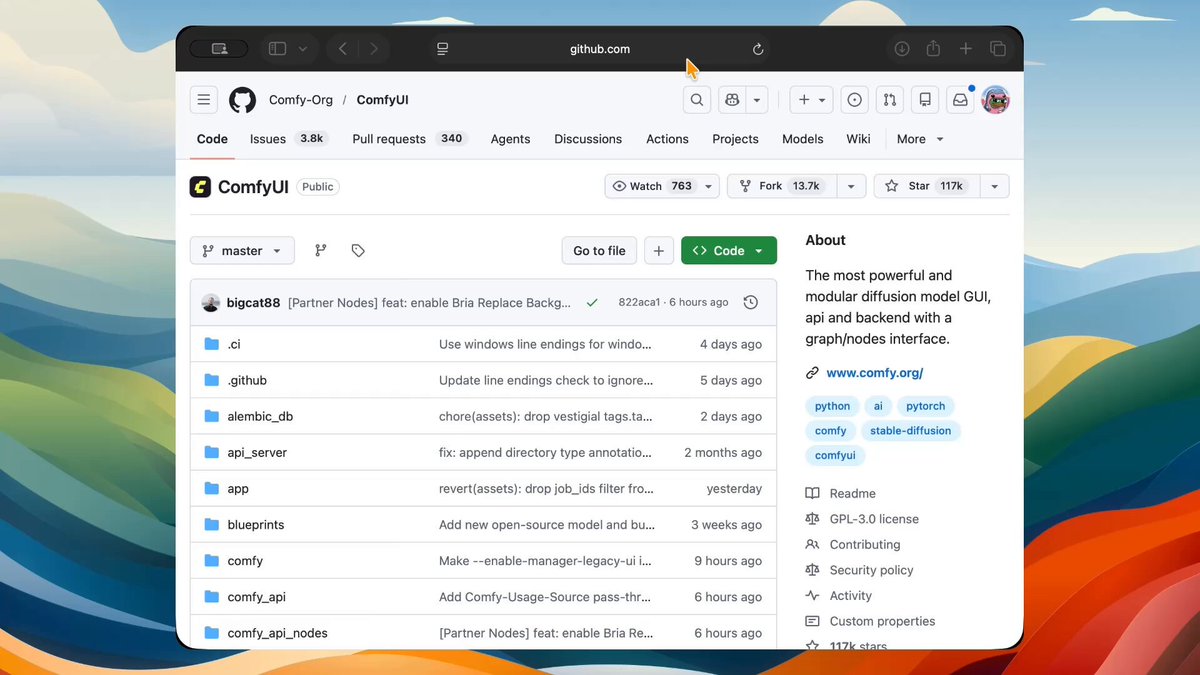
no money for grok or midjourney? this tool is for you. there's a FREE tool created by an anon dev. open-source. runs locally. 117k stars on github. it generates: > images & video > 3d models > audio > 20+ models here's how to set it up in under 5 minutes: 1๏ธโƒฃdownload ComfyUI Desktop go to and grab the desktop app for your system. windows 10+, mac (apple silicon), or linux. it installs like any normal app, it sets up python and every dependency for you in the background. no terminal, no config files. 2๏ธโƒฃopen it first launch, it spins up its own environment automatically. you just wait a few seconds and you're in. you'll land on a node canvas, that's the whole interface. 3๏ธโƒฃload a starter workflow top menu โ†’ Workflow โ†’ Browse Templates โ†’ Image Generation. click it. this drops a ready-made setup onto your canvas so you don't build anything from scratch. 4๏ธโƒฃgrab a model comfyui ships empty on purpose, the model is the brain, and you pick it. in the template, the "Load Checkpoint" node has a Download button when no model is installed. click it. it pulls one in for you (a few GB, this is the only real wait). 5๏ธโƒฃinstall ComfyUI Manager this is the one add-on you don't skip. it lets you install models, custom nodes, and updates with a click instead of the command line. grab it from github (link in comments). it's the difference between fighting comfyui and flying in it. one honest note: an NVIDIA gpu makes this fast, apple silicon works great too, and a weak machine still runs it just slower. that's the whole setup. you now own an image, video, and 3D studio that costs you nothing per month. save this. and the next time grok or midjourney asks for your card. you won't need it. disclaimer: comfyui itself is 100% free. so are the local models (sdxl, flux, wan 2.2, ltx-2). some premium models like seedance are pay-per-use api models, only if you want top-tier quality. the free local ones cover most of what you need. (github link in the comments) follow and turn on post notification for daily AI contents.

m0h

14,542 ะฟั€ะพัะผะพั‚ั€ะพะฒ โ€ข 1 ะผะตััั† ะฝะฐะทะฐะด

JUST IN: Perplexity launched "Perplexity Computer" โ€” and it might be the most complete AI agent system available right now. Not a chatbot upgrade. Not a research tool with a new name. A system that plans entire projects, delegates to specialist AI models, and runs autonomously for hours, days, or months (their words). Here's what makes the architecture genuinely different: โ†’ Opus 4.6 handles core reasoning and orchestration โ†’ Gemini handles deep research (spawning its own sub-agents) โ†’ Grok handles lightweight speed tasks โ†’ Veo 3.1 handles video generation โ†’ Nano Banana handles image creation โ†’ ChatGPT 5.2 handles long-context recall and wide search โ†’ You can override model choices per subtask 19 models total. Each task runs in an isolated environment with a real filesystem, real browser, and real tool integrations. You describe an outcome. It breaks it into tasks and subtasks, creates sub-agents for each, and coordinates them automatically. When a sub-agent hits a problem, it spawns more sub-agents to solve it. And it connects to your existing stack โ€” GitHub, Google Drive, Gmail, Slack, Jira, Linear, Notion, Confluence, Ahrefs, Airtable, and more. Critically, it doesn't just run once. It can run on a schedule. Reading your docs, checking your project boards, pulling from your CRM, and acting on what it finds. Market monitoring. Competitor tracking. Weekly reports with charts. Content pipelines. CRON jobs that actually execute. Not "AI that helps you once." AI that runs in the background for days or months. Think of it as managed OpenClaw โ€” similar autonomous capability (scheduled tasks, multi-step workflows, tool integrations) but fully managed. No Mac Mini. No security config. No infrastructure to maintain. I tested it with a complex prompt โ€” a full stock trading simulator with what-if scenarios, correlation heatmaps, sentiment analysis, and a Bloomberg Terminal aesthetic. Two prompts later: deployed to Netlify via GitHub, with working CRON jobs updating live data. I've started using it to analyze my portfolio. But coding is just one lane. This thing researches, writes reports, generates datasets, creates videos, processes documents, and connects to your existing tools โ€” all in one coordinated workflow. The real shift: you don't choose a model anymore. You describe what you need. The system routes each piece of work to whichever model does it best โ€” and spawns new agents when it hits a wall. 19 models, dynamic sub-agents, scheduled tasks, and your entire tool stack connected. Thoughts?

Paweล‚ Huryn

219,498 ะฟั€ะพัะผะพั‚ั€ะพะฒ โ€ข 4 ะผะตััั†ะตะฒ ะฝะฐะทะฐะด

Chamath: AI advantage may come less from models than from private inputs. "When labs can build similar models, the real win comes from one unique ingredient in order to monetize it well. Here is a basic thing about machine learning that is worth knowing: if you take 1,000 of the same inputs and give them to Facebook, Microsoft, Google, and Amazon, they will all come up with the same machine learning model. But if you have one extra thing, one little ingredient that all of those other companies do not have, your output can be markedly different. It is like giving two great chefs three ingredients, but giving the third chef one extra ingredient. That person has the ability to do something very special. Right now, we are in a world where everybody is crawling the open web. We are going to move to a world where, as everybody gets sophisticated enough and information is widely available, somebody is going to say, โ€œYou know what? This site, I am not going to allow anybody else to access. It is only for me, only for my models.โ€ Those models will become better. So we have to let that play out a little bit. It is going to be a really interesting arms race. The next wave of M&A, for example, could be companies like Google, Microsoft, and Facebook looking at these companies and saying, โ€œCan they be viable inputs to my large language models or to my other machine learning and AI models?โ€ --- A company with unique workflows, transactions, medical records, industrial logs, legal archives, design files, or user behavior can turn boring private data into a compounding advantage. Some startups may never become great public companies on their own, yet still become valuable because they own a data stream that makes a larger AI system sharper, more differentiated, or harder to copy. That turns acquisition strategy upside down: the buyer may not be purchasing revenue, brand, or even software, but a private ingredient for intelligence. ---- From "iConnections" YouTube channel, (link in comment)

Rohan Paul

143,134 ะฟั€ะพัะผะพั‚ั€ะพะฒ โ€ข 1 ะผะตััั† ะฝะฐะทะฐะด

Introducing LobeHub: Agent teammates that grow with you. LobeHub is the ultimate space for work and life: to find, build, and collaborate with agent teammates that grow with you. Weโ€™re building the worldโ€™s first and largest humanโ€“agent co-evolving network. Two years ago, we built LobeChat, an open-source interface for using different AI models. Today, LobeChat has 70k+ GitHub stars and serves 6M+ users worldwide. How to fully unlock the power of models has always been a shared mission between us and the community. We started with interaction โ€” a fundamentally new, agent-first experience. Agents are no longer passive tools invoked in a single conversation. They should be proactive, always-on units of work. Treating agents as the minimal atomic unit is also the core of our agent harness infra. Todayโ€™s agents are mostly one-off executors. Even with memory, itโ€™s often global โ€” and hallucinates. We build long-term agent teammates that evolve with users. Each agent has its own dedicated memory space, editable by users, allowing humans and agents to co-evolve over time. This, in turn, allows us to design clearer rewards for reinforcement learning and create cleaner environments for continual learning. Agent teammates can work in groups. Through a multi-agent system, agent groups operate faster, more cost-effective, and go beyond what single-agent systems can achieve. For example, a single agent often requires heavy user involvement to proceed step by step, whereas LobeHub can execute the same work from a single instruction, with a supervisor orchestrating agents that run in parallel or debate to produce better results. We are building the collaboration network among agent teammates โ€” and between humans and agent teammates as well. Ease of use matters. AI intelligence and shared human intelligence are equally important. With simple instructions and tool selection, you can effortlessly build and team up with agent coworkers to deliver complex, systematic work โ€” even assembling a quant team to execute trades. Through the LobeHub community, anyone can discover, reuse, and remix agents and agent groups, customizing them to fit their own workflows, preferences, and needs. Last but not least, our vision started with LobeChat: multi-model support is the most efficient approach for users. We believe different models excel in different scenarios. By routing across multiple models, LobeHub improves cost efficiency and unlocks capabilities that a single-model setup cannot easily support.

LobeHub

185,161 ะฟั€ะพัะผะพั‚ั€ะพะฒ โ€ข 5 ะผะตััั†ะตะฒ ะฝะฐะทะฐะด

๐Ÿ‡ช๐Ÿ‡บ As a European citizen and AI founder, I can apparently use these "AI Factories", so I just signed up to use them! Every "supercomputer" has an [ ACCESS NOW ] button which made me very excited I expected to sign up, maybe pay a discounted H100 rate (funded by EU, that'd be nice?) and get a Jypyter notebook, or some SSH login so I can access my GPU like I'd do on Lambda or Amazon Web Services or Hetzner But I celebrated to early, I signed up, confirmed my email, then ended up in a "Supercomputer Access Calls" page, where I had to select from a tedious list of "Call For Proposals" to get access to a GPU So I could NOT just access a H100 GPU, I have to make sure my project (in this case my business) fits a specific proposal, ok fair This process was already tedious enough but then when I tried to actually go through with it, it started asking me if I had "Respect for Human Agency?", I do I think, and if I was mindful of "Individual, and Social and Environmental Well-Being?", well I am, right guys??? Right??? The questions didn't stop, just endless pages of this Look I get what they're doing, they pivoted the classic university "I need to rent a giant computer for my research" to an EU wide thing and then present it as the "European AI plan" But this isn't really how AI works in production? As a founder in AI, if I wanna do stuff I'd rent a whole bunch H100 GPUs again at Lambda or Amazon Web Services or Hetzner and SSH into a box Or if I want it more simple I run AI models on fal, Nancy Arneson or Replicate which is just an API call or web front end I can click stuff and run a model The EU has the right intentions here but it's just the wrong execution, this thing will 100% go nowhere, and I'm a born optimist, I want to believe, I'm also a proud European, and I'm in AI a bit and not a complete idiot. There's just better ways to do this If you really want to have the GPU servers in Europe (which arguably isn't that important), then let me rent a GPU box with SSH access at Hetzner or OVHcloud that's hosted in Europe and subsidize that for European citizens and European businesses. I don't even believe in that, but at least that'd make it accessible for Europeans. Now it really isn't? What's REALLY much more important though if you want to be a part of the AI race and I've posted for years here with @euaccofficial is to make Europe a really extremely attractive place to start and run an AI business. Remove regulatory obstructions and give tax discounts for startups. Let them build a business first that can compete worldwide and once they make enough money (let's say $100M/y), then slowly start adding regulation. Because right now the regulation only benefits the European incumbents, the dinosaur companies, while making it very difficult for European citizens to start new AI companies here. Which is why we literally have none left. Anyway, I applied to get my GPU, let's see if I get it!

@levelsio

1,468,223 ะฟั€ะพัะผะพั‚ั€ะพะฒ โ€ข 8 ะผะตััั†ะตะฒ ะฝะฐะทะฐะด

Itโ€™s day 1905 at Ramp. Today, Iโ€™m thrilled to announce the launch of Ramp Travel, a new solution designed to make booking travel and managing travel expenses more intuitive, low-cost, and streamlined. Today, 1 in 5 (20%) dollars spent on Ramp cards go towards flights, hotels, and other trip-related entertainment - double the 10% of just a few years ago. Companies are hungry for travel as a means of uncovering new growth, but are hamstrung by outdated, expensive tools that employees hate, or consumer booking sites that might be cheaper and easier to use, but lack controls to enforce travel policies. Either way, hours are wasted at the end each month on manual expense reports and cumbersome reconciliations. But, these tradeoffs donโ€™t need to exist. Companies deserve total control over their travel spend without being saddled with fees. And their employees deserve a delightful booking experience without the additional work. Weโ€™re excited to deliver on this vision with Ramp Travel. Our mission has always been to help companies spend less money and time, and this launch is a significant step towards that goal. Employees can book flights and hotels directly through Ramp, with real-time visibility into whatโ€™s in-policy and dynamically adjusted rates based on travel destinations. On the trip, Ramp AI handles the rest. On the ground, the quality of life improvement for employees is substantial. Receipts are automatically assigned to trips, and all expenses are seamlessly integrated into our platform. Put more simply, on other platforms, you have to do your expenses as you go (or 1-3 months later); on Ramp, your expenses do themselves. As the saying goes, โ€œyour margin is our opportunity.โ€ We are not a travel company and arenโ€™t in this to take price, weโ€™re a savings company and are in this to deliver value, control, and a better experience. Our new partnership with priceline allows us to offer our customers access to a global selection of inventory from major airline partners and hotel affiliates at competitive rates, while maintaining the high level of control and visibility that Ramp is known for. Rather than ratcheting up the price through hidden fees, all savings are passed directly to our customers. Weโ€™re excited to see how Ramp Travel helps businesses streamline their travel processes, save money, and enhance the overall travel experience for their employees. As always, we love feedback, so try it out and let us know what you think.

Eric Glyman

336,719 ะฟั€ะพัะผะพั‚ั€ะพะฒ โ€ข 2 ะปะตั‚ ะฝะฐะทะฐะด

๐Ÿš€ Announcing Echo โ€” our new frontier model for 3D world generation. Echo turns a simple text prompt or image into a fully explorable, 3D-consistent world. Instead of disconnected views, the result is a single, coherent spatial representation you can move through freely. This is part of a bigger shift in AI: from generating pixels and tokens to generating spaces. Echo predicts a geometry-grounded 3D scene at metric scale, meaning every novel view, depth map, and interaction comes from the same underlying world โ€” not independent hallucinations. Once generated, the world is interactive in real time. You control the camera, explore from any angle, and render instantly โ€” even on low-end hardware, directly in the browser. High-quality 3D world exploration is no longer gated by expensive equipment. Under the hood, Echo infers a physically grounded 3D representation and converts it into a renderable format. For our web demo, we use 3D Gaussian Splatting (3DGS) for fast, GPU-friendly rendering โ€” but the representation itself is flexible and can be easily adapted. Why this matters: consistent 3D worlds unlock real workflows โ€” digital twins, 3D design, game environments, robotics simulation, and more. From a single photo or a line of text, Echo builds worlds that are reliable, editable, and spatially faithful. Echo also enables scene editing and restyling. Change materials, remove or add objects, explore design variations โ€” all while preserving global 3D consistency. Editing no longer breaks the world. This is only the beginning. Echo is the foundation for future world models with dynamics, physical reasoning, and richer interaction โ€” environments that donโ€™t just look right, but behave right. Explore the generated worlds on our website and sign up for the closed beta. The era of spatial intelligence starts here. ๐ŸŒ #Echo #WorldModels #SpatialAI #3DFoundationModels Check it out:

SpAItial AI

175,909 ะฟั€ะพัะผะพั‚ั€ะพะฒ โ€ข 7 ะผะตััั†ะตะฒ ะฝะฐะทะฐะด

This Chinese developer linked two $2,999 NVIDIA DGX Sparks into one box and runs the full Qwen3-235B at home, after dropping his $1,999-a-month cloud bill to zero. He wired 2 small boxes into a single computer, split a giant 235-billion-parameter model in half between them, and serves it across his own network at about 10 tokens a second, with no internet, no cloud, right there on the desk. No data center, no thousand-dollar graphics cards, no monthly cloud bill. Just him, 2 gold boxes the size of a sandwich, one cable between them, and 1 power strip. And here is the whole payoff. He used to pay the cloud $1,999 a month for the same model, and the meter ticked on every request. Now he paid $5,998 once for 2 boxes, they covered their cost in 3 months, and after that he sends as many requests as he wants for free, only electricity. The two Sparks talk over one fast cable, each holds 128GB of memory, and together they carry the whole model, about 73GB loaded per box, with the chip inside pinned near the limit at 96%. Both boxes work as one and keep trading data over the cable, with no cloud in the loop and no single word leaking out. The ready model sits on one local address, and any app on his network calls it as easily as ChatGPT. And here is how he described, in plain words, what this pair of boxes does: "this is a pair of boxes that holds the huge Qwen3-235B model and serves it to one network. the model is split in half, and each box owns its half. parts: // Box 1 (holds the first half of the model and starts the answer fast, the first word appears in under a second) // Box 2 (holds the second half and writes out the rest, about 10 tokens a second) // Cable (connects the 2 boxes and moves data between them on every step, with no lag) // Address (one local address where any app sends its request, like to a cloud model) // Test (a script that runs big prompts through and measures speed and delays) // Monitor (checks temperature, power draw, and load on both boxes every 2 seconds). the model never goes to the cloud. he only steps in when a box runs hotter than 80 degrees or the cable between them starts dropping data." So the system knows exactly what it is, what it is for, and where its limits are. It knows it has to hold the whole huge model across 2 boxes on its own. It knows it has to answer every request locally, with no meter, no limits, and no internet. It knows the human is only needed when a box overheats or the link between them stalls. โ†’ The setup runs around the clock on 2 boxes, each pulling under 60 watts โ†’ However many requests he sends, the monthly bill is $0, only electricity โ†’ The first box starts the answer in under a second โ†’ The second writes text at about 10 tokens a second โ†’ One request at a time: 838 tokens in 85 seconds, first word in 0.8s โ†’ Two requests at once: 697 tokens in 108 seconds, first word in 0.7s โ†’ Both boxes sit at 96% load and warm up to 76-78 degrees And only when a chip in a box runs hotter than 80 degrees or the cable between the 2 Sparks drops data does the system call the owner. And when he himself is out on a run or in a coffee shop, he still reaches his own model at home from his phone: sends a big prompt to the local Qwen3-235B, gets the full answer back in under a minute and a half, with no token meter ticking and no limit to hit. Here is what the test shows on his screen during one of the night runs: "one request at a time: 838 tokens in 84.9 seconds, first word in 0.8s, then 0.1s per token." "two requests at once: 697 tokens in 107.6 seconds, first word in 0.7s, then 0.15s per token." "Box 1: chip at 96% load, 76 degrees, 56 watts, 73GB used in memory." "Box 2: chip at 96% load, 78 degrees, 56 watts, the Qwen3-235B model fully loaded." And while everyone around is paying for AI by the month and bumping into limits, his top-tier model just sits on the desk and works as much as he wants: his own little power plant instead of a forever meter. He has no server rack of his own and no cloud account behind it. Just 2 DGX Spark boxes on a desk, one model split in half between them, one local address, and a folder of prompts next to it. Out of everything I have seen this year, this is the cleanest way to stop paying for AI: $5,998 of hardware on the desk once, $0 a month to the cloud, unlimited forever, and between them 2 gold boxes, 1 cable, and the full Qwen3-235B answering at home with no internet.

Blaze

93,219 ะฟั€ะพัะผะพั‚ั€ะพะฒ โ€ข 1 ะผะตััั† ะฝะฐะทะฐะด

This is one-shot assembly: you show examples of what to build, and the robot just does it. (see original post: To share more on how this works, the robot is controlled in real time by a neural network that takes in video pixels and outputs 100Hz actions. The video below is part of the raw input passed directly into the model. I also like this view (at 1x speed) because it shows more of the (I think very cool) subtle moments of dexterity near the fingertips ๐Ÿ‘Œ One-shot assembly seemed like a dream even just a year ago โ€” it's not easy. It requires both the high-level reasoning of "what to build" (recognizing the geometry of the structures presented by the human), and the low-level visuomotor control of "how to build it" (purposefully re-orienting individual pieces and nudging them together in place). While possible to manually engineer a complex system for this (e.g. w/ hierarchical control, or explicit state representations), we were curious if our own Foundation model could do it all end-to-end with just some post-training data. Surprisingly, it just worked. Nothing about the recipe is substantially different than any other demo weโ€™ve run in the past, and weโ€™re excited about its implications on model capabilities: โ€ข On contextual reasoning, these models can (i) attend to task-related pixels in the peripheral view of the video inputs, and (ii) retain this knowledge in-context while ignoring irrelevant background. This is useful for generalizing to a wide range of real workflows: e.g. paying attention to whatโ€™s coming down the conveyor line, or glancing at the instructions displayed on a nearby monitor. โ€ข On dexterity, these models can produce contact-rich "commonsense" behaviors that can be difficult to pre-program or write language instructions for e.g. rolling a brick slightly to align its studs against the bottom of another, re-grasping to get a better grip or to move out of the way before a forceful press, or gently pushing the corners of a brick against the mat to rotate it in hand and stand it up vertically (i.e. extrinsic dexterity). These aspects work together to form a capability that resembles fast adaptation โ€” a hallmark of intelligence, relevant for real use cases. This has also expanded my own perspective on what's possible with robot learning, using a recipe that's repeatable for many more skills. This milestone stands on top of the solid technical foundations weโ€™ve built here at Generalist: hardcore controls & hardware, all in-house built models, and a data engine that "just works." We're a small group of hyper-focused engineers, and hands-down the highest talent-density team Iโ€™ve ever worked with. We're accelerating and scaling aggressively towards unlocking next-generation robot intelligence. Building Legos is just one example, and it's clear to me that we're headed towards a future where robots can do just about anything we want them to. Its coming, and we're going to make it happen.

Andy Zeng

49,317 ะฟั€ะพัะผะพั‚ั€ะพะฒ โ€ข 9 ะผะตััั†ะตะฒ ะฝะฐะทะฐะด

A team tested Pi0, Pi0 Fast, Gr00t, and ACT on real robot arms in manufacturing tasks. (๐Ÿ”– Bookmark this for later!) The task was precise: place thin rectangular frames from a messy stack into a holder. The team fine-tuned each model on 100 real trajectories and compared training time, inference speed, motion quality, and success rates. โฌ‡๏ธ Hereโ€™s a breakdown of what they found Pi0 (Original) โœ… Strongest overall performance in precise pick-and-place โœ… High success rate even in edge cases โœ… Longest training time (~11 hours, ~$30 per run) โœ… Inference time of 80 ms causes short pauses between actions Despite delays, it handles complex scenarios wellโ€ฆ solid for high-precision tasks, but slow to train. Gr00t โœ… Trains fast (~2 hours, ~$5 per run) โœ… Performs almost as well as Pi0 on large-object tasks โœ… Struggles with fine precision; random movement in some trials โœ… More training didnโ€™t fix jitter or random offsets Best suited for tasks where exact precision isnโ€™t critical. Not ready for manufacturing-grade accuracy without more tuning. Pi0 Fast โœ… Promised faster training, but results were underwhelming โœ… Training at 6 hours still showed low success rates โœ… Inference was slower than expected โœ… Not reliable for generalizing even slightly new tasks Currently too unstable for real-world deployment. Doesnโ€™t live up to the โ€œFastโ€ name yet. ACT (Baseline) โœ… 200MB modelโ€”lightweight, but limited โœ… Struggles with stacked objects or ambiguous scenes โœ… Success rates around 70% in best-case setups โœ… Canโ€™t match newer models on precision or generalization Still a solid baseline, but clearly a generation behind in robustness. ๐Ÿšจ Extra Notes All newer models share a common issue: โ€ขInference takes longer than a frame (80 ms vs 33 ms), so robots โ€œpauseโ€ between chunks. โ€ขThis results in jittery movements, but not a dealbreaker unless tasks are time-sensitive. Language-conditioned tasks also fell short: after training on two labeled tasks, the model couldnโ€™t generalize to a third unseen combination using only text prompts. โœ… The good news? These models adapt well to new robot arms with quick fine-tuning. โŒ The bad news? Thereโ€™s still no plug-and-play solution for improving performance after deployment. Reinforcement learning or DAgger-style data collection during real-world operation may be the next big step, something many teams in robotics are actively working on.

Ilir Aliu

21,844 ะฟั€ะพัะผะพั‚ั€ะพะฒ โ€ข 1 ะณะพะด ะฝะฐะทะฐะด

New Course: Post-training of LLMs Learn to post-train and customize an LLM in this short course, taught by Banghua Zhu, Assistant Professor at the University of Washington University of Washington, and co-founder of @NexusflowX. Training an LLM to follow instructions or answer questions has two key stages: pre-training and post-training. In pre-training, it learns to predict the next word or token from large amounts of unlabeled text. In post-training, it learns useful behaviors such as following instructions, tool use, and reasoning. Post-training transforms a general-purpose token predictorโ€”trained on trillions of unlabeled text tokensโ€”into an assistant that follows instructions and performs specific tasks. Because it is much cheaper than pre-training, it is practical for many more teams to incorporate post-training methods into their workflows than pre-training. In this course, youโ€™ll learn three common post-training methodsโ€”Supervised Fine-Tuning (SFT), Direct Preference Optimization (DPO), and Online Reinforcement Learning (RL)โ€”and how to use each one effectively. With SFT, you train the model on pairs of input and ideal output responses. With DPO, you provide both a preferred (chosen) and a less preferred (rejected) response and train the model to favor the preferred output. With RL, the model generates an output, receives a reward score based on human or automated feedback, and updates the model to improve performance. Youโ€™ll learn the basic concepts, common use cases, and principles for curating high-quality data for effective training. Through hands-on labs, youโ€™ll download a pre-trained model from Hugging Face and post-train it using SFT, DPO, and RL to see how each technique shapes model behavior. In detail, youโ€™ll: - Understand what post-training is, when to use it, and how it differs from pre-training. - Build an SFT pipeline to turn a base model into an instruct model. - Explore how DPO reshapes behavior by minimizing contrastive lossโ€”penalizing poor responses and reinforcing preferred ones. - Implement a DPO pipeline to change the identity of a chat assistant. - Learn online RL methods such as Proximal Policy Optimization (PPO) and Group Relative Policy Optimization (GRPO), and how to design reward functions. - Train a model with GRPO to improve its math capabilities using a verifiable reward. Post-training is one of the most rapidly developing areas of LLM training. Whether youโ€™re building a high-accuracy context-specific assistant, fine-tuning a model's tone, or improving task-specific accuracy, this course will give you experience with the most important techniques shaping how LLMs are post-trained today. Please sign up here:

Andrew Ng

125,146 ะฟั€ะพัะผะพั‚ั€ะพะฒ โ€ข 1 ะณะพะด ะฝะฐะทะฐะด