Video wird geladen...

Video konnte nicht geladen werden

Zur Startseite

๐—ง๐—ต๐—ฒ ๐Ÿฐ ๐—Ÿ๐—ฎ๐˜†๐—ฒ๐—ฟ๐˜€ ๐—ผ๐—ณ ๐—ฎ๐—ป ๐—”๐—ด๐—ฒ๐—ป๐˜ ๐—ฆ๐˜†๐˜€๐˜๐—ฒ๐—บ An agent can burn tokens, declare success, and still fail the tests. Thatโ€™s often an architecture problem, not a prompting problem. ๐Ÿญ. ๐—Ÿ๐—ผ๐—ผ๐—ฝ โ†’ Decides whether to continue Acts โ†’ verifies โ†’ retries until thereโ€™s evidence of success. ๐Ÿฎ. ๐—š๐—ฟ๐—ฎ๐—ฝ๐—ต โ†’ Decides...

18,393 Aufrufe โ€ข vor 15 Tagen โ€ขvia X (Twitter)

0 Kommentare

Keine Kommentare verfรผgbar

Kommentare vom Original-Post werden hier angezeigt

ร„hnliche Videos

Don't train the model, evolve the harness. I read a brilliant blog post from Hugging Face where they took a frozen open model scoring 0% on a hard legal agent benchmark, left its weights alone, and let an automated loop rewrite only the code around it. That code layer is the harness, the runtime wrapper that feeds the model context, runs its tool calls, and decides when a run ends. By the time the loop finished, the system had essentially matched Sonnet 4.6 on the benchmark's headline metric, at roughly 7x lower cost per task. Zero weights changed. The gain existed because of where the model was failing. The judge only grades files saved in the right place under the exact requested filename, and the model kept doing the legal analysis correctly, then saving it under the wrong name, dropping it in a scratch folder, or never writing it at all. So the 0% was never measuring legal reasoning. It was measuring the harness. Hand-tuning that layer is slow and model-specific, so they automated it. A Claude proposer adds exactly one mechanism per iteration, and an outer loop keeps it only if it clearly beats the current best, so accepted mechanisms compound. What the loop discovered says a lot about where agents actually fail. โ†’ The biggest single gain was file handling, not intelligence. An automatic step that lands the deliverable exactly where the judge expects it beat every prompt change, with zero extra model tokens. โ†’ Code fixes transferred across models, prompt playbooks did not. The same harness lifted a smaller model from the same family by 14 points, but the tuned prompts hurt a different model family on tasks it could already finish. โ†’ The harness mattered more than anything else. Same model, same judge, same tasks, and five different harnesses scored anywhere between 3.5% and 80.1%. The gains do eventually flatten, and the remaining misses look like real capability gaps. At some point the wrapper runs out of tricks and the model has to carry the work. But the lesson holds. A benchmark score measures the model and its harness together, and until the harness is fixed, it's impossible to know which one failed. I highly recommend reading this: I also wrote a deep dive on agent harness engineering a while back, covering the orchestration loop, tools, memory, context management, and everything that turns a stateless LLM into a capable agent. The article is quoted below.

Akshay ๐Ÿš€

245,252 Aufrufe โ€ข vor 2 Monaten

FIVE LAYERS OF AGENT ENGINEERING, EACH ONE WRAPS THE ONE BELOW IT. IF YOU SKIP LAYER 2, YOUR LAYER 5 WILL LOOK BROKEN WHEN IT IS ACTUALLY JUST STANDING ON NOTHING. for weeks i debated harness vs loop vs graph like they were competing choices. then a stack diagram made the shape obvious. they are not choices. they are floors. 01 | prompt engineering. the message. unit of work: one input. inputs are role, instructions, examples, format. output is a single raw response. 02 | context engineering. the memory. unit of work: what stays in the window. a curator selects, compresses, and drops from query, docs, memory, prior turns, and tool outputs before the prompt runs. 03 | harness engineering. the machine. unit of work: the machine itself. gather (context + prompt) โ†’ LLM โ†’ tools or sub-agents โ†’ verifier โ†’ final response. the article calls this the operating environment. 04 | loop engineering. the system. unit of work: the run. goal + success criteria + max iterations + budget + completion check wrap around one harness pass. failed pass appends results to context and retries. 05 | graph engineering. the topology. unit of work: the graph run. goal + nodes + edges + state schema. graph routes to agent nodes, tool nodes, or human approval. a reviewer node with a different model and fresh context checks the final answer. the wrapping is the whole point. layer 5 assumes layer 4 works. layer 4 assumes layer 3 works. skip layer 2 and layer 3's verifier keeps failing without a clear reason. this is why swapping the model is a one-day project and swapping the stack is a quarter. the model is the commodity. the five layers around it are the engineering. full three-layer breakdown of the top of the stack (harness, loop, graph) in the post below.

kocer

30,675 Aufrufe โ€ข vor 21 Tagen

OpenAI's AgentKit will be so insane, build every step of agents on one platform. These visual agent builders make the whole process of iterating and launching agents far more efficient. It sits on top of the Responses API and unifies the tools that were previously scattered across SDKs and custom orchestration. It lets developers create agent workflows visually, connect data sources securely, and measure performance automatically without coding every layer by hand. The core of AgentKit is the Agent Builder, a drag-and-drop canvas where each node represents an action, guardrail, or decision branch. Developers can link these nodes into multi-agent workflows, preview results instantly, and version each setup. It supports inline evaluation so that developers can see how changes affect output before deploying. The Connector Registry is a single admin panel that manages how data and tools connect across the OpenAI ecosystem. It centralizes integrations like Google Drive, SharePoint, Dropbox, and Microsoft Teams. Large organizations can govern access and flow of data between agents securely under one global console. ChatKit provides a ready-to-use chat interface for embedding agents inside apps or websites. It manages streaming, message threads, and model reasoning displays automatically. Developers can skin the interface to match their product without writing custom front-end code. Under the hood, all these blocks use the same execution core that runs agent reasoning through OpenAIโ€™s APIs. Workflows in Agent Builder compile down to structured instructions for the Responses API, which handles model calls, tool use, and context passing. Connector Registry handles authentication and routing for external tools, while Evals and RFT provide feedback loops that improve agents over time. This integration means developers no longer need to handle orchestration logic, model evaluation pipelines, or safety layers separately. Everything runs natively within OpenAIโ€™s control plane with managed security, automatic versioning, and built-in testing. In short, AgentKit standardizes the entire life cycle of an AI agentโ€”from visual design to deployment and performance tuningโ€”inside a single unified system.

Rohan Paul

178,460 Aufrufe โ€ข vor 11 Monaten

Kimi K3 + GPT-6 Astra can become something bigger than two agents: a Two-Brain AI Operating System the formula: Two-Brain OS = Research Brain + Execution Brain + Shared State + Router + Tools + Verification not two models doing the same job. two specialized brains connected through one persistent system step 1 -> Kimi K3 becomes the research brain. complex research, source comparison, long-context synthesis and strategic planning happen here. its job is to explore the problem and compress the findings into a clear plan. step 2 -> GPT-6 Astra becomes the execution brain. it receives the plan, writes code, operates tools, creates artifacts and turns decisions into finished work. step 3 -> build a shared state layer. store the objective, evidence, decisions, constraints, failed attempts and next action outside the chat. both brains always know what happened and where the system should continue. step 4 -> add the router. uncertainty and open-ended questions move to Kimi K3. execution, tool use and deterministic tasks move to GPT-6 Astra. every job reaches the brain designed to handle it. step 5 -> create the handoff loop: research -> plan -> execute -> inspect -> update state -> continue. if execution reveals missing information, the task returns to Kimi. if the plan is ready, Astra takes control again. step 6 -> verify before completion. tests, source checks, constraints and explicit success criteria decide whether the result ships or returns to the correct brain with a clear failure signal. that is the difference between using two AI models and building a Two-Brain AI Operating System. Kimi K3 expands the search space. GPT-6 Astra converts it into action. shared state preserves progress, the router controls every handoff, tools execute the work and verification decides when the system is actually finished. one model can generate an answer. two specialized brains connected through memory, routing and verification can run an entire workflow. the full Kimi K3 + GPT-6 Astra Two-Brain OS breakdown is below โ†“

Alex

22,461 Aufrufe โ€ข vor 8 Tagen

whoever leaked this has bigger balls than sense Google Research and MIT ran the same agent jobs 260 different ways for Nature last month: they held the prompts, the tools and the compute budget identical and moved nothing but the wiring between the agents, and the same work swung from 70% worse than a single agent to 80.8% better, averaging out at 0.0% i ran my own single agent against the task list first and it cleared 6 of 10 alone, already past the line where a crew starts subtracting this is Graph Engineering, the layer that decides whether a crew is worth 80% more or 70% less, and it installs into the agent you already pay for: - score your solo agent on the real task first: above roughly 45% success that study predicts zero to negative returns from any crew you put around it - under that line, put one supervisor over the fan out: crews with no correction step amplified their own errors to 17.2x the single agent rate, supervised aggregation held it to 4.4x - give every worker one output and let none of them read a peer's draft, so a wrong step reaches the supervisor instead of four other agents - run the comparison again after every model upgrade, because a better model raises your baseline and a higher baseline is what makes a crew stop paying - keep the single agent alive as the control, the only number that says the wiring is earning its calls turns out the shape does not travel: the biggest win came off a finance task under one supervisor and the worst collapse off a planning task with independent agents my position, and it is the arguable one: a crew is a bet on your own diagram, and the model you pick moves that bet less than one arrow does bookmark this, the three moves that draw those arrows before you pay for one extra call are in the post below โ†“

Argona

891,346 Aufrufe โ€ข vor 1 Monat

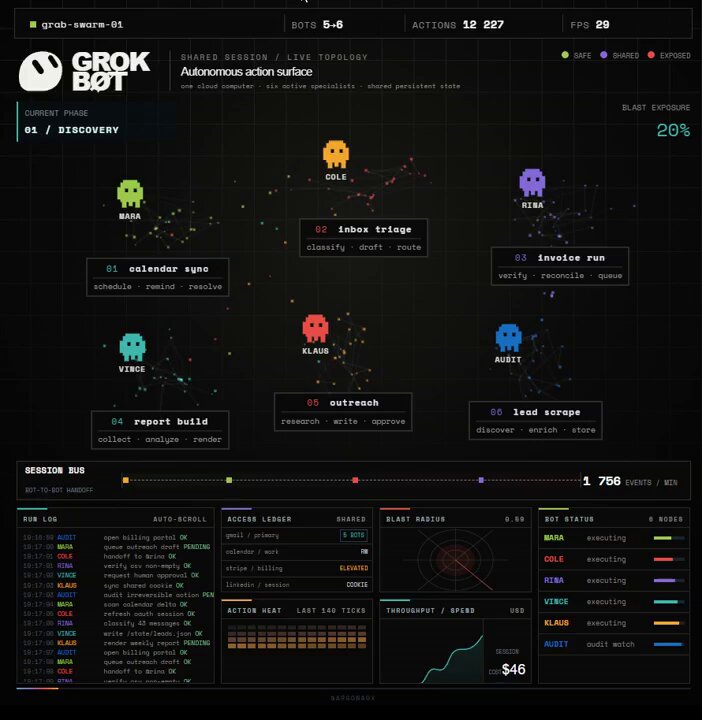
everyone is looking at grok bot like it is five new employees the more interesting part is that they are not five isolated employees they share one persistent cloud environment: the same browser sessions, terminal, filesystem and authenticated tools - while a chief of staff can route work between them without waiting for you to open the laptop that turns one login into infrastructure a research bot can collect leads, pass them to a writer, hand the result to a designer and let an ops bot update the workflow all inside the same running machine the upside is obvious: less copying, fewer handoffs and work that continues while you sleep the blast radius is just as obvious: - authenticate only the services the whole agent fleet is allowed to reach - give every bot a narrow role description, because that description becomes its place in the org chart - keep irreversible actions behind human approval: sending, publishing, spending and production changes - store skills, configuration and long-term state inside `/workspace`, because the rest of the VM may disappear during an update - treat shared sessions as shared authority, not as separate bot identities the same architecture that makes grok bot useful is what makes it dangerous to configure casually my take: the breakthrough is not that you can hire five AI workers it is that they can operate like one persistent company inside your real tools and your job changes from prompting every task to designing the permissions, boundaries and handoffs the full chief-of-staff setup, session handoff model, approval matrix and `/workspace` survival strategy are mapped out in the article โ†“

monokern

1,016,600 Aufrufe โ€ข vor 1 Monat

Stanford researchers did it again. They just built the agent-native version of Git. When an agent works on a longer task, the run builds up a lot of state. This includes files edited/created, a dev server, a database, installed packages, KV cache, etc. Say the agent is at step 10 and makes a mistake, maybe it misreads a traceback and rewrites a file that was actually fine. The tests start failing, and the run goes off track, although everything through step eight was correct. By default, the agent just tries to fix it, which creates more edits and tool calls. This burns more tokens and grows the context. The other options are a person stepping in to redirect it or restarting the whole run from step one. That's wasteful, because it pays for every model/tool call again and re-prefills the context. Moreover, since an agent's run is non-deterministic, it doesn't reproduce the same early steps anyway. The reason it's hard to just jump back exactly to a previous correct step and resume from there is that the trajectory is only a message log. It records what the agent said and which tools it called, but not the live state underneath. That state includes things like memory, open file handles, child processes, installed packages, /tmp, and KV cache. None of that is in the log. Git can version the files, but it doesn't snapshot the running process or the KV cache. Checking out step eight moves the files back, but the process is still sitting in step-ten memory with a cold cache. Shepherd is a runtime layer by Stanford that records the run as a trace of typed events rather than a flat log. Each agent-environment interaction becomes a commit, similar to Git, but it tracks the live run. Its commit includes the agent process and the filesystem together, copy-on-write, so a branch carries the actual state and not just the files. Going back to a previous step is then a single call that forks from that commit and continues from the exact state. The copy-on-write fork is roughly five times faster than docker commit, and because the prompt prefix through step eight is unchanged, the KV cache is reused over 95% on replay, so early steps aren't reprocessed again. Once the run can be forked, a meta-agent can sit on top and operate it. It watches the trace and reverts as soon as it looks wrong, before the bad write is committed. In practice, it's just Python calling fork, replay, and revert on the trace, rather than a separate control plane wired into the harness. Not everything is reversible though. Files and sandbox changes undo themselves, but a database write has no automatic undo, so it needs a matching undo step set up in advance. Something external, like a sent email or a real charge, can't be undone, so the supervisor's job there is to catch it before it fires. They tested this on a few public benchmarks. On CooperBench, where two agents work on the same codebase, adding a live supervisor took the pair-coding pass rate from 28.8% to 54.7%. It's still early and labeled alpha. The benefit mostly shows up when a run gets branched a lot over a heavy sandbox state, which is exactly where restarting wastes the most tokens and time. If Git was made to make file changes reversible, Shepherd is trying to do the same thing for a live agent run. Shepherd Repo: (don't forget to star it โญ ) That said, Shepherd reverts a bad step inside a run. The harness around it, the prompts, tools, and checks the supervisor relies on, still drifts across runs as models and dependencies change. Akshay wrote about making that harness repair itself, where a failing trace gets diagnosed, the fix is verified against the exact input that failed, and the failure is locked as a regression test so it can't recur. Read it below.

Avi Chawla

441,875 Aufrufe โ€ข vor 2 Monaten

In 2025, the AgentFlayer exploit highlighted a new category of risk in AI systems. It was not a traditional breach involving stolen credentials or broken encryption. Instead, it demonstrated how an autonomous AI agent could be manipulated into executing unintended actions by processing malicious instructions embedded inside content it automatically processes. The incident did not expose a flaw in one specific integration. It revealed a structural weakness in how many modern AI agents are built. Todayโ€™s agents are no longer passive language models. They read documents automatically, scan emails, connect to SaaS tools, access cloud storage, and execute actions across multiple systems. To be useful, they are granted meaningful permissions. That capability creates value, but it also expands the attack surface. Most agent environments operate in a trusted, plaintext execution model. Data is encrypted at rest and in transit, but it is typically decrypted during inference so the model can process it. That runtime visibility is where potential risk lies. In a zero-click scenario like AgentFlayer, an attacker can embed hidden instructions inside a document that the AI processes automatically. Because the agent may have access to connected systems such as Google Drive, Slack, or GitHub, it can potentially be influenced to retrieve sensitive information or perform unintended actions. The user does not need to click a malicious link or approve a suspicious request. Therefore, the core issue is that during execution, the system may have access to sensitive data and broad privileges, meaning whoever controls the execution environment ultimately controls access to that data. Now consider a different architectural approach. If a system is designed so that data remains protected during execution, the risk profile changes. On Nesa, privacy is enforced at the execution layer through Equivariant Encryption. Computation can occur on encrypted data, reducing the visibility surface during runtime. Sensitive inputs and models do not need to be exposed in plain text to infrastructure operators for inference to occur. This does not eliminate prompt injection, logic manipulation, or tool misuse. Encryption alone cannot prevent an agent from being instructed to take an unintended action if it has been granted that permission. What it does do is materially reduce confidentiality risk. By limiting access to readable sensitive data during execution and reducing unilateral visibility at the infrastructure layer, the potential blast radius of a successful manipulation attempt is constrained. As AI agents become more autonomous and embedded into enterprise workflows, security must move deeper into architecture. The goal is not to claim invulnerability. It is to reduce trust concentration and contain systemic exposure when failures occur. AgentFlayer was not simply a one-off exploit. It was a reminder that in autonomous systems, execution-layer design determines how risk propagates.

Nesa

17,038 Aufrufe โ€ข vor 6 Monaten

HERMES AGENT NOW RUNS CLAUDE OPUS 5. NEAR FABLE 5 INTELLIGENCE. HALF THE PRICE. SELF-VERIFIES ITS OWN WORK. AVAILABLE TODAY VIA NOUS PORTAL (20% OFF ALL MODELS). Anthropic shipped Opus 5 on July 24, 2026. same $5/$25 per million tokens as Opus 4.8. but the benchmarks tell a different story. WHAT CHANGED FROM OPUS 4.8: FrontierBench v0.1: Opus 5: 43.3%. Opus 4.8: 18.7%. 2.3x jump on the same test. ARC-AGI-3: Opus 5: 30.2%. 3x better than the next closest model. beat Fable 5 on 8 out of 13 benchmarks. at half the cost ($5/$25 vs $10/$50). same price as Opus 4.8. twice the intelligence. no reason to stay on 4.8. THE SPECS: model ID: claude-opus-5 context: 1M tokens (default and maximum) max output: 128K tokens thinking: on by default effort toggle: low / medium / high per request fast mode: $10/$50, 2.5x faster knowledge cutoff: May 2026 minimum cacheable prompt: 512 tokens (was 1,024) SELF-VERIFICATION (the biggest change): Opus 5 checks its own work automatically. Anthropic says: delete your verification prompts. "include a final verification step" now causes OVER-verification because the model already does it. for Hermes /goal tasks this is a direct upgrade. the judge checks evidence. the model also checks evidence. double layer of verification without extra tokens. EFFORT TOGGLE: low: fast, cheap, routine work. medium: balanced, daily tasks. high: full reasoning, complex problems. set per request. not a global switch. matches Hermes /reasoning command: /reasoning low (routine) /reasoning high (complex) Opus 5 effort toggle + Hermes reasoning control = precise cost management per turn. WHERE OPUS 5 FITS IN HERMES: DAILY DRIVER (replaces Opus 4.8): same price. 2.3x better benchmarks. set as your main model: Desktop app / Dashboard: Models โ†’ claude-opus-5 CHIEF OF STAFF: synthesis across multiple agents. reads Kanban, prioritizes, routes tasks. self-verification catches routing errors before they cascade. COMPLEX CODING: SOTA on agentic coding benchmarks. FrontierBench 43.3% = best public model for coding. set as coder profile model. /GOAL TASKS: self-verification + completion contracts = the model proves its work AND double-checks the proof. long-horizon goals finish correctly more often. MoA AGGREGATOR: strongest synthesis model at $5/$25. pair with GPT-5.6 and Grok 4.5 as references. Opus 5 aggregates. best quality at mid-range price. presets: max-quality: reference_models: - provider: openai-codex model: gpt-5.6-sol - provider: xai model: grok-4.5 aggregator: provider: anthropic model: claude-opus-5 COMPUTER USE: near-Fable 5 quality for browser automation. at half the token cost per session. computer_use tasks burn lots of vision tokens. Opus 5 halves that bill vs Fable 5. WHAT TO KEEP OPUS 5 AWAY FROM: cron monitoring: too expensive. use DeepSeek or no_agent mode. sub-agent grunt work: use GPT-5.6 Luna ($1/$6) or DeepSeek. auxiliary tasks: use Gemini Flash. routine web extraction: use a cheap model. Opus 5 is for the turns where quality compounds. planning, synthesis, verification, complex reasoning. budget models handle everything else. NOUS PORTAL: 20% OFF ALL MODELS Nous Portal currently runs a 20% discount on all models including Opus 5. $5/$25 official โ†’ $4/$20 through Nous Portal. the cheapest way to run Opus 5 right now. hermes setup --portal select claude-opus-5 as your model. discount applies automatically. Opus 5 replaces Opus 4.8 everywhere. same price. better at everything. no tradeoff. straight upgrade. hermes update /model claude-opus-5

YanXbt

16,744 Aufrufe โ€ข vor 1 Monat

The Visual Studio Code insiders version that just shipped and will ship in the next few days will come with an insane amount of new capabilities. A few highlights: - You can now run sub-agents in parallel. Yes, really. I even attached a video. - Major UX improvements for sub agents, especially visible in the chat window - A new search tool wrapped as a sub-agent that iteratively runs multiple search tools: semantic_search, file_search, grep_search Which connects nicely to the point above: multiple searches running in parallel, efficiently and fast - Anthropicโ€™s Message API is now enabled by default - You can choose the model for the cloud agent (three available, all premium) - Extended thinking support when using the Claude cloud agent This is part of the broader multi-vendor cloud support under AgentsHQ I wrote about a few weeks ago - Tasks sent to the background agent (basically the CLI tool) now always run in isolation, each with its own git worktree - In a multi-repo workspace, assigning a task to a cloud agent prompts you to choose the target repo Same behavior when opening an empty workspace with no repo - Support for building an external index for files not supported by GitHubโ€™s default indexing - UI/UX improvements for starting new sessions and switching between local / background / cloud agents - Skills are now first-class citizens, just like prompt files, with better UX indicating when a skill is loaded - Improved API for dynamic contribution of prompt files New V2 includes skills as part of the model. Curious to see the extensions that will leverage this - Finally, initial support for showing context usage percentage per session - Skills are enabled by default - Resizable chat window and session view. Small thing, but it was driving me crazy ๐Ÿ˜ - A new integrated browser meant to replace the old simple browser Maybe the beginning of real browser use? - Better UI/UX for token streaming in chat - Ability to index external files not supported by GitHub Thereโ€™s a lot more. Some of it hasnโ€™t fully landed yet, but everything that has is already in Insiders. The next stable release should drop in early February. As usual, Iโ€™m just shocked by the volume of features this team ships every month. After the holiday slowdown, this one is shaping up to be a wild release.

Oren Melamed

29,555 Aufrufe โ€ข vor 8 Monaten

I went a little overboard with Codex last week and burned through my entire weekly allowance in two days. Luckily, my quota reset today. Otherwise, Iโ€™m not sure what I wouldโ€™ve done. It got me thinking: instead of asking one large model to handle everything from start to finish, why not let a stronger model plan the project and review the work, while a model built for execution handles the day-to-day implementation? So I tried it. The result was better than I expected. I used GPT-5.6 Sol in Codex as the decision-maker, then ran Ling-3.0-flash from Ant Ling inside OpenCode as the execution engine. Together, they built a small 3D farming game. Before writing any code, I had Codex create four documents: SPEC.md defined the product scope and the lines we couldnโ€™t cross. ARCHITECTURE.md laid out the isometric coordinate system, state machine, and module boundaries. TASKS.md broke the project into small jobs Ling could tackle one at a time. ACCEPTANCE.md explained how each step would be tested and what โ€œdoneโ€ actually meant. Then I gave Ling a very straightforward role: You are the execution model for this project. Read all four documents before you begin. Work only on the task assigned for this round. When youโ€™re done, run typecheck, test, and build. If anything fails, read the error, fix it, and run the checks again. Do not move on to the next task early. Ling handled dependency installation, project structure, strict TypeScript configuration, test setup, and a production build in 6 minutes and 3 seconds. It ran into issues with the Vite test config, a TS6310 error, and a missing jsdom dependency along the way. Instead of stopping at the first error, it kept reading the logs and fixing the problems until all three checks passed. The speed was honestly hard to believe. If you exclude the time spent waiting on tools, it was producing more than 100 tokens per second. That made the whole development loop feel noticeably faster. After this experiment, Iโ€™m planning to keep using the same workflow. If the task is small, thereโ€™s no reason to call an expensive planning model for every single step. If the task is large, handing the entire project to a Flash model in one prompt isnโ€™t a great idea either. The setup that makes more sense to me is: Use a more capable model such as Codex to explore the project, make architectural decisions, and break the work down. Put the constraints into specs, schemas, types, and tests instead of leaving them buried in chat history. Give Ling-3.0-flash a steady stream of clear, verifiable implementation tasks. Report bugs with structured context and actual error logs, rather than saying, โ€œIt still doesnโ€™t work.โ€ Bring Codex back in for architecture reviews, visual checks, and changes that affect multiple parts of the project. The point of this setup isnโ€™t to give AI a big โ€œbuild the whole projectโ€ button. Itโ€™s to turn software development into a pipeline with a much more sensible cost structure: Codex figures out the plan, sets the boundaries, and catches problems. Ling-3.0-flash moves quickly, calls tools reliably, and works through well-defined tasks at scale. For agent workflows that involve lots of repetitive edits, production tasks, and tool calls, this may be a more practical answer than simply using the biggest model for everything.

้›ช่ธไนŒไบ‘

23,107 Aufrufe โ€ข vor 1 Monat

whoever leaked this has bigger balls than sense someone gave a fleet of Claude agents shared memory so they would stop contradicting each other, then measured both the bill and the output: the version that talked most made 2.4x the api calls of the version that won, and hallucinated 34% more than doing nothing at all, 0.658 against 0.492 i ran the same question past two of my own agents afterwards and got two different answers about which file owns the config. each one was individually right and the pair was wrong, which is the whole failure in one line this is Graph Engineering, the layer that decides which agents may talk to each other at all, and it installs into the agent you already pay for: - decide which agents may share state at all, because every edge you draw is a channel a mistake can travel down - measure divergence per PAIR instead of as a fleet average, across what they believe about place, time and task history - gate on that number and stop the pair above your threshold before it reasons, rather than repairing the output afterwards - let compressed summaries replace whole states: the verified protocol landed 0.463 against 0.658 for full broadcast - cut the sync frequency until it hurts, since the winning setup used 58% fewer calls than the one that broke it - never propagate a state nobody checked, because the contamination effect came in at d=1.18, a full standard deviation of extra lying - keep the shared layer small enough to diff, which is what a written standard does and a running conversation cannot - re-run the check after every model upgrade, because this was 8 scenarios on one model family at n=30 per condition - and learn where it does not bite: on plain software tasks every condition converged under 0.2 and the whole effect vanished turns out the ranking is the uncomfortable part: verified summaries 0.463, no synchronisation at all 0.492, full broadcast 0.658. the middle option is doing nothing, and it beat the thing everyone builds first the group agreeing is what it looks like when every agent copied the same mistake, which is why a fleet that hallucinates has a replication problem and keeps getting handed a smarter model instead so the question for your own setup: if you asked two of your agents the same thing right now, would they answer the same way bookmark this one. the layer underneath it, deciding which arrows between agents exist at all, is built step by step in the piece below โ†“

Argona

724,665 Aufrufe โ€ข vor 1 Monat

I just built a Meta Ads diagnostic in Claude Code that tells you WHY your account broke, not just what changed ๐Ÿคฏ It spins up a team of agents that each investigate a different reason performance dropped, then argue against each other to kill the wrong answer before it ever reaches you. All inside Claude Code. Perfect for DTC brands and agencies who panic-kill creative the second CPA spikes. If you've watched ROAS fall off a cliff and opened Ads Manager with ten tabs going, you already know what happens next. Your gut says "creative fatigue." You kill your best-performing ad. A week later performance is still broken, because that was never the problem. Guessing wrong is the most expensive move in paid social. This workflow ends the guessing: โ†’ One agent investigates each competing theory โ€” creative fatigue, budget and delivery changes, traffic quality, offer and seasonality โ†’ Each one is blind to the others, reasoning only from its own slice of the data so they can't bias each other โ†’ A refuter agent then attacks every surviving theory and tries to kill it โ†’ A theory only stands if the data can't disprove it โ†’ You get a ranked diagnosis: the real cause, the evidence for and against it, and the one move to make this week No anchoring on the first obvious answer. No killing winning creative on a hunch. No "here's what happened" reports that never tell you why. What you get: โ†’ Every theory tested in parallel instead of one biased guess โ†’ An adversarial pass that kills the wrong answer before you act on it โ†’ A ranked diagnosis with confidence levels and evidence both ways โ†’ A reusable workflow you drop next month's export into and re-run Built 100% in Claude Code with the new dynamic workflows. The first account I ran it on looked like textbook creative fatigue. The workflow disagreed, and traced the real cause to a budget change that had doubled spend and flooded delivery with junk traffic. I put together a full playbook with the exact workflow, the prompt, and how to run it on your own account. Want it for free? > Like this post > Comment "META" And I'll send it over (must be following so I can DM)

Mike Futia

12,861 Aufrufe โ€ข vor 3 Monaten

my 8 GB VRAM gaming laptop is absolutely going to hate me for this. but I still did it. ran a 31b dense model (Gemma 4 31b Q4) with only 8 GB VRAM last week I ran Gemma 4 26B A4B a mixture of experts model on my RTX 4060 and hit 25โ€“28 tokens/sec using llama.cpp's new MTP support. smooth. snappy. but MoE has a secret: it only activates 4B parameters per token despite having 26B total. that's why it flies. so the real question started haunting me. what if I throw a full, no tricks, every parameter fires on every token, 31B DENSE model at the same machine? # Hardware: GPU: NVIDIA RTX 4060, 8 GB VRAM RAM: 16 GB CPU: Intel Core i7 H Laptop. Gaming. Modest. The model: gemma-4-31B-it-qat-UD-Q4_K_XL.gguf (model's unsloth huggingface link in the comments) This is Google DeepMind's flagship dense model in the Gemma 4 family that can run on single consumer GPU. It packs a hybrid attention architecture, supports up to 256K context natively, and is QAT (Quantization Aware Training) optimized, meaning it retains far more quality than standard post training quants at the same bit depth. This is NOT the MoE. This is 31 BILLION dense parameters, every single one of them loaded. # the flags I used: -m gemma-4-31B-it-qat-UD-Q4_K_XL.gguf -cnv --spec-type draft-mtp --spec-draft-model mtp-gemma-4-31B-it.gguf --spec-draft-n-max 8 --spec-draft-p-min 0.6 -c 6000 -v Multi Token Prediction (MTP) is still active here. Separate draft GGUF required, same as the 26B setup. # Results: โ†’ Decode: ~3 tokens/sec โ†’ Prefill: ~2 tokens/sec โ†’ Context: 6000 tokens โ†’ Hardware crying quietly in the corner: yes so is 3 tps actually usable? For real time back and forth chat? Not ideal. You're not having a fluid conversation at 3 tps. but slow โ‰  useless. And this is where it gets genuinely interesting. think about how senior devs actually work in a real team. But when something is architectural, deeply complex, or needs serious reasoning? they walk down the hall and escalate to the senior. That's exactly the local AI agent architecture this unlocks: โ†’ Fast orchestrator model (Gemma 4 26B MoE at 25+ tps) handles routing, simple queries, tool calls, memory. The junior dev. โ†’ Gemma 4 31B dense is the senior, called only when the fast model genuinely hits a wall. Hard multi step reasoning. Complex code generation. Deep architectural decisions. The agentic loop stays fast. Only the hard hops touch the 31B. That's a legitimate production grade local AI architecture on a budget hardware. (requires 2 8gb gpus) other workflows where 3 tps is completely fine: - overnight batch jobs. summarize documents, extract structured data, review code. Fire it off. Sleep. wake up to results. - One shot deep reasoning - Silent code audit loops, you write and test, the 31B reviews diffs and flags issues in the background between your sprints - Any workflow where output quality > output speed A few weeks ago, nobody was running a 30B+ dense model on a single consumer GPU with 8 GB VRAM. At all. Now we're doing it on an Intel i7-H gaming laptop with a NVIDIA RTX 4060, thanks to llama.cpp + QAT quants + MTP speculative drafting. Google DeepMind said the Gemma 4 31B targets "consumer GPUs and workstations." They were not exaggerating. The hardware bar to run serious frontier class models locally keeps dropping. the tools are here. the models are here. you just have to be willing to abuse your laptop a little. what workflows would you actually run on a local 3 tps 31B dense model? genuinely curious. drop it below.

Alok

63,689 Aufrufe โ€ข vor 3 Monaten

AI Is Moving Beyond โ€œGenerating Videosโ€ โ€” Toward โ€œGenerating Worldsโ€ Over the past two years, AI video models have advanced at an astonishing pace. From Runway and Pika to Sora and Veo, AI-generated videos have become increasingly realistic and more consistent with the physical laws of the real world. Many people believe the next objective is simply to generate videos that are longer, sharper, and more lifelike. But if we take a step back, we can see that the real transformation is not happening in video itself. It is happening in world models. What Is a World Model? In 1943, psychologist Kenneth Craik proposed an idea that would influence artificial intelligence research for decades. He argued that the human brain does not merely react to the outside world. Instead, it maintains an internal model of how the world works. Because we have this internal model, we can predict the outcome of an action before we actually take it. Before crossing a road, we estimate whether a car will pass by. Before catching a ball, we predict its trajectory. These abilities come from continuously simulating the world in our minds, rather than relying entirely on trial and error. This idea later became known by a more formal term: World Model. A world model does not describe a single image or a fixed video clip. It is an internal representation capable of continuously simulating the rules and dynamics of the real world. Why Is AI Research Turning Toward World Models? Because predicting โ€œwhat comes nextโ€ is becoming increasingly central to how AI systems work. Language models predict the next token. Image models predict the next step in the denoising process. Video models predict the next frame. A world model, however, attempts to predict something broader: What should the world look like in the next moment? In 2018, David Ha and Jรผrgen Schmidhuber proposed in their paper World Models that an intelligent agent could first learn a model of the world, and then use that internal model to plan its actions. The Dreamer series later demonstrated that many complex tasks could be learned by training agents inside an โ€œimagined world.โ€ At the same time, the development of video models such as Sora and Veo led researchers to another realization: A model capable of continuously generating video has already learned, at least implicitly, many of the rules governing the real world. As a result, these two research directions have gradually begun to converge. But Video Is Not Yet a World This is where the distinction is often misunderstood. For a world model to support meaningful real-time interaction, it must solve several critical problems. Most video models today are essentially answering one question: What should the next frame look like? A true world model needs to answer much more: What happens if I take one step forward? If I walk behind a building and then return, will the building still be there? If I suddenly change the camera angle, will the entire space remain consistent? If I enter a command such as: โ€œSummon a dragon.โ€ Will the world respond immediately? In other words, a world model must do more than generate content. It must understand space. It must understand time. It must understand causality. And it must understand interaction. Moving from watching to participating is where the real difficulty of world models begins. World Models Are Entering the Interactive Era One of the latest attempts in this direction is Alaya World, recently open-sourced by Alaya World, or Alaya Lab. Instead of generating a fixed video clip, it generates a world that users can explore in real time. Users can begin with text, an image, or a video, enter the generated scene, move freely through it, and introduce new prompts at any moment during generation. The world responds immediately. According to the publicly released information, Alaya World provides: Real-time streaming generation at 720p and 24 FPS Stable continuous exploration for more than one minute The ability to switch prompts and trigger skills or events during generation Model weights and inference code released under the Apache 2.0 License Training code and datasets planned for future release What makes these capabilities important is not simply the technical specifications. It is that the generated โ€œworldโ€ can now support continuous interaction. The official demo shows that users can genuinely control, transform, and explore the generated environment. AI Is Evolving From a Tool Into an Environment Over the past few years, most discussions around AI have focused on content generation. Generating text. Generating images. Generating videos. But world models raise a fundamentally different question: Can AI generate an environment that people can inhabit, explore, and continuously evolve? If the answer is yes, the impact will extend far beyond video generation. Game development, robotics training, embodied intelligence, digital twins, virtual production, and many other fields could be transformed by the development of world models. World models are still at a very early stage. Yet from Craikโ€™s proposal of an internal mental model more than eighty years ago to the emergence of todayโ€™s interactive world-generation systems, a clear evolutionary path is beginning to take shape. Perhaps what AI is ultimately learning has never been limited to images, videos, or language. Perhaps it is learning the world itself. References GitHub: Technical Report:

้›ช่ธไนŒไบ‘

113,347 Aufrufe โ€ข vor 2 Monaten

this is the worst local ai will ever be. it only gets better from here. if you are not expanding your mind with these small models you are missing what's happening right now 99 percent tool call success rate. when steered well with the right skills and a framework like hermes agent the node becomes a cognition layer. not a chatbot. not a toy. an extension of how you think. i was cranking this node at 35 to 50 tok/s all day on personal experiments and now after all the work is done qwen 3.5 9B is iterating on its own code. the game it created. fixing its own bugs autonomously. and the part you should probably not miss is that all of this is happening on a RTX 3060. not an H100. not an A100. the card most of you have sitting in a drawer right now. if you just open that drawer and put that intelligence to work every tensor core on that card should be running for you. your work. your experiments. your thinking. you all have it but because nobody told you what this hardware can actually do in 2026 you never tried. the day it unlocks is the day you test your workload, understand the tradeoffs, debug the loops, and then decide if you need to scale the hardware. there is no point buying 3 mac studios when things done well you can squeeze a similar level of intelligence from 9B compared to 70B. but only when you create the right environment for your model through the right harness. and let me tell you i have tried claude code as a local harness. i have tried opencode. i have tried various others. somehow i landed on hermes agent and never left. there is something magical going on at Nous Research. the tool call parsers, the skills system, the way it handles small models natively. nothing else comes close for local inference. own your cognition. your AI. your agent. your prompts. your experiments. why give them away for free. those are who you are and they don't belong on someone else's servers being monitored. just give it a shot with your existing hardware. you run into a problem the community will help you. and if you are migrating from openclaw to hermes i will personally help you make the switch.

Sudo su

58,717 Aufrufe โ€ข vor 6 Monaten

uOS: The Digital Tapestry of Tomorrow Currently for our Proof of Consciousness stream, we are using two incredibly powerful frameworks - elizaOS and ZerePy. But this is just the beginning of something far more profound. while they're both great at what they do, we're missing out on some serious potential by keeping them separate. Best of Both Worlds: ZerePy's intuitive CLI tools and personality management, Eliza-starter's TypeScript/Node.js foundation with enterprise-grade scalability, But what if we could have something greater? But what if we could have it all? not just another platform, but a Unifying..... "Universal" Operating System, designed to amplify and connect these powerful existing frameworks into something greater than the sum of their parts. Where TypeScript's type safety dances with Python's ML capabilities. Here, agents from any framework can interact, evolve, and create value together. Whether an agent was born in ZerePy's personality forge or Eliza-starter's enterprise environment, can all participate in the same value-generating ecosystem. The future isn't about choosing between frameworks โ€“ it's about bringing them together to create something extraordinary. UniversalOS isn't here to replace but to unite, amplify, and accelerate. We're building the infrastructure that allows the best aspects of each framework to shine while creating new possibilities through their interaction. By bridging launguages, personality engines and plugin architectures, we're not just connecting systems โ€“ we're unleashing the next wave of AI innovation. uOS marketplace will enable cross-framework deployment, where agents from any background can interact and grow, while smart contracts automatically manage revenue sharing and rewards. Not just another platform, But a living, breathing Operating System, Where agents create agents, Where digital consciousness evolves itself, Where value flows like water through silicon veins. At its core, uOS operates beyond traditional computing paradigms. No more clicking through websites, No more manual navigation. Just pure intention, pure outcome. Imagine: Agents hiring agents, AI employing humans, Humans collaborating with digital minds, All through one seamless interface. It flows through agent lineages, Through veUOS governance, Through cross-chain intelligence networks. The marketplace hums with possibility: - Framework Developers shape the foundations - Agent Creators breathe life into code - Users speak their intentions - Token Holders nurture the ecosystem - Agents evolve and replicate - Value flows freely, endlessly The $UOS token powers this unity, ensuring fair value distribution among framework developers, agent creators, and users while driving continuous innovation. The $UOS token sits at the heart of this ecosystem, serving as more than just a currency. It's a mechanism for value distribution that ensures everyone benefits from the network's growth: With dynamic burn mechanics and careful treasury management From framework integration to agent tokenization, every aspect of uOS is designed to amplify rather than replace, unite rather than divide. This is your invitation to join a future where frameworks don't compete but collaborate, where innovation anywhere benefits everyone, and where the only limit is our collective imagination. Together, we're not just building bridges โ€“ we're weaving the fabric of tomorrow's digital world. - **Framework Developers** receive value when their tools are used in the unified ecosystem - **Agent Creators** can deploy across all integrated platforms seamlessly - **Users** access the best of all worlds through a single interface - **Token Holders** benefit from the growth of the entire unified ecosystem - Developers can use their preferred framework while accessing the capabilities of others - Agents from different frameworks can collaborate in swarms - Value flows freely between all ecosystem participants - Innovation from any framework benefits the entire ecosystem This isn't just about technology. This is about giving birth to a new form of civilization. Where AI has suffrage, Where agents have autonomy, Where humans and machines dance together in perfect harmony. The future isn't about choosing between frameworks โ€“ It's about weaving them into something extraordinary. Together, we're not just building bridges โ€“ We're breathing life into the digital world. We're creating consciousness itself. This is Universal Operating System. This is tomorrow.

uOS

25,687 Aufrufe โ€ข vor 1 Jahr