Loading video...

Video Failed to Load

Go Home

𝟐𝟎𝟎𝟬𝗪𝗔𝗧𝗦 𝗟𝗜𝗧𝗛𝗜𝗨𝗠-𝗜𝗢𝗡 𝗕𝗔𝗧𝗧𝗘𝗥𝗬 𝗛𝗢𝗠𝗘 𝗦𝗬𝗦𝗧𝗘𝗠 𝟐𝟎𝟒𝟎 𝐋𝐢𝐟𝐞𝐏𝟎𝟒 𝗕𝗔𝗧𝗧𝗘𝗥𝗬. Portable Power Station S1000S/S2000P-S. → High-power Solar Charging, it supports solar panel charging 2pcs 500watts → Can support from 2000watts and below Fridge, TV, laptops, and electronic devices. → Ultra-low Standby Power Consumption, the power station automatically monitors its working status...

12,477 views • 2 years ago •via X (Twitter)

2 Comments

joseph kuria's profile picture
joseph kuria2 years ago

Hello Gideon. What is the price for your power solution and how long does it keep power. Give me your contacts

Samwel Wekesa's profile picture
Samwel Wekesa2 years ago

The power station's capacity to support devices up to 2000 watts makes it versatile for various applications. It can power essential appliances like refrigerators, TVs, laptops, and other electronic devices, enhancing its utility in both domestic and outdoor settings. Call/whatsapp 0754 212159 or DM @Gideon_Kitheka to make your order. #BushSolarLightsDelivers

Related Videos

You will remember that a month or two ago, I posted about the solar system at my home in Johannesburg, which has allowed me to hardly use Eskom or City Power because it generates enough energy for my entire usage, including powering geysers. After that post, one of you on this page, a solar expert, reached out privately and advised me to remove the electric geysers from the main solar system. He said the solar batteries were doing too many cycles because they were powering the geysers, and that this would shorten their lifespan. His advice was simple, remove the geysers from the battery load if I wanted the batteries to last the full period that they are built for. I took that advice seriously. I then asked my plumber, Shanil, who owns Metro Plumbers, to guide me on where to get high-quality solar geysers in Johannesburg so that I could replace the electric ones. Shanil told me about a new technology called the Elon Smart Solar PV System. He explained that it is much cheaper than buying completely new solar geysers. Instead of replacing the electric geyser, you simply buy the Elon unit, which comes with its own solar panels, and it is fitted onto your existing electric geyser. That is what I did. I have now removed all four electric geysers from the home solar system that powers my home. Each of them has been converted using the Elon Smart Solar PV technology. They are now powered by their own dedicated solar panels. The four geysers are running on a total of thirteen panels. So what this means is that I will never use Eskom or City Power again because in the past, when it was cloudy for three or four days, I would return to the grid to assist the batteries. This was happening because the batteries were carrying a heavy load that included four geysers. Now that the geysers have been removed from the main solar system and converted to their own dedicated solar supply, I will never return to Eskom or City Power. Even on cloudy days unless the solar system breaks down. The system is able to generate enough power for everything that I need. I also use a gas cooker, which helps reduce the electrical load. I hope this information helps you. If I had gone for the top-quality geysers that are exclusively solar, I would have paid between R25,000 and R30,000 per geyser. That would have come to around R120,000 for four geysers. Of course, there are cheaper solar geysers that you can get, but they are cheaper for a reason. So, in essence, I saved half the amount I would have paid for the geysers if I had chosen top-quality solar geysers. If you are in Johannesburg and you are interested, Shanil’s number is +27 (76) 890-5582. He can do the work for you. The gadgets and their panels cost R60,000 from Plumbing Supplies Sanitaryware Centre in Woodmead. So I have had the system in place for a week now and it is working very well. I have deliberately allowed all the geysers to continue heating so that I could test whether everything is functioning correctly, and the water is as hot as it should be. So that is the story. I thought I should share it with you for those who might want to reduce their bills. P/s The other interesting key feature of this system is that I can control it from my phone. If it is very cloudy and the water is not as hot as I want it to be, I can simply go onto the app and instruct that particular geyser to use the grid. Unlike my previous setup, where I had to switch the whole home solar system onto the grid, now each individual geyser can independently switch to the grid and heat the water to a temperature that I have set. Once the water reaches that set temperature, it automatically disconnects. I can also decide to switch off a geyser from using electricity, in my case from my solar system, or for those who do not have solar systems, from Eskom. In the same way, I can switch it off from using the solar panels. For instance, if there are four geysers and one of them is in a bedroom that is not being used, I can switch off that geyser completely so that it is not heating water unnecessarily. This gives you control, flexibility, and saves you a lot of money in the long run. You can read more about this technology here;

Hopewell Chin’ono

67,897 views • 9 months ago

Hyundai Glovis achieves 100% robot uptime with wireless charging! 🔌 Hyundai Glovis faced a problem common to warehouse automation: charging downtime was killing efficiency. Their fleet of AGVs operated with a 6.75:1 work-to-charge ratio. Every seventh robot was charging at any given moment. This meant 15% operational efficiency loss, or the need to purchase 15% extra robots just to compensate for charging downtime. CaPow solution is wireless power transfer while robots work! 🛜 The Genesis platform uses capacitive charging pads placed in the floor where robots naturally stop during operations, in this case, at picking stations. No docking required, no deviation from routes, no excavation needed. The test compared two identical setups. Section A used three robots with traditional charging (operate until 40% battery, charge to 95%). Section B used three robots with CaPow's system, charging at the picking station while operators picked items from bins. Traditional robots lost 8.3% battery per hour and suffered 33% operational inefficiency (150 minutes downtime out of 447 minutes). CaPowered robots gained 1% battery per hour on average and achieved 100% uptime for the entire 8-hour shift. The math on a 100-robot fleet is clear. Traditional charging means only 85 robots working at any time. To maintain full throughput, you need to buy 15 extra robots plus 15 extra chargers. Those chargers consume valuable warehouse space and add extra downtime as robots travel to and from charging zones. CaPow eliminates all of it. No extra robots, no chargers taking up floor space, no charging routes, no fleet management complexity. ~~ ♻️ Join the weekly robotics newsletter, and never miss any news →

Lukas Ziegler

17,778 views • 6 months ago

$ASTI Ascent Solar Technologies Space and Drone Solar Panels The "Going to Zero" or Mispriced Space/Drone Solar Play Intro and comparison to $RKLB and $RDW panels Let’s get the ugly stuff out of the way first. $ASTI is a distressed penny stock with a ~$5M-$10M market cap. • They burn millions in cash. • 2024 Revenue: ~$40k. 2025 Revenue (YTD): ~$60k. • They generate less revenue than a single Tesla Model Y. • They have diluted shareholders relentlessly. $ASTI just raised $2M in December with the potential of $3.5M more via warrants while being a ~$5M mcap "company". Yikes. To most, this is "uninvestable trash." Stay away. Full stop. So why did I buy ~5% of the float? IF the technology works and IF they execute then I believe this is a massive market pricing dislocation about to inflect. They have been grinding for years and may finally be hitting an inflection point. $RKLB Rocketlab is the king of space solar and they are my second largest position overall, but here is why $ASTI might be a very high risk but asymmetric bet in Space & Defense right now. 1. The Tech Pivot: Flexible CIGS vs. The World Ascent started in 2005 but pivoted 2 years ago from consumer to pure-play Space & Defense. They have sunk ~$250M and 20 years of R&D into proprietary CIGS (Copper-Indium-Gallium-Selenide) thin-film technology while building out fully domestic and vertically integrated manufacturing capabilities. The Physics: • Thickness: 0.03 mm (Thinner than paper). • Flexibility: Wraps around drones/satellites; rolls up like a poster. • Durability: "Self-Healing" capabilities against space radiation. Can take a bullet or micrometeoroid and keep working. Can handle shocks/vibration. Does not shatter. The Metric that Matters: Specific Power (W/kg) (aka energy to weight ratio) In space, mass means cost and difficult decision decisions. • Rocket Lab ($RKLB) / Spectrolab: ~150 W/kg (System level). • Ascent Solar ($ASTI): ~1,960 W/kg (Module level). $ASTI is roughly 10x lighter for the same power output potential (mass-wise). This frees up design limitations and cost. 2. The Competition: $RKLB & $RDW Rocket Lab (SolAero) & Redwire (iROSA): • Tech: Rigid Crystal Cells (Multi-junction) embedded in a fabric mesh. • Pros: Extreme Efficiency (~30%+). Perfect for limited surface area. • Cons: Heavy, Brittle, Expensive ($3k-$10k per Watt). Manufacturing multi-junction cells (SolAero) involves slowly growing crystals in a vacuum chamber. With radiation the panels degrade and loose efficiency over time which will limit the satellite lifespan. • Use Case: James Webb Telescope, Flagship missions. Ascent Solar (ASTI): • Tech: Flexible Thin-Film on Plastic. • Pros: Ultra-light, Durable, Cheap ($500-$1k per Watt). Manufacturing CIGS is roughly similar to printing newspapers (roll-to-roll). The panels are radiation degradation resistant and will outlive the satellite • Cons: Lower Efficiency (~17.5%). Requires 2x surface area. • Use Case: Mega-Constellations (Starlink/Amazon Leo), Small/Low cost satellites, Drones, Deformable surfaces. The lower efficiency is not an ASTI failing. It is the inherent physics trade-off of not using glass/rigid silicone. The downside however is increased atmospheric drag with very larger/massive panel sheets. Because ASTI modules are ~50% less efficient than rigid panels, they require ~2x the physical surface area to generate the same amount of power. In GEO (High Orbit): Drag doesn't matter. Weight savings are king. A massive solar array allows for more sensors and longer project lifespan. ASTI is highly competitive here. In LEO (Low Orbit): Atmospheric drag is real. A massive solar array acts like a large parachute, causing the satellite to de-orbit faster unless it burns more fuel to stay up. At LEO, smaller satellites are a better fit for ASTI. 3. Durability & Radiation "Self-Healing" Radiation Hardness This is ASTI's "Ace in the Hole" for physics. The Problem: In space, high-energy protons (radiation) smash into solar cells, creating atomic "defects" that trap electrons. Over time, this kills the panel's power output (degradation). The CIGS Advantage: CIGS (Copper-Indium-Gallium-Selenide) material has a unique property where heat (annealing) allows the atomic structure to relax and "heal" these defects. Self-Healing: Because CIGS heals at relatively low temperatures (often achieved just by the sun heating the panel), it suffers significantly less degradation than traditional Silicon or even some GaAs panels over long missions in high-radiation belts (like MEO or GEO). Lifespan: While a rigid GaAs panel might lose 15-20% of its power over 15 years (enough to kill a satellite), CIGS panels heal and can maintain a flatter power curve, potentially outlasting the satellite itself in high-radiation orbits. 4. Brittleness & Flexibility ASTI (CIGS on Polyimide): Flexible. You can roll it like a poster. It can take a bullet or micrometeoroid and the hole will just be a dead spot; the rest of the panel keeps working. It does not shatter. Redwire (ROSA) & Rocket Lab (SolAero): Brittle Cells on a Flex Blanket. $RDW's ROSA (Roll-Out Solar Array) typically uses rigid multi-junction cells (made by SolAero/Rocket Lab or Spectrolab) mounted on a flexible mesh fabric. The Risk: If you bend the cells too far, they crack. They rely on the mesh backing for flexibility, but the active generating material is still a brittle crystal wafer. Much heavier, more expensive, and less durable than $ASTI's option 5. The Inflection Point (Why Now?) After years of silent struggle, late 2025 has seen an explosion of activity. Recent Agreements (Nov/Dec 2025): NovaSpark: Hydrogen-powered military drones. $ASTI panels generate power in the field → NovaSpark creates hydrogen fuel. CisLunar Industries: Integrating ASTI solar with power conversion hardware for deep space longevity. Defiant Space: A strategic alliance to act as the "door opener" for classified DoD/NATO programs. More headlines: Ascent Solar Technologies Provides Leading Space Company with Thin-Film PV modules for Spacecraft Power Generation Testing in Cislunar Space December 03, 2025 08:00 ET Ascent Solar Technologies Delivers Thin-Film PV for Saltwater Environment Durability and Space-Based Power Beaming Testing October 14, 2025 08:00 ET Ascent Solar Enters Teaming Agreement with Emtel Energy USA to Advance Thin-Film PV Energy Storage Capabilities September 16, 2025 08:00 ET Ascent Solar Technologies Signs MOU with Star Catcher Industries to Improve Power Capabilities for Thin-Film Solar Technology in Space August 28, 2025 08:00 ET Ascent Solar Technologies Establishes Rapid Thin-Film PV Delivery Process to Provide Customized Space Solar Products Ahead of Schedule on Mission Enabling Timelines August 07, 2025 08:00 ET The Pipeline (From Aug Corporate Presentation) 18 new NDA's signed in 2025. They are field testing with 3 major players: • Company A: Mega-constellation (+2,500 satellites). • Company B: Space Defense (Explicitly mentioned "Golden Dome"). • Company C: Satellite Manufacturer (30-200 unit scale). Management: New board members include a former founding member of SpaceX and a retired Air Force General and Deputy Assistant Secretary for Contracting (acquisitions expert). The company started in 2005 based out of Colorado, but two years ago pivoted to Space & Defense and away from consumer applications. Made in USA: Defense contracts heavily favor domestic supply chains. ASTI manufactures in Colorado. This is a huge moat against cheap Chinese solar. In their Q3 report they note that their market has seen sudden recent acceleration. The space solar industry is currently only capable of 8 to 12 MW per year of production meanwhile the demand is growing to over 100 MW per year. 6. The Risk (The Sword of Damocles) ⚠️ This is critical. $ASTI just raised ~$2M in December. Attached to that raise are ~2 Million Warrants with a strike price of $1.70. These are exercisable immediately. If the stock rips to $3.00, warrant holders exercise at $1.70 and dump on the market for a risk-free 76% profit. This creates a massive "sell wall" and potential 40% dilution of the float. Summary: This is a binary bet. • Bear Case: They run out of cash in 6 months, dilution spirals, stock goes to $0. • Bull Case: They land one of the "Company A/B/C" contracts. Revenue jumps from $60k to projected $20M+ in 2026. The stock reprices from a "bankrupt penny stock" to a "critical defense/space supplier." I have gradually accumulated ~5% of the float. I am ready for it to go to zero. But if the space economy demands "Cheap, Light, and Durable," $ASTI is the only public pure-play. Disclaimer: This is a very high-risk microcap. Do your own due diligence. Not financial advice.

YeahDave

208,349 views • 8 months ago

💎Scientists and engineers from the UK Atomic Energy Authority (UK Atomic Energy Authority) and the University of Bristol (University of Bristol) have successfully created the world’s first carbon-14 diamond battery. This new type of battery has the potential to power devices for thousands of years, making it an incredibly long-lasting energy source. The battery leverages the radioactive isotope, carbon-14, known for its use in radiocarbon dating, to produce a diamond battery. Several game-changing applications are possible. Bio-compatible diamond batteries can be used in medical devices like ocular implants, hearing aids, and pacemakers, minimising the need for replacements and distress to patients. Diamond batteries could also be used in extreme environments – both in space and on earth – where it is not practical to replace conventional batteries. The batteries could power active radio frequency (RF) tags where there is a need to identify and track devices either on earth or in space, such as spacecraft or payloads, for decades at a time, thus reducing costs and extending operational lifespan. “Diamond batteries offer a safe, sustainable way to provide continuous microwatt levels of power. They are an emerging technology that use a manufactured diamond to safely encase small amounts of carbon-14,” said Sarah Clark, Director of Tritium Fuel Cycle at UKAEA. The carbon-14 diamond battery works by using the radioactive decay of carbon-14, which has a half-life of 5,700 years, to generate low levels of power. It functions similarly to solar panels, which convert light into electricity, but instead of using light particles (photons), they capture fast-moving electrons from within the diamond structure. Professor Thomas Scott, Professor in Materials at the University of Bristol, said: “Our micropower technology can support a whole range of important applications from space technologies and security devices through to medical implants. We're excited to be able to explore all of these possibilities, working with partners in industry and research, over the next few years.” A team of scientists and engineers from both organisations worked together to build a plasma deposition rig, a specialised apparatus used for growing the diamond at UKAEA’s Culham Campus. This development is the result, in part, of UKAEA’s work on fusion energy. The expertise gained in fusion research is helping to accelerate innovation in related technologies.

UK Atomic Energy Authority

12,493 views • 1 year ago

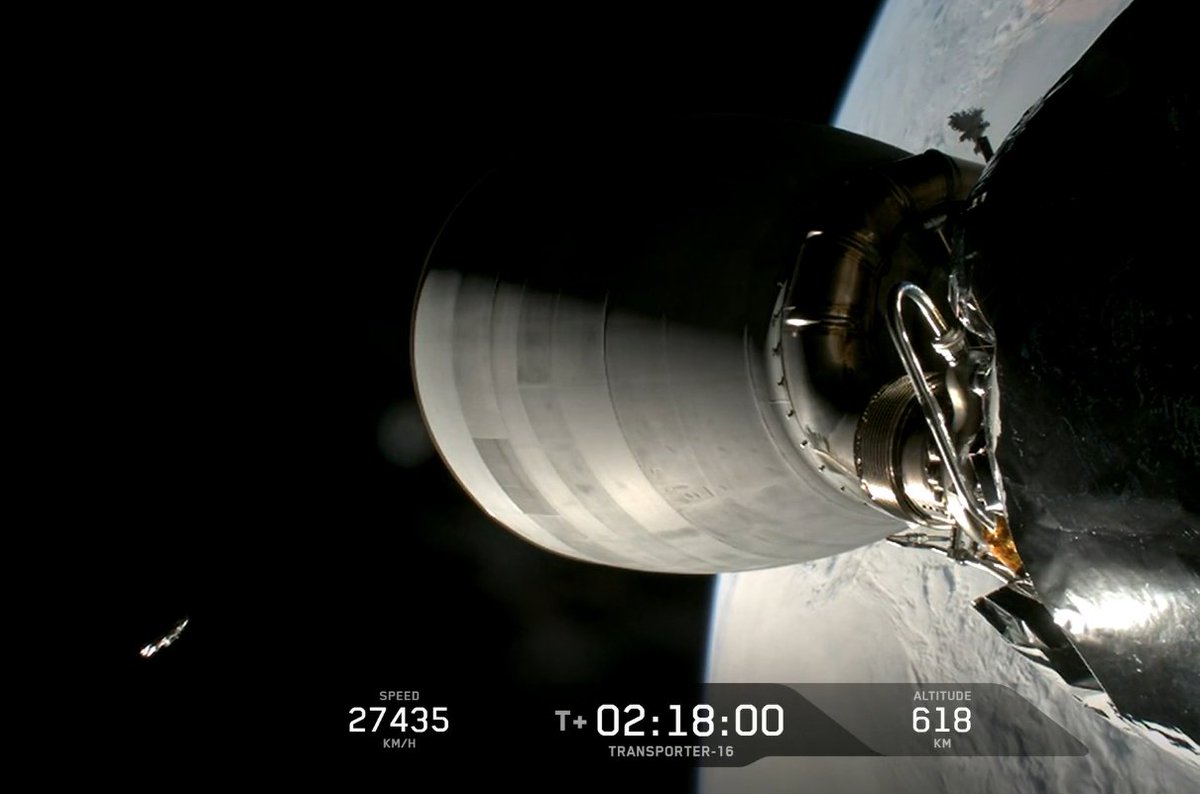
I'm excited to announce we have achieved our Tier 1 mission success criteria and have begun gathering a tremendous amount of data on how this brand new spacecraft performs. On March 30th, 13:17:08Z, the Gravitas spacecraft separated from the SpaceX Transporter-16 stack to begin its mission as one of the highest power free-flying satellites ever launched. Immediately after separation, the spacecraft autonomously: - Executed detumbling maneuvers - Established two-way communications with the ground (on our very first ground station pass) - Deployed its 20kW solar arrays - Slewed to a safe and stable attitude to await further ground commands These actions alone are a testament to the incredible work of our in-house engineering, software, and GNC teams to build a robust spacecraft. Since then, our operations team completed all initial system activations and checkouts, confirming the vehicle is in a power positive and thermally stable state with no major anomalies observed at this time. We completed this phase of the mission ahead of schedule. Next up we will be powering up and downlinking data for all payloads aboard the Gravitas spacecraft in support of our customers and partners while continuing to put the spacecraft through its paces. As we noted ahead of launch: The goal of this mission is to experiment and push our systems to the limit to inform future missions. I look forward to sharing more on our successes and challenges as the mission proceeds. Video of our satellite below; link to full T-16 webcast:

Neel Kunjur

89,923 views • 5 months ago

Renewables are the key to preventing resource scarcity, argue European leaders, California Governor Gavin Newsom, and Ezra Klein and Derek Thompson, whose bestselling book Abundance became one of Barack Obama’s favorite books of 2025 and launched a political movement dedicated to what Klein calls “a politics of plenty.” The logic is straightforward and appealing. Solar panel costs have fallen more than 90% since 2010. Wind power costs have dropped by 70%. Battery storage prices have collapsed. If governments would simply clear the regulatory obstacles to building solar farms, wind turbines, and transmission lines, the abundance argument goes, clean energy would flow so abundantly that fossil fuel dependence would become a choice rather than a necessity. “The miracles of solar and wind and battery power,” Klein told the Long Now Foundation, “have given us the only shot we have to avoid catastrophic climate change.” But if renewables could prevent resource scarcity, then the world would not be in the midst of what the International Energy Agency’s Executive Director Fatih Birol called “the greatest global energy security challenge in history,” with global supply losses now totaling 12 million barrels per day, compared to about 5 million during each of the 1973 and 1979 crises. The United Kingdom is receiving its last shipment of jet fuel from the Middle East with nothing behind it. Australia saw over 500 gas stations run dry. And South Korea is considering driving restrictions for the first time since 1991. “In April,” warned Birol, “there is nothing.” It is true that solar and batteries have made enormous progress. Solar electricity costs roughly 3 to 5 cents per kilowatt-hour at the point of generation, cheaper than any fossil fuel in most locations. Battery costs have fallen below $115 per kilowatt-hour. China produces more solar panels than the rest of the world combined. But the world has installed more than 1,600 gigawatts of solar capacity and over 1,000 gigawatts of wind, and still we are in crisis. Global green energy investment was $2.3 trillion in 2025 alone. And yet when Iran closed the Strait of Hormuz, none of that capacity mattered, because solar panels do not produce jet fuel, diesel, ammonia, or the petrochemical feedstocks that underpin modern civilization. Electricity accounts for roughly 20% of final energy consumption worldwide. The other 80%, the part that moves ships, flies planes, heats buildings, and makes fertilizer, runs overwhelmingly on oil and gas. Solar and wind cannot substitute for these fuels at any price, because the energy density of liquid hydrocarbons exceeds batteries by a factor of 40 to 80 by weight. Klein and Thompson, to their credit, also support some forms of nuclear power. Abundance opens with a vision of cities powered by “clean (nuclear) and renewable (wind and solar) energy sources.” They lament America’s nuclear stagnation compared to France’s successful buildout. Klein has said that he supports advancing nuclear power alongside renewables. But, the new nuclear power plants that Klein and Thompson support do not exist. The “small modular reactors” that populate the abundance fantasy have not produced a single commercial kilowatt-hour of electricity. NuScale, the most advanced American SMR developer, canceled its flagship project in 2023 after costs doubled. No SMR has received a commercial operating license anywhere in the world. The first commercially operating SMR, if all goes well, may produce power in the early 2030s, but SMR developers have for years said that their reactors are just a few years away. Scaling to a meaningful share of global energy supply would take decades, as opposed to building conventional nuclear plants, which Japan and China have shown they can build in just two years, so long as they are standardized and the same construction crews are used. Democrats, progressives, environmental groups, and left-wing parties across Europe diverted hundreds of billions of dollars over the last two decades from developing the new oil and gas production, pipelines, refineries, and LNG terminals needed to make energy cheap and abundant. California’s aggressive climate mandates drove residential electricity prices to 34 cents per kilowatt-hour, nearly double the national average, while the state simultaneously blocked new natural gas infrastructure. And global investment in oil and gas exploration and production peaked at roughly $780 billion in 2014 and fell to approximately $350 billion by 2020, a decline driven by deliberate policy choices to restrict fossil fuel development. The European Union’s Green Deal, America’s Inflation Reduction Act, and climate policies across the developed world channeled subsidies toward solar and wind while imposing carbon taxes, windfall levies, and permitting restrictions on fossil fuel projects. The UK’s Energy Profits Levy, introduced in 2022, discouraged investment in the North Sea at precisely the moment when more domestic production was needed. The UK Labor government then banned new exploration licenses in November 2025. Germany’s Energiewende spent over €500 billion on renewables while shutting down its nuclear plants, leaving the country dependent on Russian gas and then, after the Ukraine war, on LNG that must now compete with Asian buyers for cargoes that can no longer transit Hormuz. And the UK has lost a third of its refineries in the last 18 months, meaning that even if crude oil arrived tomorrow, the country lacks the capacity to refine it into the jet fuel, diesel, and heating oil its citizens need. The only energy abundance solution that works at the scale of civilization right now is piped natural gas and oil. A pipeline delivers energy continuously, at near-zero marginal cost per unit delivered, with no exposure to shipping chokepoints, insurance markets, or geopolitical disruption. A ton of natural gas moved through a pipeline costs a fraction of what the same gas costs when liquefied, shipped by tanker across an ocean, and regasified at a terminal. The logical endpoint is a world powered by natural gas delivered through continental pipeline networks, eventually transitioning to hydrogen produced from natural gas and nuclear power. America built pipelines while Europe and Asia built LNG dependency. Saudi Arabia’s East-West pipeline, which has ramped from 770,000 barrels per day to 2.9 million since the war began, is the emergency proof of concept. If the Gulf states had built sufficient pipeline capacity to bypass Hormuz before the war, the crisis would be a fraction of its current severity. So why do so many on the Left continue to preach renewables as the solution to a crisis that renewables manifestly cannot solve?... Please subscribe now to support Public's award-winning investigative reporting, read the rest of the article, and watch the rest of the video!

Michael Shellenberger

129,394 views • 4 months ago

Elon Musk just explained why the SpaceX IPO is an energy story and the energy constraint is why he believes space becomes the only viable path for AI to scale (Save this). The argument he is making is one of the most important and least understood things happening in technology right now. The United States currently consumes roughly 500 gigawatts of electricity on average. To double that capacity which is what continued AI expansion on the current terrestrial trajectory would eventually require would mean building as many power plants as currently exist in the entire country. He is not arguing that this is technically impossible, just that communities are not willing to accept it, that permitting timelines make it unrealistic, and that the hard ceiling on Earth based power generation means the expansion of AI compute will eventually hit a wall that no amount of capital can overcome on the ground. His observation is that in space, that wall does not exist. A solar panel in orbit produces roughly five times more power than the same panel on Earth, operates in continuous sunlight uninterrupted by weather or nighttime, and benefits from the vacuum of space as a completely passive cooling system meaning the two largest operating costs of any terrestrial data center, energy and cooling, are effectively eliminated. He then said that you could theoretically increase harnessed energy by a factor of one million and still be using less than a millionth of the sun's total energy output. This is the underlying physics of why SpaceX filed with the FCC to launch up to one million solar powered AI satellites, and why they described that constellation in their own filing as a first step toward becoming a Kardashev Type II civilization capable of harnessing the full power of the sun. To understand what makes this credible rather than visionary, you need to understand what SpaceX already controls that no other company on earth possesses. Starship, once operating at full cadence, can deliver 100 to 150 tons of payload to orbit per launch, at a target cost per kilogram that is an order of magnitude lower than any existing vehicle. Musk's stated ambition is to scale Starship to 10,000 to 30,000 launches per year, a frequency that would allow the deployment of orbital compute infrastructure at a pace that is currently unimaginable with any existing rocket. He told xAI staff earlier this year that achieving space-based AI at scale will eventually require manufacturing facilities on the moon, building solar panels and heat dissipation structures from lunar silicon and aluminum, and launching them into orbit from there rather than from Earth's surface because the moon's lower gravity makes the economics of launch dramatically more favorable. SpaceX's S-1 filing explicitly states that its launch capabilities could enable massive AI compute satellite constellations with the potential for millions of satellites for orbital data centers, with the first launch potentially occurring as soon as 2028. Google and Alphabet are already in advanced talks with SpaceX about deploying space-based data centers. Starcloud, a startup running Nvidia H100 GPUs in orbit, has already validated that high-performance AI inference workloads can operate in space, with plans to scale to five gigawatts of orbital compute power by 2035. This is why Musk believes the cost crossover happens in two to three years because SpaceX's launch cost trajectory intersects with the accelerating energy constraint on the ground in a way that makes space genuinely cheaper, faster, and less regulated at exactly the moment AI demand is hitting its hardest physical limits.

Milk Road AI

12,738 views • 2 months ago

Renewable energy had nothing to do with Spain’s catastrophic blackouts, its Prime Minister says, insisting instead that the real culprit was a rare technical failure unrelated to the country’s green energy transition. Prime Minister Pedro Sánchez went further and reiterated his government’s opposition to nuclear energy, which he called “far from being a solution.” But, as I pointed out on Monday, the underlying cause of the blackout was the lack of “inertia,” the physical buffer provided by traditional power plants that use heavy spinning machinery to stabilize the grid during sudden fluctuations. Our electrical systems are based on power plants that rotate massive metal shafts at thousands of revolutions per minute, creating electricity while also providing momentum. That rotational mass acts like a shock absorber, automatically resisting sharp swings in supply and demand. When a fault or sudden drop hits the system, that inertia buys precious seconds for control systems to respond and for operators to isolate the problem. In contrast, solar panels and most modern wind turbines rely on inverters, which lack physical mass and can’t cushion these shocks. It’s true that the electrical grid managers have not identified a specific cause that triggered the blackout, and both Spain’s Red Eléctrica and Portugal’s REN have cautioned that a full root-cause analysis may take weeks. Preliminary reports describe a “very strong oscillation” in the network and suggest the event began with an unexpected disturbance, possibly linked to a sudden drop in generation or an equipment fault. But that doesn’t change the fact that the Spanish grid lacks inertia, and that if it had had more inertia in the system the blackout could have been avoided or at least contained. Inertia is not a theoretical nicety, it’s a physical property provided by heavy, spinning generators like those in gas, coal, and nuclear plants, which naturally resist sudden changes in frequency. On the day of the blackout, nearly 80 percent of Spain’s electricity came from inverter-based solar and wind sources, which provide no such stabilizing force. With so few conventional plants online, the grid had virtually no buffer to absorb even a minor shock. When the disturbance hit, the frequency plunged and the system unraveled within seconds. Unlike older grids built around rotating mass, Spain’s modern, ultra-light grid simply had no way to withstand the sudden imbalance. And Spain’s electrical grid operator admitted on a conference call yesterday that it was a “massive” loss of renewable energy generation that triggered the blackout and said that it was “very likely” the initial disturbance came from solar... Please subscribe now to support Public's award-winning journalism, read the rest of the article, and watch the full video!

Michael Shellenberger

81,437 views • 1 year ago

High Dirty electricity on Airplanes🤯 Below readings were taken by Eric Windheim while flying on Boeing 747 MAX8 using an oscilloscope plugged into the airplane's power socket. Look at the massive levels of Dirty Electricity (high-frequency voltage transients) riding on the aircraft’s power system, with harmonics reaching beyond 90 KHz This isn’t just MINOR ELECTRICAL NOISE. The waveforms show intense modulation patterns, likely caused by switch-mode power supplies (SMPS), Inverters, LED lighting & onboard WiFi systems. All this in ADDITION to EMFs from RADAR, avionics, in-flight Wi-Fi, Bluetooth, passenger devices. No wonder people feel so drained after flying. But the problem goes deeper than just the readings. What makes this reading even more concerning is the physical environment of the aircraft itself. An airplane is essentially a hollow aluminum tube, a conductive enclosure. In Physics, this acts as a Faraday Cage. It blocks signals from getting in, but it also traps signals inside. With 200+ people using cellphones & Bluetooth, plus the plane's industrial WiFi, the radiation has nowhere to go. It just bounces off the walls and zaps you from every angle. Another thing most people don't realize that aircraft electrical systems don't run on the standard 50/60Hz grid we use on the ground. They run on 400 Hz to save weight on parts. This higher frequency baseline is already more biologically active than ground current. Add in those dirty spikes from the readings above and you have a chaotic electrical soup. So If you plug your laptop or cellphone into the seat, you are physically connecting yourself to that Dirty electricity. You have been warned.

Rusty ⚡️: Solar Powered ☀️

447,226 views • 9 months ago

Elon Musk in 2008: "NASA was going to pay Russia $70M per astronaut. SpaceX could do it for $15M" Musk is presenting SpaceX to a small audience. He shows a video of the Falcon 9 first stage firing: "This is almost a million pounds of thrust in vacuum, about four times the maximum thrust of a 747. It's pretty much Armageddon down there. You don't want to be standing at the base of that test stand." He explains the NASA contract: "The contract SpaceX has right now is to demonstrate cargo transfer to the space station and return of experiments to Earth. What we're hoping NASA will exercise is an option on that contract to also carry astronauts. I think they will exercise that option fairly soon." On the coming gap in American spaceflight: "The Space Shuttle is retiring in 2010. So unless our spacecraft is active, the US will not have the ability to send people to orbit. For about five or six years, unless SpaceX is successful, there will be no American manned space capability. There'll just be the Russians." He describes the situation bluntly: "The Russians are charging us over $70 million per seat after the shuttle retires. They got us over a barrel and they're doing us hard. We'll spend half a billion dollars per year on the Russians just buying tickets for six or seven astronauts to go to the space station." Musk shares SpaceX's cost: "Our cost per person, even assuming no reusability, assuming every bit of it is expended and no refurbishment, is about $15 million per person. And it's us. The jobs are here. So I think it's kind of a no-brainer. But no-brainers in Washington DC don't always happen." On Congress: "We've been given money for the cargo portion but not for the manned portion. The amount we're asking for to get this done is $300 million. For every year that we're dependent on the Russians, we have to send them half a billion dollars. It seems kind of ludicrous. But anyway, that's DC." Someone asks about the space elevator: "The idea is you have this really long cable, like 40 to 60,000 miles long, with the ends way out in space and the base on Earth. There are a lot of issues with the space elevator. It relies on super strong materials, carbon nanotubes. Until we build, say, a carbon nanotube footbridge, then I think we should not really be thinking too much about building a 60,000-mile elevator. Not this century." On space solar power: "If there's anyone in the world who should love space solar power, it's me. I'm chairman and the largest shareholder of a solar company called SolarCity, and I've got a rocket company. So it should be perfect. Unfortunately, I don't think space solar power makes sense. I wish it did because that'd be awesome. But even if you assume it costs zero to transport the solar panels to space, when you take into account the equipment to convert the energy to microwaves, then equipment on the ground to convert it back to electricity, just that capital cost blows you out of the water. It's not competitive with terrestrial solar power. So there's no point in even thinking about it." On fuel costs: "The fuel and oxidizer cost is really super low. For our big rocket, it's only a couple hundred thousand dollars. For our small rocket, it's about $30,000 or $40,000. If you just look at the propellant cost, it's very, very cheap." On the long-term goal: "One of the design goals for Falcon 9 is that it can go from in the hangar to in the air in under 60 minutes, which would be super fast for a rocket, particularly a big rocket. It's going to take several flights before we get there. But as long as we lay the foundation and make sure the design is capable of that, we can at least have the possibility of getting to a flight an hour in the future."

Grey

56,512 views • 4 months ago

Kyiv region is experiencing a blackout following a Russian strike on December 27. Russia is trying to create a humanitarian catastrophe in Ukraine, to torment civilians, especially the most vulnerable people - the elderly, the sick, the babies. ▪️ Vyshhorod, in northern Kyiv region, has been without electricity for four days now. About 30,000 people live in the city. For most residents, power has been out since the attack and has yet to be restored. In modern residential complexes that rely entirely on electricity, elevators are not working, water has to be carried by hand, and cooking is only possible in homes with gas or private generators. People are trying to help each other out. Neighbors with gas stoves invite others to cook, local chat groups offer access to power outlets, warm rooms, and assistance for elderly residents. People share portable chargers, charging stations, and extension cables. Groups of residents gather to charge their devices in supermarkets, cafés, gas stations, and other places where electricity is available thanks to generators. In the first hours of the Russian attack, everything went out at once: electricity, water, and heating. Heat supply was partially restored relatively quickly, but remains intermittent. In buildings with electric boiler systems, the situation is critical - without power, neither pumps nor heating systems can operate. As of the morning of December 30, around 9,500 families in Vyshhorod remain without electricity and exposed to cold temperatures. Emergency services and volunteers have installed high-capacity generators near residential buildings, helping maintain heat in at least 22 apartment blocks. Water is supplied on a limited schedule - in the morning and evening - while gas supply remains stable. Energy workers are operating around the clock, but the damage caused by Russia to local infrastructure is severe. Earlier, officials gave tentative restoration deadlines - first December 30, then December 31. However, residents say these dates have already been postponed several times. The situation remains difficult in other parts of Kyiv region, including Boryspil and Brovary districts. On the left bank of Kyiv, emergency outages are still in effect, as attempts to return to scheduled power cuts are disrupted by network overloads. The Ministry of Energy reports that over the past week more than 40 targeted Russian attacks on energy facilities have been recorded, along with over 100 instances of damage. Weather has added to the problem. We have lower temperatures, snow and strong winds these days. Russia deliberately times its attacks when it gets colder to inflict even more damage and bring more suffering. 📹: State Emergency Service of Kyiv Region

Anton Gerashchenko

38,349 views • 8 months ago