Apex 🛰
@Apex_Spacecraft • 4,621 subscribers
The Spacecraft Platform Company
Videos

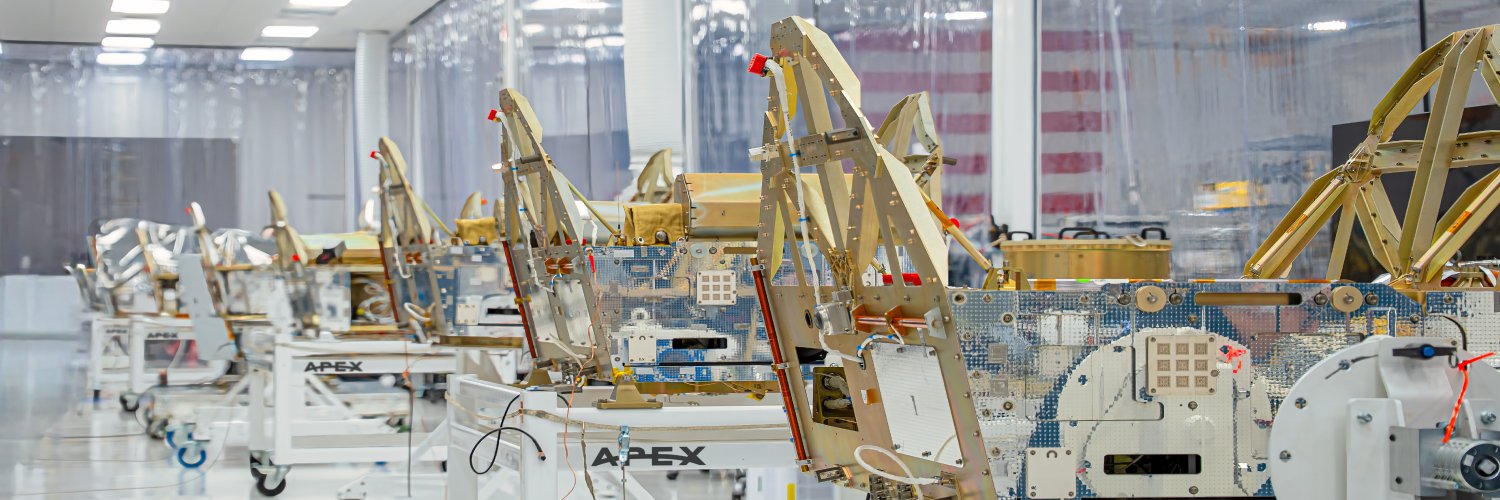
Today, we unveil Project Shadow — Apex's on-orbit Space-Based Interceptor (SBI) technology demonstration, launching NET June 2026. At Apex, we often launch self-funded missions to advance our technology and demonstrate our capabilities in space. Over 1.5 years ago, we launched our first Aries satellite, which continues to serve as an on-orbit software testbed for our team and customers. Project Shadow is our next step internally funded mission (with more to come in the future). Launching on our Nova satellite bus platform, Shadow integrates and demonstrates key SBI technologies in a single, end-to-end mission. Here’s an inside look at Shadow: 1. Apex’s Nova platform will be outfitted with the “Orbital Magazine” configuration package, providing environmental management for the demonstration interceptors, a Link-182–compatible radio, and Missile Warning/Tracking sensors. 2. The Orbital Magazine will carry two scaled-down demonstration interceptors, each equipped with a solid rocket motor (SRM) and a suite of data-collection sensors. 3. The Orbital Magazine will launch NET June 2026, and after LEOPS and commissioning, Apex will issue a fire control command. 4. The Orbital Magazine will deploy the first interceptor and establish an inter-satellite link. The interceptor will be tasked to fire its SRM while oriented in the inverse velocity direction, avoiding other in-space objects, and safely deorbiting after the burn. 5. During the burn, the Missile Warning/Tracking payloads on the Orbital Magazine will gather critical data on on-orbit SRM performance, determine tracks, and more. 6. The second interceptor will be deployed shortly after, establish a crosslink, and receive a command to fire its SRM, following a similar trajectory to the first demonstration interceptor and safely deorbiting. Project Shadow is self-funded by Apex. We believe that supporting America, our allies, and democracy requires direct investment in the development and maturation of key defense technologies — including SBIs. Learn more about next year’s mission from SpaceNews with the link below.
Apex 🛰1,120,975 görüntüleme • 11 ay önce

Nova-1 is set to deploy from SpaceX's Transporter-17 just after midnight tonight. As the first Nova in orbit, Nova-1 will serve as a flying testbed, proving out the Nova platform architecture and the vertically integrated tech stack (power, avionics, solar, flight software) that will underpin all future Apex platforms. Nova mission success has been divided into three discrete phases, each with a clearly defined set of objectives that will help prove Nova’s readiness as a true constellation workhorse. Phase 1: Minimum Viable Product Establish communications and confirm power-positivity. Platform is healthy in orbit. Phase 2: Crossing the Threshold Continue platform commissioning. Power on payloads and downlink data. Phase 3: Fully Operational Space Platform Complete platform commissioning. Begin Project Shadow commissioning and mission ops. Pushing the Limit Following Project Shadow, Apex will continue testing the limits of Nova’s performance on orbit. Stay tuned for more mission updates over the next several weeks.
Apex 🛰218,496 görüntüleme • 3 ay önce

Apex is vertically integrating propulsion. Why? Because the electric propulsion industry was built around specialized spacecraft programs, not the production rates and schedules of a high-volume spacecraft factory. Electric propulsion technology itself is mature and well proven, but the traditional approach often relies on complex designs, specialized manufacturing processes, and propulsion systems tailored to individual missions. We have designed a new electric propulsion system and collaborated with NASA JPL to build on their proven technology while optimizing the new thruster design for mass production and reliability in orbit. Apex's thruster is a throttleable, 1 kW-class Hall-effect thruster built around our design-for-manufacturing principles: fewer parts, simpler processes, repeatable builds. Heritage where it counts for reliability, redesigned where it counts for rate. For Apex's larger platforms, multiple thrusters can be clustered to scale thrust and delta-v, rather than requiring a bespoke propulsion program for every bus. Owning propulsion follows the same logic as the rest of our vertical integration strategy: own the design, own the supply chain, own the schedule – and deliver for our customers at scale.
Apex 🛰10,988 görüntüleme • 14 gün önce
Daha fazla içerik yok.