

a16z Frontier
@a16zfrontier • 1,603,821 subscribers
Outliers welcome Posts are not investment advice or an ad for investment services. See https://t.co/CrY32IX80W 👇
Videos


Crypto is at a pivotal moment. As Congress debates landmark market structure legislation, Marc Andreessen and Chris Dixon discuss the decisions that could shape where the next generation of financial infrastructure is built, and whether the United States remains the global leader in crypto innovation: 00:00 Intro 05:31 From crypto subculture to financial infrastructure 08:37 Why crypto needs rules now 12:20 The regulatory war on crypto 15:41 How CLARITY could prevent another FTX 22:42 Why criminals using crypto may be easier to catch 26:20 Privacy, blockchains, and the invention of HTTPS 30:41 Government ethics and crypto 34:52 The banking lobby’s stablecoin fight 37:05 Why every major bank is building on blockchains 41:04 Developer liability as a killshot 45:23 How CLARITY provides oversight 49:30 What happens if CLARITY fails? 50:50 Regulation vs. innovation 54:12 Why America should lead 55:36 What CLARITY could unlock Marc Andreessen 🇺🇸 Chris Dixon Robert Hackett
a16z Frontier969,989 views • 2 months ago

AI is getting better at solving hard math problems, especially given recent drops. But what does that mean for the cryptography that protects everything from private messages to healthcare to banking and crypto wallets? Stanford cryptographer Dan Boneh, with Eddy Lazzarin ☀️, Justin Thaler, Liz Harkavy, and Sonal Chokshi, makes sense of the warnings sounded recently. They cover: - what’s fact vs. assumption - what’s new and what risks cryptographers have long prepared for - where quantum computing doesn't (and does) fit - opportunities for builders Highlights: 00:37 – What sparked the most recent debate about AI and cryptography 01:35 – Signal vs. noise: What the math does and doesn’t tell us 05:29 – Why cryptography depends on open problems 09:25 – Why the stakes go beyond blockchains 10:43 – How AI could strengthen confidence in cryptography 13:50 – Considerations for users and institutions 20:10 – Where AI and quantum threats overlap 22:32 – Building systems that can change cryptographic methods 23:59 – Hash-based versus lattice-based cryptography 33:07 – Opportunities for builders, and better security tools 38:14 – What comes next if there were a cryptographic break?
a16z Frontier171,388 views • 19 days ago

.Circle set out to put dollars on the internet and make them work everywhere. Now Jeremy Allaire thinks the main users of that infrastructure could be machines. He joins Chris Dixon to talk about what comes after digital dollars, and what the agent economy needs when software can earn, spend, and hire. Highlights: 1:58 Circle’s original vision for programmable money 7:19 Why institutions started taking stablecoins seriously 12:04 Learnings from building a global financial network 15:03 What gives a stablecoin its moat? 26:28 Crypto’s growing adoption in the shadow of AI 28:11 From making existing things better to creating entirely new markets 32:59 The weirdest experiments being built on Arc 37:02 What happens when AI hires AI 38:04 Why the next big thing starts out looking like a toy 39:05 Can blockchains counter AI’s centralizing tendencies? 44:01 What the machine economy could look like in five years
a16z Frontier55,400 views • 9 days ago


There are lots of very powerful forces -- including smart people working on things, semiconductors getting faster, networks getting better, software and hardware improving -- things that drive technologies upwards And so it's always a good idea when you hear people dismiss things as toys to think very carefully about what trajectory that technology is following: You have to look at those forces and map the trajectory...
a16z Frontier17,728 views • 5 days ago


Crypto succeeds when we stop calling it crypto. GP Guy Wuollet thinks financial services will run on blockchains, just like other businesses now run on the internet. So what gets us there? 00:00 "Everything is computer — except finance" 00:52 From a16z intern to general partner 14:34 How crypto moves into the mainstream 19:28 Why timing matters for crypto adoption 23:31 Token launches, liquidity, and going public 28:20 Backing founders for the long term 36:21 Opportunities in crypto 38:42 New markets for energy and compute 39:49 Stablecoins and finance’s digital transformation 43:29 Why perpetual futures are gaining traction 45:26 What tokenization changes for Wall Street 49:04 On oil painting and the pleasure of making things
a16z Frontier46,244 views • 22 days ago

Can a sufficiently powerful quantum computer forge the signatures used to authorize Bitcoin and Ethereum transactions? What would it take to upgrade both networks before that happens? In this new lecture, Stanford cryptographer Dan Boneh explores why blockchains may turn to signatures built from hash functions. He also presents new research on threshold signing. The talk ends with the questions Bitcoin still has to answer, including whether post-quantum signatures will require larger blocks, what happens to abandoned coins, and how someone such as Satoshi could prove ownership after Bitcoin’s current signatures have been retired. 00:00 Why blockchains need to prepare for quantum computers 03:05 Why Bitcoin may bet on hash-based signatures 06:25 The “big footgun” in stateful signatures 08:58 A quantum-safe signature that takes one billion hashes 14:13 Inside SLH-DSA’s virtual tree 20:30 How Bitcoin and Ethereum could make the switch 23:48 What happens when a wallet loses its state? 32:47 Can threshold signing survive the quantum transition? 36:39 How to hide lattice cryptography from the blockchain 38:49 Why threshold one-time signatures seem impossible 45:36 How context prevents forged signatures 49:37 The forgotten idea behind Winternitz signatures 54:50 Turning one-time signatures into threshold signatures 1:04:27 Will quantum-safe signatures require bigger Bitcoin blocks? 1:06:26 Abandoned bitcoin and Satoshi’s recovery problem
a16z Frontier121,037 views • 2 months ago
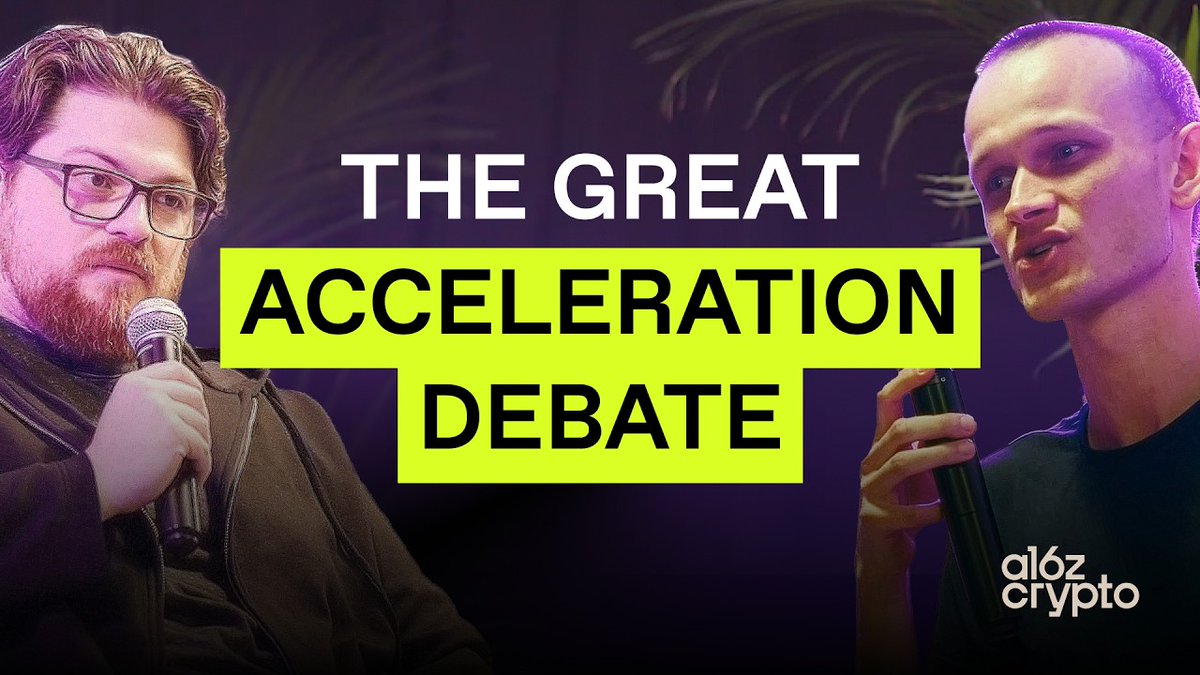
E/ACC vs. D/ACC: THE DEBATE vitalik.eth thinks slowing down AGI by four years is worth it. Beff (e/acc) thinks that's exponential opportunity cost. They debated it live, moderated by Eddy Lazzarin ☀️ and Shaw. 00:00 Opening 07:02 Thermodynamics and first principles 16:04 Acceleration, entropy, and civilization 28:29 The core disagreement 32:42 Comparing and contrasting e/acc and d/acc 36:20 Open source, open hardware, and local intelligence 54:18 Should AI be slowed down? 1:02:35 Autonomous agents and artificial life 1:21:07 Crypto as the trust layer between humans and AI 1:35:37 Closing arguments
a16z Frontier236,976 views • 7 months ago


Today we're talking about the passage of the GENIUS Act. The "Guiding and Establishing National Innovation for US Stablecoins Act" — which provides clear rules of the road for stablecoins in the U.S. We cover the law's implications, the recent high-stakes vote in the House of Representatives, and the bipartisan efforts to pass this groundbreaking bill. We also touch on the CLARITY Act — a major new “market structure” bill that would establish a clear regulatory framework for digital asset markets — which the House also passed with bipartisan support and which is now headed to the Senate. Here to separate the signal from the noise are members of the a16z crypto team who had a front-row seat to the action. We've got miles jennings, a16z crypto's General Counsel and Head of Policy, plus a16z Government Affairs Partners Ben Napier and Michael Reed, who are responsible for liaising with House Republicans and House Democrats, respectively. They share the inside scoop. Timestamps: (0:00) Introduction (1:01) Understanding the GENIUS Act (3:56) News Summary: What Happened in the House (5:45) Central Bank Digital Currency (CBDC) Contention (7:01) House Vote Drama: Republicans (9:31) House Vote Drama: Democrats (14:28) Winners and Losers (16:01) Decentralized Stablecoins and SEC Involvement (17:49) CLARITY Act and Future Legislation (21:47) Looking Ahead w/ our host 🎙️
a16z Frontier79,882 views • 1 year ago

Guy Wuollet on why crypto is an overlooked place to build in the age of AI: "You cannot vibe code USDC. You cannot have a weekend project and end up building something like a Hyperliquid." "The things we're building onchain today, I believe will be long-term enduring networks that have broad societal impact." "Whereas if you're interested in building a short-term project or pure software, I think there's the obvious question of why does that not get eclipsed by one of the large model companies in a couple of years." Guy Wuollet
a16z Frontier35,061 views • 5 months ago