

andrew engler
@aerockrose • 3,120 subscribers
3x founder, CEO https://t.co/TDxnDsbqvl. Built 3 $100M insurtech businesses. I dream of insurance, ml, and self organizing criticality.
Videos

Steve Ballmer reveals the interview test Microsoft used to separate problem-solvers from gamblers: "I'm thinking of a number between 1 and 100. First guess, I give you $5. Then $4, $3, $2, $1. After that, you pay me." "There are far more numbers on which you lose than win."
andrew engler4,381,423 次观看 • 4 个月前

Costco's CEO reveals the Kirkland test that makes private label feel unfair: A buyer brought him a bacon, egg, and cheese sandwich that matched the national brand. He sent it back. "How can we exceed the national brand on the bacon involved in that?" Because bacon was "the highest value attribute." The buyer came back with "40% more protein" and Costco was still able to "maintain our price." Then he explains the real edge: "They know down to the whole production of the item..." "That just makes them a better buyer when they're dealing with the big brands." The concept is the highest-value-attribute test. Do not beat competitors everywhere. Find the one attribute customers value most, overdeliver there, and use volume/process knowledge to keep price intact. Source: WSJ interview with Costco CEO Ron Vachris
andrew engler1,722,430 次观看 • 2 个月前

Jeff Bezos explains the stock-is-not-company rule behind Amazon's $113 to $6 collapse. "Our stock peaked somewhere around $113." "Then after the internet bubble busted open, our stock went down to $6." "It went from $113 to $6 in less than a year." "My annual shareholder letter that year starts with a one word sentence." "Ouch." Then Bezos gives the rule most operators forget in a crash: "The stock is not the company, and the company is not the stock." While the outside price was collapsing, he was watching the inside machine: "Number of customers." "Profit per unit." "Defects." "Every single thing about the business was getting better and fast." The useful idea: do not let the market's scoreboard replace your operating dashboard. A price can scream panic while the business is quietly getting healthier. - Jeff Bezos (Jeff Bezos) on Bloomberg's The David Rubenstein Show
andrew engler1,339,468 次观看 • 2 个月前

Mark Zuckerberg explains why turning down Yahoo's $1 billion Facebook offer hurt in a way nobody expected: "Yahoo came in with this really meaningful offer. I mean, a billion." "We had 10 million people using the product... It wasn't obvious we were going to succeed far beyond that." "The painful part wasn't turning down the offer. It was that huge amounts of the company quit... the whole management team was gone within about a year."
andrew engler1,441,641 次观看 • 3 个月前


Costco's CEO reveals the uncomfortable math behind keeping prices low: "We always wanted to have great prices. Never do it on the back of your people. Pay good wages." "Employees 10 years or more make almost $29/hour. Our average wage is almost $25/hour." The cheapest operator is not always the one squeezing the most. Sometimes the edge is retention.
andrew engler1,661,842 次观看 • 4 个月前

Bill Gates reveals the cash rule Microsoft learned after one customer stopped paying: "We had a dispute with our customer. They weren't paying us." "I'm gonna have enough money in the bank to pay everyone's salary for a year, even if nobody pays me anything." "So I was very conservative financially." The one-year payroll buffer was not fear. It was operating leverage: enough runway to outlast bad customers, slow payments, and bigger competitors with more capital. Cash buys judgment. Bill Gates
andrew engler593,425 次观看 • 2 个月前

Jeff Bezos explains the heavy-eater test behind Amazon Prime. The finance model said the idea looked "horrifying." Amazon would offer "unlimited shipping." No minimum order threshold. A customer could buy "a single $20 item" or "a single $10 item" and still get "free two-day shipping." Then Bezos names the part most models miss: "Shipping is expensive, and customers love free shipping." "When we modeled this, it didn't look pretty." "What happens when you offer a free, all-you-can-eat buffet? Who shows up to the buffet first? The heavy eaters." I like this as an operator test. A scary early cohort can mean the product is broken. It can also mean the people with the most acute pain found it first. The question is whether the heavy users are abusing the system, or proving where the market has been under-served. Prime worked because the expensive users were not a rounding error. They were the demand signal. Jeff Bezos at The Economic Club of Washington, D.C. Jeff Bezos
andrew engler337,382 次观看 • 1 个月前

Larry Ellison explains Steve Jobs' moral high ground rule for saving Apple without buying it. "My idea was simple. Buy Apple." "Apple wasn't worth much back then. About five billion dollars." "I had already arranged to borrow all the money." "All Steve had to do was say yes." But Steve chose the harder path: "persuade Apple to buy NeXT Computer," join the board, and wait for the board to see he was "the right guy to lead the company." Ellison asked the obvious operator question: "If we don't buy Apple, how are we going to make any money?" Jobs' answer: "You don't need any more money." "I'm not doing this for the money. I don't want to get paid." "If I do this, I need to do this standing on the moral high ground." Ellison called it "the most expensive real estate on earth." Then he watched Jobs "build the most valuable company on earth." The useful idea: control is not always the same as ownership. Sometimes the cleanest path is to leave the cap table alone, earn authority through the mission, and make the institution want you back. That is the moral high ground rule. - Larry Ellison on USC Commencement 2016
andrew engler306,664 次观看 • 2 个月前

Jensen Huang reveals the operating rule behind NVIDIA's speed: "I don't like going into a problem and somebody says, 'It takes 74 days to do this today, and we can do it for you in 72 days.' I'd rather strip it all back to zero and say, 'Explain to me why 74 days in the first place.' Oftentimes, you'd be surprised. It might come to six days." That is the difference between improving a process and interrogating the constraint. After building $300M+ businesses, this is the part I have seen repeatedly: elite operators do not just ask for a better version of the current system. They ask whether the system should exist in its current form at all.
andrew engler489,879 次观看 • 4 个月前

Warren Buffett reveals the underpricing test behind Apple's iPhone: a $1,000 device can be worth more than a $1 million plane. "I do not focus on the sales in the next quarter or the next year." "Hundreds and hundreds and hundreds of millions of people practically live their lives by it." "That little piece of whatever it is, that is some of the most valuable real estate in the world." "They spend hours a day." "It is part of their habit of living." "If we did not have it, you could not sell them anything else. They either went next door or they came back." "The iPhone 10 cost $1,000 and that is a lot of money." "I have a plane that costs me maybe a million dollars a year." "I would rather give up the plane, which is a million or a million and a half a year, for something that costs $1,000." "The iPhone is enormously underpriced." That is the replacement-friction test. The moat is not just usage. It is what customers refuse to substitute when supply disappears, prices rise, or a cheaper alternative shows up. Before you optimize conversion, pricing, or retention, ask the Buffett question: what would your best customer give up before giving up you? - Warren Buffett on CNBC
andrew engler232,665 次观看 • 2 个月前

In 2011, Ford CEO Alan Mulally gave a 52-min masterclass on leading a turnaround when everything is broken. He walked into a company losing $17B a year. His frameworks: - The data sets you free - One Ford, not 97 distractions - Weekly truth-telling at 7 a.m. 12 lessons:
andrew engler515,242 次观看 • 5 个月前

Arnold Schwarzenegger explains the income-property filter that made him a millionaire before movies. He did not start with a franchise check or a Hollywood payday. "I had $26,000 ... in cash in the bank." "I was looking around like a fanatic for an apartment building." "Before I ever buy an apartment or house, I got to have income property first." He bought a six-unit building for "$235,000, $240,000." Two or three years later, "we sold it for double." That turned the first $26,000 into "$150,000, almost $200,000 profit." Then it compounded into "100 plus apartments" before he was "heavily into the film business." The useful part is that the first dollars went into an asset that created more choices, not a lifestyle that removed them. At Argo, the product work that actually moved numbers had the same feel. We had to prove the economics early enough to keep reinvesting, which is how the new product portfolio got to more than $72M in revenue. I like decisions where the first win buys the right to make a better second decision. - Arnold Schwarzenegger (Arnold Schwarzenegger) on In Depth with Graham Bensinger
andrew engler183,092 次观看 • 1 个月前

Magic Johnson explains the proof-first rule behind owning 125 Starbucks stores. He did not walk in with a celebrity pitch. He walked in with receipts: "My movie theaters were crushing it in the inner cities." "It showed people you can make money doing business in the inner cities of America." "I took the numbers up to them." "My theaters are top 10 highest-grossing theaters in the nation." Then he showed Howard Schultz the constraint: "The growth of your business would be through urban America." Why? "You got one on every corner in suburban America." The hard part was not the idea. It was getting the system to believe the proof: "The hardest thing was to go before the board." "I was able to do that, and they all signed off." The receipt: "I became the first person to ever own Starbucks outside of Starbucks." "We built 125 in 40 different markets across America." The useful lesson: If the market does not believe your category, do not argue harder. Bring a proof object so concrete the room has to update. - Magic Johnson (Earvin Magic Johnson) on Bloomberg Originals
andrew engler231,213 次观看 • 2 个月前

In 2013, Nassim Taleb gave a 53-min Stanford masterclass on why chaos makes some businesses stronger. His ideas: - The coffee cup that survives 4 million hits - Why helicopter engineers ride their own machines - The country where nobody knows the president 12 lessons on risk:
andrew engler517,722 次观看 • 5 个月前
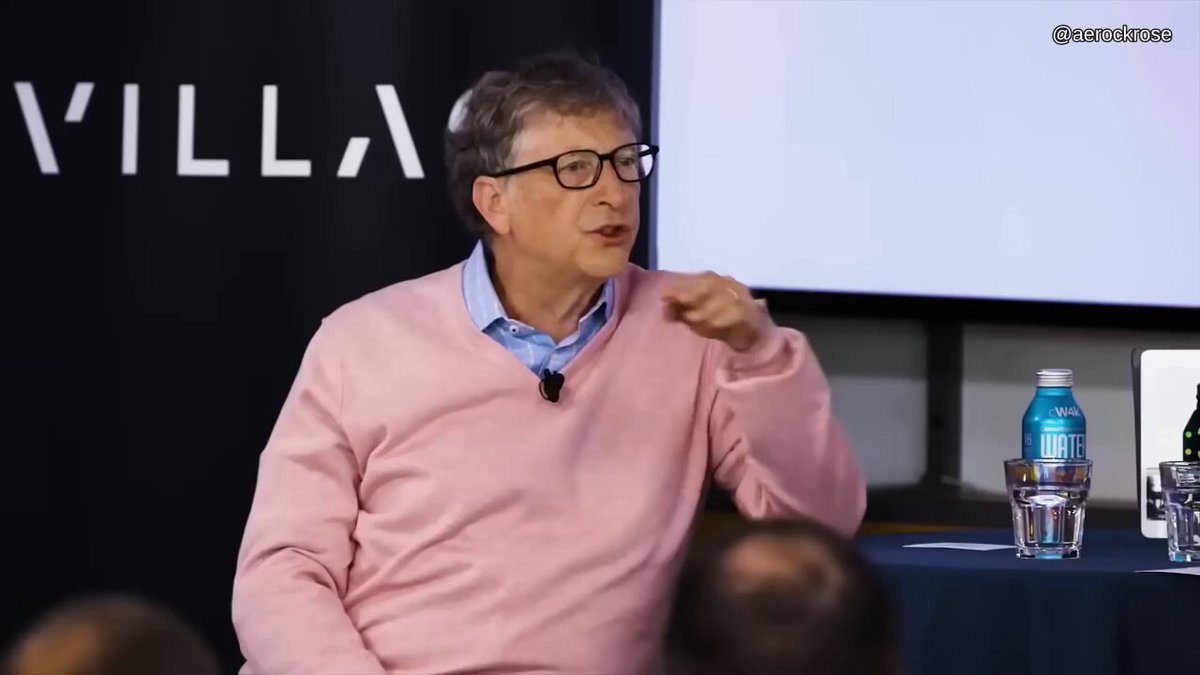

Larry Ellison reveals the $1B management wall that forced Oracle to replace almost its entire leadership team. "We hit a wall." "We reached a billion dollars in revenue." "The people who were running a billion dollar company were the same people that would run the company when we were a $50 million company." "I had an incredible sense of loyalty to those people." "The company had outgrown the management." "Virtually the entire management team had to be replaced." "I had to ask people who I'd worked with for a decade to leave." "Either I had to ask them to leave Oracle, or everyone would have to leave Oracle." The concept is the scale ceiling: the team that gets you from 0 to $50M is not automatically the team that gets you through $1B. Loyalty matters, but the organization eventually needs the next level of judgment. - Larry Ellison in a 1997 interview
andrew engler214,278 次观看 • 2 个月前


Warren Buffett reveals the research loop behind earning 50% a year with a small account. When asked how he'd start over with under $1M, he did not say "find a hot sector." He said: "In my particular case, it would be going through the 20,000 pages." "I went through the Moody's Transportation Manual a couple of times." "That was 1,500 or 2,000 pages." "I found all kinds of interesting things." "I would try and know everything about everything small." "And I would find something." "With a million dollars, you could earn 50% a year." "But you have to be in love with the subject." The concept is small-market obsession. Big markets get arbitraged fast. Small, boring, ignored corners still reward people willing to read what nobody else wants to read. For an operator, this is not just investing advice. It is how you find overlooked customers, hidden supplier constraints, mispriced talent, weird distribution channels, and ugly little details that compound into an edge. Buffett's edge was not a hack. It was loving the boring work long enough to see what everyone else skipped.
andrew engler199,550 次观看 • 2 个月前

Jeff Bezos explains the Wandering Rule behind real invention: "When I sit down to work on a problem, I know I don't know where I'm going." "To go in a straight line, to be efficient, efficiency and invention are sort of at odds." "Real invention, not incremental improvement... real lateral thinking... requires wandering." "You have to give yourself permission to wander." "A lot of people feel like wandering is inefficient." "I don't know how long the meeting is going to take if we're trying to solve a problem." The useful distinction: Use efficiency when the path is known. Use wandering when the problem is still being discovered. Most teams kill invention by demanding a straight line too early.
andrew engler156,724 次观看 • 3 个月前