
Archaic Lens
@ArchaicLens • 17,887 subscribers
have traveled to 49 countries investigating and documenting the shared symbolisms between ancient cultures worldwide. My book is linked below:
Shorts


Videos


Sulawesi in the news for dramatically pushing back the date of oceanic crossing by hominids. Here’s a video I took on Sulawesi of some bizarre megalithic jars with animal relief carvings on the lid similar to Gobekli Tepe. The true age of these is actually unknown although a date of 2500 BC is often cited. I have my skepticisms around that, and even more so now that we know people have been there for 1.5 *million* years. Thanks for the excellent reporting Michael Button
Archaic Lens143,278 görüntüleme • 11 ay önce

Perhaps there is no evidence of plant or animal domestication at Gobekli Tepe specifically, but there IS EVIDENCE of both plant and animal domestication at the incredible Tas Tepeler site of Nevali Cori. In fact Nevali Cori yeilds some of the earliest evidence of plant and animal domestication anywhere in the world. The Tas Tepeler people could very well have been the first to invent both, and my money is that they were. So much of their archaeology has yet to be explored and its probably only a matter of time before we find evidence of domestication at another Tas Tepeler site older than Nevali Cori. Don't try to excavate Nevali Cori any more however as it was intentionally flooded to build a dam and now sits forever at the bottom of the reservoir of the Attaturk Dam. Here's a recreation of an enclosure at Nevali Cori I recently filmed at a museum in Berlin. If it looks familiar, it's because it looks quite similar to Gobekli Tepe.
Archaic Lens17,854 görüntüleme • 1 ay önce

Throwback to my last expedition to the Richat structure, where untold numbers of Acheulean hand axes lie scattered, each one an estimated 500,000 years old and moulded by the hands of homo erectus, where salt streaks across the land and if you look closely shells lie embedded in said salt, and everywhere you look a landscape as unfamiliar to me as mars itself. Was it Atlantis? Or was it a half million year old “proto-city” not of homo sapiens but of homo erectus? How did the salt get there? When did the salt get there? Why are there marine organisms? How old are the marine organisms? How did they get there? These questions deserve answers. Perhaps some are already answered. Regardless the area deserves more study.
Archaic Lens17,310 görüntüleme • 1 ay önce

Never Before Seen On The Internet (I think). The secret Make-Make cave of Easter Island. I scoured the island for days searching for this cave and was delighted to finally find it and document it for the world. Make-Make was the creator diety of Easter Island and it’s cult was present, I’m told, from the very beginnings through the statue building period and through the Orongo period.
Archaic Lens128,015 görüntüleme • 1 yıl önce

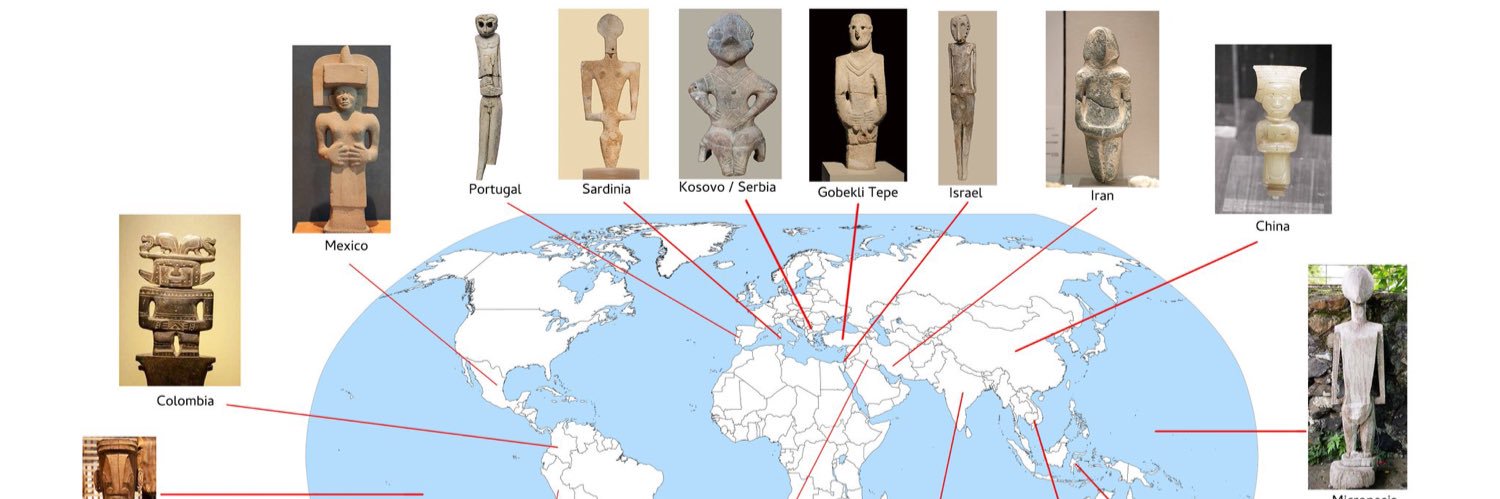
Did you know that there is/was a site very similar to Gobekli Tepe named Nevali Cori, dated to 8400 BC. You cannot visit it though, because it was destroyed / submerged in the 90s during the construction of the Attaturk dam. I became interested in Nevali Cori because some t pillars and idols from there with their hands around their navel are on display in the Urfa Museum. Makes sense, it’s the Tas Tepeler culture and this symbolism was born from them, as far as I can tell. But my jaw hit the floor when I saw this. It is a recreation of one of the enclosures of Nevali Cori, on display at the Nues Museum in Berlin. Not only do all the T-pillars have eyes which I don’t recall seeing on any other T pillars anywhere ever, every last one of them has their hands around their navel. I could not believe it. So… I’ll just leave this here. I’m guessing most of you, like me, had never seen this enclosure before. At this time I do not know if this enclosure is sitting underwater or if the pillars were removed before the flooding. And of course if you’re new to my channel, I spent years tracking this symbolism all over the world and published a book with all my findings on amazon here: As far as I can tell this symbolism began at Gobekli Tepe / Tas Tepeler and subsequently spread around the world often but not always in tandem with agriculture and copper working.
Archaic Lens30,809 görüntüleme • 4 ay önce

Nan Madol. Pohnpei, Micronesia. 96 completely artificial islands structurally enforced with megalithic columnar basalt and backfilled with coral. Most of these islands are unexplored and wholly inaccessible to this day due to the dense mangrove forests that have overtaken them. What... was this place?
Archaic Lens64,255 görüntüleme • 10 ay önce
Sulawesi in the news again for 67,000 year old rock art. Here are some things I saw on Sulawesi where hundreds of megaliths including gigantic jars and navel idols scatter three valleys made by a lost civilization that essentially left no trace save for the megaliths. No habitations. No tools. No pottery. No structures. Just hundreds of megaliths scattered amongst the valleys.
Archaic Lens28,160 görüntüleme • 8 ay önce

Join me for a good look inside what is possibly the world's most remote and least visited museum - at the Richat Structure. From what I've personally seen at just one site alone (documented in a previous video) there are enough artifacts at the Richat to fill a hundred of these museums and that is not an exaggeration. This museum, founded by Theodor Monod, displays just the tiniest sliver of a fraction of the artifacts found in the area. It should be known that the amount of Paleolithic human activity at the Richat Structure was staggering.
Archaic Lens46,788 görüntüleme • 1 yıl önce

Something that really came alive for me on the expedition with Pillars of the Past was the way Peruvian cultures like the Inca and Wari would channel and utilize water in their ancient cities. I had seen pieces of ancient aqueducts before but this was the first time I saw these systems still functioning. I believe these cities were fully equipped with water features throughout, providing drinking water, showers, baths, etc. Here we explore aqueducts and pieces of aqueduct construction from the Inca sites of Intihuatana and Vilcashuamán, and the Wari capital of Viñaque. Admittedly there's not much left to go on, but I do believe we are dealing with a people and culture who had fully mastered the flow of water, and these fragments provide a glimpse.
Archaic Lens24,173 görüntüleme • 10 ay önce

Ancient Navels of the Earth Part I of III (full version - sound on) Let's go on the ground to Easter Island, Cusco, Peru and Delphi, Greece and examine a package of symbols and skills that is present in all three locations which bear the same ancient name, the navel of the earth.
Archaic Lens26,291 görüntüleme • 1 yıl önce

One of the more remarkable aspects of the Nuragic civilization is that they cast bronze figurines of themselves like ancient action figures. You can see them in the Cagliari museum. They give us an unparalleled look into the aesthetics of their culture which almost seems to leap off the pages of the Lord of the Rings. Can you imagine what daily life might have been like in this world? These are the same people who built nearly 10,000 dry-stacked megalithic castles at roughly the same time the Egyptians were building pyramids. The same people who dotted their landscape with sacred wells, aligned to the moon. They left us no written records, save for an assortment of enigmatic symbols that may have expressed specific ideas. These figurines though perhaps tell us more than words ever could.
Archaic Lens20,771 görüntüleme • 11 ay önce
One thing I love about Angkor Wat is that it is a literal hall of records. The outer hall of the structure is the longest bas relief ever made by humans which tells the stories and histories that were most important to the builders. Here, Garuda is shown engaged in a great battle. In another temple nearby, he is shown “holding up” our world, quite literally making our world possible, while clutching a naga serpent in his feet. Whoever Garuda was, remembering his feats and honoring him was clearly important to the builders of Angkor.
Archaic Lens15,805 görüntüleme • 9 ay önce

Menorca doesn’t come up much in the archaeological dialogue but on this tiny island in the Mediterranean people built t-pillar enclosures startlingly similar to Gobekli Tepe (which were also found buried, by the way) and utilized polygonal masonry with the same kinds of cornered cuts you see in Peru and Egypt
Archaic Lens13,854 görüntüleme • 8 ay önce