
Karthik 🇮🇳
@beastoftraal • 92,982 subscribers
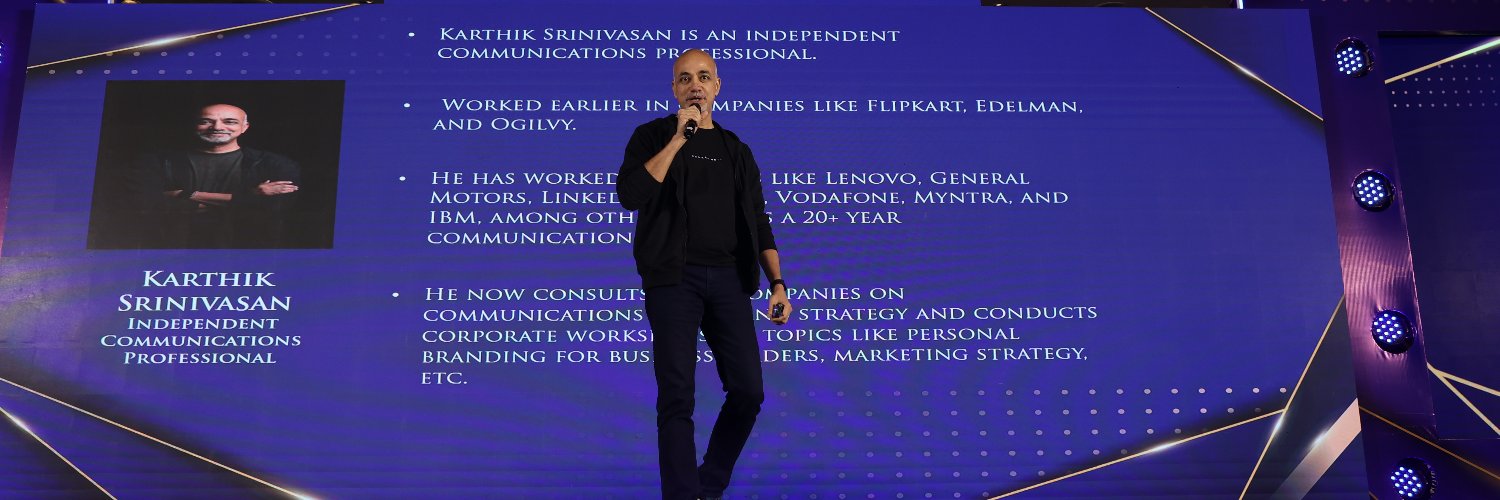
Communications strategy consultant (see pinned tweet). Connect with me for corporate workshops on personal branding. No paid posts - my words are not for sale.
Shorts


Videos

On an IndiGo flight from Mangaluru to Bengaluru yesterday, the passenger next to me had pre-booked a samosa. When the crew came around, there was no samosa. He was offered the 'item of the day' - a roll. He politely pointed out that he had paid for a samosa, shown to him visually and in text while booking. The crew explained that the item keeps changing. They offered a sandwich instead. He declined and eventually said he’d seek a refund. IndiGo is 20! It has genuinely changed connectivity in India, particularly to some of the smaller cities where flying in is so much more convenient than other forms of transport. And I'm thankful for that meaningful change, captured beautifully in this 20-year-anniversary film (written in-house, produced by Hardcover) that bookends two moments in people's lives as the narrative device. But why isn't IndiGo doing more with food? At 20, IndiGo has phenomenal scale, enormous passenger volumes and hence, significant bargaining power with food brands and suppliers. But its onboard food feels like an afterthought with limited choices, often unexciting, and increasingly disconnected from where consumer food is headed (protein, lower sugar/salt/oil, better ingredients) and genuinely interesting Indian products. The answer definitely is not more choices. IndiGo's limited menu makes perfect operational sense. Fewer SKUs mean easier procurement, storage, loading, forecasting, faster service and less wastage. Much like McDonald's, operational simplicity is a tremendous advantage. But simplicity doesn't have to mean mediocrity. Imagine 5 or 6 'hero' products that are exceptionally good: a genuinely delicious 15–20g protein snack, a great Indian breakfast, a regional favorite that rotates by route, a really good indulgent snack, and a couple of excellent vegetarian options. Partner with ITC (YogaBar), TWT or the hundreds of Indian food companies innovating in this space. Let them make the product and IndiGo can give them access to millions of passengers. Isn't the opportunity bigger than food revenue? Imagine making passengers think: "I'll just eat on the flight"! That's ancillary revenue, customer delight and brand differentiation, without compromising IndiGo's low-cost operating model. After spending 20 years making flying cheaper and more reliable, perhaps the next opportunity is making one small part of the experience surprisingly good. And food might be the best place to start given how predictably bad it is now - the only way is up, if there's intent. #brand #marketing #positioning
Karthik 🇮🇳67,043 views • 1 day ago

Using a hugely touchy subject like food (particularly serving Karnataka-style sambhar to a Tamilian!) is usually very risky, but the agency Mind Your Language does really well here with the breakfast mix-up between the 4 stars, for a very good reason! Gently amusing, and fully in context! Great job! #advertising #marketing #creativity
Karthik 🇮🇳49,965 views • 10 days ago


Hahahahahaha... this is a brilliant way to use a celebrity in an ad 😂 Not only does not use Ranveer Singh (and Johnny Sins - 'Google' him!) in a totally unexpected (and hilarious) way using the much-derided Indian TV series trope, but it also makes the product category far more accessible to a wider set of people beyond it being used in hushed tones! Great job by Moonshot, the agency. #advertising #marketing #creative #creativity
Karthik 🇮🇳3,009,537 views • 2 years ago

"Usne Tum Logon Ko Ch****a Banaya. Jaante Ho Kyun? Kyunki Tum Ch****e Ho. Dharam Ke Naam Par Ch****e Ban Gaye Tum Log. Aur Bante Rahoge. Tum Bante Rahoge. Tumhe Maarne Waala Har Woh Hindu Bante Rahega. Har Woh Aadmi Jiske Paas Kuch Nahi Karne Ko, Dharam Ke Naam Par Ch****a Bante Rahega."
Karthik 🇮🇳483,856 views • 5 months ago


An incredibly sweet Raksha Bandhan ad from Dabur Real (conceived in-house)! But, like the one I wrote about earlier this week, the brand connect is near zero and is even forced at times (when the juice is shown as part of a juice drinking session, or used as a gift), but the writing gets two things really, really well. The first is the very fact that an ad actually shows a differently abled child. And the writing placed this girl in the most normal way without drawing attention to her the way Titan did a few months ago (see: She is just herself and everyone in the family just accept her the way she is, the way it should be. I could just imagine a similar child identifying herself/himself when they see this ad and feel totally 'seen' and included in the mainstream. That's beautiful. The second is the fact that despite the ad being largely predictable (I could guess what the little boy was up to, but that's also perhaps a factor of me seeing way too many ads day after day - your mileage may vary), the way he explains why he was doing what he was doing (secretively) is absolutely wonderful. The choice of his reasons is so well written and thought out. Like that other ad (from earlier this week: the brand connect is very weak. You could replace that brand with a tablet/iPad brand or seller/retailer... or a brand that offers internet connectivity (Airtel, Jio, ACT, etc.) and the same narrative would fit in perfectly. Ideally, I'd have loved to see the product being the enabler of the sentiment/emotion depicted in the narrative, but such writing requires a lot more thought from the ground up. And for topical (days) narratives, such expectations seem too much these days. But what Real does within that limitation is lovely, as in they chose to tell a really heartfelt story in context of Raksha Bandhan. #advertising #marketing #rakshabandhan
Karthik 🇮🇳29,793 views • 15 days ago

This is perhaps the best Raksha Bandhan ad I have seen this year, though, to be honest, it wouldn't qualify as an ad at all - more of a short film. It is adequately predictable, feels like something plucked out of a longer movie, but still managed to make me sit through it because it did the basics really well. For starters, unlike most raksha bandhan ads, the brother doesn't simply bring a solitary rakhi and get it tied. He actually brings the paraphernalia, including the diya... lights the diya, and the rakhi becomes a part of the larger effort, and not the only one (yes, it is the most visible part). The act reminded me of this 2025 Diwali ad, by the way: And his response to 'money' is where I thought the ad's writer did give it some thought. It was a charming response, fully in context of the situation, with a good sense of humor. And the camera panning to the constable was a nice touch too! Why a short film, and not an ad? Because the brand connect is literally zero. Swap any brand in the ad and it would equally... not fit :) The agency doesn't make any attempt to integrate anything about the product inside the narrative. To be fair, they cannot - it's that kind of a product 🤷♂️ At least if it was a brand of washing detergent, or cooking oil, or plywood... or something, they may have considered adding something about the product inside the narrative... and still, it would look weak/forced. It feels like the story was conceived as a standalone idea removed from any advertising context, and just shot because someone could bankroll this from the/a brand. #advertising #marketing #creativity
Karthik 🇮🇳34,516 views • 18 days ago


Such a badly made ad film, for a premium watch brand like Rado, and featuring stars like Hrithik Roshan and Katrina Kaif! As you start watching it, observe the presence and absence (and changing hands, left to right) of the ring on Katrina's finger. Then, from 0:38 to 0:42, all I could do is a combination of LOL + cringe as it becomes completely apparent that the stars are not together in a shoot but were digitally (AI?) put together in a really bad way. The clumsy way the ad's makers have managed (or botched up) the 'eye contact' is both hilarious and sad. Couldn't the brand have spent at least a fraction of the fees paid to the two stars in getting a better agency to do a better edit where things are not so laughably silly? #advertising #marketing
Karthik 🇮🇳545,568 views • 1 year ago

About this new Titan Raga ad starring Alia Bhatt (agency: Ogilvy): First impression: Oh wow!! Second impression: Hey, wait...! I watched it for the first time and my instinctive reaction was, "What a lovely idea!". The way Alia dealt with the guy, in front of his wife, seemed full of grace, even though he arguably didn't deserve that grace. But then, a thought occurred to me. Is Alia Bhatt playing a fictional character of a stylish, anonymous woman at a restaurant? Or is she playing Alia Bhatt the celebrity? If it’s the latter, the 'staring' completely changes context. The guy would have stared disbelievingly even if it were Ravi Kishan seated there! And he probably would have walked up for a selfie/autograph. Staring star-struck at a celebrity in a public place is fundamentally different from a man ogling an unknown woman. Did the ad give us any cues to differentiate between the two, right at the beginning? Nope. Sure, if Alia were playing herself, he would have excitedly whispered to his wife when she sat down, but we don't get to hear him say anything to her beyond 'You want to order something'. What he could be saying next, we don't know... and the narrative has already locked us into reading it as ogling, without ever clearing up who we're actually looking at - anonymous woman or the super celebrity. Even when Alia walks up to them, the man's expression could be read as, 'Alia Bhatt, THE star is walking up to us?!'. Only after Alia starts talking to the wife, do we fully realize that Alia is not playing herself but an anonymous woman. And that we should have been seeing not Alia the star, but the character, right from the beginning... a bit too late. The creative asks us to read the man's stare through the lens of male gaze/objectification, for a full minute. But casting a mega-celebrity introduces an alternative, equally plausible explanation for that exact same stare, right up to this point in the narrative: spotting a celebrity in a public place. This is an ad where non-celebrity casting would have served the brand’s message so much better. #advertising #marketing
Karthik 🇮🇳31,483 views • 21 days ago

The same scene, across three languages: Revathi & Karthik, Mouna Raagam (Tamil, 1986) Neelam & Chunky Pandey, Kasak (Hindi, 1992) Prema & Shiva Rajkumar, Chandrodaya (Kannada, 1999) What monumental difference in staging, acting, and most importantly the power of background music (Ilayaraja, Rajesh Roshan, and Hamsalekha, respectively).
Karthik 🇮🇳759,810 views • 2 years ago

If I say, 'Liril Soap' and 'Laaa la la la la', many people may start humming the classic Liril soap ad jingle. But the shocker is that the jingle was not original, but "inspired"! The bigger shocker was that the original jingle was also made for a lime-based soap just like HUL's Liril - Henkel's Fa! Henkel's Fa ad campaign in 1968-69 by the Düsseldorf-based agency Hubert Troost Werbeagentur (usually called Troost) featured the 'Laaa la la la la' song. It was composed by the German composer Klaus Doldinger. The jingle became so popular that a vinyl single of the track (Listen: was released in 1969 under the pseudonym Paul Nero Sounds (one of Doldinger’s aliases for his more commercial/pop-oriented output at the time), explicitly tied to the Fa commercial: "Paul Nero Sounds (Klaus Doldinger) - Wild Freshness (FA Commercial)". It appeared on compilations like Pop-Shopping: Juicy Music From German Commercials 1960-1975. Liril's (the soap itself inspired by Fa) first ad was released in 1974, in cinema theaters. It featured Air India stewardess Karen Lunel, and was made by the agency Lintas, and directed by Kailash Surendranath. The jingle was credited to Vanraj Bhatia (even though he simply added some Indian elements like Sitar, as an interlude, the actual melody was a direct lift from the Fa ad jingle by Klaus) and was sung by Preeti Desai. That two lime-based soaps, across 2 countries, have almost similar visual devices (shots of the soap interspersed with bikini-clad woman bathing) and identical music, is no coincidence, and is probably part of the larger ethos of that time in India when Hindi film music too heavily "borrowed" from foreign sources without any credit. I should know, because I created an entire website listing original songs against many, many Indian film songs: (many of the song links may be broken but you can always Google the titles and find new uploads on YouTube). The Fa ad plays first, followed by the Liril ad. #advertising #marketing
Karthik 🇮🇳130,432 views • 4 months ago


BJP missed a great marketing opportunity in making Modi's meditation into an interactive event since they have already invested in such an impressive multi-camera set-up. They should have announced a 'Meditate with Modi' virtual event where they livestream the entire 45-hour meditation on Modi's YouTube channel and ask devotees (of Modi, that is) to join him in meditating (from the comfort of their own homes). Now, I hope BJP at least has the presence of mind to, a. Send the edited video as a nomnation for the best cinematography Oscar next year, and b. Release a 'Behind the scenes' video to showcase how impressive the camera work is.
Karthik 🇮🇳506,899 views • 2 years ago

'Men will be men' with a wonderful twist! For the Swiss retailer Migros, agency Thjnk Zürich takes a refreshingly unconventional approach to showcasing fresh produce. The most predictable route would have been to feature two mothers competing to pack the most imaginative, healthy lunchbox for their kids. But that trope is tired, and wouldn't have made a dent at all. In fact, if it were two mothers, the narrative would probably lean into them exchanging recipes and happily shopping at Migros together. Instead, by putting two dads in the arena, the ad unlocks a hilarious, hyper-competitive dynamic. What starts as a simple lunchbox comparison quickly spirals into an absurd arms race of food art with cucumber crocodiles and carrot race cars to an all-out gourmet standoff at a neighborhood barbecue. It’s the petty, silent game of oneupmanship between the dads that makes the ad memorable, all while seamlessly driving home the brand's message: they have the widest range of fresh produce to fuel any culinary ambition. #advertising #marketing #creativity
Karthik 🇮🇳76,839 views • 3 months ago

Back in the early-2000s when the Cola wars were in vogue, Pepsi first retorted to Coca-Cola's 'Thanda Matlab Coca-Cola' (starring Aamir Khan who recently credited someone other than the person who is often credited for that slogan: with a campaign where Fardeen Khan, who is seen running an empty stall says, 'Business Thanda Matlab, Cola Cola'. While that ad has vanished off the internet, there is another variant in that series that still exists. In this ad featuring Rahul Khanna and Fardeen Khan, the latter uses Coca-Cola's slogan of that time verbatim - 'Life ho toh aisi'. But the context in which he utters is meant as a direct attack on Coca-Cola. Even his t-shirt has that fake brand (Cola-Cola, also in the shop's sign board) in the cola's signature red! Compared to such direct attacks, the Cola wars (there was one recently, around 'half time) now seem tame. It's good in a way, though - less people need to drink (naturally or artificially) sugared carbonated drinks anyway, given that they are horribly unhealthy. So, less noise is always better :) #advertising #marketing #brandrivalry
Karthik 🇮🇳48,855 views • 2 months ago


Hahahahahahahahahahahahaha 😂 Fantastic use of a popular Diwali 'meme' in its Diwali 2024 ad by Zomato! Hands down, the funniest Diwali ad (while also being apt for Zomato) so far. Conceived in-house (says a lot about the kind of talent that exists inside Zomato) and produced by Ryde Studios. #advertising #marketing #diwali #deepavali
Karthik 🇮🇳358,473 views • 1 year ago