
Davide Scaramuzza
@davsca1 • 18,946 subscribers
Professor of Robotics, University of Zurich
Videos


Check out our #ECCV2026 paper "Low-latency Event-based Object Detection with Spatially-Sparse Linear Attention", where we make linear attention sparse in space, recurrent in time, and parallel in training, enabling the first purely-linear-attention-based neural network for asynchronous object detection with #EventCameras, outperforming the previous best asynchronous method with 20x less computation with truly event-by-event inference on CPU! Code released! Paper: Code: Video: Event cameras promise extremely low-latency vision, but to fully exploit them, the neural network must be low-latency too. We introduce #SpatiallySparseLinearAttention (#SSLA) for asynchronous object detection directly from raw events. Linear attention is particularly appealing for event cameras: it can be trained efficiently in parallel on long event sequences, while at inference it operates recurrently, updating its prediction every time a new event arrives. The problem is that conventional linear attention updates its entire state for every event. For object detection, where fine spatial resolution matters, this quickly becomes expensive. Our key idea is simple: an event only carries information about a small spatial region, so why update the entire spatial state? SSLA updates only the relevant parts of the state, enabling fine-grained spatial representations while keeping per-event computation low. We achieve: - >20× lower per-event computation than the strongest prior asynchronous baseline - State-of-the-art accuracy among asynchronous object detection methods - Truly event-by-event inference on CPU, designed to preserve the latency advantage of event cameras Come to our poster on Friday September 11, 2026 from 4-6pm at ExHall #389 Reference: Haiqing Hao, Zhipeng Sui, Rong Zou, Zijia Dai, Nikola Zubić, Davide Scaramuzza, Wenhui Wang Low-latency Event-based Object Detection with Spatially-Sparse Linear Attention ECCV, 2026 Prophesee SynSense University of Zurich UZH Science European Research Council (ERC) UZHai UZH IfI Tesla BYD #EventCameras #ComputerVision #Robotics #DeepLearning #NeuromorphicVision #AI
Davide Scaramuzza52,916 次观看 • 1 个月前

We are excited to share that our paper “Low-Latency Event-Based Velocimetry for Quadrotor Control in a Narrow Pipe” published in the IEEE Transactions on Robotics! One year in the making! PDF: Video: We focus on autonomous quadrotor flight in narrow pipes, where self-induced, unsteady airflow can significantly affect stability and control. Our approach closes the loop using real-time flow field measurements: an #EventCamera-based smoke velocimetry method provides low-latency airflow estimates, which are used by a learning-based disturbance estimator and integrated into a reinforcement-learning controller. The results are improved hovering and lateral translation performance, helping make flight in confined spaces more stable and safer! Kudos to Leonard Bauersfeld Leonard Bauersfeld! Reference: Low-Latency Event-Based Velocimetry for Quadrotor Control in a Narrow Pipe, IEEE Transactions on Robotics (T-RO), 2026 European Research Council (ERC) UZH IfI UZH Space Hub University of Zurich Swiss Robotics UZH Science UZHai AUTOASSESS IEEE Transactions on Robotics (T-RO) #DVS Prophesee
Davide Scaramuzza50,385 次观看 • 8 个月前

Check out our latest work, "Actor-Critic Model Predictive Control: Differentiable Optimization meets Reinforcement Learning for Agile Flight," published in the IEEE Transactions on Robotics, where we reconcile #OptimalControl and #ReinforcementLearning, achieving the same super-human performance, but with superior generalizability, as our previous model-free deep RL! Code released! PDF: Code: Full Video: Model-free #ReinforcementLearning (RL) is known for its strong task performance and flexibility in optimizing general reward formulations. On the other hand, #ModelPredictiveControl (MPC) provides robustness, constraint handling, and powerful online replanning capabilities. In this work, we extend our previous AC-MPC paper (Romero, ICRA'24) by taking a deeper look at how both approaches can be unified. We introduce and extend Actor-Critic Model Predictive Control (AC-MPC), a framework that embeds a differentiable MPC inside an Actor-Critic RL architecture. This integration allows the MPC-based actor to perform short-term predictive optimization, while the critic facilitates long-horizon learning and exploration. We conduct a comprehensive study that highlights AC-MPC’s key advantages: - Better out-of-distribution generalization, both against unknown disturbances and changes in the quadrotor dynamics - Improved sample efficiency - A novel empirical analysis uncovering a relationship between the critic’s value function and the MPC cost function, providing deeper insight into their interplay. We validate our method in simulation and the real world on a quadcopter flying at superhuman speeds of up to 21 m/s, matching state-of-the-art model-free RL performance, and retaining the predictive structure of MPC for more reliable out-of-distribution behavior. Reference: Actor-Critic Model Predictive Control: Differentiable Optimization meets Reinforcement Learning for Agile Flight IEEE Transactions on Robotics (T-RO), 2025 PDF: Full Video: Code: Kudos to Ángel Romero, Elie Aljalbout, Yunlong Song! University of Zurich UZH Science UZH Space Hub AUTOASSESS European Research Council (ERC) UZHai
Davide Scaramuzza27,351 次观看 • 9 个月前

We are excited to be among the very first groups selected by NVIDIA Robotics to test the new NVIDIA #Thor. We have managed to run a #VisionLanguageModel (Qwen 2.5 VL) for semantic understanding of the environment, along with a monocular depth model (#DepthAnything v2), for safe autonomous navigation, all onboard. No cloud, no internet connection required! The video shows a simple result obtained in just two weeks of work. Kudos to Leonard Bauersfeld Jiaxu Xing Ismail Geles Yannick Armati for making this possible! #ComputerVision #Robotics University of Zurich UZH Space Hub UZH IfI European Research Council (ERC)
Davide Scaramuzza31,527 次观看 • 1 年前

We are excited to share our latest work, "Superhuman Safe and Agile Racing through Multi-Agent Reinforcement Learning," done in collaboration with Google DeepMind . Autonomous drones have reached superhuman speed in isolation, but what happens when multiple agents share the same airspace? Paper: Website: Video: Using league-based self-play, we train #ReinforcementLearning agents that race against a diverse, evolving population of opponents. Through this competitive training, sophisticated behaviors emerge without explicit programming: strategic overtaking, proactive collision avoidance, and even awareness of aerodynamic downwash from nearby drones. In real-world multi-player races at speeds exceeding 80kph (50 mph) and accelerations up to 7g, our agents outperform a five-time Swiss national drone racing champion while reducing collision rates by 50% compared to single-agent baselines. Crucially, training against diverse artificial opponents enables zero-shot generalization to human pilots, achieving over 90% race completion in mixed human-AI races with up to four competitors. A key insight: human pilots adopt riskier strategies when trailing, leading to more crashes under competitive pressure. Our learned policies, by contrast, maintain consistent safety margins regardless of race standing, a property essential for deploying autonomous systems alongside humans. Also, the multi-agent self-play policies are more robust than those trained independently, suggesting that training in competitive environments is not only key to winning races but also to learning safer, more reliable autonomy for real-world multi-robot systems. Kudos to Ismail Geles, Leonard Bauersfeld, Markus Wulfmeier! Ismail Geles Leonard Bauersfeld Markus Wulfmeier European Research Council (ERC) UZH IfI University of Zurich UZH Science UZH Space Hub Swiss Robotics NCCR Robotics
Davide Scaramuzza14,742 次观看 • 5 个月前

We are excited to share our #ICRA2026 paper "Dream to Fly: Model-Based Reinforcement Learning for Vision-Based Drone Flight"! Paper: Video: Can we use Model-Based #ReinforcementLearning (MBRL) to fly a drone from pixels to commands? In this work, we train quadrotor navigation policies from scratch using #WorldModels, mapping raw onboard camera pixels directly to control commands, much like a human pilot! While model-free methods like PPO are sample-inefficient and struggle in this setting, we leverage #MBRL to train visuomotor policies capable of agile flight through a racetrack using only raw pixel observations, no explicit state estimation needed. A key finding: because our policies are trained end-to-end directly from pixels, we no longer need the perception-aware reward term used in previous methods. Instead, this behavior emerges naturally! The policies learn to guide the camera toward feature-rich areas of the observation space on their own. Kudos to Ángel Romero Ashwin Shenai Ismail Geles Elie Aljalbout Reference: "Dream to Fly: Model-Based Reinforcement Learning for Vision-Based Drone Flight" Angel Romero*, Ashwin Shenai*, Ismail Geles, Elie Aljalbout, Davide Scaramuzza IEEE International Conference on Robotics and Automation (ICRA), Vienna, 2026. European Research Council (ERC) AUTOASSESS UZH IfI University of Zurich UZH Science Prophesee SynSense UZH Space Hub Swiss Robotics NCCR Robotics
Davide Scaramuzza16,200 次观看 • 6 个月前

We are excited to share our latest work, "Learning on the Fly: Rapid Policy Adaptation via Differentiable Simulation", where a policy learns to adapt in the real world to unknown disturbances within 5 seconds, both with and without explicit state estimation, directly from visual features. Code released! PDF: Project Page: Starting from a simple analytical dynamics model, the system continuously learns residual dynamics from real-world data and embeds the refined model into a differentiable simulator. This enables fast, gradient-based policy updates that are far more sample-efficient than classical #ReinforcementLearning. We demonstrate rapid adaptation in <5 seconds in agile quadrotor control under challenging conditions, including added payloads, wind disturbances, and large sim-to-real gaps. In real-world experiments, our method reduces hovering error by up to 81% compared to L1-MPC and 55% compared to PPO-based adaptive methods. It also operates directly from visual features without explicit state estimation. Reference: “Learning on the Fly: Rapid Policy Adaptation via Differentiable Simulation” IEEE Robotics and Automation Letters, 2026 PDF: Video: Code: Website: Kudos to Michael Pan, Jiaxu Xing, Rudolf Reiter, Yifan Zhai, Elie Aljalbout! UZH Space Hub UZH IfI European Research Council (ERC) AUTOASSESS UZH Science University of Zurich
Davide Scaramuzza19,283 次观看 • 9 个月前

Check out our #ICRA2024 paper "Actor-Critic Model Predictive Control." Model-free #reinforcementlearning (RL) is known for its strong task performance and flexibility in optimizing general reward formulations. On the other hand, #ModelPredictiveControl (MPC) benefits from robustness and online replanning capabilities. We combine both approaches by introducing a new framework called Actor-Critic Model Predictive Control. The key idea is to embed a differentiable MPC within an Actor-Critic RL framework. The proposed approach leverages the short-term predictive optimization capabilities of MPC with the exploratory and end-to-end training properties of RL. The resulting policy effectively manages both short-term decisions through the MPC-based actor and long-term prediction via the critic network, unifying the benefits of both model-based control and end-to-end learning. We validate our method in simulation and the real world with a quadcopter across various high-level tasks. We show that the proposed architecture can achieve real-time control performance, learn complex behaviors via trial and error, and retain the predictive properties of the MPC to better handle out-of-distribution behavior. Paper: Full Video with more details: Kudos to Ángel Romero, Yunlong Song IEEE ICRA University of Zurich UZH Science UZH Space Hub Aerial Core AUTOASSESS European Research Council (ERC)
Davide Scaramuzza34,920 次观看 • 2 年前

Can an inexpensive, off-the-shelf IMU be the only sensor to estimate the full state (position, velocity, orientation) of a quadrotor flying through a track at high speed and even be on-pair with vision-based localization? The answer is yes, within certain limitations! In this #RAL2023 paper, we propose a learning-based odometry algorithm that couples a model-based filter driven by the inertial measurements with a learning-based module with access to the control commands. Our system outperforms by a large margin the state-of-the-art visual-inertial odometry (#VIO) algorithms and the state-of-the-art learned-inertial odometry algorithm, #TLIO, for the task of drone racing. Additionally, we show that our system is as accurate as a VIO algorithm that uses a camera to localize to a known map of the racing track. The main limitation of our approach is that it cannot generalize to trajectories that have not been seen at training time. However, in drone racing competitions, the track is known beforehand. Human pilots spend hours or even days of practice on the race track before the competition. Similarly, our system can be trained with the data collected during practice time and deployed during the competition. Future work will investigate how to generalize to trajectories not seen at training time. The code is released! Paper: Video: Code: Kudos to Giovanni Cioffi Leonard Bauersfeld Elia Kaufmann European Research Council (ERC) University of Zurich UZH Science UZH Space Hub NCCR Robotics Aerial Core #RAL2023 #IROS2023 #SLAM
Davide Scaramuzza37,061 次观看 • 3 年前
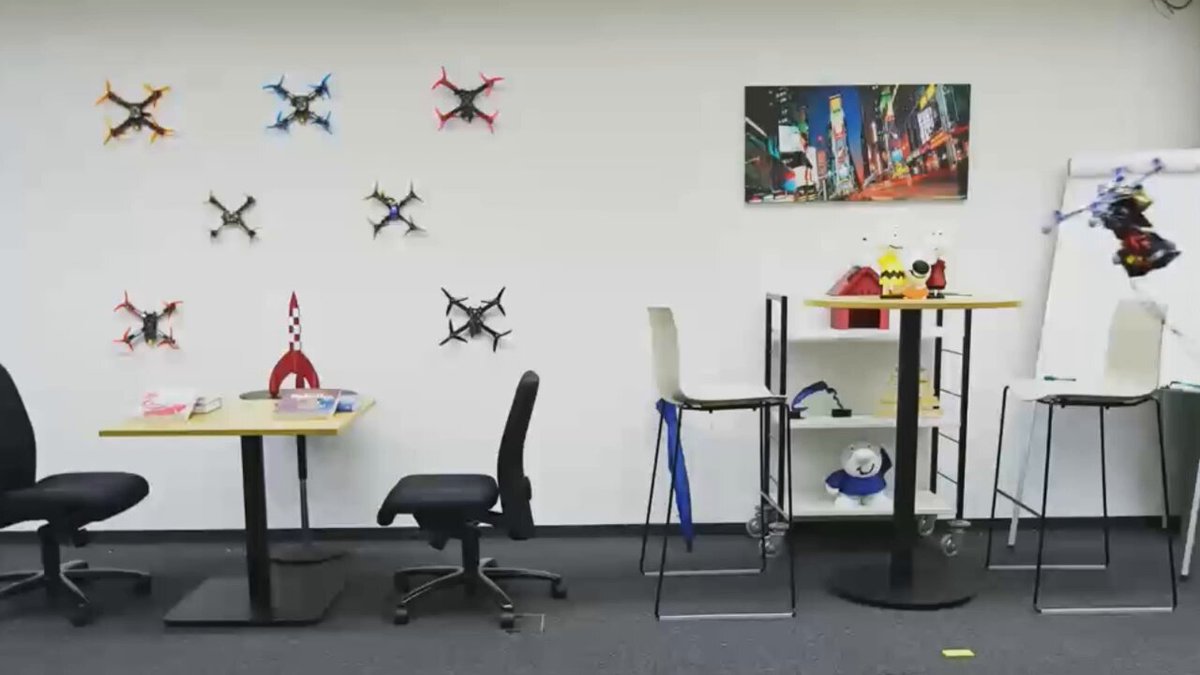
We are excited to share our work “Event-Aided Sharp Radiance Field Reconstruction for Fast-Flying Drones” published in IEEE Transactions on Robotics IEEE Transactions on Robotics (T-RO), which tackles sharp radiance field reconstruction under agile drone motion, where RGB frames are heavily motion-blurred and pose priors become unreliable! 4 years in the making! Code & dataset released! PDF: Code & Dataset: Full Narrated Video: High-speed flight is essential for time- and battery-constrained missions (e.g., inspection, exploration, search & rescue). However, fast motion corrupts visual data with severe motion blur and introduces drift/noise in visual-inertial odometry, making NeRF-based 3D reconstruction particularly brittle. We propose a unified framework that leverages asynchronous #EventCamera streams together with motion-blurred frames to reconstruct high-fidelity radiance fields from agile drone flights. Our key idea is to embed event-image fusion directly into radiance field optimization while jointly refining a shared, continuous-time camera trajectory initialized from event-based VIO. This enables us to recover sharp radiance fields and accurate trajectories without ground-truth supervision during training. We validate our method on synthetic data and on real sequences captured by a drone flying up to 2 m/s. Despite severe blur and noisy pose priors, our method preserves fine scene details and achieves a performance gain of over 50% on real-world data compared to state-of-the-art methods. Kudos to Rong Zou and Marco Cannici! Marco Cannici Reference: Rong Zou*, Marco Cannici*, Davide Scaramuzza Event-Aided Sharp Radiance Field Reconstruction for Fast-Flying Drones IEEE Transactions on Robotics (T-RO), 2026 NCCR Robotics European Research Council (ERC) AUTOASSESS UZH IfI University of Zurich UZH Science Prophesee SynSense UZH Space Hub
Davide Scaramuzza12,028 次观看 • 7 个月前

We are thrilled to share our breakthrough research on "Agile Flight from Pixels without State Estimation," to be presented and live-demonstrated at #RSS2024 next week! You heard well: no state estimation means no explicit visual localization, no SLAM, no VIO, and no IMU! Paper: Video (Narrated): Last year, we demonstrated that #ReinforcementLearning (RL) policies could outperform world-champion drone-racing pilots using the same quadrotor hardware; however, unlike human pilots, these policies continuously estimated an explicit state from known gate positions, the camera feed, and inertial measurements (IMU). In this new work, we tackle the challenge of learning vision-based drone racing using an end-to-end reinforcement learning approach that eliminates the need for IMU data or explicit state estimation. Like professional pilots, we go directly from images to control commands. The training is facilitated by an asymmetric actor-critic with access to privileged information. To overcome the computational complexity during image-based RL training, we use an appropriate sensor representation, which can be efficiently simulated during training without rendering images. We achieve agile flight at speeds up to 40 km/h with accelerations up to 2 g's. Although our demonstration focuses on drone racing, we believe that our method has an impact beyond drone racing and can serve as a foundation for future research into real-world applications in structured environments. Besides the paper presentation, we will also give a live demo next Tuesday and Wednesday between and hrs at TU Delft: Reference: Ismail Geles*, Leonard Bauersfeld*, Angel Romero, Jiaxu Xing, Davide Scaramuzza "Demonstrating Agile Flight from Pixels without State Estimation" Robotics: Science and Systems (RSS), 2024. Kudos to Ismail Geles Leonard Bauersfeld Ángel Romero Jiaxu Xing! University of Zurich UZH Science UZH Space Hub Aerial Core AUTOASSESS European Research Council (ERC)
Davide Scaramuzza28,002 次观看 • 2 年前

We are excited to share our #CORL2024 paper on learning quadrotor obstacle avoidance from the visual stream of a single #eventcamera! Trained entirely in simulation! We demonstrate obstacle avoidance both in the dark and in a forest up to 5m/s. PDF: Video: Project page: Event cameras are sensors that output per-pixel-level intensity changes at microsecond latency resolution; they feature nearly zero motion blur and high dynamic range but produce a very large volume of events under significant ego-motion and further lack a high-fidelity continuous-time sensor model in simulation, making direct #sim2real transfer not possible. By leveraging depth prediction as a pretext task, we pre-train a reactive obstacle avoidance policy with “approximated” simulated events and then fine-tune the perception component with limited events-and-depth real-world data. This technique bridges the sim2real gap for #eventcameras! As at the current state, there is no continuous-time sensor model for event cameras, we hope that this work can finally spur future research leveraging simulation for training event-vision-based policies to create faster, agile robots! Kudos to Anish Bhattacharya, @marcocannic, Vijay Kumar Nikolai Matni UZH Science University of Zurich UZH Space Hub UZH IfI European Research Council (ERC) GRASP Laboratory Penn Engineering
Davide Scaramuzza17,263 次观看 • 1 年前


Last Sunday, we competed in the Vision Assistance Race at the CYBATHLON 2024—the "cyber Olympics" designed to push the boundaries of assistive technology. In this race, our system guided a blind participant through everyday tasks such as walking along a sidewalk, sorting colors, ordering from a touchscreen, purchasing a box of tea, and navigating a forest—all powered by computer vision assistance! We used two RGB cameras and a depth camera for localization, 3D mapping, and semantic understanding and a belt for haptic feedback. Our system received the Jury Award for the most innovative and user-friendly solution! Congratulations to our amazing team: Cornelius von Einem, Patrick Pfreundschuh, Giovanni Cioffi, Alexander Wyss, Roland Siegwart, Hans Wernher van de Venn, Alireza Darvishy, and especially to our pilot, Lukas Hendry! A big thank you to all our Master's students who contributed to this achievement, including Victoria Catalán Pastor and Tim Flueckiger! University of Zurich UZH Science UZH Space Hub ETH Zurich Autonomous Systems Lab, ETH Zürich ZHAW UZH IfI European Research Council (ERC)
Davide Scaramuzza16,533 次观看 • 2 年前

Check out our #RSS2024 paper "#MPCC++: Model Predictive Contouring Control for Time-Optimal Flight with Safety Constraints." Model Predictive Contouring Control (MPCC) has shown promising results for agile robotics applications, including car and drone racing. Existing approaches struggle to introduce safety considerations, often resulting in crashes. What does it take to drive or fly fast and safe? We enhance our former MPCC by incorporating spatial constraints that reliably prevent obstacle collisions, allowing planning the fastest trajectory within these safety limits. To improve performance, we leverage real-world data to refine the dynamic model. Our approach is the first to achieve a 100% success rate in real-world experiments. This safety benefit comes without compromising performance, as our method achieves lap times comparable to the best-performing state-based #ReinforcementLearning (RL) policies. Reference M. Krinner, A. Romero, L. Bauersfeld, M. Zeilinger, A. Carron, D. Scaramuzza, "MPCC++: Model Predictive Contouring Control for Time-Optimal Flight with Safety Constraints" Robotics, Science and Systems, 2024 PDF: Video: Kudos to Maria Krinner, Angel Romero Aguilar, Leonard Bauersfeld, Melanie Zeilinger, Andrea Carron! Ángel Romero Leonard Bauersfeld University of Zurich UZH Science UZH Space Hub AUTOASSESS European Research Council (ERC) #MPC #ModelPredictiveControl
Davide Scaramuzza17,933 次观看 • 2 年前

We are excited to share our #CORL2024 paper (oral) on "Learning Quadruped Locomotion Using Differentiable Simulation" done in collaboration with Sangbae Kim Massachusetts Institute of Technology (MIT). We present a new way to learn to walk in minutes without parallelization, outperforming PPO in sample efficiency! PDF: Video: We present a new framework for learning quadruped locomotion. By leveraging differentiable simulation for policy optimization, our approach achieves fast convergence and stable training, significantly outperforming model-free #ReinforcementLearning methods like PPO in sample efficiency. The key enabler is to combine a high-fidelity, non-differentiable simulator for forward dynamics with a simplified surrogate model for gradient backpropagation. Our framework enables learning quadruped walking in simulation in minutes without parallelization. When augmented with GPU parallelization, our approach allows the quadruped robot to master diverse locomotion skills on challenging terrains in minutes. This work highlights one of the first successful real-world applications of differentiable simulation for quadruped robots, offering a compelling alternative to traditional RL methods. Kudos to Yunlong Song! UZH Science University of Zurich UZH Space Hub UZH IfI European Research Council (ERC) Massachusetts Institute of Technology (MIT)MechE
Davide Scaramuzza15,572 次观看 • 1 年前

If you are at #RSS2024 come and see our live demo on how to fly fast from pixels without state estimation (no visual localization, no SLAM, no VIO, no IMU). Last chance today from 12:00 to 13:30 hrs in the Mechanical Engineering building of TU Delft. Paper: Narrated video:
Davide Scaramuzza15,899 次观看 • 2 年前

Check out our #ICRA2024 paper "Contrastive Initial State Buffer for Reinforcement Learning," which tackles the sample inefficiency in #ReinforcementLearning head-on. Code released! We introduce an approach agnostic to the underlying RL algorithm: the Contrastive Initial State Buffer. This tool strategically selects states from past experiences and uses them to initialize the agent in the environment to guide it toward more informative states. Our experiments on drone racing and legged locomotion show that our method achieves higher task performance while also speeding up training convergence. Reference: Nico Messikommer, Yunlong Song, Davide Scaramuzza Contrastive Initial State Buffer for Reinforcement Learning IEEE International Conference on Robotics and Automation (ICRA), 2024. PDF: Code: Video: Kudos to Messikommer Yunlong Song Aerial Core European Research Council (ERC) University of Zurich UZH Space Hub IEEE ICRA UZH Science
Davide Scaramuzza13,860 次观看 • 2 年前

Check out our #PAMI paper with code "Dense Continuous-Time Optical Flow from Event Cameras," where we show how to regress *continuous-time* trajectories of every pixel from event cameras alone or events plus frames! The key idea is to iteratively estimate per-pixel polynomials using a recurrent lookup and update scheme. Paper: Code: DOI: We present a method for estimating dense continuous-time optical flow from event data. Traditional dense optical flow methods compute the pixel displacement between two images. Due to missing information, these approaches cannot recover the pixel trajectories in the blind time between two images. We show that it is possible to compute per-pixel, continuous-time optical flow using events from an event camera. Events provide temporally fine-grained information about movement in pixel space due to their asynchronous nature and microsecond response time. We leverage these benefits to predict pixel trajectories densely in continuous time via parameterized Bézier curves. To achieve this, we build a neural network with strong inductive biases for this task: First, we build multiple sequential correlation volumes in time using event data. Second, we use Bézier curves to index these correlation volumes at multiple timestamps along the trajectory. Third, we use the retrieved correlation to update the Bézier curve representations iteratively. Our method can optionally include image pairs to boost performance further. To train and evaluate our model, we introduce a synthetic dataset (MultiFlow) that features moving objects and ground truth trajectories for every pixel. Our quantitative experiments suggest that our method successfully predicts pixel trajectories in continuous time and is competitive in the traditional two-view pixel displacement metric on MultiFlow and DSEC-Flow. Open source code and datasets are released to the public. Kudos to Mathias Gehrig Manasi Muglikar
Davide Scaramuzza12,692 次观看 • 2 年前