

Harper Carroll
@HarperSCarroll • 31,835 subscribers
AI Computer Scientist • @harpercarrollai on IG • taught AI/ML @Stanford • built @Meta • AI is less scary under the hood ↓ 10-day AI basics + more (free)
Videos

Google and AI are completely different, and understanding how they work changes how you use them. *To be specific: by “AI” here I mean Large Language Models, or LLMs. Google has technically always been AI – its PageRank algorithm, which decides which links to return to you, has always been a form of AI. And yes, Google is now augmented with LLMs. What we’re comparing in this post is traditional Google (using PageRank) and LLMs.* Lets break down the differences in plain English & answer some of the most commonly asked questions below (so you know when to use which tool): Q: What’s the biggest difference between Google and LLMs like ChatGPT? Google searches. LLMs predict. Google scans the internet and returns the most relevant websites using a ranking system. LLMs don’t search. They learn from massive amounts of text — and then predict what word comes next based on probability. Q: So are LLMs just looking things up? No. They’re word generators. They learn patterns in language, and then generate text that follows those patterns. That’s why they can sound confident — even when they’re wrong. Many - crucially, not all!!! - models today have been augmented with the ability to pull some data from the internet and insert it into its context window (i.e. the input into the LLM, the prediction machine) which reduces the risk of “hallucination,” (i.e. making things up) but even so, the model is still a predictor. It can (and often does) still mess up EVEN with web search added. Q: What’s the biggest tradeoff to watch out for? Hallucinations. LLMs are generators (& not a fact checkers). So they can make things up. That’s why tools like web-browsing and retrieval-augmented generation (RAG) are so important. They anchor generation to real data. But they’re not foolproof. Bottom line: If Google is a librarian, LLMs are improv actors who’ve read the entire library. Sometimes brilliant. Sometimes also wrong. But when you understand *how* they think — you can use them way more effectively. Leave your questions or comments in the section below 🥰👇 & share to spread the word!! This concept is simple and yet so important. You guys rock, sending love to you all!
Harper Carroll44,225 Aufrufe • vor 1 Tag

Did you know the most sophisticated AI systems were actually so chaotic? Yep - this AI meme is actually pretty accurate. “Deep learning” (as mentioned in the X post) refers to neural networks, which are the models that underlie the “generative” AI systems you know about: the text-, image-, video-, and song-generation models. Are you surprised to learn that these systems aren’t straightforward? Does this usage of math make sense to you? Hi, I’m Harper, AI educator, engineer and advisor. ••• My goal is to democratize AI, so everyone can understand it, use it, and make informed decisions about it. Happy you’re here. ••• I have two degrees in Computer Science specializing in Artificial Intelligence from Stanford University, experience teaching PhD-level AI courses there, and 4+ years building AI at Facebook / Meta. Follow Harper Carroll Clips if you want to learn about AI, and let me know in the comments if there’s anything specific you want to learn about.
Harper Carroll169,980 Aufrufe • vor 9 Tagen


What does it mean when an AI model is “open weights” and how is it different than “open source”? Welcome to the next episode of the Open Model Series with merve, Hugging Face AI/ML engineer & open-sourceress! Every week we will discuss open-source & open-weight AI: what it is, how it works, and how you can run them on your own compute. Episode 3 out next week; episode 1 linked below. Please leave all your questions about open-source & open-weight AI in the comments. This is a super important topic that is novel to most people, and it can be challenging to grasp - so your questions are shared with many others.
Harper Carroll32,624 Aufrufe • vor 2 Monaten


Welcome to the first episode of the Open Model Series with merve, Hugging Face AI/ML engineer & “open-sourceress”! You’ve probably heard about how you can run “open (source/weight) models” on your own computer – even on your own laptops. We’re here to answer all the questions you have about open models, what they are, and how to use them. Episode two out next week. Please leave your questions & topic requests in the comments!
Harper Carroll31,663 Aufrufe • vor 2 Monaten
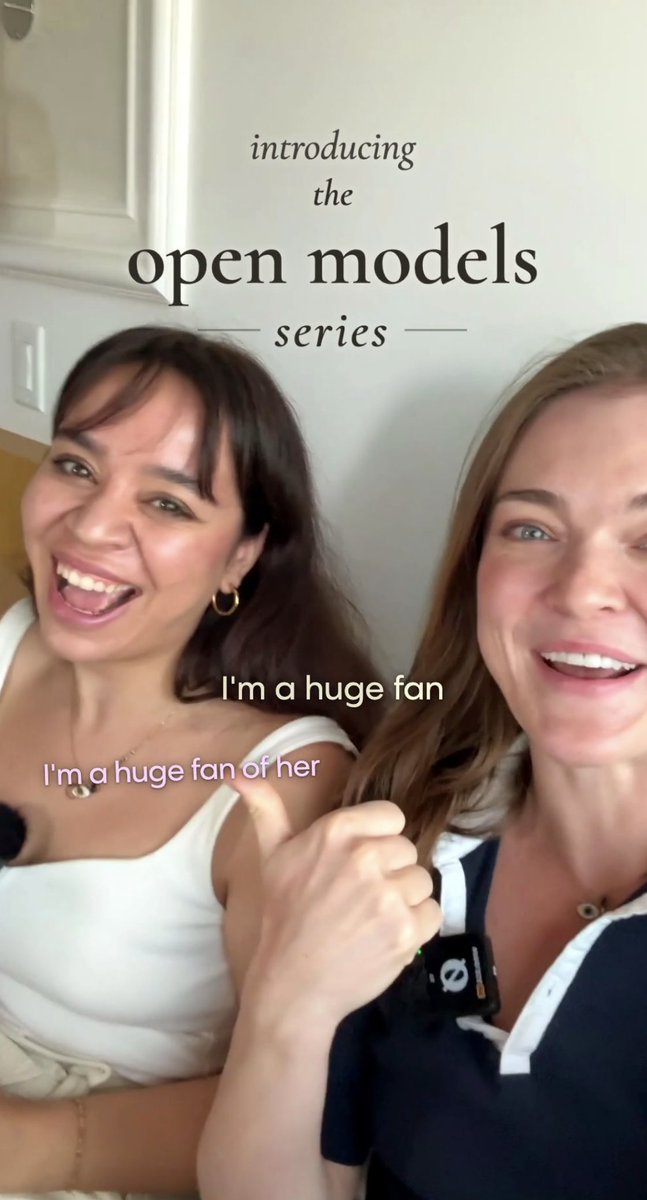
Announcing the Open Model Series: a new series on open source AI models, with merve of Hugging Face. Hugging Face is the open model hub: it hosts model weights, datasets, evals, & demo apps, and maintains the open-source libraries (like transformers) used to run and train them. I think of it like GitHub, but for AI models. You can download open models and run them on your own machines. In this series we'll cover what open source and open weight models are, how they work, how to run them yourself, and why they're important. By the way - this video is edited entirely with Claude! I can make a tutorial on how I did it. If there's a question you want answered about open models, leave it in the comments. We will read them all. Episode 1 is out soon.
Harper Carroll30,392 Aufrufe • vor 2 Monaten


These AI avatars are arguably the best in the world. Which do you think is actually me: A or B? Please answer the poll below. I’m curious what percentage are fooled! Was in NYC to interview Synthesia 🎥 CEO/cofounder Victor Riparbelli and had fun making this avatar. — 👋 Hi, I’m Harper, AI educator, engineer and advisor. I have two degrees in Computer Science specializing in Artificial Intelligence from Stanford, experience teaching PhD-level AI courses there, and 4+ years building AI at Facebook / Meta
Harper Carroll165,923 Aufrufe • vor 2 Jahren

The open-source & open-weight frontier is 7 months behind the closed-model frontier. Let’s talk about it. Check out last week’s episode for the reasons why you might want to consider open-source & open-weight models. Welcome to the fourth episode of the Open Model Series with merve, Hugging Face AI/ML engineer & open-sourceress! We have been discussing open-source & open-weight AI: what it is, how it works, and how you can run them on your own compute. Please leave all your questions about open-source & open-weight AI in the comments! This is a super important topic that is novel to most people, and it can be challenging to grasp - so rest assured your questions are shared with many others!
Harper Carroll17,279 Aufrufe • vor 1 Monat

CLAWDBOT. Open-source always-on assistant. You don’t need a Mac Mini - you can run it on AWS free tier. Can confirm. First video about this. More to come ! To be clear, I’m anti-hype. Last year I didn’t report on a LOT of AI releases that were making headlines - including major ones that I got early access to - because I sensed they were overhyped, and to be honest, I was right. Claude Code feels different. Because of how phenomenal Claude Code has been, I jumped to try Clawdbot. Will report back! What do you want me to try out?
Harper Carroll44,427 Aufrufe • vor 9 Monaten

Ever wondered what neural networks are and how they work? Systems like ChatGPT use neural networks to work as well as they do. Neural networks are composed of "layers" of neurons, layers with different functions; connections between layers called "weights"; and mathematical functions called "activation functions". If you’re interested in learning about these systems, check the comments. Ultimately, the neural network structure of the model serves to visually demonstrate that it is, in fact, a complex mathematical equation. When companies release the model's weights, they are releasing a key component needed to run the model's complete equation. Without the weights, the equation is incomplete. For the math-minded: the weights of a model are the learned numbers (they are variables during training) that are then used as constants in the mathematical functions that make up the model. Neural networks are ultimately just one big, hyper-complex mathematical function, and when a model is trained, it learns the constants associated with the high-dimensional input.
Harper Carroll50,905 Aufrufe • vor 11 Monaten
Post-run man with arm. What is model overfitting and how can you tell if it’s happening to yours?
Harper Carroll38,408 Aufrufe • vor 9 Monaten

CLAUDE IS ADDING WATERMARKS In compliance with the new EU AI Act, Claude is adding watermarks to its text outputs. For text outputs, it works as described in this clip. The clip is actually from 2024, from my video on SynthID, Google’s AI watermarking technology that works the same way as Claude’s watermarking tech. Basically, if you remember from our “How does AI work?” video, AI is a word generator, and samples from its generated probability distributions of the next word. With the watermark, the probability distribution of the output text is shifted slightly away from what it would have been without the watermark. Note that the watermark is invisible - you can’t see it with the human eye, since it’s literally just text written slightly differently - and currently, the mechanism to detect this watermark only exists within Anthropic (the team behind Claude) itself. Their published article says they are "working to enable users and other third parties to detect Claude's embedded watermarks.” For images, Claude is adding a signature to the metadata - which is easy to remove. What do you think? Google has been adding watermarks (with SynthID) for a while. Watermarking will now be rolled out industry-wide in compliance with the EU AI Act. SynthID was open source and I had some critiques about it… see below for the 5 minute video.
Harper Carroll13,218 Aufrufe • vor 2 Monaten

AI (LLMs) vs. Google Search They are not the same, and knowing the difference is crucial
Harper Carroll33,340 Aufrufe • vor 1 Jahr

