Загрузка видео...

Не удалось загрузить видео

На главную

Google and AI are completely different, and understanding how they work changes how you use them. *To be specific: by “AI” here I mean Large Language Models, or LLMs. Google has technically always been AI – its PageRank algorithm, which decides which links to return to you, has always...

44,225 просмотров • 1 день назад •via X (Twitter)

Комментарии: 14

Фото профиля AI Minus Hype
AI Minus Hype1 день назад

Useful distinction. Search retrieves existing documents, while an LLM generates a fresh answer from patterns, so it can be fluent and wrong with no source to check. Treating it as a drafting partner rather than a lookup tool is the habit that matters.

Фото профиля Vickie MacFadden
Vickie MacFadden1 день назад

So true. I pay for Grok, Claude, ChatGPT and Gemini, and run my own Hermes agents on a personal server. Different jobs need different AI, and knowing which one is improvising is half the skill.

Фото профиля Harper Carroll
Harper Carroll1 день назад

Also, if you're new here, hi! I'm Harper. I've spent a decade building AI as a Stanford computer scientist and coding AI systems at Meta & at a startup acquired by NVIDIA. I've always loved to teach, and now I get to create educational videos to share the skills, understanding, and intuition I've worked years to develop with you. For my (free) 10 Days of AI Basics series + more:

Фото профиля Harper Carroll
Harper Carroll1 день назад

Btw I mean Google Search and not the whole company! Google has lots of AI products, and of course now Google Search has the AI summary at the top, which uses LLMs + sources. What we’re getting at here is how agentic AI = LLMs & the harness around them, which enables tool use (for example, web search) in addition to token generation.

Фото профиля David Arnal
David Arnal1 день назад

Google gives you sources to evaluate; LLMs give you answers to scrutinize. Knowing when you need evidence versus a useful starting point makes all the difference.

Фото профиля Andreas Pitzer
Andreas Pitzer1 день назад

@grok is PageRank an "AI algorithm"?

Фото профиля Impact Factory Ai
Impact Factory Ai1 день назад

The real skill is knowing when to ask AI and when to verify the answer with actual sources.

Фото профиля Fuelmeup
Fuelmeup1 день назад

This explainer lands at a weird moment. Google itself now runs AI Overviews and leans on LLMs, and a whole industry has sprung up just to help brands rank inside ChatGPT and Gemini answers. Meanwhile Gen Z already trusts ChatGPT over Google for product research, per a Forbes survey in late September. So the line you're drawing between search and prediction is real, but the two tools are blurring fast. Knowing which one you're talking to matters more than ever.

Фото профиля Harper Carroll
Harper Carroll1 день назад

Btw I mean Google Search and not the whole company! Google has lots of AI products, and of course now Google Search has the AI summary at the top, which uses LLMs + sources. What we’re getting at here is how agentic AI = LLMs & the harness around them, which enables tool use (for example, web search) in addition to token generation.

Фото профиля Sami Daar
Sami Daar1 день назад

The search versus generation split is the part most people never learn. Once you know a model is predicting text, you stop trusting its confident tone.

Фото профиля AIinPlainTalk
AIinPlainTalk1 день назад

A simple way to use both: use search when you need a fact, a date, or a price, because it points to pages that already exist. Use a chat tool when you need a first draft or a plain explanation, then check any numbers or names it gives you against a source you trust.

Фото профиля Teranode
Teranode1 день назад

The librarian vs improv actor line is a great way to put it. Improv is brilliant for a first draft. For the answers people actually act on, what's your favorite habit for bringing the librarian back in?

Фото профиля SSindia 🇺🇸
SSindia 🇺🇸1 день назад

Wait. I thought PageRank was a deterministic algorithm that always featured the same links for anybody for the same query and at a given point in time. Isn't that the case? (not talking about personalized Google search.)

Фото профиля Doc Holliday
Doc Holliday1 день назад

Still not convinced this isn’t an AI person. Which is a compliment. 🤣

Похожие видео

WARP SPEED: EPISODE 5 - starring Varunram Ganesh, Founder of Lapis Varunram Ganesh The next generation of 20 year olds are going to default to LLMs for search. Varun is building Lapis into the most accurate AI search analytics platform. They are part of Y Combinator F25 - 1 day away from demo day with a countdown clock on his desk. The insight: people are already defaulting to ChatGPT over Google. As time goes on, more leveraged decisions get made through LLMs, not search engines. "So many people are searching on Google, they're going to be searching on ChatGPT. Why aren't people knowing where they are on ChatGPT?" Lapis tells you exactly what a human will search for your website to show up in AI. And unlike Google, it's not about ranking positions - LLMs reason differently. On Warp: "I don't even think about payroll. Which is just to say Warp is such a good product that I just don't think about it. No spam emails. No upsells. It's just so smooth." In this conversation: (0:00) - Shift from Google-style search to LLMs: “More leveraged decisions are now made through the LLM.” (0:15) - What Lapis does: the most accurate AI search analytics platform. (1:15) - YC intensity: six weeks from Demo Day, rapid feedback loops, constant customer conversations. (2:00) - “The hardest part of running a startup is the most boring stuff.” (2:41) - How AI search differs from Google search. (3:23) - Building a company through trust. (3:51) - “Every founder said, ‘Check out Gabriella Warp - a genuinely friendly solution. (4:02) - Big providers needed six weeks just to get set up. (4:20) - Texted Ayush and got set up in 15 minutes. (4:25) - Warp is so smooth you don’t think about payroll — no spam emails, no upsells, just seamless.

Ayush S

57,591 просмотров • 10 месяцев назад

Terence Tao, Professor of Mathematics at UCLA and Fields Medalist, on why nobody can fully explain why LLMs work: Tao starts with the mechanics, which are no mystery at all. You gather an enormous amount of text and you fit a curve to it. "The magic of LLMs is that if you train these LLMs on enough data — so trillions and trillions of data points — and you really try to fit as good a curve as possible, and this takes like millions and millions of dollars of computing power and months and months of time, then suddenly, even when you iterate, it stays coherent. It begins to sound not like monkeys but it actually sounds like a human speaking." That is the entire recipe: data, compute, time, curve-fitting. None of it obviously adds up to fluent English. Then Tao says the part that most people building these systems move past quickly: "And somehow we don't fully understand why that's the case." The admission comes from one of the most capable living mathematicians, and the gap he describes sits at the centre of the field. His best account of what's happening puts the mystery in the language rather than the machine: "What seems to be true is that language, like English or other natural languages, contains a lot of hidden patterns that we're not consciously aware of. I mean, we know some of the laws of English, there's laws of grammar and things, but there are sort of unspoken, unwritten rules of language that humans pick up." It relocates the question: the structure was always latent in the text, and the model found it. Why enough curve-fitting surfaces that structure is still unanswered. Tao reaches for a child to explain it: "A human child, even though they're not taught what a noun is, what a verb is or whatever, they can pick up what order English words go in just by continual exposure to the language." Which is honest about the limits of the explanation, because we can't fully account for how children do it either. From there, the unexplained behaviour compounds. Exposure to language turns out to be enough to produce something that looks like reasoning: "It seems like you can teach these models to also pick up patterns in language to the point where you can give them math questions. The answer to 2 plus 3 is — and they will say five." And once a model handles language at all, you can push it into resembling self-correction: "Once you have a little bit of ability to speak English, you can kind of go in loops and sort of check your work and make fewer mistakes, and you can prompt these models to proceed step by step and not say something unless it's been double checked and so forth. And so they become a little bit smarter, quote unquote, to the point where they can solve many, many complicated tasks." The scare quotes around "smarter" carry the whole argument. Tao does not concede that the unexplained fluency implies anything underneath it: "But they're still just guessing the next word to say. It's not really grounded in any deep understanding of the real world. It's just that they have seen the patterns in the English language or other language that they've absorbed so well."

Big Brain AI

191,957 просмотров • 1 месяц назад

Announcing How Transformer LLMs Work, created with Jay Alammar and Maarten Grootendorst, co-authors of the beautifully illustrated book, “Hands-On Large Language Models.” This course offers a deep dive into the inner workings of the transformer architecture that powers large language models (LLMs). The transformer architecture revolutionized generative AI; in fact, the "GPT" in ChatGPT stands for "Generative Pre-Trained Transformer." Originally introduced in the Google Brain team's groundbreaking 2017 paper "Attention Is All You Need," by Vaswani and others, transformers were a highly scalable model for machine translation tasks. Variants of this architecture now power today’s LLMs such as those from OpenAI, Google, Meta, Cohere, Anthropic and DeepSeek. In this course, you’ll learn in detail how LLMs process text. You'll also work through code examples that illustrate that transformer's individual components. In details, you’ll learn: - How the representation of language has evolved, from Bag-of-Words to Word2Vec embeddings to the transformer architecture that captures a word's meanings taking into account the context of other words in the input. - How inputs are broken down into tokens before they are sent to the language model. - The details of a transformer's main stages: Tokenization and embedding, the stack of transformer blocks, and the language model head. - The inner workings of the transformer block, including attention, which calculates relevance scores, and the feedforward layer, which incorporates stored information learned in training. - How cached calculations make transformers faster. - Some of the most recent ideas in the latest models such as Mixture-of-Experts (MoE) which uses multiple sub-models and a router on each layer to improve the quality of LLMs. By the end of this course, you’ll have a deep understanding of how LLMs actually process text and be able to read through papers describing the latest models and understand the details. Gaining this intuition will improve your approach to building LLM applications. Please sign up here:

Andrew Ng

268,459 просмотров • 1 год назад

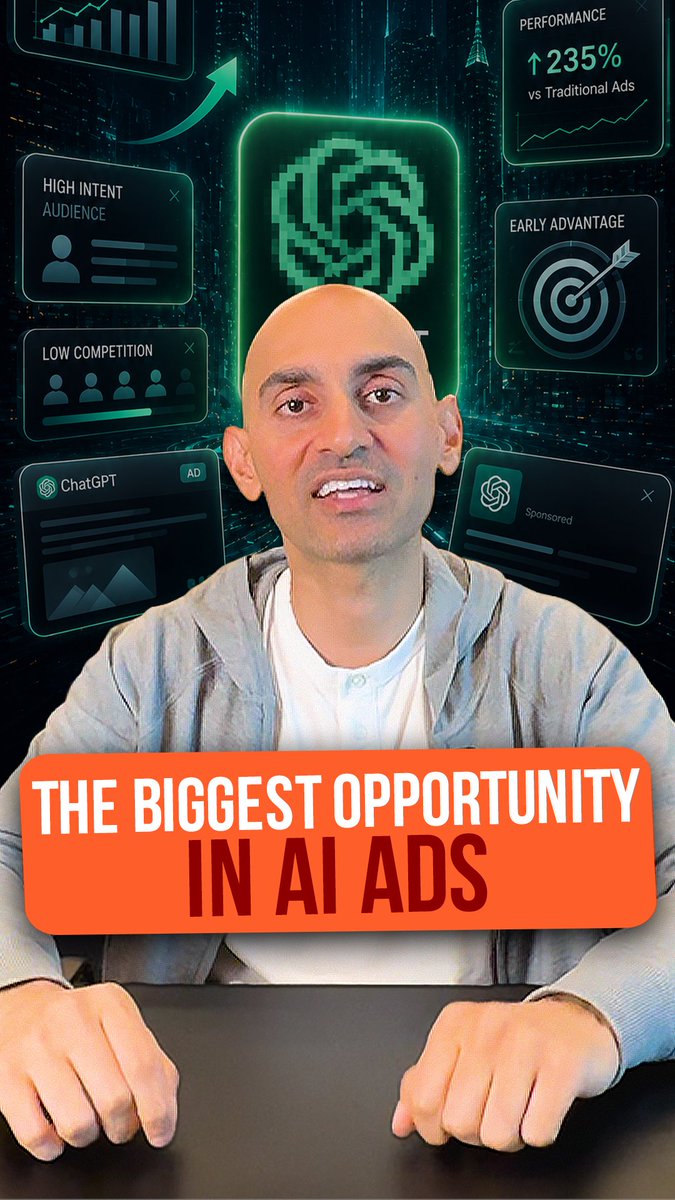
For the first time ever, you can buy ads inside ChatGPT. And because the platform is still new, almost nobody has figured out how to use it properly yet. That means the opportunity is wide open. Here’s what changed. OpenAI launched a self-serve Ads Manager, making ChatGPT ads accessible to businesses that previously would not have been able to participate. You no longer need to be a massive brand with an enormous advertising budget. But these ads work differently from Google. Google usually matches an ad to the words someone searches. ChatGPT looks at the larger context of the conversation and what that person is trying to accomplish. That creates a new challenge: how do you know which conversations your business should appear in? You start with real demand. What are people already searching for in your industry? What questions are they asking? What problems are they trying to solve? And what language do they use to describe those problems? That’s where Ubersuggest comes in. Use it to find the topics people search for most, see how competitive they are and identify where your competitors are already getting attention. Then turn those insights into the conversation themes, ad angles and landing pages you use for your ChatGPT campaigns. The technology is new, but the principle is not: Understand what people want, learn how they talk about it and show up when they are ready to make a decision. The companies that learn this early will have an advantage while everyone else is still trying to understand how it works.

Neil Patel

12,249 просмотров • 2 месяцев назад

Announcing a new Coursera course: Retrieval Augmented Generation (RAG) You'll learn to build high performance, production-ready RAG systems in this hands-on, in-depth course created by and taught by , experienced AI and ML engineer, researcher, and educator. RAG is a critical component today of many LLM-based applications in customer support, internal company Q&A systems, even many of the leading chatbots that use web search to answer your questions. This course teaches you in-depth how to make RAG work well. LLMs can produce generic or outdated responses, especially when asked specialized questions not covered in its training data. RAG is the most widely used technique for addressing this. It brings in data from new data sources, such as internal documents or recent news, to give the LLM the relevant context to private, recent, or specialized information. This lets it generate more grounded and accurate responses. In this course, you’ll learn to design and implement every part of a RAG system, from retrievers to vector databases to generation to evals. You’ll learn about the fundamental principles behind RAG and how to optimize it at both the component and whole-system levels. As AI evolves, RAG is evolving too. New models can handle longer context windows, reason more effectively, and can be parts of complex agentic workflows. One exciting growth area is Agentic RAG, in which an AI agent at runtime (rather than it being hardcoded at development time) autonomously decides what data to retrieve, and when/how to go deeper. Even with this evolution, access to high-quality data at runtime is essential, which is why RAG is a key part of so many applications. You'll learn via hands-on experiences to: - Build a RAG system with retrieval and prompt augmentation - Compare retrieval methods like BM25, semantic search, and Reciprocal Rank Fusion - Chunk, index, and retrieve documents using a Weaviate vector database and a news dataset - Develop a chatbot, using open-source LLMs hosted by Together AI, for a fictional store that answers product and FAQ questions - Use evals to drive improving reliability, and incorporate multi-modal data RAG is an important foundational technique. Become good at it through this course! Please sign up here:

Andrew Ng

124,981 просмотров • 1 год назад

Everyone is focused on tracking the ways LLMs are getting better. And they are. But we know there are still things that LLMs can’t do well—the tasks where you can feel the architecture fighting the problem. So I was excited to chat with Eve Bodnia (@eve_bodnia), who is developing an alternative AI model to LLMs, on Every 📧's AI & I. Eve's argument: energy-based models (EBMs), which map possible outcomes onto a mathematical landscape, will lead to the next AI phase shift. We get into: - How energy-based models work. Likely outcomes sit in valleys, and unlikely ones sit on peaks. Whereas LLMs process one token at a time, an EBM scans the full terrain to find the lowest point, or the most probable answer. - Language-based versus data-native models. LLMs are language-dependent even when the problem has nothing to do with language. "If your data is numbers, relationships, and functions, and you try to map those rules into words and then search for the next word, you're losing a lot of information," Bodnia says. EBMs work directly with the underlying data structure, including numbers and spatial coordinates. - Sequential versus panoramic reasoning. An LLM is like driving through San Francisco without a map. Each turn constrains the next, and if you go down the wrong street, you can't reverse course. An EBM has the bird's-eye view—it can evaluate multiple routes at once and course-correct before hitting a dead end. - The LLM plateau no one wants to talk about. LLMs are getting incrementally better, step-change improvements aren’t coming, Eve argues. To achieve that, we need new solutions that compensate for what LLMs are inherently bad at, like non-language reasoning, verification, and real-time data analysis. This is a must-watch for anyone who's curious what might come after the LLM. Watch below! Timestamps: Introduction: 00:00:51 Why correctness and verifiability matter in AI: 00:02:09 What an energy-based model is: 00:09:33 How EBMs construct energy landscapes to understand data: 00:14:21 Why modeling intelligence through language alone is a flawed approach: 00:19:00 What it means for a model to "understand" data: 00:26:54 How EBMs solve the vibe coding problem and enable formally verified code: 00:37:21 Why LLM progress is plateauing: 00:43:21 Mission-critical industries haven't adopted LLMs, and why EBMs can fill that gap: 00:49:54

Dan Shipper 📧

26,900 просмотров • 6 месяцев назад