
Nina Schick
@NinaDSchick • 59,285 subscribers
Documenting how we’re manufacturing Intelligence | AGI & Geopolitics
Videos

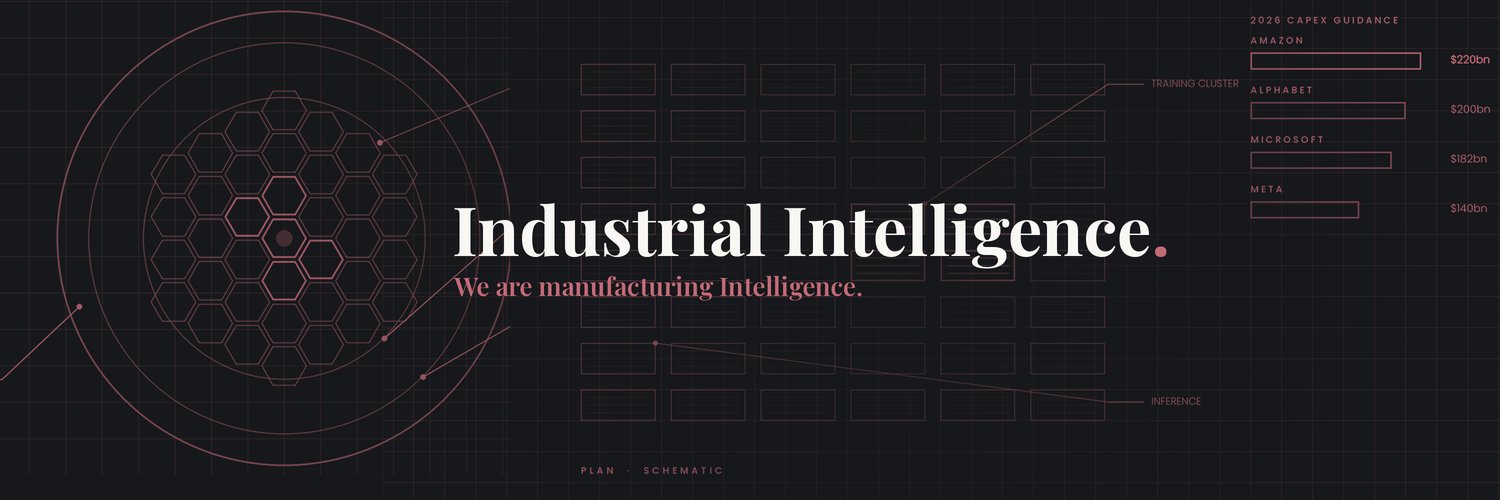
We are turning energy into non-biological Intelligence. Data centers are literally 'factories' that produce Intelligence. Electricity is the essential input. The electricity powers computation, and the computation produces and processes the tokens through which machine Intelligence operates. As these systems become more capable and autonomous, they consume vastly more tokens, driving ever greater demand for computation and electricity. OpenRouter estimates that an agentic request already consumes around 15 times as many tokens as a human-led request on its platform. This fundamentally changes the nature of electricity demand as our demand for useful Intelligence has no obvious ceiling. If more computation can produce more valuable work, we will keep finding more work for machines to do - and so, we will need ever more electricity. We got future energy demand so wrong because we did not foresee that non-biological Intelligence could be produced industrially; and that we would need an entirely new energy paradigm to support that.
Nina Schick211,136 Aufrufe • vor 16 Tagen

The world runs on a single island (!!) Over 90% of leading-edge chips are manufactured by TSMC in Taiwan — a democratic nation just 100 miles off the coast of China, which the CCP openly claims as its own territory. Given the stakes, it’s astonishing (almost absurd) that the entire global economy rests on a geopolitical fault line this volatile. Once you see what happens inside a TSMC production line, the extreme ultraviolet lithography machines, the atomic-level precision, the thousands of interlocking steps ,you realise TSMC isn’t just hard to replicate. It is, for now, irreplaceable. The U.S. is scrambling to onshore semiconductor manufacturing, while China is aggressively pursuing chip sovereignty and instructing its tech giants to reduce reliance on American hardware. But both sides understand the same reality: if China moved on Taiwan, the balance of global power would shift overnight. This is the wild card at the centre of the AI race — a tiny island everyone depends on, and whose fate may determine the future of global power.
Nina Schick2,584,252 Aufrufe • vor 8 Monaten

Elon Musk is attempting something extraordinary. Not just building another company. He is building the largest AI training cluster in the world. A million GPUs wired together. A brute-force attempt to scale intelligence itself. The capital required to do this is staggering. Forty to sixty billion dollars for one cluster. And yet this is just one experiment. This is the scale of ambition in AI right now. It is not about incremental software. It is about rewiring the fundamental limits of what machines can learn and know.
Nina Schick517,598 Aufrufe • vor 10 Monaten

Three years ago, a million tokens of AI inference cost $60. Today? Six cents. A 99.9% cost collapse. When something this powerful becomes this cheap, it doesn’t stay confined to research labs, It is able to flood the economy. AI is now diffusing faster than any technology in history — into every industry, every workflow, every device; 800 million people use ChatGPT weekly. And we’re still nowhere near the high-water mark of what’s possible. The real story is diffusion and ubiquity. Can intelligence become a utility — cheap, improving, self-learning, and embedded everywhere? Because in a geopolitical contest defined by capability and speed, the nation that diffuses intelligence the fastest, across government, industry, and society, will gain an extraordinary advantage.
Nina Schick292,607 Aufrufe • vor 9 Monaten

For two hundred thousand years, intelligence has been the rarest resource on earth. Locked inside individual human minds. Non‑scalable. Scarce. Every advance in civilization — every leap in science, art, industry, and statecraft — flowed from that scarcity. Artificial intelligence breaks that pattern. It makes intelligence abundant. It makes it cheap. It makes it scale. This is not just another wave of automation or software. It is the industrialization of intelligence itself. When intelligence becomes a utility, it stops being a tool that sits on top of society and starts becoming the foundation of society. It is a transformation as profound as the harnessing of electricity — but on a higher plane. Electricity powered machines. Industrial intelligence powers knowledge. And knowledge shapes everything. This shift will reorder the very structures that underpin nations. The two pillars that define sovereignty — economic strength and security — are being rebuilt on a substrate of machine intelligence. Nations that master this new utility will not simply gain efficiency. They will redefine what prosperity, power, and freedom mean in the 21st century. For me, this is the central story of our time. It is not about the latest app. It is not about hype cycles. It is about the first time in history that intelligence itself — the raw material of progress — has become infinite and industrial. The question is not whether it will transform society. It already is. The question is who will shape that transformation.
Nina Schick139,400 Aufrufe • vor 8 Monaten
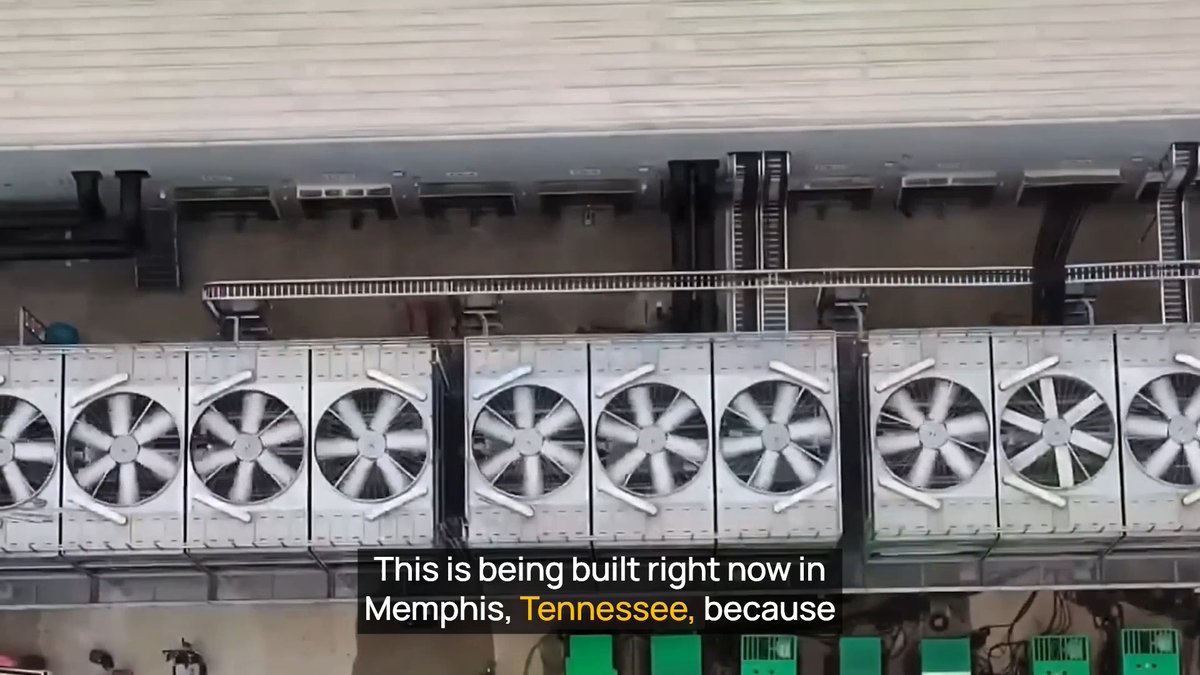
Elon Musk is building a training cluster/ supercomputer so vast it’s visible from space. Colossus, in Memphis, Tennessee, is more than an AI experiment. It’s a statement of intent. A million GPUs wired together by the end of this year. A $40 to $60 billion physical bet that brute-force scale will birth the world’s most intelligent AI. This isn’t theory. It’s infrastructure. It’s industrial. And it shows us what the future looks like, not just in capability, but in the sheer energy, capital, and ambition now required to compete at the frontier. Colossus is the embodiment of a new era: Intelligence as utility.
Nina Schick36,923 Aufrufe • vor 1 Monat

China’s mission is defined. It sees technology as the vehicle for reclaiming power. The West, by contrast, has been distracted. Our brightest minds have too often been funneled into building trivial apps. Delivery services. Digital gimmicks. Social feeds. Meanwhile, AI has the power to reshape prosperity, security, and freedom. That is what this moment demands. A strategic reimagining of democracy in the age of intelligence. Because the greatest risk is not that AI overtakes us. It is that we fail to rise to the occasion.
Nina Schick128,503 Aufrufe • vor 9 Monaten

Rare earth minerals are a critical chokepoint for everything that matters to the modern economy. From semiconductors to defense systems. China controls over 70 percent of REE supply and over 90 percent of the processing. The world is waking up to this dependence. Japan, Australia, and the US are trying to diversify. The Pentagon has even taken a stake in America’s only rare earth mining firm. But right now, China holds the cards.
Nina Schick53,255 Aufrufe • vor 3 Monaten

Everyone calls these new AI facilities data centres. That's wrong. What Elon Musk built in Memphis — gutting an abandoned refrigerator factory, wiring together 200,000 GPUs in 122 days — is not a data centre. It's an Intelligence Factory. This is the first film in my Industrial Intelligence series. Full video below.
Nina Schick48,353 Aufrufe • vor 5 Monaten
Only two nations truly grasp the stakes. The United States and China. China declared its ambitions early. As far back as 2017, AI supremacy became national doctrine. By 2019, they had a plan to embed AI into every layer of the People’s Liberation Army—from logistics to weapons systems. The U.S. took a more fragmented approach, focusing on private sector innovation. But that changed overnight when Trump returned to office. The new American AI Action Plan is explicit. It removes regulatory barriers. It accelerates infrastructure. It promotes a full-stack national AI capability as a strategic imperative. This is not a policy debate. It is a race for dominance.
Nina Schick33,835 Aufrufe • vor 5 Monaten
The global competition for elite AI talent is unlike anything we have seen before. Multi-billion dollar compensation offers. Frontier labs battling for a handful of world-class minds. Because, the interesting thing is this: in a world defined by exponential systems, even a single individual can bend the arc of history.
Nina Schick20,831 Aufrufe • vor 2 Monaten

The pursuit of AI is the pursuit of knowledge. And knowledge has no endpoint. Intelligence is being turned into a commodity, scaled like any other industrial resource. But what it unlocks is something far more profound. David Deutsch calls it the beginning of infinity. That idea feels especially relevant now. As AI expands our capacity to understand complex systems from biology to medicine to physics we are not approaching a finish line. We are stepping into a phase where discovery becomes continuous.
Nina Schick44,128 Aufrufe • vor 8 Monaten

Scaling performance is only part of the equation. The other half is cost. And what we are seeing right now is an unprecedented collapse in cost at industrial scale. Three years ago, running a million-token output with AI cost about sixty dollars. Today, it costs less than a cent. That is a 99.9 percent drop. In any other sector, that would be called a revolution. When something this powerful becomes that cheap, it is no longer a specialist tool. It becomes a foundational utility. This is the shift from niche capability to industrial infrastructure.
Nina Schick30,435 Aufrufe • vor 8 Monaten

The greatest risk we face today is not market volatility. It is not even war in the traditional sense. It is that democracies fail to reimagine sovereignty and prosperity in the age of AI. This is not a theoretical threat. It is a practical one. Because power is shifting, rapidly, from the old levers of influence to the new architecture of intelligence. Nations that cannot adapt will not only fall behind. They will lose control of their economic future, their digital infrastructure, and ultimately their political agency.
Nina Schick33,207 Aufrufe • vor 11 Monaten

The AI divide between the United States and Europe is becoming impossible to ignore. In the US, xAI built the world’s largest AI facility in just 122 days. In France or Germany, it could take five years simply to secure the permits. And even if Europe could build faster, power is the deeper constraint. Europe has the highest industrial electricity in the world. And, it is an net energy importer. If Europe doesn't unlock cheaper electricity (fast!) it will fall further behind.
Nina Schick10,689 Aufrufe • vor 3 Monaten

Everyone is asking about AI’s ROI. The use cases. The productivity gains. All of that matters, but it comes later. Because the bigger story isn’t about applications. It’s that a general intelligence is being industrialised. AI is no longer a software feature. It’s becoming the infrastructure layer of the next economy. The foundation upon which every industry, every transaction, and even future systems of governance will run. We’ve seen this before. Moore’s Law turned silicon into the backbone of the digital age. Now AI scaling laws are doing the same for intelligence — only faster, cheaper, and far more profound. Intelligence is becoming something we can manufacture, distribute, and embed everywhere. And once intelligence becomes industrial, the question shifts. It’s no longer what are the use cases? It’s who controls the infrastructure of intelligence? Because that answer won’t just determine which companies win — it will determine which nations do.
Nina Schick17,904 Aufrufe • vor 7 Monaten

We’re no longer just scaling computing power. We’re using compute to scale intelligence itself. That’s what makes this moment historically significant. For sixty years, progress in computing followed Moore’s Law—transistor density doubling roughly every two years. But AI is advancing on a far steeper curve. Today, frontier model capabilities are improving on a cadence closer to every six months—an order of magnitude faster than classical hardware scaling. The underlying principle is both simple and radical: when you increase data, compute, and model complexity, intelligence emerges. Scaling laws show that larger models—given sufficient compute and high-quality data—become predictably more capable. In just over a decade, we’ve gone from neural nets that could identify cats to systems that can draft legal briefs, write production-grade code, generate scientific hypotheses, and outperform top human competitors in mathematics, strategy, and reasoning tasks. This is no longer “software” in the traditional sense. It is a new form of intelligence—synthetic, scalable, rapidly compounding, and increasingly able to take meaningful action in the real world. The geopolitical, economic, and societal implications of this shift are only beginning to unfold—and they will redefine global power in the decades ahead.
Nina Schick17,750 Aufrufe • vor 8 Monaten
Keine weiteren Inhalte verfügbar