

nxthompson
@nxthompson • 129,810 subscribers
CEO @theatlantic. Author of “The Running Ground" and host of "The Most Interesting Thing in AI."
Shorts

Videos

Meta’s AI glasses are one of the company’s most successful products in years. They offer genuine utility, with a direct way for users to interact with its AI. But people have long been wary of smart glasses—especially when face recognition is involved. Here’s Boz on Meta's NameTag feature, which identifies faces and alerts the glasses wearer when it detects someone they know. Produced by Atlantic Re:think, The Atlantic's creative marketing studio.
nxthompson260,108 views • 2 months ago

A new paper shows that AI does make your writing more homogenous—and it'll do the same even if you just ask it to edit your writing. Even weirder: it's not like it'll push you toward the voice of an average human, it'll push you toward a kind of AI-optimized voice that's subtly different from the way any people write.
nxthompson123,783 views • 5 months ago

“People will be shocked that the only jobs available to them are not nearly as desirable as the job that they've had.” Much of the focus around AI and white-collar work has been on the number of jobs that might disappear. But Clara Shih says we should also consider what will happen to the ones that remain. Watch our whole conversation about AI and the future of work here:
nxthompson14,950 views • 15 days ago

I asked ian bremmer if Europe can catch up in AI and he flipped it in a remarkable way. AI is probably going to help the US economy more than the European economy. But in doing so, it might disrupt many of the systems from which derive our sense of self-worth. And if that happens, Europe might play a role in helping us adopt new ones. Watch my full discussion with Ian here:
nxthompson17,801 views • 25 days ago
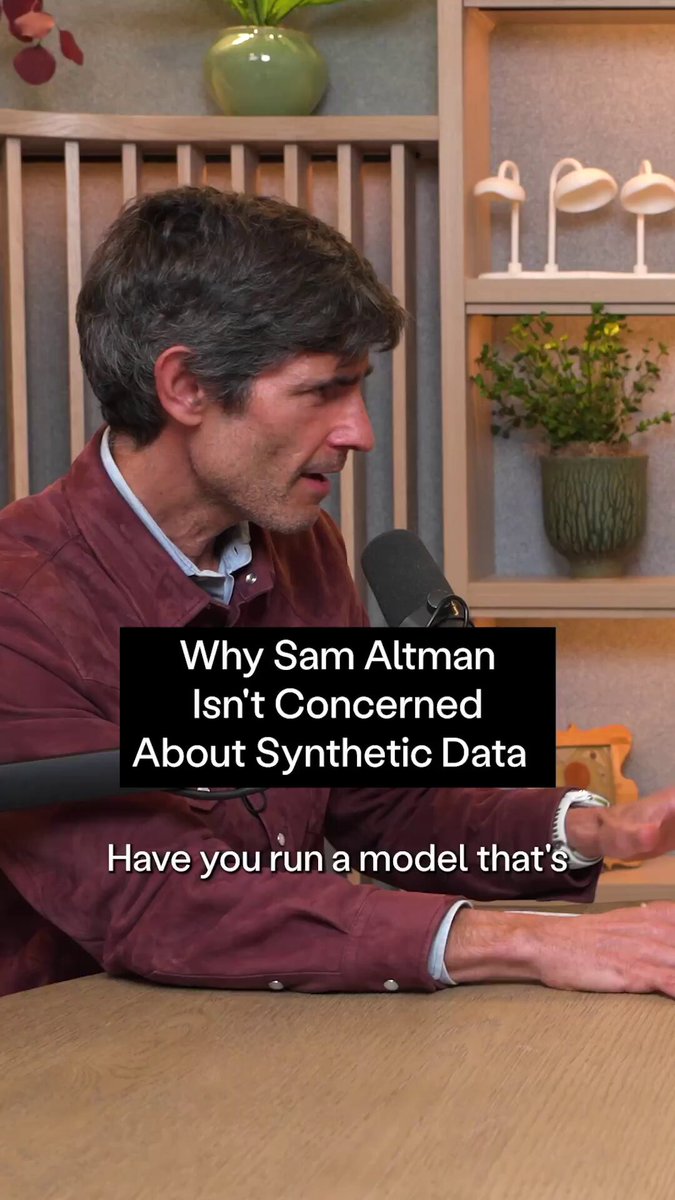
I was a little surprised by Sam Altman's answer here. But if he’s right—and you can train a model completely on synthetic data—it would have all sorts of implications for how we develop and deploy this technology. Watch my full interview with Sam here: Produced by Atlantic Re:think, The Atlantic's creative marketing studio.
nxthompson66,505 views • 4 months ago

Nick Bostrom says there are a few reasons to treat AI models with respect: 1. It’s the right thing to do. 2. It helps build good habits. 3. The models might remember it when they become more powerful than us and spare the human race from total annihilation. He had some fascinating points. You can watch our full convo here: Produced by Atlantic Re:think, The Atlantic's creative marketing studio, in collaboration with PwC.
nxthompson50,535 views • 4 months ago

There are lots of reasons to be concerned about a future where people talk to chatbots more than humans, but this is one I hadn’t heard before. For a democracy to work, its citizens have to be engaged and connected. If everyone spends all their time with chatbots, those relationships will fray, and eventually, the institutions will too. ian bremmer and I went deep on some of the risks AI poses to government and society. Watch the whole thing here:
nxthompson12,406 views • 27 days ago

I love this advice from Steven Johnson about how young people, and really all people, should think about using AI. Treat it like the smartest person you know. Bounce ideas off of it, ask it lots of questions, and use it as a tool for learning—not doing. Steven and I talked a lot about AI and cognitive offloading. You can watch our whole conversation here: Produced independently of The Atlantic’s editorial staff. Supporting sponsor: PwC
nxthompson13,946 views • 1 month ago

Why is AI suddenly cracking all kinds of previously unsolved problems in math? My guess is that it’s because: A) Math is verifiable so it's easier for models to improve B) Theoretical math highly benefits from chain of thought reasoning C) The answers and breakthroughs can be tested and verified by expert humans. But this leads to another question: what if progress in other fields is moving just as fast and we can't see it?
nxthompson17,404 views • 1 month ago

As Sam Altman says here, no one knows what the media business will look like in the AI era. But it's increasingly clear it will involve agents–perhaps on a scale where vastly more of them interact with our content than humans. That could open up all sorts of possibilities with micropayments, licensing, bulk subscriptions, and other ideas no one has thought of yet. Watch my full conversation with Sam here: Produced by Atlantic Re:think, The Atlantic's creative marketing studio.
nxthompson36,138 views • 4 months ago

This was a brilliant answer from Yuval Noah Harari on how AI might change the world. It's still far too early to tell, but this might become the most powerful technology ever created, so we should probably spend more time worrying about the implications of that and less time stressing over ROI every quarter. #Davos26 #WEF26
nxthompson52,684 views • 7 months ago

This is one of the more interesting cases I’ve heard for why we should put AI data centers in space. Yes, it would benefit a few billionaires, but it could also lessen the environmental toll on Earth. And we’re going to need to cut AI's carbon footprint in as many ways as we can. Space architect Ariel Ekblaw and I went deep on the opportunities—and many challenges—of building AI infrastructure in orbit. Watch our conversation here: Produced by Atlantic Re:think, The Atlantic's creative marketing studio, in collaboration with PwC.
nxthompson25,876 views • 4 months ago

The most interesting thing in tech: Commerce bans foreign nationals—including Anthropic's own staff!—from using Fable. So the company shuts it down for all. Anthropic keeps warning AI is existentially dangerous but then keeps shipping. The government wants AI built here but incoherent regulations just derailed a leading product. It's not going well, folks.
nxthompson17,740 views • 3 months ago


Sitting on some steps at a NYC high school waiting for my son to finish soccer practice just now …
nxthompson17,458 views • 4 months ago

One of the most interesting ideas I heard this year: In a world in which everyone uses A.I. for everything, the next great competitive edge might lie with people who keep their minds sharp by doing tasks themselves—even when they could be easily outsourced to A.I. I thoroughly enjoyed talking to Nita Farahany about the future of human cognition. Listen here: Produced by Atlantic Re:think, The Atlantic's creative marketing studio, in collaboration with PwC.
nxthompson25,449 views • 8 months ago

If you are going to give a commencement address in the next couple of weeks, do not mention AI or you might get loud boos. It happened in Florida last week; and it just happened to Eric Schmidt in Arizona. Many young people are decidedly not excited about AI and the future it promises to deliver them.
nxthompson14,023 views • 4 months ago


I’m thrilled to announce The Most Interesting Thing in AI is back for another season. This moment in AI is the most exciting, as well as unsettling, that I’ve lived through. It has spurred lots of questions about where we are heading—and I’ve got an incredible list of guests to help me work through them. Episode one drops next Wednesday. We’ve officially made the switch to video; I hope you’ll subscribe and watch on YouTube: Produced by Atlantic Re:think, The Atlantic's creative marketing studio, in collaboration with PwC.
nxthompson10,972 views • 5 months ago