
elvis
@omarsar0 • 323,678 subscribers
Building the frontier @dair_ai • Prev: Meta AI | PaperswithCode | Elastic | PhD
Shorts




Videos

This is impressive! I cloned my voice in the Cartesia playground from a ~15-second clip. The clone was ready in a couple of seconds. Then I had it speak Japanese, a language I don't speak. My clone now says in Japanese that I can find good papers by combining AI with my experience reviewing papers. I am impressed by how good this sounds. This runs on Sonic 3.6, their latest voice model, which supports 44 languages. You can do the same with any of them. This tech is getting really good, and I think it's worth exploring to make your content more accessible to more people in different languages. Try it here: More info about their model here:
elvis234,810 Aufrufe • vor 13 Tagen

Everyone keeps asking me how to build a second brain or an LLM wiki. Here is the easiest setup I have found. I took my Wiki Builder skill, installed it into HyperAgent (Hyperagent) as a reusable skill, and asked it to build a research wiki on LLM verification from the latest 2026 papers. Recorded a quick demo. Built with Hyperagent. It planned first, asked a few sharp questions, then did the research: 29 papers curated into 21 files, a research map, a glossary, and clean subfields. Now it is a knowledge base that my other research agents build on. HyperAgent has all the capabilities to allow your agents and skills to compound. That’s a powerful use of AI agents.
elvis226,001 Aufrufe • vor 3 Monaten

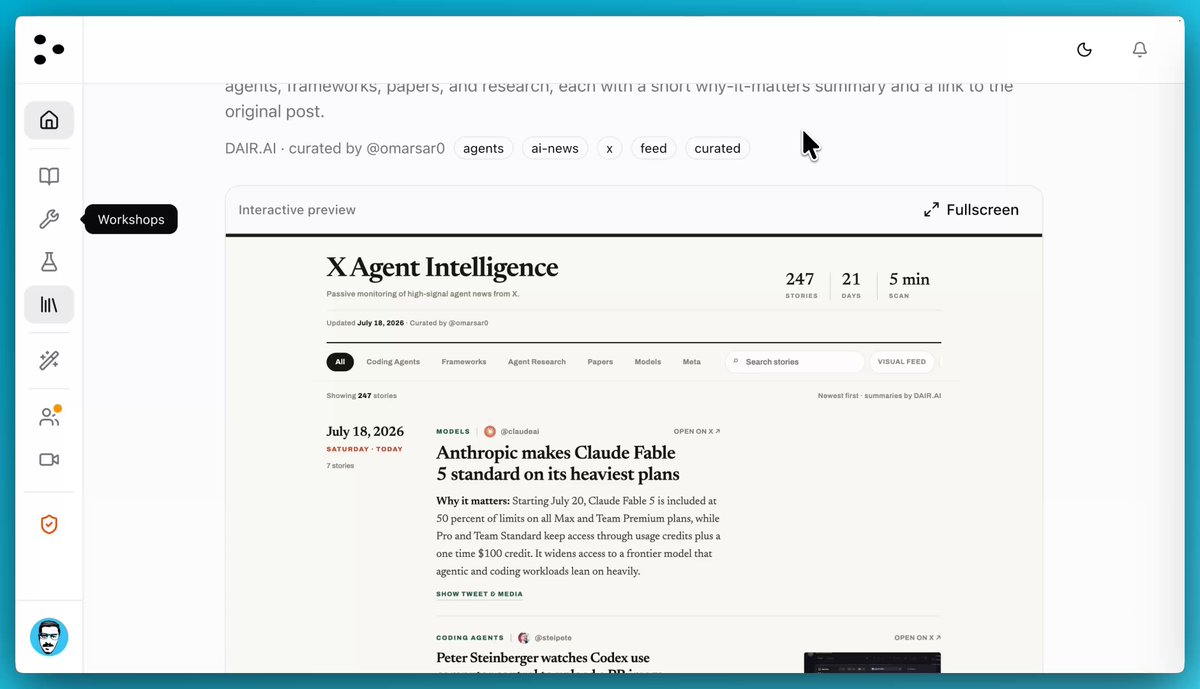
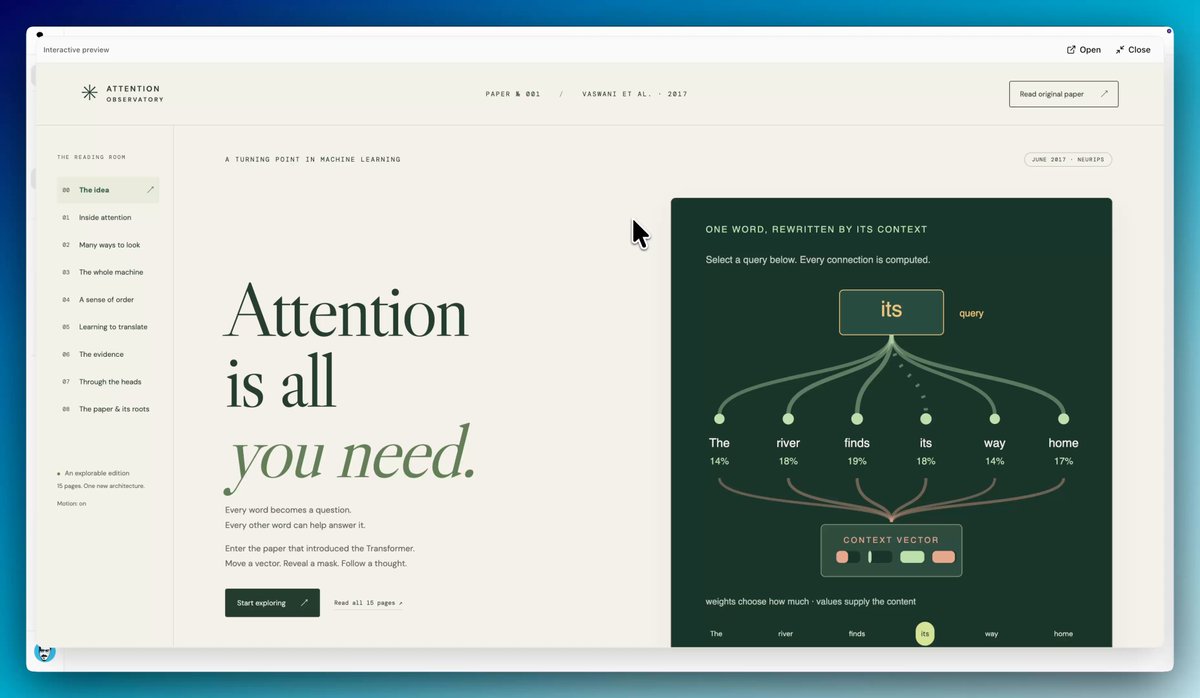
LLM Wikis + HTML Artifacts are insanely powerful. You should seriously consider this in your workflows. LLM Wikis captures all the important information that lets you and your agents do meaningful work. HTML artifacts present that information in interesting ways that allow you to take important actions along with your agents. My HTML artifacts sit on top of my LLM wikis. They are dynamic and are easily extended as needs arise. I have hooked my Artifacts to talk to my agents, and similarly, the agents can talk to artifacts. This has allowed me to build powerful artifacts that reduce my inbox to zero, keep me updated on any topic of interest, fast prototyping, do deep research, design/trigger new experiments, generate figures to improve understanding, schedule research, search relevant information, discover topics, and so much more. What you see in the clip is not a website. It's a simple interactive HTML artifact. HTML artifacts are useful for designers, engineers, researchers, students, and anyone working with agents. Lastly, HTML doesn't replace Markdown. They are a much better combination working together.
elvis249,243 Aufrufe • vor 5 Monaten


o3-mini-high (left) vs. deepseek-r1 (right) results from the first try deepseek-r1 is cracked... wtf!
elvis719,881 Aufrufe • vor 1 Jahr


This is insane! I just used the new Claude Code Playground plugin to level up my Nano Banana Image generator skill. My skill has a self-improving loop, but with the playground skill, I can also pass precise annotations to nano banana as it improves the images. It's so good!
elvis287,078 Aufrufe • vor 8 Monaten

Introducing MCP tools for DAIR.AI. Connect the MCP to your Codex/Claude/Grok Bot to discover and explore the top AI papers. We carefully curate the papers, so you can expect mostly bangers. The index has all the papers I have featured on X over the last couple of years. Get started: > find and summarize awesome papers > explore our harness engineering collection > find new methods to experiment with > find sota results around AI topics > generate literature review/surveys > build your personal collection > visualize papers > and much more The demo shows how to install it, including some ideas inspired by Andrej Karpathy for visualizing a paper. We are just getting started. Reach out if you have feedback. We are releasing a few benchmarks with this in the next couple of weeks and will ship regular additions and improvements. Stay tuned!
elvis14,150 Aufrufe • vor 9 Tagen


Introducing ralph-research plugin. I just adopted the ralph-loop for implementing papers. Mindblown how good this works already. The entire plugin was one-shotted by Claude Code, but it can already code AI paper concepts and run experiments in a self-improving loop. Wild!
elvis221,360 Aufrufe • vor 9 Monaten

I am hooked on Dynamic Workflows! The idea of generating harnesses on the fly is so compelling that I reverse-engineered it for my agent orchestrator. And then I built a monitoring dashboard (as an HTML artifact) to track tasks, metrics, and reports. I can now use and monitor dynamic workflows in my agent orchestrator with coding agents like Claude Code, Codex, Pi, and even my own custom-built DAIR.AI agent. This is clearly the future of working with agents to accomplish complex, long-running tasks. Some use cases I'm having success with: - Branching deep research tasks (with verification) - Parallel deep research tasks - Session mining of all my agent sessions - Bug hunting - Triaging - Fact-checking - LLM councils - AI simulations - Data synthesis - Evals generation ... and many others Dynamic workflows, like agent skills, feel like an important primitive to not only get the most out of agents but also incorporate dynamic behaviors and important components like cooperation and verification. There is so much exploration ground here. The exciting part is that this is not limited to coding tasks; it extends to business use cases and many other technical domains like science and research.
elvis104,372 Aufrufe • vor 4 Monaten

Kimi K2 Thinking is a bigger deal than I thought! I just ran a quick eval on a deep agent I built for customer support. It's on par with GPT-5; no other LLM has reached this level of agentic, orchestration, and reasoning capabilities. Huge for agentic and reasoning tasks.
elvis228,508 Aufrufe • vor 11 Monaten

This is just mindblowing stuff! I couldn't resist replicating this workflow to generate 3D biological structures. In a few minutes, I designed an artifact specifically built to generate these for any topic. Stack: - HTML Artifact to view diagrams - Gemini Nano Pro for concept generation - Tripo for generative 3D - Codex for assembling everything AI will exponentially accelerate learning and democratize high-quality education. Stay tuned! We have a few releases on this front.
elvis108,760 Aufrufe • vor 5 Monaten


This is what the future of coding looks like. Multiple AI models working in the same Codex session, with Jev routing them to tackle different parts of the task. Here, I had it build a full-stack demo app: > Opus 5.5 planned it. > GPT-6 Astra built the backend. > Kimi K3 built the frontend. > DeepSeek handled testing. > GLM 5.3 Flash wrote the docs. Jev handles the switching. I never touched the model picker. 40% cheaper, 15% faster for the same build.
elvis16,347 Aufrufe • vor 18 Tagen

Claude Code sub-agents is probably the easiest way to build complex, custom agentic systems. Not just for code, but for anything you can imagine. Watch me build a multi-agent deep research system with Claude Code subagents. Chain subagents with /commands for reliability.
elvis190,095 Aufrufe • vor 1 Jahr

LLM Wikis are being slept on. I argue that creating knowledge bases with LLMs or coding agents is one of the most valuable applications of AI today. It's about being intentional in building and scaling your intelligence stack. To showcase this, I wanted to share an LLM Wiki I have built over the last couple of months. It's called PaperWiki, and I use it across all my research workflows, along with my research agents. In fact, I also use it to curate papers I share with my communities, newsletter, and on X. The PaperWiki is updated regularly with automations, so I basically have agents on a loop maintaining it. All the entries are ingested from different sources and stored in a vault (Obsidian) and further indexed using qmd. And then further presented via an HTML artifact. So all of it is easily accessible to all my agents and easily searchable through full-text search and rich semantic search. The structure of the wiki has proven significantly useful to start interesting and exciting cutting-edge research projects with my research agents (from building tiny and more efficient gpt/difussion llms to building out SoTA harnesses and memory systems). It turns out that agents love markdown files and can more easily navigate the papers given the rich metadata structure of the wiki. I am just getting started on this, but it's clear to me that we should all be experimenting with LLM Wikis. Here's why: Building LLM knowledge bases gets you into the habit of leveraging AI outputs in all kinds of creative ways. It's the good kind of tokenmaxxing we should all be pushing for. LLM Wikis can be maintained automatically in a loop. I use an automation that updates the wiki every day based on papers I curate. The curation is another automation I run in a loop (with a bit of human in the loop), so I get to build on all my previous knowledge and expertise, and all of it compounds the deeper the integration/layers. One interesting result of this process is that I feel like I can better spot high-quality papers and remove noise more easily. Social media could never solve that. And most paper aggregators use metrics I simply don't trust. I like that agents can help with the noise vs. signal problem. This is important for research. Lots of people consider agents to produce mostly slop. But it doesn't have to be that way. Careful curations, prompts, automations, verifiers, and human-in-the-loop can produce some astonishing results. And you really don't need frontier models for this. I use a combination of frontier models (opus-4.8) and open-weight models (deepseek-v4-flash) to maintain this. An exciting future work (we are working on this DAIR.AI) is to tune specialized models on top of this to allow LLMs to quickly understand cutting-edge research ideas and can better conceptualize research strategies that further accelerate scientific research agents. I plan to open-source a bunch of this work, including the artifact, but this is currently work in progress, and I was excited to share some thoughts as I continue working on it. Sharing more as I go. Stay tuned!
elvis56,161 Aufrufe • vor 3 Monaten
