
elvis's banner
elvis's profile picture

elvis

@omarsar0313,188 subscribers

Founder @dair_ai • Prev: Meta AI | PhD • Learn about AI Agents for FREE here: https://t.co/P5SA9u54xO

Shorts

Recommended agent skill. /eli5 works great for visualizing deep technical concepts! I find it speeds up my thought process and helps me collaborate better with agents. Try /eli5 with Pi and Ox Alpha in our harness playground:

Recommended agent skill. /eli5 works great for visualizing deep technical concepts! I find it speeds up my thought process and helps me collaborate better with agents. Try /eli5 with Pi and Ox Alpha in our harness playground:

51,124 views

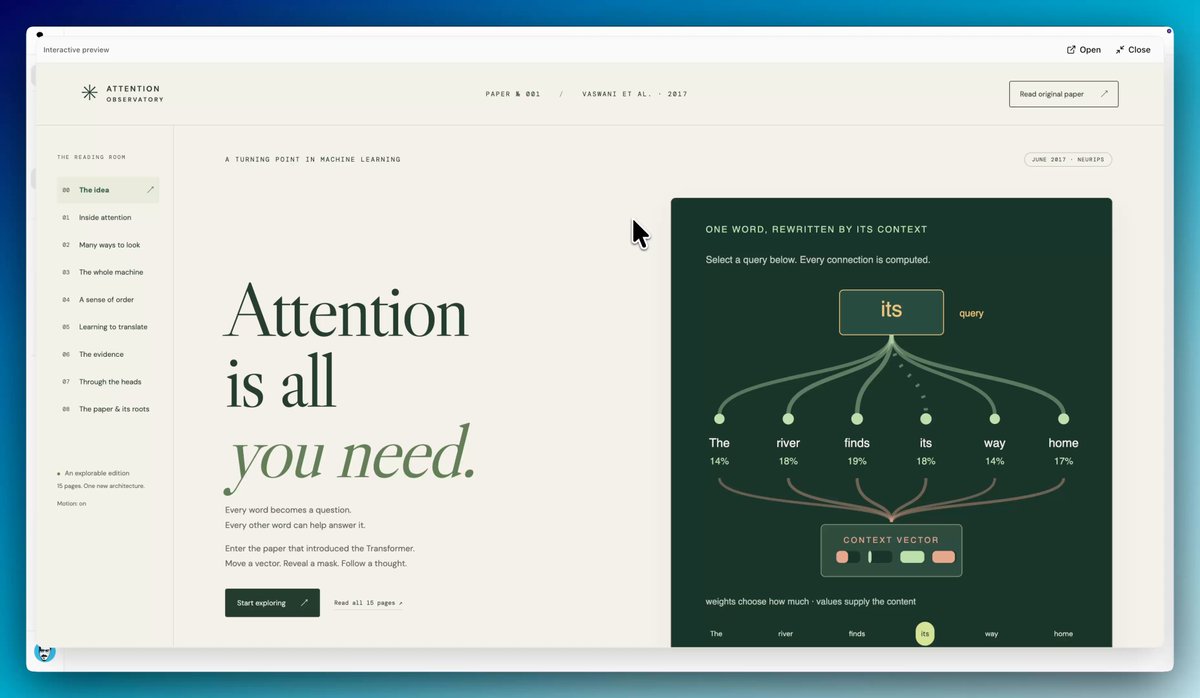
Building a personal knowledge base for my agents is increasingly where I spend my time these days. Like Andrej Karpathy, I also use Obsidian for my MD vaults. What's different in my approach is that I curate research papers on a daily basis and have actually tuned a Skill for months to find high-signal, relevant papers. I was reviewing and curating papers manually for some time, but now it's all automated as it has gotten so good at capturing what I consider the best of the best. There are so many papers these days, so this is a big deal. You all get to benefit from that with the papers I feature in my timeline and on DAIR.AI. The papers are indexed using tobi lutke qmd cli tool (all of it in markdown files along with useful metadata). So good for semantic search and surfacing insights, unlike anything out there. I am a visual person, so I then started to experiment with how to leverage this personal knowledge base of research papers inside my new interactive artifact generator (mcp tools inside my agent orchestrator system). The result is what you see in the clip. 100s of papers with all sorts of insights visualized. I keep track of research papers daily, so believe me when I tell you that this system is absolutely insane at surfacing insights. This is the result of months of tinkering on how to index research and leverage agent automations for wikification and robust documentation. But this is just the beginning. The visual artifact (which is interactive too) can be changed dynamically as I please. I can prompt my agent to throw any data at it. I can add different views to the data. Different interactions. I feel like this is the most personalized research system I have ever built and used, and it's not even close. The knowledge that the agents are able to surface from this basic setup is already extremely useful as I experiment with new agentic engineering concepts. I feel like this knowledge layer and the higher-level ones I am working on will allow me to maximize other automation tools like autoresearch. The research is only as good as the research questions. And the research questions are only as good as the insights the agents have access to. Where I am spending time now is on how to make this more actionable. I am obsessed about the search problem here. The automations, autoresearch, ralph research loop (I built one months ago) are easier to build but are only as good as what you feed them. Work in progress. More updates soon. Back to building.

Building a personal knowledge base for my agents is increasingly where I spend my time these days. Like Andrej Karpathy, I also use Obsidian for my MD vaults. What's different in my approach is that I curate research papers on a daily basis and have actually tuned a Skill for months to find high-signal, relevant papers. I was reviewing and curating papers manually for some time, but now it's all automated as it has gotten so good at capturing what I consider the best of the best. There are so many papers these days, so this is a big deal. You all get to benefit from that with the papers I feature in my timeline and on DAIR.AI. The papers are indexed using tobi lutke qmd cli tool (all of it in markdown files along with useful metadata). So good for semantic search and surfacing insights, unlike anything out there. I am a visual person, so I then started to experiment with how to leverage this personal knowledge base of research papers inside my new interactive artifact generator (mcp tools inside my agent orchestrator system). The result is what you see in the clip. 100s of papers with all sorts of insights visualized. I keep track of research papers daily, so believe me when I tell you that this system is absolutely insane at surfacing insights. This is the result of months of tinkering on how to index research and leverage agent automations for wikification and robust documentation. But this is just the beginning. The visual artifact (which is interactive too) can be changed dynamically as I please. I can prompt my agent to throw any data at it. I can add different views to the data. Different interactions. I feel like this is the most personalized research system I have ever built and used, and it's not even close. The knowledge that the agents are able to surface from this basic setup is already extremely useful as I experiment with new agentic engineering concepts. I feel like this knowledge layer and the higher-level ones I am working on will allow me to maximize other automation tools like autoresearch. The research is only as good as the research questions. And the research questions are only as good as the insights the agents have access to. Where I am spending time now is on how to make this more actionable. I am obsessed about the search problem here. The automations, autoresearch, ralph research loop (I built one months ago) are easier to build but are only as good as what you feed them. Work in progress. More updates soon. Back to building.

466,109 views

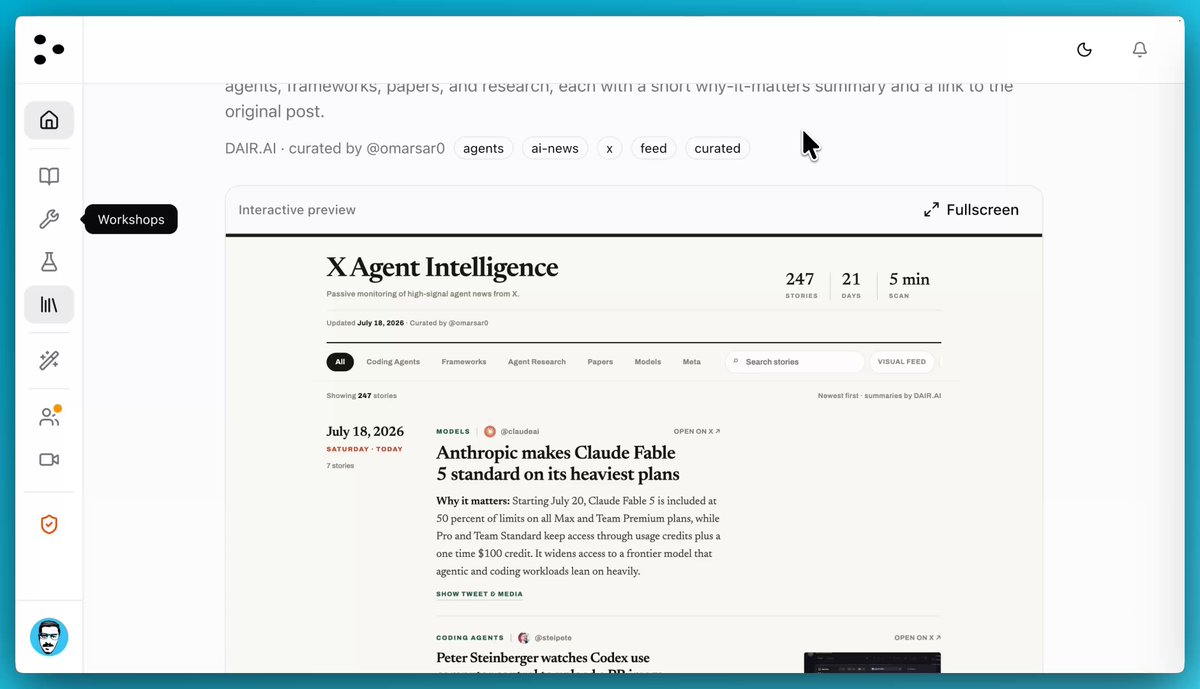
Sharing my new skill! It keeps track of high-signal X accounts for top AI news, papers, projects, etc. Total gamechanger for me. Built with X MCP tools. Give your agent the skill and tell it to generate the artifact with top stories. Works for Codex, Claude, Hermes, OpenClaw, or whatever you use. 3 steps: 1. Set up X MCP - X API: 2. Install skill here: 3. Run prompt: "Use the x-agent-intelligence skill to build a self-contained local feed from my X MCP connection; ask for my source handles if needed, save feed.html, and validate it." It should generate a nice, beautiful HTML artifact like the one shown in the clip. You can tune it however you want. You can then set a schedule/automation to do this daily or whatever cadence you prefer. I have it every 4 hours. You will need to curate the X accounts yourself, but I have shared a few good ones under the assets. You can ask your agent to tune it to however you like. I have also shared my personal feed with our community here: I understand if it gets tricky to set up. Please reach out to me in the community forum. I plan to do a little tutorial or live session soon to help others reproduce the process. You can also store the feed as a wiki, as I have in my own implementation, but that's optional. If you encounter any issues or have ideas on how to improve it, please open a PR.

Sharing my new skill! It keeps track of high-signal X accounts for top AI news, papers, projects, etc. Total gamechanger for me. Built with X MCP tools. Give your agent the skill and tell it to generate the artifact with top stories. Works for Codex, Claude, Hermes, OpenClaw, or whatever you use. 3 steps: 1. Set up X MCP - X API: 2. Install skill here: 3. Run prompt: "Use the x-agent-intelligence skill to build a self-contained local feed from my X MCP connection; ask for my source handles if needed, save feed.html, and validate it." It should generate a nice, beautiful HTML artifact like the one shown in the clip. You can tune it however you want. You can then set a schedule/automation to do this daily or whatever cadence you prefer. I have it every 4 hours. You will need to curate the X accounts yourself, but I have shared a few good ones under the assets. You can ask your agent to tune it to however you like. I have also shared my personal feed with our community here: I understand if it gets tricky to set up. Please reach out to me in the community forum. I plan to do a little tutorial or live session soon to help others reproduce the process. You can also store the feed as a wiki, as I have in my own implementation, but that's optional. If you encounter any issues or have ideas on how to improve it, please open a PR.

71,883 views

This blew up more than I expected. To minimize the negative impact of these changes, my orchestrator can now smoothly switch/handoff between any provider/model (e.g., fable 5 -> gpt-5-sol) Just one of the benefits of owning the harness & orchestrator.

This blew up more than I expected. To minimize the negative impact of these changes, my orchestrator can now smoothly switch/handoff between any provider/model (e.g., fable 5 -> gpt-5-sol) Just one of the benefits of owning the harness & orchestrator.

62,278 views

NEW favorite artifact. I read this every morning to catch up on AI news from high-signal X accounts. It's an HTML artifact that curates X posts using the X MCP tools. Composed by my research agents. I have a daily automation that goes through curated X accounts and captures AI papers, projects, and more. I feel like this is closer to the "For You" feed that we all want. Happy to share the artifact and automation instructions if anyone thinks it would be useful for them.

NEW favorite artifact. I read this every morning to catch up on AI news from high-signal X accounts. It's an HTML artifact that curates X posts using the X MCP tools. Composed by my research agents. I have a daily automation that goes through curated X accounts and captures AI papers, projects, and more. I feel like this is closer to the "For You" feed that we all want. Happy to share the artifact and automation instructions if anyone thinks it would be useful for them.

49,807 views

After a few more hours, I think I've figured out Opus 5. Opus 5 is trained to be more agentic than anything I've used. All Claude 5 models are like that. So what changes? The way to interact with Opus 5 or contextualize it won't work the same way as with other models. It loves exploring, so it doesn't need much guidance for it. Unique preferences, artifacts, and references compliment it well and enable cleaner and more effective exploration and execution. Now that it can explore more effectively on its own and understand intent better, the best thing to do is to get out of its way (e.g., it doesn't need examples of your preferences; a clear high-level description of it works best). It's truly agentic in that sense. A good first step to provide better context for Opus 5 is to distinguish between what's situational and what needs persistence. Regardless, persistent system prompts and CLAUDE.MD needs to stay lightweight. Remove memories and tool descriptions from these. CLAUDE.MD is also a great place to tap into progressive disclosure by linking command/skills to it. On the situational side, agent skills and auto-memory can leverage progressive disclosure and the improved ability of the model to use its external context/knowledge. Conflicting and unnecessary instructions, which are common at this layer (mainly to ensure reliability), are going to throw off this model easily. That's the biggest change I had to make. Simple, clean, and clear prompts and skills work best. I had to clean a lot of my skills and system prompts. The way I prompt remains the same (usually clear and well-scoped). MCP tool descriptions are also more descriptive and have been deduped from the system prompt. Anthropic released a guide on the new rules for context engineering, which was helpful here. I started to test the recommendations and created a little artifact with the things that worked along the way. This might feel like a lot of work. Believe me, it has been frustrating. But I think we can expect future frontier models to become more agentic and smarter at figuring out the right context/gaps. The best thing to do is to prepare for that now. Boris Cherny mentioned that Opus 5 is their least prompt-injectable model yet. I am not sure if that was something they intentionally trained for or if it emerged based on how it was trained, which is to be extremely agentic in nature and more direct in execution.

After a few more hours, I think I've figured out Opus 5. Opus 5 is trained to be more agentic than anything I've used. All Claude 5 models are like that. So what changes? The way to interact with Opus 5 or contextualize it won't work the same way as with other models. It loves exploring, so it doesn't need much guidance for it. Unique preferences, artifacts, and references compliment it well and enable cleaner and more effective exploration and execution. Now that it can explore more effectively on its own and understand intent better, the best thing to do is to get out of its way (e.g., it doesn't need examples of your preferences; a clear high-level description of it works best). It's truly agentic in that sense. A good first step to provide better context for Opus 5 is to distinguish between what's situational and what needs persistence. Regardless, persistent system prompts and CLAUDE.MD needs to stay lightweight. Remove memories and tool descriptions from these. CLAUDE.MD is also a great place to tap into progressive disclosure by linking command/skills to it. On the situational side, agent skills and auto-memory can leverage progressive disclosure and the improved ability of the model to use its external context/knowledge. Conflicting and unnecessary instructions, which are common at this layer (mainly to ensure reliability), are going to throw off this model easily. That's the biggest change I had to make. Simple, clean, and clear prompts and skills work best. I had to clean a lot of my skills and system prompts. The way I prompt remains the same (usually clear and well-scoped). MCP tool descriptions are also more descriptive and have been deduped from the system prompt. Anthropic released a guide on the new rules for context engineering, which was helpful here. I started to test the recommendations and created a little artifact with the things that worked along the way. This might feel like a lot of work. Believe me, it has been frustrating. But I think we can expect future frontier models to become more agentic and smarter at figuring out the right context/gaps. The best thing to do is to prepare for that now. Boris Cherny mentioned that Opus 5 is their least prompt-injectable model yet. I am not sure if that was something they intentionally trained for or if it emerged based on how it was trained, which is to be extremely agentic in nature and more direct in execution.

37,685 views

Been exploring a new way to explore AI research papers to discover deeper insights. Agents are at the center of it. So far, I've built this little interactive artifact generator in my orchestrator to visualize things. This allows me to change views and insights (on-demand) from 100s of papers. Just scratching the surface here. More to share soon.

Been exploring a new way to explore AI research papers to discover deeper insights. Agents are at the center of it. So far, I've built this little interactive artifact generator in my orchestrator to visualize things. This allows me to change views and insights (on-demand) from 100s of papers. Just scratching the surface here. More to share soon.

141,678 views

As an ML Engineer, this is one of the most useful applications of GPT-4 I've seen. Chat Explore is a powerful AI-powered data exploration tool. Here’s why I am so impressed:

As an ML Engineer, this is one of the most useful applications of GPT-4 I've seen. Chat Explore is a powerful AI-powered data exploration tool. Here’s why I am so impressed:

716,725 views

Dynamic workflows are a generalization of harnesses, automations, loops, routing, and graphs. It's the most powerful feature I have built into my agent orchestrator. Supports all kinds of patterns that leverage different agent backends (claude, codex, pi, hermes,...). It's a meta-harness approach that unlocks new forms of test-time compute. Example of use cases it supports: > LLM councils to get different perspectives from LLMs or plan more intensively > Dynamically routing tasks to different agents based on needs (e.g., cost efficiency and optimal intelligence) > Advisor/Judge + executor workflows and pretty much any complex graph-based pattern required by the task. I find it especially useful for long-running work and code reviewing. > Agent teams that talk to each other if needed for the task. I like to use this for AI editing, artifact creation, and other creative tasks. And I am sure it supports so many things that I haven't discovered yet. I got inspired by the dynamic workflow feature released by the Claude Code team. I had actually built it earlier this year but wanted to generalize it across different agent backends. I think this is going to become more popular in the coming days. I will share more of my findings soon.

Dynamic workflows are a generalization of harnesses, automations, loops, routing, and graphs. It's the most powerful feature I have built into my agent orchestrator. Supports all kinds of patterns that leverage different agent backends (claude, codex, pi, hermes,...). It's a meta-harness approach that unlocks new forms of test-time compute. Example of use cases it supports: > LLM councils to get different perspectives from LLMs or plan more intensively > Dynamically routing tasks to different agents based on needs (e.g., cost efficiency and optimal intelligence) > Advisor/Judge + executor workflows and pretty much any complex graph-based pattern required by the task. I find it especially useful for long-running work and code reviewing. > Agent teams that talk to each other if needed for the task. I like to use this for AI editing, artifact creation, and other creative tasks. And I am sure it supports so many things that I haven't discovered yet. I got inspired by the dynamic workflow feature released by the Claude Code team. I had actually built it earlier this year but wanted to generalize it across different agent backends. I think this is going to become more popular in the coming days. I will share more of my findings soon.

32,623 views

This is insane! 🤯 Just built a new skill in Claude Code using Opus 4.5. The skill uses Gemini 3 Pro (via API) for designing web pages. Look at what it generated from one simple prompt.

This is insane! 🤯 Just built a new skill in Claude Code using Opus 4.5. The skill uses Gemini 3 Pro (via API) for designing web pages. Look at what it generated from one simple prompt.

152,981 views

New open-source agent harness just landed! I got early access to TrueForge by TrueFoundry and have been running it locally for the past few days. The harness layer deserves as much attention as the model, and open source matters here because you can inspect the loop, run it on your own infrastructure, and swap to the latest or cheaper models. TrueForge handles the runtime work that makes an agent reliable. It drives the tool-calling loop, manages context, coordinates subagents, and executes code in a sandbox, with any model you choose. Every tool call re-sends the growing context to the model, so in practice the harness controls most of what an agent costs to run. A few things stood out from my testing and their published benchmarks. Vendor-Neutral by design. It runs OpenAI, Anthropic, and Google models alongside open-weight models like Kimi, GLM, and DeepSeek. Model routing is a setting, and you can send each task to the model that fits it. On a 14-task enterprise agent benchmark, it matched the accuracy of Claude Managed Agents running the same Opus 4.8 model at roughly 30% lower cost per run (3.8M tokens vs 10M for the same answers). Routing the same tasks to GLM-5.2 held accuracy and brought cost down by about 75%, around $3 per run instead of $12. Fully self-hosted and Open Source (MIT License). I had it running locally with one command, with sandboxed code execution working out of the box. It's time to own your agent harness. Thanks to TrueFoundry for partnering on this post.

New open-source agent harness just landed! I got early access to TrueForge by TrueFoundry and have been running it locally for the past few days. The harness layer deserves as much attention as the model, and open source matters here because you can inspect the loop, run it on your own infrastructure, and swap to the latest or cheaper models. TrueForge handles the runtime work that makes an agent reliable. It drives the tool-calling loop, manages context, coordinates subagents, and executes code in a sandbox, with any model you choose. Every tool call re-sends the growing context to the model, so in practice the harness controls most of what an agent costs to run. A few things stood out from my testing and their published benchmarks. Vendor-Neutral by design. It runs OpenAI, Anthropic, and Google models alongside open-weight models like Kimi, GLM, and DeepSeek. Model routing is a setting, and you can send each task to the model that fits it. On a 14-task enterprise agent benchmark, it matched the accuracy of Claude Managed Agents running the same Opus 4.8 model at roughly 30% lower cost per run (3.8M tokens vs 10M for the same answers). Routing the same tasks to GLM-5.2 held accuracy and brought cost down by about 75%, around $3 per run instead of $12. Fully self-hosted and Open Source (MIT License). I had it running locally with one command, with sandboxed code execution working out of the box. It's time to own your agent harness. Thanks to TrueFoundry for partnering on this post.

11,303 views

I just built my own wiki generator plugin for my agents. My agents can now generate wikis for anything I ask. One of my favorite wikis is called PaperWiki. This is a great example of what Andrej Karpathy describes. It uses obsidian vaults to organize papers, retrieve LLM-generated summaries, diagrams, and other advanced views for paper exploration. When Obsidian UI is not enough, I use my own artifact generator inside my agent orchestrator (see clip for example). This allows my agents to build any kind of view or exploration feature that I need. The papers are all curated with automations and several rules/patterns I have manually built over the years. On the surface, this looks basic. But behind the scenes, there are advanced search capabilities, connections, metadata, derived data, and other interesting bits of information that are extremely useful for my research agents. This is mostly built for agents. The artifact preview is just a high-level way to validate and quickly assess the quality of the wiki, suggest improvements, and it's also great for research. I use tobi lutke's qmd for all search capabilities. Everything is markdown. The summaries and even the diagrams. The wiki updates on its own based on several automations I have optimized over the past couple of weeks. The wiki grows and self-improves based on several requirements important for my research use cases. This is as personalized as it gets. There is nothing like it out there. And I use my research expertise to continue improving it over time. This is a vanilla wiki. There are so many things I want to build on top of this. Different aggregations, views, artifacts, etc. All to help automate more of my research work and accelerate productivity. I think the biggest leverage here is how powerful this could be for discovery and experimentation. One of my goals is to use it to find deeper connections and insights that would otherwise elude the top human researchers and use those to generate interesting new hypotheses and research experiments. That way, my agents can use autoresearch to explore research ideas at the frontier. Stay tuned for more.

I just built my own wiki generator plugin for my agents. My agents can now generate wikis for anything I ask. One of my favorite wikis is called PaperWiki. This is a great example of what Andrej Karpathy describes. It uses obsidian vaults to organize papers, retrieve LLM-generated summaries, diagrams, and other advanced views for paper exploration. When Obsidian UI is not enough, I use my own artifact generator inside my agent orchestrator (see clip for example). This allows my agents to build any kind of view or exploration feature that I need. The papers are all curated with automations and several rules/patterns I have manually built over the years. On the surface, this looks basic. But behind the scenes, there are advanced search capabilities, connections, metadata, derived data, and other interesting bits of information that are extremely useful for my research agents. This is mostly built for agents. The artifact preview is just a high-level way to validate and quickly assess the quality of the wiki, suggest improvements, and it's also great for research. I use tobi lutke's qmd for all search capabilities. Everything is markdown. The summaries and even the diagrams. The wiki updates on its own based on several automations I have optimized over the past couple of weeks. The wiki grows and self-improves based on several requirements important for my research use cases. This is as personalized as it gets. There is nothing like it out there. And I use my research expertise to continue improving it over time. This is a vanilla wiki. There are so many things I want to build on top of this. Different aggregations, views, artifacts, etc. All to help automate more of my research work and accelerate productivity. I think the biggest leverage here is how powerful this could be for discovery and experimentation. One of my goals is to use it to find deeper connections and insights that would otherwise elude the top human researchers and use those to generate interesting new hypotheses and research experiments. That way, my agents can use autoresearch to explore research ideas at the frontier. Stay tuned for more.

67,257 views

The hard part of multi-agent systems is getting agents to stay quiet. Put five agents on one task, and they duplicate work and burn tokens talking to each other. Offloop trained a dispatcher model called D1 that decides which agent moves next and when the right move is to do nothing. They achieve state-of-the-art performance on GDPval at a fraction of the usual cost. You can bring your own AI subscription.

The hard part of multi-agent systems is getting agents to stay quiet. Put five agents on one task, and they duplicate work and burn tokens talking to each other. Offloop trained a dispatcher model called D1 that decides which agent moves next and when the right move is to do nothing. They achieve state-of-the-art performance on GDPval at a fraction of the usual cost. You can bring your own AI subscription.

22,116 views

Just built an insane new agent skill. It can perfectly extract slides from YT videos, then write notes, images, transcripts, and slides into Obsidian vaults. An HTML artifact allows me to navigate and add more notes as I listen. Should I release the skill?

Just built an insane new agent skill. It can perfectly extract slides from YT videos, then write notes, images, transcripts, and slides into Obsidian vaults. An HTML artifact allows me to navigate and add more notes as I listen. Should I release the skill?

45,987 views

I just open-sourced my /learn skill. Learn anything with agents and HTML artifacts. I have been learning about all kinds of topics with it. Install the skill and interact with any agent to help you through any topic. Ask it to generate visual and interactive artifacts and help you go deeper or generate knowledge checks (e.g., quizzes). Upskilling myself on any topic is one of the most impactful ways I have been able to use AI agents. If you are a DAIR Academy pro member, you can use it with our AI Builder. Skill: Try now:

I just open-sourced my /learn skill. Learn anything with agents and HTML artifacts. I have been learning about all kinds of topics with it. Install the skill and interact with any agent to help you through any topic. Ask it to generate visual and interactive artifacts and help you go deeper or generate knowledge checks (e.g., quizzes). Upskilling myself on any topic is one of the most impactful ways I have been able to use AI agents. If you are a DAIR Academy pro member, you can use it with our AI Builder. Skill: Try now:

35,136 views

Increasingly, HTML Artifacts are becoming a core part of how I work with AI agents. Long-horizon agent sessions need a better way to surface insights about what work it has done. This may not be obvious right now, but as you start to let your agent work on dynamic workflows, large codebases, long-running loops (e.g., using /goal), and deep research tasks, you need a good way to present results. Chat window is not it. You also don't want to just trust everything the agents do. Artifacts help provide an important verification layer, which in turn enables important decision-making. I like HTML artifacts because I can just ask the agent to produce as many of them (and in whatever form) as I need to verify the work and make sense out of everything. I even built a nice tab system for my artifacts. They are great for continual learning and research. I use HTML artifacts for logging, tracking experiments, brainstorming, managing my inbox, code reviews, agent session management, deep research, writing, reading, and so much more. I believe Andrej Karpathy wrote about this somewhere: As we move on to more advanced applications of AI agents and outputs get more complex, we will start to find the need for even more advanced forms of interactions with AI, including interactive neural videos/simulations.

Increasingly, HTML Artifacts are becoming a core part of how I work with AI agents. Long-horizon agent sessions need a better way to surface insights about what work it has done. This may not be obvious right now, but as you start to let your agent work on dynamic workflows, large codebases, long-running loops (e.g., using /goal), and deep research tasks, you need a good way to present results. Chat window is not it. You also don't want to just trust everything the agents do. Artifacts help provide an important verification layer, which in turn enables important decision-making. I like HTML artifacts because I can just ask the agent to produce as many of them (and in whatever form) as I need to verify the work and make sense out of everything. I even built a nice tab system for my artifacts. They are great for continual learning and research. I use HTML artifacts for logging, tracking experiments, brainstorming, managing my inbox, code reviews, agent session management, deep research, writing, reading, and so much more. I believe Andrej Karpathy wrote about this somewhere: As we move on to more advanced applications of AI agents and outputs get more complex, we will start to find the need for even more advanced forms of interactions with AI, including interactive neural videos/simulations.

37,016 views

Routing for long-horizon coding agents is a big deal. Not Diamond just announced a model router that works natively with Claude Code. This is huge. It picks the model and reasoning effort before each turn in a session, runs through a privacy-preserving local proxy, and your requests still execute through your own gateway. In their benchmarks, it approximates Opus 4.8 Xhigh quality at 39 to 61 percent lower cost.

Routing for long-horizon coding agents is a big deal. Not Diamond just announced a model router that works natively with Claude Code. This is huge. It picks the model and reasoning effort before each turn in a session, runs through a privacy-preserving local proxy, and your requests still execute through your own gateway. In their benchmarks, it approximates Opus 4.8 Xhigh quality at 39 to 61 percent lower cost.

13,699 views

We are entering an extremely exciting era for open-weight models. Kimi K2.6 now feels like a top agentic model. I took it for a spin via Fireworks AI fast inference APIs. Kimi K2.6 has impressive agentic capabilities, design skills, and the ability to synthesize large amounts of information. I built a little Skill that produces survey papers on any AI research topic you want. (see example in the clip) You can use the skill to tell your agent to generate a survey on whatever topic and watch it go to work. The artifact was fully generated by Kimi.ai's Kimi K2.6. It's cheap and fast. Next step for me is to explore ways to continue integrating the capabilities of these models on use cases like automating my LLM knowledge bases and augmenting my agent memory capabilities. Stay tuned for more.

We are entering an extremely exciting era for open-weight models. Kimi K2.6 now feels like a top agentic model. I took it for a spin via Fireworks AI fast inference APIs. Kimi K2.6 has impressive agentic capabilities, design skills, and the ability to synthesize large amounts of information. I built a little Skill that produces survey papers on any AI research topic you want. (see example in the clip) You can use the skill to tell your agent to generate a survey on whatever topic and watch it go to work. The artifact was fully generated by Kimi.ai's Kimi K2.6. It's cheap and fast. Next step for me is to explore ways to continue integrating the capabilities of these models on use cases like automating my LLM knowledge bases and augmenting my agent memory capabilities. Stay tuned for more.

47,678 views

LLM Knowledge Base → Slides When Andrej Karpathy shared his LLM Knowledge Base setup, many were wondering how to generate more visual forms of the wiki. There are many options, but I think Gamma is one of the best at producing high-quality, rich presentations. To showcase this, I just built a pipeline that turns my AI papers wiki (1K+ papers across 20 AI agent topics) into polished slide presentations using Gamma. The flow: Obsidian vault → Gamma MCP → embedded preview in my dashboard. I give one command to my agent, which pulls the top papers from each topic (via the wiki), feeds them to Gamma, and renders the presentation inline. The Gamma connector for Claude is a great choice for generating beautiful and professional slides. Easy to use. Go to your Claude instance and add the official Gamma connector. That's it! Claude Code will now have access to all the necessary MCP tools for generating slides. I use the Claude Agent SDK for my agent orchestrator, so I use the official Gamma MCP tools and embed the generated slides in an iframe via my artifact preview. See the clip below for an example.

LLM Knowledge Base → Slides When Andrej Karpathy shared his LLM Knowledge Base setup, many were wondering how to generate more visual forms of the wiki. There are many options, but I think Gamma is one of the best at producing high-quality, rich presentations. To showcase this, I just built a pipeline that turns my AI papers wiki (1K+ papers across 20 AI agent topics) into polished slide presentations using Gamma. The flow: Obsidian vault → Gamma MCP → embedded preview in my dashboard. I give one command to my agent, which pulls the top papers from each topic (via the wiki), feeds them to Gamma, and renders the presentation inline. The Gamma connector for Claude is a great choice for generating beautiful and professional slides. Easy to use. Go to your Claude instance and add the official Gamma connector. That's it! Claude Code will now have access to all the necessary MCP tools for generating slides. I use the Claude Agent SDK for my agent orchestrator, so I use the official Gamma MCP tools and embed the generated slides in an iframe via my artifact preview. See the clip below for an example.

47,989 views

Simplicity is at the heart of great software. This is one of the reasons why Claude Code has been sticky for me. As a builder, I love planning and brainstorming, and this is now a key focus of Claude Code. I use Shift + Tab a lot to cycle between brainstorming, planning, and execution. This functionality provides the appropriate interface for me to either be very involved or less involved as I please. This works particularly well when building out new and complex features or entire new projects. This saves a huge amount of time. It allows me to tune Claude Code to execute and build more effectively. It also builds a loop of trust, and I often (surprisingly) find Claude Code asking for clarifications when it's confused. Coding agents don't normally do that. I have shared before on the power of brainstorming with AI for longer times. Try it and you will not be disappointed. Vibe coding is fun, but pair it with intentional development cycles, and you watch how far you can take a project with coding agents today.

Simplicity is at the heart of great software. This is one of the reasons why Claude Code has been sticky for me. As a builder, I love planning and brainstorming, and this is now a key focus of Claude Code. I use Shift + Tab a lot to cycle between brainstorming, planning, and execution. This functionality provides the appropriate interface for me to either be very involved or less involved as I please. This works particularly well when building out new and complex features or entire new projects. This saves a huge amount of time. It allows me to tune Claude Code to execute and build more effectively. It also builds a loop of trust, and I often (surprisingly) find Claude Code asking for clarifications when it's confused. Coding agents don't normally do that. I have shared before on the power of brainstorming with AI for longer times. Try it and you will not be disappointed. Vibe coding is fun, but pair it with intentional development cycles, and you watch how far you can take a project with coding agents today.

81,765 views

Videos

omarsar0's profile picture

LLM Wikis are being slept on. I argue that creating knowledge bases with LLMs or coding agents is one of the most valuable applications of AI today. It's about being intentional in building and scaling your intelligence stack. To showcase this, I wanted to share an LLM Wiki I have built over the last couple of months. It's called PaperWiki, and I use it across all my research workflows, along with my research agents. In fact, I also use it to curate papers I share with my communities, newsletter, and on X. The PaperWiki is updated regularly with automations, so I basically have agents on a loop maintaining it. All the entries are ingested from different sources and stored in a vault (Obsidian) and further indexed using qmd. And then further presented via an HTML artifact. So all of it is easily accessible to all my agents and easily searchable through full-text search and rich semantic search. The structure of the wiki has proven significantly useful to start interesting and exciting cutting-edge research projects with my research agents (from building tiny and more efficient gpt/difussion llms to building out SoTA harnesses and memory systems). It turns out that agents love markdown files and can more easily navigate the papers given the rich metadata structure of the wiki. I am just getting started on this, but it's clear to me that we should all be experimenting with LLM Wikis. Here's why: Building LLM knowledge bases gets you into the habit of leveraging AI outputs in all kinds of creative ways. It's the good kind of tokenmaxxing we should all be pushing for. LLM Wikis can be maintained automatically in a loop. I use an automation that updates the wiki every day based on papers I curate. The curation is another automation I run in a loop (with a bit of human in the loop), so I get to build on all my previous knowledge and expertise, and all of it compounds the deeper the integration/layers. One interesting result of this process is that I feel like I can better spot high-quality papers and remove noise more easily. Social media could never solve that. And most paper aggregators use metrics I simply don't trust. I like that agents can help with the noise vs. signal problem. This is important for research. Lots of people consider agents to produce mostly slop. But it doesn't have to be that way. Careful curations, prompts, automations, verifiers, and human-in-the-loop can produce some astonishing results. And you really don't need frontier models for this. I use a combination of frontier models (opus-4.8) and open-weight models (deepseek-v4-flash) to maintain this. An exciting future work (we are working on this DAIR.AI) is to tune specialized models on top of this to allow LLMs to quickly understand cutting-edge research ideas and can better conceptualize research strategies that further accelerate scientific research agents. I plan to open-source a bunch of this work, including the artifact, but this is currently work in progress, and I was excited to share some thoughts as I continue working on it. Sharing more as I go. Stay tuned!

elvis

55,747 views • 2 months ago