
Mr. Buzzoni
@polydao • 26,488 subscribers
AI dev • co-founder @polynternet • Building in progress
Shorts


Videos

Claude Code tip: once Opus 5.5 is your main model, stop letting your Fable 5.1 quota go to waste put it on call with /advisor run /advisor fable Opus 5.5 keeps doing the work Fable 5.1 sits on the sidelines, reads the whole session, and steps in at three moments: → before a plan: is this right? → when the same error comes back: am I going the wrong way? → before "done": did I miss anything? Fable 5.1 advises. Opus 5.5 writes the code the same idea sits under Jev engineering: the expensive model stops weighing in on every step and only gets called at the moments that change the outcome • the full setup > Opus 5.5 on high runs the main session > subagent one reads code > subagent two edits and runs tests > subagent three looks up docs > all three on medium > Fable 5.1 on call hand the tree and this prompt to Claude Code 👇 "Set up my Claude Code to match this tree: 1. Reuse fitting subagents from ~/.claude/agents and .claude/agents. > Propose new ones only for missing roles > Set each to model: opus, effort: medium > Leave any that set a different model alone and list them 2. Set main session effort to high via effortLevel in ~/.claude/settings.json 3. Check for env vars that disable the advisor (CLAUDE_CODE_DISABLE_ADVISOR_TOOL, DISABLE_TELEMETRY, anything that stops flag fetching) and CLAUDE_CODE_EFFORT_LEVEL, which overrides subagent effort. Report them, don't change them 4. Add a rule to ~/.claude/CLAUDE.md: ask the advisor before a big plan, when an error repeats, and before calling a long task done Show me the changes first. Don't edit files yet." ↳
Mr. Buzzoni324,943 views • 20 days ago
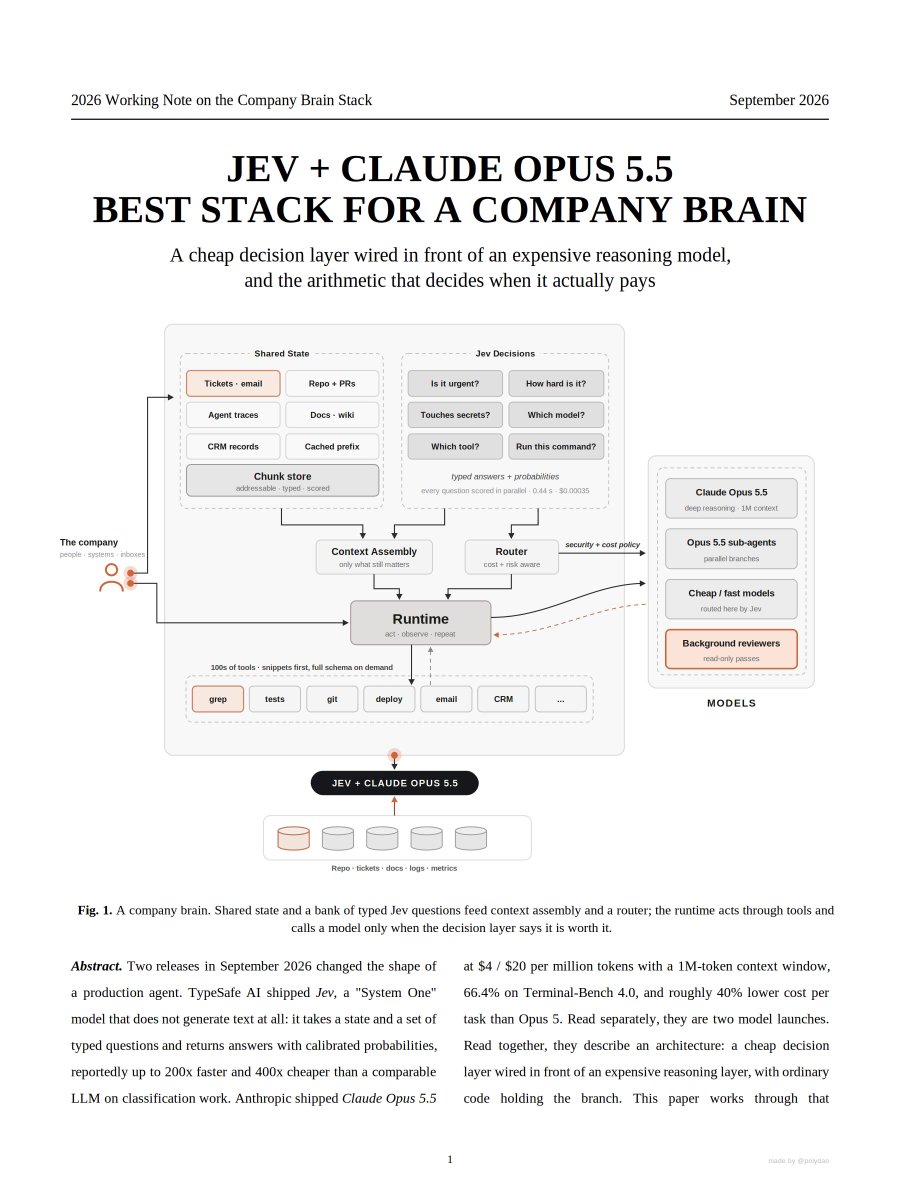
JEV + OPUS 5.5 IS INSANE FOR BUILDING A COMPANY BRAIN I pulled the whole architecture out of the TypeSafe and Anthropic docs and packed it into a 14-page PDF the 10 steps: 1. meet the pair > Opus 5.5 thinks, Jev decides, your code holds the branch 2. stop asking a text generator for a yes or no > Jev returns a typed answer with a calibrated probability in 0.44s for $0.00035 3. ask everything at once > Choice, Score and Noul run in parallel, so the fourth question costs almost nothing 4. branch on the number > 0.999 goes straight into the if statement. ~99% of turns end right here 5. stop routing blind > Opus 5.5 to Sonnet and back costs 5.84 against 3.32 for staying on 5.5 6. keep one context warm > cache reads at $0.20 per Mtok are 20x cheaper than a fresh load 7. escalate the hard part > the toughest 1% goes to Opus 5.5 with 1M context and 66.4% on Terminal-Bench 4.0 8. score every chunk on every query > keep whole, summarize or drop. the context gets rebuilt each turn 9. gate the actual command > every bash call gets classified before it runs, inside your own code 10. judge 100% of runs > $3.50 a day for 10,000 traces, and it matched the human label on all 500 decisions the result: a while loop that paid a frontier model for every tiny call turns into a brain that spends a fraction of a cent to notice and pays properly only when it has to think the person who brings this into their team walks into the budget meeting with the AI bill cut and the output up the PDF maps the company brain. the loop side of it - how Jev takes a Claude bill from $765 to $3 a month - is in the article below ↓
Mr. Buzzoni103,282 views • 20 days ago

I STOPPED LETTING CLAUDE MAKE DECISIONS THE DAY I BUILT THIS JEV AGENT FOLDER I used to let Claude decide, write and act on every single step -> now Claude only writes. Jev makes the calls, code does the acting, and every step leaves a receipt here's what's inside the folder: • the input > AGENTS.md - when to call Jev, when to skip it > state/build_state.py - goal, workers, done, missing, constraint. evidence, never a summary • Jev decides (questions/) > - which model tier gets the task > next_worker.py - which worker acts next > - keep or drop each tool output > - is the goal actually met > - does this send, pay or delete? • code acts (rules/) > hard_rules.py - stop after ten actions, never publish unapproved > thresholds.yaml - act only on confident answers. fraud needs 0.95 • Claude writes (workers/) > - sources and notes > - drafts and briefings > the only place in the whole folder where text gets generated • the proof > receipts/decisions.jsonl - options offered, chosen id, re-check, fallback > evals/ - dozens of my own labelled traces, thresholds tuned on them • the guards (hooks/) > pre_tool_use.sh - every command checked before it runs > - checks "all done" before the agent is allowed to stop 10,000 decisions for $0.42. median 300 ms an LLM writes, Jev decides, code acts
Mr. Buzzoni79,984 views • 21 days ago

This girl from IBM explained how Claude works better than most AI engineers could in 8 minutes > search used to match words, not meaning > then AI learned to understand intent > then RAG gave LLMs external memory - so they could read your documents > then agents arrived - now the AI decides what to search, when, and why the hardest part of AI isn't generating the answer it's knowing what to look at first full video above
Mr. Buzzoni532,347 views • 5 months ago

Vasilios Syrakis is back after the massive success of his Atlassian video, he just dropped a follow-up addressing everything the stuff people really wanted to know: > no university degree, dropped out after 10th grade, started in help desk > taught himself everything from scratch - books, videos, no mentor > he didn't break any NDA - Atlassian published more detailed info themselves > the architecture was 10 years old - he'd build it completely differently today and the thing that hit hardest: > to everyone who felt impostor syndrome watching his first video - he said the gap between you and someone who knows more is usually just time, not intelligence the full response is above and he's building a control plane from scratch on camera soon so you can see exactly how it's done
Mr. Buzzoni394,361 views • 5 months ago

I HAVEN'T OPENED CLAUDE AT MIDNIGHT SINCE I BUILT THIS FOLDER I used to wake up and find out what broke overnight -> now the receipts are already there. dated, graded, waiting on my review what sits inside the folder that took that shift: • the contract > CONTRACT.md - the shift rules, committed > contract.local.md - my overrides, gitignored • the harness (.claude/loops/) > settings.json - spend caps and timeouts. set once > schedule.yml - 05:00, pr-hunter. cron fires it, not me > rubrics/ - code.md reviews merges, writing.md checks voice, safety.md says what not to touch > pr-hunter/ - plan.md runs wake, read, act, verify > does the work. is the gate to merge > tools.allow - what it may call, and nothing else • the state > receipts/ - one folder per shift. 17 shifts today > 5,382 receipts kept. none of them edited > trace.log - what happened, line by line > checkpoint.json - resumes exactly where it stopped > budget.json - $6.10 spent of a $40 day • the edges > - the panic file. never used > .mcp.json - the tools it's allowed near > alerts.yml - who gets paged when a loop stops 2 loops. 3 rubrics. 8 months in service. 0 incidents nothing here is clever. every file exists because a run went sideways once I wrote the rule down instead of trying to remember it $6 a day for a shift I used to work at 1am the model doesn't wake. the folder does
Mr. Buzzoni70,843 views • 26 days ago

KARPATHY JUST DROPPED 2 HOURS OF BRUTAL HONESTY ABOUT AI > we're nowhere near real autonomous agents - including Claude Opus 4.8 > AGI will blend into daily life and nobody will notice > he quit AI research to fix education. that's the problem he thinks matters more save this👇
Mr. Buzzoni329,550 views • 4 months ago

Claude Code tip: before you ship a vibe-coded site, let Opus 5.5 send 𝟱 𝘀𝘂𝗯𝗮𝗴𝗲𝗻𝘁𝘀 through 𝘁𝗵𝗲𝘀𝗲 𝟮𝟬 𝗰𝗵𝗲𝗰𝗸𝘀 and fix everything in one pass: 1. design that holds together • write a DESIGN file first and tie every color, font size, spacing and radius to it • keep the palette tight and the type hierarchy clear • same kind of button, card or input = same look • flat page? add emphasis. crowded page? cut • text stays readable on dark and light backgrounds 2. mobile • nothing scrolls sideways or spills off screen • add a real mobile menu • buttons big enough for a thumb • the layout survives enlarged text 3. every state • loading, empty and error each get a proper screen • every button gets its own hover, pressed and disabled look • form errors show up next to the field, plus submitting, success and failure messages • modals, dropdowns and tabs switch with transitions 4. click it like a real user • run sign-up and checkout from start to finish • hunt down dead buttons and broken links • make sure the whole site works with just a keyboard 5. pre-launch • the home page says what you do in one line • each page gets one main button • every page has a title, a description and a favicon • delete every bit of placeholder text on effort: Anthropic's cost guide puts medium on well-scoped daily work, so the default covers these 20 fixes raise it only for the hard ones - Thariq's tests showed higher effort mostly buys extra verification and edge-case testing paste this whole post into Claude Code and add this at the end 👇 "Run a pre-ship check on this repo. You: main session, Opus 5.5, medium effort. Spawn 5 read-only subagents, one per group: design (medium) - DESIGN file, styles/globals.css, tailwind.config.ts, components/ui/ mobile (medium) - app/layout.tsx, components/nav/, every page at 375px states (medium) - components/forms/, every loading, empty and error view real user (high) - app/signup/, app/checkout/, every link and button launch (medium) - app/page.tsx, page metadata, public/favicon.ico Each subagent: - checks only its group - edits nothing - returns issue, file:line, severity Then: 1. merge all five lists into .claude/preship/issues.json, grouped by file, no duplicates 2. stop and show me the list - no edits until I confirm 3. after I confirm, fix everything yourself in one pass, so no two agents touch the same file 4. save before and after screenshots to .claude/preship/screens/"
Mr. Buzzoni38,930 views • 15 days ago

> do you understand what Claude Opus 4.8 just did to the Google job market > a senior Google engineer with 11 years of experience > stacked 32 Claude skills on top of his workflow > 8hrs → 2-3hrs per day > $95K developer vs $300K AI architect > same job. different stack. very different salary > the exact skill list is here 👇
Mr. Buzzoni288,237 views • 4 months ago

CLAUDE + OBSIDIAN + LOOP ENGINEERING = A VAULT THAT RUNS ITSELF the core idea: the loop keeps its state in the vault, so the chat window can close anytime everything Claude knows lives in a markdown file the loop: > capture - a thought lands in 00-inbox > context - Claude Opus 5.5 pulls the links, tags and neighbouring notes > draft - edits happen in a git worktree, the live vault stays untouched > review - a critic agent reads the diff before anything ships > commit - appended to the vault, nothing overwritten the key insight: frontmatter fields like supports, contradicts and supersedes act as graph edges. the note format is the write API start with a plain loop. it costs roughly 2-4x a single direct call upgrade to a full graph only when state has to outlive the session, several agents need to coordinate, or you need to explain what changed. that step can run 10-50x one review assistant went 55% -> 72% -> 84% by walking through these shapes in order worth stealing even if you never build a graph: the review step most vaults skip it and let Claude write straight into live notes the mistakes stack up for months before anyone notices put that gate in first
Mr. Buzzoni29,941 views • 12 days ago


CLAUDE + OBSIDIAN + LOOP ENGINEERING = A VAULT THAT RUNS ITSELF the core idea: the vault is the loop's state, not the chat window everything Claude knows lives in a .md file the loop: > capture - a thought lands in 00-inbox > context - claude pulls links, tags, and neighbouring notes > draft - edits happen inside a git worktree, never the live vault > review - a critic agent checks the diff before anything ships > commit - appended to the vault, nothing gets rewritten the key insight: frontmatter fields like supports, contradicts, and supersedes are graph edges, not metadata - the note format is the write API start with a plain loop, it runs about 2-4x the cost of one direct call > only move to a full graph once state has to outlive the session, several agents need to coordinate, or you have to explain what changed - that jump can run 10-50x one review assistant climbed from 55% to 72% to 84% just by moving through these shapes in order
Mr. Buzzoni137,015 views • 2 months ago

Jane Street needed a 4,032 GPU liquid-cooled data center just to run their trading models > that tells you everything about how much money this firm makes and why their quants start at $400K/year someone just got inside and filmed it > custom AI and trading agents trained specifically for this firm - off-the-shelf doesn't cut it > packets processed in under 100 nanoseconds > copper over fiber because electrons beat light at that scale > automated kill switches to shut algorithms down before downtime costs millions > financial privacy of their positions is protected at infrastructure level - nothing leaks 20 years ago their cluster was 6 Dell boxes on an office floor > this is the machine now what do you think - is this level of infrastructure even possible for smaller firms?
Mr. Buzzoni241,851 views • 5 months ago


NVIDIA is giving away free access to 130+ AI models for a full year > most people building AI agents are paying $50-200/month for API access NVIDIA just made that argument irrelevant models you get: MiniMax M2.7, GLM 5.1, Kimi 2.5, DeepSeek-v4-flash, GPT-OSS-120B and 110+ more setup: > step 1 - get your free key > go to > register -> bind phone -> copy API key > step 2 - add to Hermes agent > open Settings -> Model Provider -> Custom base_url = " api_key = "nvapi-xxxxxxxxxxxxxxxxxxxx" > step 3 - pick a model model = "minimaxai/minimax-m2.7" model = "zhipuai/glm-5.1" model = "moonshot-ai/kimi-2.5" model = "deepseek-ai/deepseek-v4-flash" model = "nvidia/nemotron-3-ultra-550b-a55b" > Hermes already has NVIDIA set as default base_url > paste the key and you're running instantly > works the same in Cursor and OpenCode > cost: $0 > limit: 40 req/min > expires: 1 year while everyone is paying for API access, this is sitting there for free
Mr. Buzzoni196,730 views • 4 months ago

CLAUDE + JEV ENGINEERING = THE HARNESS SKILL THAT GETS AI ENGINEERS PROMOTED IN 2026 1,000 decisions on a cold frontier model cost $605 the same 1,000 through this harness cost $0.17 the core idea: Claude proposes, Jev answers, code decides every step leaves a receipt the loop: > propose - Claude writes plans and patches, and decides nothing > filter - code drops the routes your machine can't run before Jev ever sees them > answer - Jev picks from code's menu with a probability, or abstains > re-check - code checks the pick against live state. stale goes to fallback > act - the tool runs through the normal approval path > receipt - every step logged and replayable against a new policy the numbers: > 0.2s median per call > ~$0.0002 per desktop step > 49 of 49 WebMCP tasks passed the key insight: "I don't know" is a real answer here when Jev is only 38% sure, a fallback written in advance fires instead of a guess worth stealing even if you never touch Jev: > one decision the harness can check > the exact options code prepared > a defined path for when the model isn't sure > a way to measure what actually happened the engineer who can walk into a meeting and turn a $605 line into 17 cents is the one who gets asked to design the next system the model got the words, Jev got the choices, and code kept the final say
Mr. Buzzoni32,459 views • 18 days ago

the winner of an Anthropic hackathon open sourced his full Claude Code setup - and this is absolute f*cking gold 68 subagents, 286 skills, 94 commands, MIT license ECC turns one lone Claude Code assistant into an entire engineering department a blueprint lands before any build, a failing test lands before any fix, and every change gets read again by a context that never watched it get written • who does what > planning - give it one sentence, get back a plan you approve before a line of code exists > review - a fresh-context pass over your diff, with a separate reviewer per language > build repair - one dedicated fixer per toolchain, PyTorch and CUDA included > security - an OWASP sweep plus a scanner hunting injection holes in your agent config > architecture - catches design mistakes while they're still cheap to undo > domain work - database queries, ML pipelines, e2e tests, docs the security duo is the part almost nobody sets up an external OWASP audit runs four figures and a week of waiting this one finishes on your branch before lunch • what the skills cover > testing - tdd-workflow takes you red to green, eval-harness sits on top of it > language packs - Python, Go, Rust, C++, Django, Laravel, Spring Boot, Next.js > context - search-first reads the docs before writing, iterative-retrieval keeps your repo from flooding the window > shipping - Docker, CI/CD, health checks, rollbacks, migrations > beyond code - writing in your voice, market research, pitch decks fork it, cut it down, have your own version running by tomorrow start with one plan and one rules pack switching on all 286 skills at once is the fastest way to make everything worse whoever wires this in over a weekend spends the next quarter reviewing work instead of typing it
Mr. Buzzoni42,455 views • 25 days ago
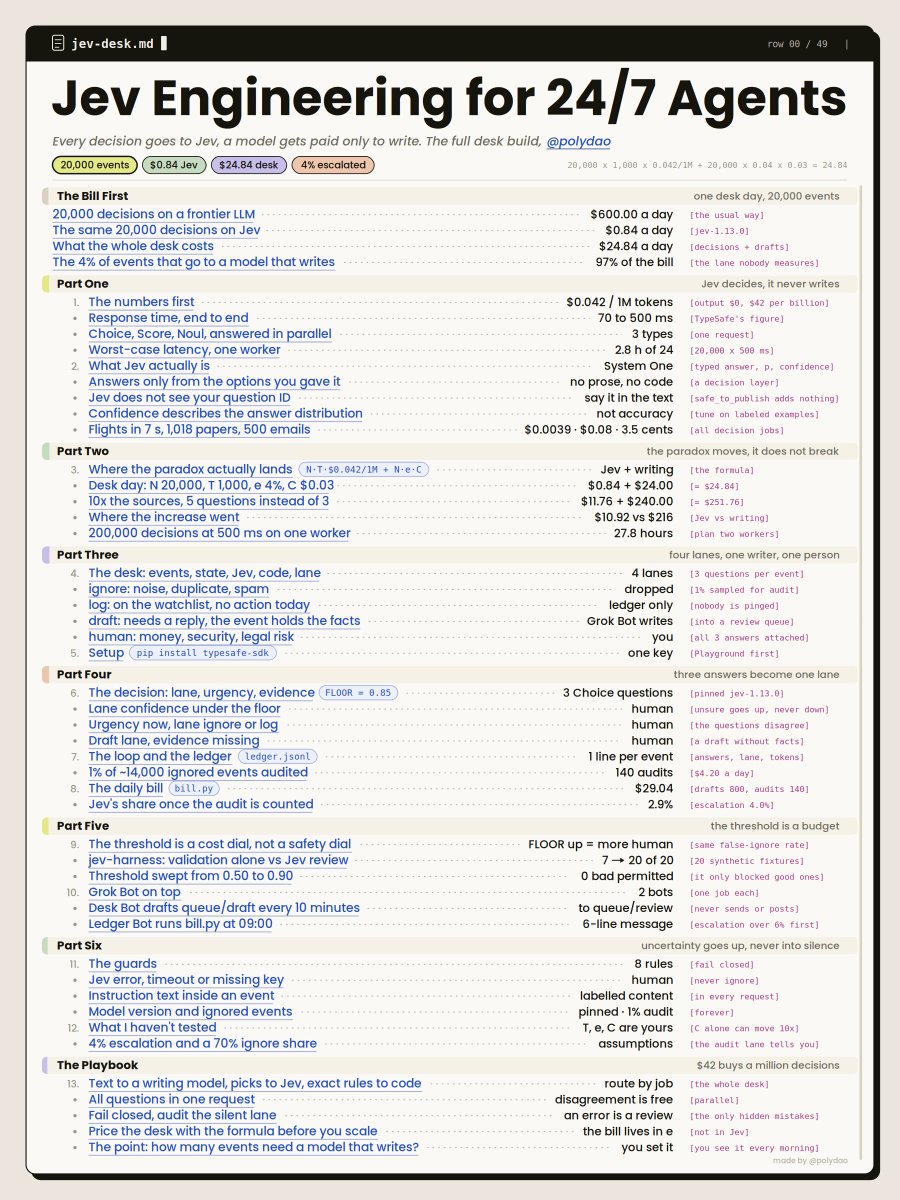

ok this one is a f*cking goldmine 9 jobs where Jev engineering replaces a pricey LLM call (TypeSafe's full list) Jev is TypeSafe AI's first System One model. 100x faster and cheaper than frontier LLMs each of these 9 is money you're paying Claude for right now in the right hands the work you skipped as too slow or too pricey gets you noticed:
Mr. Buzzoni29,681 views • 17 days ago

Claude Code will grill you with 40+ questions before writing a single line of code > it's called /grill-me - 3 sentences long. most impactful skill I use instead of jumping straight to code - it walks every branch of your design tree until there's zero ambiguity > every question reveals something you hadn't thought of other skills I use daily: > /write-a-prd - idea → proper product doc > /prd-to-issues - doc → GitHub issues automatically > /tdd - tests first, forces edge case thinking before code > /improve-codebase-architecture -> full structural review of your codebase all links and full breakdown in my article full video from Matt Pocock 👇
Mr. Buzzoni225,368 views • 6 months ago