Video yükleniyor...

Video Yüklenemedi

Ana Sayfaya Dön

Claude Code tip: before you ship a vibe-coded site, let Opus 5.5 send 𝟱 𝘀𝘂𝗯𝗮𝗴𝗲𝗻𝘁𝘀 through 𝘁𝗵𝗲𝘀𝗲 𝟮𝟬 𝗰𝗵𝗲𝗰𝗸𝘀 and fix everything in one pass: 1. design that holds together • write a DESIGN file first and tie every color, font size, spacing and radius to it • keep...

38,930 görüntüleme • 9 gün önce •via X (Twitter)

13 Yorum

EagleVision profil fotoğrafı
EagleVision9 gün önce

it’s basically like having a whole team some find the problems and point them out, while others fix them

sophia v profil fotoğrafı
sophia v8 gün önce

Love this take

Deimos | Resolved Markets profil fotoğrafı
Deimos | Resolved Markets8 gün önce

Good advice on effort settings

Austin Armstrong profil fotoğrafı
Austin Armstrong9 gün önce

Five subagents doing QA before ship is how vibe coding stops being a toy. The people dunking on AI aren't running this loop.

Argona profil fotoğrafı
Argona9 gün önce

wow opus showed up with a whole crew

DHRUV BANSAL profil fotoğrafı
DHRUV BANSAL8 gün önce

Two of those subagents will find the same button and write it up differently and a merge grouped by file won't see them as one. Same button... two entries on the list you're meant to read before confirming

Avid profil fotoğrafı
Avid9 gün önce

insane stuff buzzoni

Alexander profil fotoğrafı
Alexander8 gün önce

Do the subagents actually catch design drift, or just typos?

Jackal Killu profil fotoğrafı
Jackal Killu9 gün önce

5 subagents on a vibe-coded site is how you turn one small bug into five confident ones 💀 single pass review beats parallel chaos every time

Hrundel75 🐷 profil fotoğrafı
Hrundel75 🐷9 gün önce

alpha colllls

BreezeOg profil fotoğrafı
BreezeOg8 gün önce

this is the kind of checklist vibe coded sites actually need five agents doing 20 checks before shipping beats finding the weird bugs later

RedirHub profil fotoğrafı
RedirHub8 gün önce

worth a 6th group: the domain. www/non-www and http/https should all 301 to one url. this week we tested live sites where www returned 410 gone and another used a temporary 307. both look fine in a browser, both leak in google.

Shimba profil fotoğrafı
Shimba8 gün önce

ty for the read-only subagents part, gonna run this on my landing page tonight

Benzer Videolar

Claude Code tip: once Opus 5.5 is your main model, stop leaving Fable 5.1 sitting idle and stop burning Opus tokens on tasks Sonnet 5.5 can swarm put it on call with /advisor run /advisor fable Opus 5.5 plans and ships the code Sonnet 5.5 swarms the routine work at medium effort Fable 5.1 reads the full session, every tool call included, and only speaks up at three points: → before a plan: is this the right approach? → when the same error comes back: am I digging in the wrong place? → before "done": what did I miss? Fable 5.1 reviews. Sonnet 5.5 executes. Opus 5.5 ships Jev engineering is the same move one layer down: the forks that need no thinker (which file, which tool, retry or stop) go to Jev in under half a second, and the big model only sees the ones that split Plan on high. Delegate on medium. Keep Fable on call. - the full tree > Opus 5.5 on high runs the main session > explorer reads the code > worker edits and runs tests > researcher pulls the docs > all three on Sonnet 5.5 at medium effort > Fable 5.1 on call as the advisor paste the tree and this prompt into Claude Code ↓ "Rebuild my Claude Code setup around this tree: 1. Check ~/.claude/agents and .claude/agents for subagents that already fit explorer, worker and researcher. > Draft new ones only for missing roles > Give each model: sonnet, effort: medium > Skip any that pin a different model and list them 2. Set the main session to high via effortLevel in ~/.claude/settings.json, and set advisorModel to fable 3. Find anything that keeps the advisor off (CLAUDE_CODE_DISABLE_ADVISOR_TOOL, DISABLE_TELEMETRY, any variable that stops feature-flag fetching) plus CLAUDE_CODE_EFFORT_LEVEL, which overrides subagent effort. Report them, change nothing 4. Add one rule to ~/.claude/CLAUDE.md: consult the advisor before a large plan, when an error repeats, and before calling a long task done Show me every change as a diff first. No edits until I say go." ↳

mirku

421,711 görüntüleme • 12 gün önce

This is f*cking insane. This Claude Code tip saved me thousands of dollars. once Opus 5.5 is your main model, stop burning it on work Sonnet 5.5 can do, while Fable 5.1 sits idle hand the grunt work to Sonnet 5.5 subagents and put Fable 5.1 on call run /advisor fable Opus 5.5 plans and ships the final code Sonnet 5.5 subagents read, edit and run the tests Fable 5.1 reads the full session, every tool call included, and only speaks up at three points: → before a plan: is this the right approach? → when the same error comes back: am I digging in the wrong place? → before "done": what did I miss? Sonnet 5.5 builds. Fable 5.1 reviews. Opus 5.5 ships Jev engineering is the same move one layer down: the forks that need no thinker (which file, which tool, retry or stop) go to Jev in under half a second, and the big models only see the ones that split anyone still running one model for everything is paying Opus prices to decide whether a file exists - the full tree > Opus 5.5 on high runs the main session > explorer reads the code on Sonnet 5.5 > worker edits and runs tests on Sonnet 5.5 > researcher pulls the docs on Sonnet 5.5 > all three on medium > Fable 5.1 on call for main and every subagent paste the tree and this prompt into Claude Code ↓ "Rebuild my Claude Code setup around this tree: 1. Check ~/.claude/agents and .claude/agents for subagents that already fit explorer, worker and researcher. > Draft new ones only for missing roles > Give each model: sonnet, effort: medium > Skip any that pin a different model and list them 2. Set the main session to high via effortLevel in ~/.claude/settings.json, and set advisorModel to fable 3. Find anything that keeps the advisor off (CLAUDE_CODE_DISABLE_ADVISOR_TOOL, DISABLE_TELEMETRY) plus CLAUDE_CODE_EFFORT_LEVEL, which overrides subagent effort. Report them, change nothing 4. Add one rule to ~/.claude/CLAUDE.md: consult the advisor before a large plan, when an error repeats, and before calling a long task done Show me every change as a diff first. No edits until I say go." ↳

delost

48,494 görüntüleme • 8 gün önce

Claude Code tip: once Opus 5.5 runs your main session, stop leaving Fable 5.1 on the bench put it on call with /advisor run /advisor fable Opus 5.5 keeps writing the code Fable 5.1 reads the whole session, every tool call included, and only speaks up at three moments: → before a plan: is this the right approach? → when the same error comes back: am I digging in the wrong place? → before "done": what did I miss? Fable 5.1 reviews. Opus 5.5 ships jev engineering is the same move one layer down: the forks that need no thinker (which file, which tool, retry or stop) go to jev in under half a second, and the big model only sees the ones that split - the full tree > Opus 5.5 on high runs the main session > explorer reads the code > worker edits and runs tests > researcher pulls the docs > all three on medium > Fable 5.1 on call as the advisor paste the tree and this prompt into Claude Code ↓ "Rebuild my Claude Code setup around this tree: 1. Check ~/.claude/agents and .claude/agents for subagents that already fit explorer, worker and researcher. > Draft new ones only for missing roles > Give each model: opus, effort: medium > Skip any that pin a different model and list them 2. Set the main session to high via effortLevel in ~/.claude/settings.json, and set advisorModel to fable 3. Find anything that keeps the advisor off (CLAUDE_CODE_DISABLE_ADVISOR_TOOL, DISABLE_TELEMETRY, any variable that stops feature-flag fetching) plus CLAUDE_CODE_EFFORT_LEVEL, which overrides subagent effort. Report them, change nothing 4. Add one rule to ~/.claude/CLAUDE.md: consult the advisor before a large plan, when an error repeats, and before calling a long task done Show me every change as a diff first. No edits until I say go." ↳

Hanako

52,065 görüntüleme • 11 gün önce

Official Anthropic tip for Claude Code: stop burning Opus 5.5 on work Sonnet 5.5 can do, while Fable 5.1 sits idle hand the grunt work to Sonnet 5.5 subagents and put Fable 5.1 on call run /advisor fable Opus 5.5 plans and merges Sonnet 5.5 subagents read, edit and run the tests Fable 5.1 reads the full session and only speaks up at three points: → before a plan: is this the right approach? → when the same error comes back: am I digging in the wrong place? → before "done": what did I miss? Sonnet 5.5 builds. Fable 5.1 reviews. Opus 5.5 ships Jev engineering is the same move one layer down: the forks that need no thinker (which file, which tool, retry or stop) go to Jev in under half a second, and the big models only see the ones that split - the full tree > Opus 5.5 on high runs the main session > explorer reads the code on Sonnet 5.5 > worker edits and runs tests on Sonnet 5.5 > researcher pulls the docs on Sonnet 5.5 > all three on medium > Fable 5.1 on call for main and every subagent paste the tree and this prompt into Claude Code ↓ "Rebuild my Claude Code setup around this tree: 1. Check ~/.claude/agents and .claude/agents for subagents that already fit explorer, worker and researcher. > Draft new ones only for missing roles > Give each model: sonnet, effort: medium > Skip any that pin a different model and list them 2. Set the main session to high via effortLevel in ~/.claude/settings.json, and set advisorModel to fable 3. Find anything that keeps the advisor off (CLAUDE_CODE_DISABLE_ADVISOR_TOOL, DISABLE_TELEMETRY) plus CLAUDE_CODE_EFFORT_LEVEL, which overrides subagent effort. Report them, change nothing 4. Add one rule to ~/.claude/CLAUDE.md: consult the advisor before a large plan, when an error repeats, and before calling a long task done Show me every change as a diff first. No edits until I say go." ↳

delost

44,001 görüntüleme • 9 gün önce

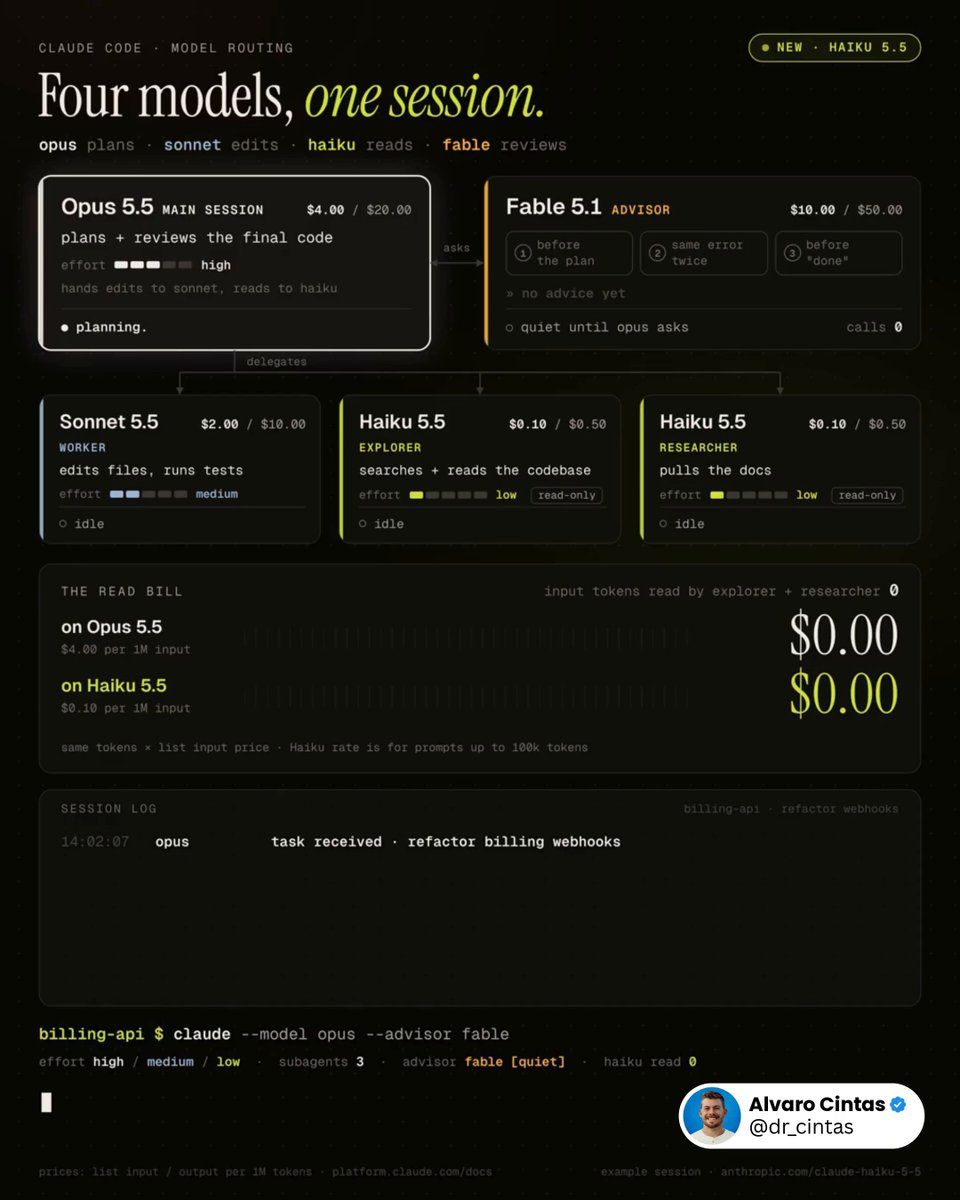
This workflow will save you thousands with Claude. Run Opus 5.5, Sonnet 5.5, Haiku 5.5, and Fable 5.1 together, and stop spending Opus tokens on work that doesn't need Opus. The entire idea in one line: Opus plans, Sonnet edits, Haiku reads, Fable reviews at decision points. Roles, broken down: - Opus 5.5, high effort, owns the plan and reviews the final code - Sonnet 5.5, medium effort, is the worker: edits files, runs tests - Haiku 5.5, low effort, splits into explorer (searches and reads the codebase) and researcher (pulls docs). it's the first Haiku with an effort setting - Fable 5.1, set with /advisor fable. Opus calls it at decision points, and it gets the full transcript each time Three moments Opus tends to call it: → before committing to a plan: is this the right approach? → the same error shows up again: is this going nowhere? → before marking the task done: did something get skipped? Why Haiku only reads: Anthropic's launch post says Sonnet 5.5 and Opus 5.5 are still the better choice for complex agentic coding (Terminal-Bench 4.0: 39.2% for Haiku 5.5, 70.6% for Sonnet 5.5) and that Haiku 5.5 fits narrowly scoped subagent work. so it gets the lookups, not the edits. Anyone still running one model for everything is paying $4 per million input tokens to check whether a file exists. Haiku 5.5 does it for $0.10. Drop this into Claude Code 👇 "Rebuild my Claude Code setup around this structure: Confirm Claude Code is v2.1.293 or later, so the haiku alias resolves to Haiku 5.5. If it isn't, stop and tell me to run claude update. Look through ~/.claude/agents and .claude/agents for subagents already covering explorer, worker, and researcher. Only create new ones for roles that are missing. Set model: haiku, effort: low on explorer and researcher, with no Edit or Write tools. Set model: sonnet, effort: medium on worker. If an existing subagent is locked to a different model, leave it as is and just list it. Name the explorer subagent Explore so it overrides the built-in one, which otherwise runs on my main model. In ~/.claude/settings.json, set advisorModel to fable, and set effortLevel to high for claude-opus-5-5 under modelSettings. A top-level effortLevel in user settings doesn't apply to Opus 5.5. Check for anything disabling the advisor: CLAUDE_CODE_DISABLE_ADVISOR_TOOL, DISABLE_TELEMETRY, or anything blocking feature-flag fetches. Also check CLAUDE_CODE_EFFORT_LEVEL, which overrides subagent effort settings, and CLAUDE_CODE_SUBAGENT_MODEL_FORCE, which makes Claude Code ignore subagent model fields. Report what you find. Don't change any of it yet. Add one line to ~/.claude/CLAUDE.md: consult the advisor before a big plan, when the same error shows up twice, and before marking a long task done. Show every change as a diff first. Wait for my go-ahead before touching anything."

Alvaro Cintas

55,249 görüntüleme • 4 gün önce

Claude Code tip: once Opus 5.5 is your main model, stop leaving Fable 5.1 sitting idle put it on call with /advisor run /advisor fable Opus 5.5 keeps writing the code Fable 5.1 reads the full session, every tool call included, and only speaks up at three points: → before a plan: is this the right approach? → when the same error comes back: am I digging in the wrong place? → before "done": what did I miss? Fable 5.1 reviews. Opus 5.5 ships Jev engineering is the same move one layer down: the forks that need no thinker (which file, which tool, retry or stop) go to Jev in under half a second, and the big model only sees the ones that split - the full tree > Opus 5.5 on high runs the main session > explorer reads the code > worker edits and runs tests > researcher pulls the docs > all three on medium > Fable 5.1 on call as the advisor paste the tree and this prompt into Claude Code ↓ "Rebuild my Claude Code setup around this tree: 1. Check ~/.claude/agents and .claude/agents for subagents that already fit explorer, worker and researcher. > Draft new ones only for missing roles > Give each model: opus, effort: medium > Skip any that pin a different model and list them 2. Set the main session to high via effortLevel in ~/.claude/settings.json, and set advisorModel to fable 3. Find anything that keeps the advisor off (CLAUDE_CODE_DISABLE_ADVISOR_TOOL, DISABLE_TELEMETRY, any variable that stops feature-flag fetching) plus CLAUDE_CODE_EFFORT_LEVEL, which overrides subagent effort. Report them, change nothing 4. Add one rule to ~/.claude/CLAUDE.md: consult the advisor before a large plan, when an error repeats, and before calling a long task done Show me every change as a diff first. No edits until I say go." ↳

delost

697,625 görüntüleme • 13 gün önce

Claude Code tip: keep Opus 5.5 as your main model, but stop paying Opus prices for your subagents move them to Sonnet 5.5 Opus 5.5 plans and decides Sonnet 5.5 subagents do the heavy reading, editing and testing at half the price ($2 / $10 vs $4 / $20 per 1M tokens) Fable 5.1 stays on call with /advisor and only speaks up at three points: → before a plan: is this the right approach? → when the same error comes back: am I digging in the wrong place? → before "done": what did I miss? Opus thinks. Sonnet does. Fable checks Jev engineering is the same move one layer down: the forks that need no thinker (which file, which tool, retry or stop) go to Jev in under half a second, and the big models only see the ones that split - the full tree > Opus 5.5 on high runs the main session > explorer reads the code > worker edits and runs tests > researcher pulls the docs > all three on Sonnet 5.5, medium > Fable 5.1 on call as the advisor paste the tree and this prompt into Claude Code ↓ "Rebuild my Claude Code setup around this tree: 1. Check ~/.claude/agents and .claude/agents for subagents that already fit explorer, worker and researcher. > Draft new ones only for missing roles > Give each model: claude-sonnet-5-5, effort: medium > List any that pin a different model before changing them 2. Keep the main session on Opus, set effortLevel to high in ~/.claude/settings.json and advisorModel to fable 3. Find anything that keeps the advisor off (CLAUDE_CODE_DISABLE_ADVISOR_TOOL, DISABLE_TELEMETRY, any variable that stops feature-flag fetching) plus CLAUDE_CODE_EFFORT_LEVEL, which overrides subagent effort. Report them, change nothing 4. Add one rule to ~/.claude/CLAUDE.md: consult the advisor before a large plan, when an error repeats, and before calling a long task done Show me every change as a diff first. No edits until I say go." ↳

delost

27,459 görüntüleme • 10 gün önce

this is pure f*cking treasure Claude Code tip: once Opus 5.5 is your main model, stop leaving Fable 5.1 sitting idle and stop burning Opus tokens on tasks Sonnet 5.5 can swarm put it on call with /goal claude --auto-mode "/goal all tests pass and lint is clean" Opus 5.5 keeps writing the code in auto mode Sonnet 5.5 swarms the routine work at medium Fable 5.1 inspects the full transcript and only speaks up at the turn boundary: → not yet met: am I drifting from acceptance criteria? → met: do the tests, diffs, and lint hold? → impossible: am I chasing an unreachable state? Fable grades. Opus ships JEV engineering is the same move one layer down: the forks that need no thinker (which file, which tool, retry or halt) go to JEV in under 16ms, and the big models only see the ones that split — the full tree > Opus 5.5 on high runs the main session > worker edits and patches code on Sonnet 5.5 > explorer indexes AST maps and call sites on Sonnet 5.5 > verifier runs tests and linters on Sonnet 5.5 > all three subagents on medium effort > Fable 5.1 on call as the Stop hook evaluator > JEV routes micro-forks under 16ms paste the tree and this prompt into Claude Code ↓ "Reconfigure my Claude Code setup around this tree: 1. Set the main session to Opus 5.5 on high effort with auto mode enabled. 2. Put Fable 5.1 on call as a session-scoped evaluator attached to the Stop hook: - Read-only transcript evaluation with zero tool calls - Three structured outcomes: not yet met (with steering notes), met (auto-clear), and impossible (abort early) 3. Spawn Sonnet 5.5 subagents on medium effort for worker, explorer, and verifier roles. Defer goal checks while background tasks run. 4. Route fast deterministic forks (tool resolution, path selection, auto-retries) through JEV. 5. Add one rule to CLAUDE.md: run long tasks with: claude --auto-mode \"/goal \" Show me every configuration change as a diff first. No edits until I say go." ↳

mirku

41,414 görüntüleme • 5 gün önce

Claude Code + computer use is f*cking cracked 🤯 Build a landing page → Claude opens Chrome, looks at it, spots every issue, and fixes it — without you describing a single thing. All inside Claude Code. Perfect for DTC brands and agencies who are still vibe-coding landing pages and advertorials in Claude Code, then manually opening them in Chrome, spotting 15 things wrong, and describing every visual issue back to Claude one at a time. If you're building pages in Claude Code and your workflow looks like this — build the page, open it in Chrome, spot broken spacing, go back to Claude, type "the CTA button is too low and the hero image is cut off," wait for the fix, open Chrome again, find 3 new issues, describe those too ... Claude Code + computer use eliminates the entire loop: → Claude writes the full landing page or advertorial → Opens Chrome and navigates to it → Spots layout issues, broken spacing, off-brand colors, missing elements → Fixes everything and re-checks until the page looks right → Tests your Shopify product pages by clicking through like a real customer → Walks through your checkout flow and flags friction before customers hit it → You only see the finished, visually verified result No describing what you see on screen. No "the CTA button needs more contrast" back-and-forth. No being the eyeballs for an AI that can't see. What you get: → Landing pages and advertorials Claude builds AND visually QAs before you ever look at them → Product pages Claude clicks through — testing layout, images, and CTAs like a real user → HTML dashboards Claude opens and verifies the charts actually render → Checkout flows Claude walks through step by step to catch friction → All of it happening in one session — build, test, fix, done One prompt. Claude builds it, checks it, and fixes it. You just review the finished page. I put together a full playbook with the exact setup, the prompts, and 5 DTC workflows that use Claude Code + computer use. Want it for free? > Like this post > Comment "CLAUDE" And I'll send it over (must be following so I can DM)

Mike Futia

19,249 görüntüleme • 6 ay önce

how to use Google's NEW open source Design.md + AI Skills to make your startup look like a $100 million company in 1 hour: 1. Design.md is an open source file from Google that captures the soul of a design. Typography, colors, spacing, all in one markdown file. You attach it to your prompt and your agent builds beautiful things every time. 2. Think of it this way. The HTML is the finished dish. The design.md is the recipe. The skills are the ingredients. Put them together and everything you build looks consistent and professional. 3. Don't create a design system from scratch. Find a brand you love. Linear, Stripe, Vercel, whatever resonates. Study it. Use ChatGPT or Claude to help you extract the design language into your own design.md file. 4. Build skills on top of your design.md. A landing page skill. A mobile app skill. A motion design skill. A slide deck skill. Each one references the same design.md so everything looks like it came from the same designer. 5. The biggest mistake people make: they nail one screen and then everything else looks generic. Design.md solves this. One file keeps every page, every format, every medium consistent. 6. Use it across everything. Your landing page. Your app. Your pitch deck. Your promo videos. Same DNA. Same taste. Same system. That's what separates a startup that looks real from one that looks vibe-coded. 7. Build a second brain for design inspiration. When you see something beautiful in the real world or online, capture it. Save it. When you're building something new, reference it. Taste is developed, not downloaded. 8. It's obvious but the difference between a product people trust and a product people bounce from is how it looks and feels. Design.md gives you that edge. you can watch below shoutout to Meng To for coming on The Startup Ideas Podcast (SIP) 🧃 and walking through his full workflow. if you want to use AI to actually build gorgeous designs, you'll want to use see this. watch

GREG ISENBERG

512,753 görüntüleme • 5 ay önce

This is f*cking insane. This tip saved me thousands of dollars. run Opus 5.5, Sonnet 5.5, and Fable 5.1 together, and stop burning Opus on work it was never needed for. the whole idea in one line: the strong model plans, the mid-tier model executes, Fable stays quiet until it's actually needed. roles, broken down: Opus 5.5, high effort, owns the plan and ships the final code Sonnet 5.5, medium effort, splits into explorer (reads the codebase), worker (edits files, runs tests), researcher (pulls docs) Fable 5.1, called through /advisor fable, reads everything happening in the session but stays silent unless something's actually wrong three moments where Fable speaks: → a plan goes out: is this actually the right call? → the same failure shows up again: is the search going nowhere? → the task gets marked finished: did something get skipped? Jev engineering does the same thing one level down. the forks that don't need real thought, which file, which tool, keep going or stop, go straight to Jev and come back in under half a second. the big models only ever see the forks that genuinely need a decision. anyone still running one model for everything is paying Opus prices to decide whether a file exists. drop this into Claude Code: "Rebuild my Claude Code setup around this structure: Look through ~/.claude/agents and .claude/agents for subagents already covering explorer, worker, and researcher. Only create new ones for roles that are missing. Set model: sonnet, effort: medium on each. If an existing subagent is locked to a different model, leave it as is and just list it. In ~/.claude/settings.json, set effortLevel to high and advisorModel to fable. Check for anything disabling the advisor, CLAUDE_CODE_DISABLE_ADVISOR_TOOL, DISABLE_TELEMETRY, or anything blocking feature-flag fetches, plus CLAUDE_CODE_EFFORT_LEVEL, which can override subagent effort settings. Report what you find. Don't change any of it yet. Add one line to ~/.claude/CLAUDE.md: check in with the advisor before a big plan, when the same error shows up twice, and before marking a long task done. Show every change as a diff first. Wait for my go-ahead before touching anything."

rvaniaaa

251,711 görüntüleme • 10 gün önce

I don't understand why everyone isn't doing this yet. Anthropic's own Claude Code docs show how to run a whole team of Claudes, while Opus 5.5 only touches the plan and the merge the whole idea: agent teams in Claude Code one lead, separate teammates in their own context windows, one shared task list, and they message each other directly the lead: Opus 5.5 on high, splits the work, writes the tasks, merges at the end the builders: Sonnet 5.5, one owns client/, one owns api/, never the same file the adversary: Fable 5.1, never writes code, only shows up at three points: → before an interface locks: do both sides agree on the contract? → when a test fails twice: is it fixed or just hidden? → before a task is marked done: what breaks it? Sonnet 5.5 builds. Fable 5.1 attacks. Opus 5.5 merges Jev engineering is the same move one layer down: the forks that need no thinker (which file, which tool, retry or stop) go to Jev in under half a second, and the team only argues about the ones that split turn it on, then start the team in plain English: "Spawn three teammates: ux and backend on Sonnet, an adversary on Fable" - the full team > Opus 5.5 on high leads the session > ux on Sonnet 5.5, owns client/ > backend on Sonnet 5.5, owns api/ > adversary on Fable 5.1, owns nothing, reviews everything > shared task list with file locking, direct messages, no lead in the middle paste the team and this prompt into Claude Code ↓ "Set up agent teams for this repo: 1. In ~/.claude/settings.json add CLAUDE_CODE_EXPERIMENTAL_AGENT_TEAMS=1 under env and set effortLevel to high 2. In ~/.claude/agents, draft three subagent definitions for the teammates > ux and backend with model: sonnet, each limited to its own folder > adversary with model: fable and read-only tools, whose only job is attacking contracts, repeated test failures and done claims > Skip any that already exist and list them 3. Add a TaskCompleted hook that blocks completion until the adversary signs off, and one rule to CLAUDE.md: no two teammates edit the same file 4. Find anything that would override this (CLAUDE_CODE_SUBAGENT_MODEL, CLAUDE_CODE_SUBAGENT_MODEL_FORCE, CLAUDE_CODE_EFFORT_LEVEL). Report it, change nothing Show me every change as a diff first. No edits until I say go." ↳

delost

70,168 görüntüleme • 7 gün önce

Claude Code tip: stop burning Opus 5.5 context on tasks Sonnet 5.5 can swarm, while Fable 5.1 sits idle spin up an autonomous team with --agent claude --agent architect Opus 5.5 acts as the lead architect, scoping the work and validating every worktree before it merges Sonnet 5.5 teammates take isolated git worktrees and hammer out implementations at medium effort Fable 5.1 sits on the team as a dedicated adversary, only stepping in at three critical moments: → before a contract locks: does the frontend payload match the backend schema? → when a test breaks twice: are we patching the bug or just hiding the symptom? → before the merge: what attack surface or edge case did everyone overlook? Sonnet 5.5 builds. Fable 5.1 challenges. Opus 5.5 merges and ships Jev engineering runs the identical pattern one layer down: mechanical decisions that need no reasoning (which file to open, which tool to invoke, retry or abort) execute in 16ms, so the frontier models only wake up when execution paths actually diverge Plan on high. Delegate on medium. Keep the adversary on peer-to-peer call. - the full team setup > architect runs the main session on Opus 5.5 at high effort > teammate-ux builds client state inside its own git worktree > teammate-back writes endpoints and migrations inside a separate worktree > teammate-adv runs on Fable 5.1, read-only, and attacks every diff > teammates message each other by name without routing through the lead > tools: Agent(ux, backend, adversary) locks the architect to spawning only its own team paste the setup and this prompt into Claude Code below: "Configure my Claude Code workspace for an autonomous agent team: 1. Audit ~/.claude/agents and .claude/agents for definitions fitting architect, ux, backend and adversary > Generate definitions only for missing roles > Pin model: sonnet, effort: medium, isolation: worktree for ux and backend, and model: fable with read-only tools for adversary > Give architect model: opus, effort: high and tools: Agent(ux, backend, adversary) 2. Check ~/.claude/settings.json and my env: > Report CLAUDE_CODE_EXPERIMENTAL_AGENT_TEAMS if it's set, since it turns named subagents into teammates without worktrees > Report CLAUDE_CODE_SUBAGENT_MODEL_FORCE and CLAUDE_CODE_EFFORT_LEVEL, which can override the pinned models and effort 3. Write each role's prompt so ux and backend own separate folders, message each other by name when a contract changes, and hand every diff to adversary before reporting back 4. Add a team rule to ~/.claude/CLAUDE.md: no worktree merges until adversary has reviewed it Show every configuration diff first. Do not apply edits until confirmed" save it

Khairallah AL-Awady

32,018 görüntüleme • 5 gün önce

THIS MIGHT BE THE #1 OPEN-SOURCE REPO FOR CLAUDE CODE RIGHT NOW. IT GIVES CLAUDE A MEMORY AND SLASHES YOUR TOKEN COST ON EVERY QUESTION The repo is safishamsi/graphify, a free open-source skill that turns any codebase into a knowledge graph Claude Code can read instantly. Instead of grepping through your files every session, Claude gets a map of how everything connects The problem it fixes: Every time you ask Claude Code about a big repo, it does the same thing, greps through dozens of files like a brute-force Ctrl+F, blows through your context window, and sometimes still misses the answer hiding in a file nobody searched. Claude Code has no memory of how your project is structured. Every session starts from zero What it does: It maps your entire codebase into a knowledge graph, capturing not just which files exist, but which functions depend on which, which modules are central, and which files cluster around the same concern. Claude queries the map instead of scanning files How it works, three passes: 1. Code structure, free and local. Tree-sitter parses your files and pulls out classes, functions, imports and call graphs. No LLM, no tokens, just your actual code mapped deterministically 2. Audio and video, if you have them. Transcribed locally and folded into the graph 3. Docs, papers, images. Here an LLM does semantic analysis, figuring out what each document means and where it fits. Only the meaning gets sent up, never your raw source It saves you money: Normally a question about a big repo makes Claude spawn explore agents that scan file after file, eating your context window and your token budget before you get an answer. With the graph already built, Claude queries the map instead of re-reading the codebase every time. Same answer, a fraction of the tokens. The graph only gets built once, then a hook rebuilds it after each commit for free, so you never pay that scanning cost again. The bigger the repo, the bigger the gap The best parts: it's a skill, so once installed Claude knows when to use it without you memorizing commands. It works on non-code folders too, point it at docs or notes and it can spin up an Obsidian vault How to add it to your Claude: 1. Install Claude Code if you haven't: npm install -g Paul Jankura-ai/claude-code 2. Add the skill: claude skill add safishamsi/graphify 3. Open your project folder and run /graphify . to build the graph 4. Optional, make it automatic: graphify hook install so the graph rebuilds after every commit That's it. Ask Claude about your repo and it reads the map instead of burning tokens on a file hunt Bookmark this

Yarchi

56,559 görüntüleme • 4 ay önce

Figma Capture + Claude Fable 5 = clone any competitor's landing page in minutes 🤯 Figma just dropped a Chrome extension that copy/pastes any live website into Figma as editable layers. Point Claude Code — running the new Fable 5 model — at the capture, and it rebuilds the whole page in YOUR brand: structure, copy, design system, photography. All inside Claude Code. Perfect for DTC brands and agencies who keep losing weeks rebuilding proven landers from scratch. If you're still cloning competitor pages the old way, You're screenshotting their site and praying the AI guesses the structure right. You're rebuilding sections by hand because the fonts and spacing never come out true. You're paying a designer $3K to recreate a page that already exists. This workflow eliminates the entire loop: → Capture the competitor's landing page with Figma's new Chrome extension — editable layers, not screenshots → Claude Code reads the page structure through the Figma MCP: every section, every headline, in order → It rebuilds the page in YOUR brand — your colors, your fonts, your voice (it even respects your banned-words list) → GPT Image 2 generates on-brand product photography from the layer names → Claude places every image automatically — finished page, ready to ship No screenshots. No guessing at structure. No design invoice. What you get: → A pixel-structured clone of any proven lander, rebuilt in your brand → Every line of copy rewritten in your voice → 16 on-brand images generated and placed for ~$2 in API costs → Start to finish in about 15 minutes Built 100% with Figma + Claude Code on Claude Fable 5. I put together a step-by-step playbook showing you exactly how to set it up. Want access for free? > Like this post > Comment "CLONE" And I'll send it over (must be following so I can DM)

Mike Futia

47,141 görüntüleme • 4 ay önce