
Sabrina Halper
@SabrinaHalper • 15,973 subscribers
Conversations at the frontier 🎙️🔮, Investing on the side.
Videos


"I think half the co-founders of Anthropic were theoretical physicists. Jared Kaplan was exactly in the same area of physics as I was. Dario was in physics back in the day, also at Princeton, but he was more on the bio side. There's been an exodus of physicists to more interesting problems, and I think that's for a good reason" Why Matan Grinberg dropped out of his physics PhD at Princeton
Sabrina Halper286,698 Aufrufe • vor 20 Tagen

"The mathematics of string theory is probably one of the most beautiful artifacts humanity has created. In order to even produce something in theoretical physics, there's hundreds of years of literature that you need to catch up on, and also every day there's, 100 new papers that come out. And before you can contribute to theoretical physics, you need to know basically all of math, like algebraic topology, differential equations, algebraic geometry, and these are all things that people will spend their careers going in on, and yet to do the physics, you need to at least have, a pretty deep understanding of these things. And so it really teaches you how to have, good judgment with minimal information." Matan Grinberg studied physics for a decade, eventually dropping out of his PhD focused on string theory to found Factory.
Sabrina Halper237,521 Aufrufe • vor 21 Tagen

Founder of Signal, Moxie Marlinspike Marlinspike on Telegram: "Telegrams not a private messenger. There's nothing private about it. It's the opposite. It's a cloud messenger where every message you've ever sent or received is in plain text in a database that telegram the organization controls and has access to it" "It's like 'Russian oligarch starts unencrypted version of WhatsApp', a pixel for pixel clone of WhatsApp. That should be kind of a difficult brand to operate. And somehow, they've done a really amazing job of convincing the whole world that this is an encrypted messaging app and that the founder is some kind of Russian dissident, even though he goes there once a month, the whole team lives there, and their families are there." " What happened in France is they just chose not to respond to the subpoena. And so that's in violation of the law. And, he gets arrested in France, right? And everyone's like, oh, France, but I think the key point is they have the data, like they can respond to the subpoenas where as Signal, for instance, doesn't have access to the data and couldn't respond to that same request. To me it's very obvious that Russia would've had a much less polite version of that conversation with Pavel Durov and the telegram team before this moment. "
Sabrina Halper896,617 Aufrufe • vor 7 Monaten

.Moxie Marlinspike marlinspike: "I think that LLMs are one of the first technologies to actively invite confession. And so the idea behind Confer is to do something similar to Signal of building something that allows people to avail themselves of the utility and awesomeness of LLMs, but to do it in a private way. It’s an end to end encrypted version of AI chat where you can interact with AI chat like you would with chatGPT. But all your conversations and conversation history are private and only, so only you have access to them. It’s using open source models.” Moxie was hired by Meta to integrate Confer’s privacy technology in their new AI products like Muse, a decade after Moxie worked with Meta to bring the Signal Protocol to WhatsApp. *Recorded in January, in the middle of the ocean, from a floating sauna Moxie built himself.
Sabrina Halper22,811 Aufrufe • vor 15 Tagen


“You should’ve been worried yesterday.” - Jacob Kimmel on the risk of bioweapons, & Anthropic’s approach to limiting Fable’s responses: -You should’ve been terrified of bioweapons yesterday. They’re one of the highest-leverage ways to inflict massive damage, and we’re still woefully underprepared. -Making a bioweapon requires three things: knowing what to make, knowing how to make it, and actually pulling it off in a lab. -Steps 1 & 2 are increasingly accessible. The real bottleneck is step 3: physical reality. Lab work is hard. Most experiments fail. Materials are tightly regulated and difficult to obtain. -AI barely changes that physical layer. Claude can’t ship you research chemicals or make your experiments work. -The scary story is that AI lets a lone smart misfit do it. But the overlap between people capable of clearing the physical hurdles and people who couldn’t already find information on dangerous pathogens is probably pretty small. -Realistically, the highest-consequence bioweapon efforts still require something closer to nation-state resources. -People also worry AI could help design novel pathogens. That’s worth taking seriously. But there are already plenty of naturally occurring pathogens we don’t have immunity to. -Bottom line: I’d rather be too cautious than not. But AI didn’t suddenly create this risk - it has always been there.
Sabrina Halper54,034 Aufrufe • vor 2 Monaten

So much discussion about whether we should be using Chinese open-source models in the US. But how could they actually hurt us? Matan Grimberg Matan Grinberg breaks down the biggest risks- 1. Intentional vulnerabilities. A model could contain backdoors, sleeper behavior, or other weaknesses deliberately introduced into the weights, potentially sitting dormant until the right conditions trigger them. 2. Unintentional vulnerabilities. A model built in China will naturally be trained and optimized around Chinese users, codebases, languages, and data. It could perform incredibly well overall while having subtle blind spots or security weaknesses in Western systems that nobody intentionally put there. The third we may not know for years. The most concerning failures might not show up in today’s benchmarks or security evaluations. If models become deeply embedded across companies and infrastructure, vulnerabilities could emerge only after we’ve become dependent on them.
Sabrina Halper17,244 Aufrufe • vor 23 Tagen

Bowhead whales can live for over 200 years. Greenland sharks can live for up to 400. There’s even an immortal jellyfish that can reset its own life cycle. Nature has already solved longevity in dozens of different ways. What can we learn from these species in our own quest to live longer, healthier lives? Jacob Kimmel of NewLimit shares his take.
Sabrina Halper41,860 Aufrufe • vor 2 Monaten

Looking back on this clip when I interviewed Tarek Mansour 4 years ago We talked about how much conviction it took to build a company that had to wait 3 years for regulatory approval before it could even launch. And about the faith system that kept him and Luana Lopes Lara moving forward through it all. Prayer? Manifestation? Just an irrational belief that it would work? A very clear example that the world favors the optimists.
Sabrina Halper20,162 Aufrufe • vor 1 Monat
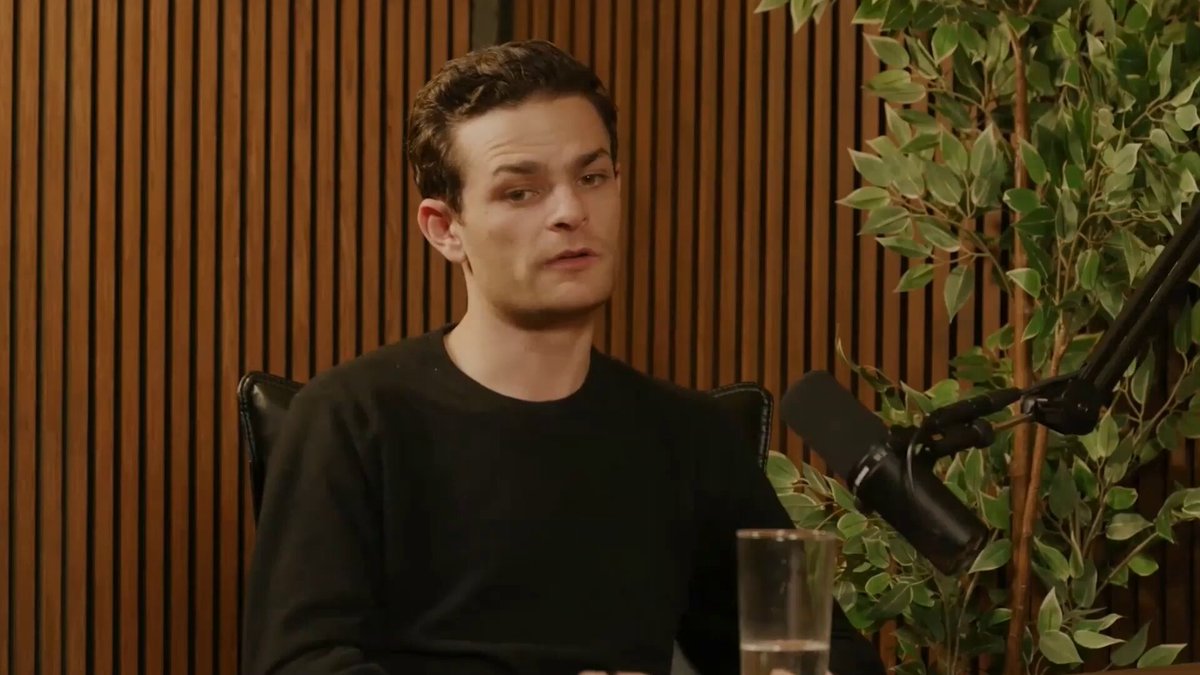
"We have this long term vision of turning biology from something which is trial and error and experimental and make it something that looks more like an engineering discipline in the next century." New Episode with Jack Dent ! 0:00 Intro 02:28 Inside Stripe w/ Patrick Collison, at <100 People 08:45 Sam Altman role in Chai Discovery origin 16:20 Chai-2 Antibody Breakthrough 19:24 Approaching biology as an engineering problem 24:45 Using AI models to treat people on an individual scale 26:52 Robotics in labs 27:22 Pharma industry today 29:49 The clinical trial bottleneck 32:53 Personalized biology models & cancer vaccines 36:24 Longevity, peptides, and trillion-dollar drugs 39:02 Does it matter that the government cut exploratory science grants? 41:00 What next-gen Chai models will do 42:08 Can frontier AI labs build this themselves? 43:26 Biology is hard
Sabrina Halper39,914 Aufrufe • vor 4 Monaten

.Dwarkesh Patel's episode with Eric Jang is awesome. Eric has a rare gift for making complicated ideas feel simple, which is exactly what struck me when I first met him at a dinner and immediately peppered him with questions. If you are looking to hear more from him, listen to our conversation from a couple years ago! "The history of neural networks and actually many things in AI have been inspired a lot by biology, like genetic algorithms, evolutionary algorithms, processes in both neuroscience and psychology and biology and so forth. I think drawing from nature is a great way to get inspiration... And this is going to get me a lot of flack from the scientific community, but I feel like in the last decade and a half-ish of deep learning progress, the vast majority of major contributions have come from people who did not really adhere to that way of thinking, but more like, how do I push as much data as fast as possible onto my GPU? It just empirically seems to me that people who are very attached to the idea of replicating a particular nature inspired architecture at the expense of enabling brute force compute... do not make the best algorithms. There's this essay by Sara Hooker called the the hardware lottery where it's arguing that people who focused on maximizing and designing their algorithms to suit the hardware so that it could run the brute force thing as fast as possible tended to win. "
Sabrina Halper39,759 Aufrufe • vor 4 Monaten

Ken Liu Ken Liu on how modern explanations to questions like "why do we dream?", "why do I love this person?", "why are we here?" explain everything while explaining nothing at all. Science can explain mechanism. It can't explain meaning. Stories create meaning. Modern states ask citizens to die for them all the time - for the sake of a story. Humans will die for a story. It's the only thing humans have ever willingly died for.
Sabrina Halper62,733 Aufrufe • vor 8 Monaten

Why did so many of history’s greatest scientists make their biggest discoveries before age 30? Your brain has two kinds of intelligence: • Fluid intelligence: your ability to reason and solve new problems. It tends to peak in your 20s–30s, possibly because evolution optimized us for the age when the population size was greatest during most of human evolution. • Crystallized intelligence: the knowledge and pattern recognition you accumulate over a lifetime. It keeps growing for decades.
Sabrina Halper17,627 Aufrufe • vor 1 Monat

Jack Dent story time - his path from high school in the UK to founding Chai is pretty amazing: - Cold-emailed Stripe as a teenager - Daniela Amodei was running Stripe’s careers inbox and forwarded his email to Patrick Collison - Interned on Stripe’s payments API and eventually became the only engineer working on it - Greg Brockman walked around the office with no shoes - Met Joshua Meier while at Harvard. Years later, Sam Altman Facebook-messaged him about Josh when he was leaving OAI - asked if he could be convinced to stay or start a company ... All of it became part of the path to co-founding Chai Discovery a few years later. Early Stripe was a talent epicenter Daniela Amodei Patrick Collison Greg Brockman Sam Altman
Sabrina Halper33,476 Aufrufe • vor 4 Monaten

Congratulations Chai Discovery - entering a golden age of biology
Sabrina Halper22,222 Aufrufe • vor 2 Monaten

"Aging is the process of a complex system slowly falling into its chaotic disequilibrium. And it's not like evolution necessarily even set a lifespan for us. It is merely the result of, once the system has been established, how long its intrinsic property stayed ordered before it became disordered." I’m excited to share my conversation with Jacob Kimmel of NewLimit. Every species who has ever lived has one shared certainty: we’ll age, decay, and die. Jacob and his team are among the small group of people on earth with the expertise and funding to work on this problem. We talked about why we age, whether cellular aging can actually be reversed, how evolution shaped our lifespan and our peaks, and how AI is fundamentally changing the next era of science. Recorded at New Limit’s HQ in South San Francisco. Timestamps: 00:00 Intro 01:25 Why Evolution Limits Lifespan 03:13 Evolution Tradeoffs Explained 07:44 Why Women Live Longer 10:15 Lessons from Long Lived Species 16:20 Peak Intelligence 23:26 What is Aging? 27:59 Yamanaka Factors 32:18 New Limit 33:56 AI's Role in Progress 37:28 Organ by Organ Longevity 40:28 Is Immortality Possible? 42:04 Lifespan Progress 45:44 How to Test Longevity Drugs 49:30 Placebo Mind Body Link 53:56 What longevity hacks actually work? 57:25 Peptides And Stem Cells 01:00:34 Gene Editing 01:05:10 Personalized Medicine 01:08:48 Philosophical Dilemmas of Longer Lifespans 01:14:57 Living Off Earth 01:16:55 AI And Bio Risks
Sabrina Halper21,980 Aufrufe • vor 2 Monaten

The significance of GLPs: 1)"For individuals who are young today, the chance they use a GLP at some point in their life surpasses 50%." 2)"They are one of the first medicines we've seen that demonstrates it's possible to have such beneficial pleiotropy- It's possible for one drug to have all of these knock-on benefits." 3)"From a business case, it's also possible to build a single product worth a trillion dollars... Biotech has been stuck in a bit of a rut. GLPs are the existence proof that if you tackle a really hard problem, but provide a lot of benefit to so many people as a result, it can be valuable enough that it justifies the underwriting several fold over."
Sabrina Halper16,403 Aufrufe • vor 2 Monaten

Isabelle Boemeke isabelle 🪐 on the pre-Hiroshima moment we’re in with AI. "The United States rushes to build the bomb, and up until that point there was a mix of excitement and fear about nuclear. I think it's similar to what we feel about AI at this moment. We are in that moment with AI where we can see both scenarios in our minds, right? It could be incredible. We could cure all these diseases, we could solve all these complex problems, but we can also all die. And it was a very similar thing, until the bombs were dropped in Hiroshima and Nagasaki and all of that potential was cemented in one image, which was of a mushroom cloud."
Sabrina Halper41,314 Aufrufe • vor 7 Monaten

Who do you think will be the most powerful human in 20 years? "It might just be the person who has the most coherent picture of what they want the future to look like." Richard Ngo It seems valuable to spend more time thinking and developing a strong pov of what you want things to look like. Easier than ever to execute on it.
Sabrina Halper22,541 Aufrufe • vor 4 Monaten