
TonyVT SkarredGhost
@SkarredGhost • 37,020 subscribers
#AR #VR developer, consultant, blogger. I love #gamedev, #China, and the Zergs' #QueenOfBlades. Most of the time I've no idea what I'm doing.
Shorts


Videos
![This soldiering training is the most impressive and immersive I've ever tried. It is 10x better than a YouTube tutorial video. It really allowed me to see the procedure from all the points of view, and even get super close to get the details. It is a collaboration between @gracia_vr and Imperial College London: they recorded a soldering session with Gaussian Splatting Videos (4DGS), so that you can enjoy it from your VR headset. You can see the action happening in front of you; you can pause and re-watch what you need, change the point of view, get closer, get more distant. And the quality with which it has been shot is impressive: I enjoyed this experience with my DELL Pro Max Tower T2 with NVIDIA Pro RTX 6000, and I could really see all the small details of the PCB that was being soldered! I was really impressed by it. But I also noticed some drawbacks. First of all, some scenes have artifacts that make seeing the details of the PCB hard. I think when it comes to training involving small details, the capture and reproduction of the splat should be flawless. Then, as much as I loved it as a passive experience, I would have liked to have also some sort of practice session in VR. The power of VR is to let you learn by doing in full safety, and this kind of training does not exploit it. But maybe the best way to enjoy it would be in MR, where you have this training video close to a real workbench where you do the actual soldering while following the tutorial. Gaussian Splat can really revolutionize training: this kind of recording is much better than any flatscreen experience, and more accurate than any 3D CGI recostruction. I suggest you give it a go at this experience in the Gracia app (it's free). Then let me know your impressions! #VirtualReality #training #DellProPrecision #GaussianSplat #technology [Disclaimer: I'm a DELL Pro Precision Ambassador, and this is why I mentioned the model of my PC. I have been given a PC to do cool tests and share my results on social media. No monetary compensation or sales affiliation is part of the collaboration]](https://image.24vids.com/tw-2087204064043917714/amplify_video_thumb/2087203965175820288/img/ARwsjy9ZPo8hwlW1.jpg)
This soldiering training is the most impressive and immersive I've ever tried. It is 10x better than a YouTube tutorial video. It really allowed me to see the procedure from all the points of view, and even get super close to get the details. It is a collaboration between @gracia_vr and Imperial College London: they recorded a soldering session with Gaussian Splatting Videos (4DGS), so that you can enjoy it from your VR headset. You can see the action happening in front of you; you can pause and re-watch what you need, change the point of view, get closer, get more distant. And the quality with which it has been shot is impressive: I enjoyed this experience with my DELL Pro Max Tower T2 with NVIDIA Pro RTX 6000, and I could really see all the small details of the PCB that was being soldered! I was really impressed by it. But I also noticed some drawbacks. First of all, some scenes have artifacts that make seeing the details of the PCB hard. I think when it comes to training involving small details, the capture and reproduction of the splat should be flawless. Then, as much as I loved it as a passive experience, I would have liked to have also some sort of practice session in VR. The power of VR is to let you learn by doing in full safety, and this kind of training does not exploit it. But maybe the best way to enjoy it would be in MR, where you have this training video close to a real workbench where you do the actual soldering while following the tutorial. Gaussian Splat can really revolutionize training: this kind of recording is much better than any flatscreen experience, and more accurate than any 3D CGI recostruction. I suggest you give it a go at this experience in the Gracia app (it's free). Then let me know your impressions! #VirtualReality #training #DellProPrecision #GaussianSplat #technology [Disclaimer: I'm a DELL Pro Precision Ambassador, and this is why I mentioned the model of my PC. I have been given a PC to do cool tests and share my results on social media. No monetary compensation or sales affiliation is part of the collaboration]
TonyVT SkarredGhost38,577 views • 2 months ago

The Unity Cube is one of the first (if not the first) apps on the #MetaQuest Store to RUN AT 207 Hz! And it also works pretty well with the experimental 240 Hz mode! I made this update so that every one of you can try for free the crazy smoothness of the new Quest framerates by just getting a little app from the store. I had this idea while I was reading about the new framerates on Quest. I thought: hey, I would like to try 207Hz, but only a very simple app could run at 207Hz in #VirtualReality. Then I realized that actually I'm the creator of such an app: The Unity Cube, the app that is just a cube. If that doesn't go at 207 Hz, no other apps can... So I worked on porting the cube to the latest SDKs, I added hand tracking, and then I implemented the 207 Hz support for the Meta Quest 3. And the result is incredibly smooth. It is like enjoying VR on steroids. There is also a strange halo effect appearing, but the experience is still enjoyable. Read about how to try 207 Hz with the Cube, how to implement 207 Hz in your Unity application, and what my impressions are about all of this in my latest article: #technology #unity3d #gamedev
TonyVT SkarredGhost13,257 views • 1 month ago
![The sense of presence in VR is something amazing. And it is what convinces me that sooner or later, VR will succeed. VR is now in one of its down moments. That's why, in these harsh days, I wanted to get back to feeling what made me fall in love with this technology: presence and immersion. I took some very good-looking PCVR experiences, like Half-Life: Alyx, or AirCar, and tried them at the maximum resolution possible on my Dell Pro Max T2 Tower, featuring an #NVIDIA RTX 6000 graphics card. Until a few months ago, I was using my old laptop, which started to show throttling issues, so I was used to lowering the render resolution, while this time, I was moving the slider up and up. The results have been astonishing: even a demo like AirCar made me in awe again, and Half-Life: Alyx was as immersive as I have ever tried it. As much as I love standalone VR, because I think it helped a lot in democratizing the technology, the WOW sensation that you can try on PCVR today is still unbeatable. Probably a good compromise between the two can be cloud rendering, but we still have to wait for it to become a reality. The sense of being somewhere else is a wonderful sensation, and everyone I demoed VR to all these years has been amazed by it, too. And every day, something makes me feel "there" (like today), I remember why I love this technology and why one day it will have a higher adoption. Sure, there are a lot of problems to solve, but I'm convinced one day it will happen. When? Well, it is always 5 to 10 years, every year... #VirtualReality #VR #technology [Disclaimer: I mentioned the PC model because I'm a #DellProPrecision ambassador, and I have been given the PC to do tests and experiments and share my results. There is no monetary compensation or sales affiliation related to this post]](https://image.24vids.com/tw-2041970837650337967/amplify_video_thumb/2041880481294381059/img/dpZGjqoqyyFV0n_8.jpg)
The sense of presence in VR is something amazing. And it is what convinces me that sooner or later, VR will succeed. VR is now in one of its down moments. That's why, in these harsh days, I wanted to get back to feeling what made me fall in love with this technology: presence and immersion. I took some very good-looking PCVR experiences, like Half-Life: Alyx, or AirCar, and tried them at the maximum resolution possible on my Dell Pro Max T2 Tower, featuring an #NVIDIA RTX 6000 graphics card. Until a few months ago, I was using my old laptop, which started to show throttling issues, so I was used to lowering the render resolution, while this time, I was moving the slider up and up. The results have been astonishing: even a demo like AirCar made me in awe again, and Half-Life: Alyx was as immersive as I have ever tried it. As much as I love standalone VR, because I think it helped a lot in democratizing the technology, the WOW sensation that you can try on PCVR today is still unbeatable. Probably a good compromise between the two can be cloud rendering, but we still have to wait for it to become a reality. The sense of being somewhere else is a wonderful sensation, and everyone I demoed VR to all these years has been amazed by it, too. And every day, something makes me feel "there" (like today), I remember why I love this technology and why one day it will have a higher adoption. Sure, there are a lot of problems to solve, but I'm convinced one day it will happen. When? Well, it is always 5 to 10 years, every year... #VirtualReality #VR #technology [Disclaimer: I mentioned the PC model because I'm a #DellProPrecision ambassador, and I have been given the PC to do tests and experiments and share my results. There is no monetary compensation or sales affiliation related to this post]
TonyVT SkarredGhost28,965 views • 6 months ago

This is an incredibly cool idea for mixed reality social interactions! Four users play together in MR, and every player has his room joined with the rooms of the other players to create a big hybrid room. Thanks to the scene understanding of Quest, you can also have a rough representation of the furniture the other users have. It's like you remove the distances and you play together in the same space, in this case by throwing each other a hot potato. I discovered this video because a few days ago I posted an article about social AR, and the amazing Ivan Aguilar pointed me to this talk by Jesse Schell at GDC where he talked about the future of MR experiences and showcased this prototype of a mixed reality game. If you want to watch the full talk, you find it here: What do you think about it? Don't you find it cool, too? #MixedReality #SpatialComputing #VirtualReality #metaverse #innovation
TonyVT SkarredGhost82,275 views • 2 years ago


Video Gaussian Splats are one of the most wonderful things I've experienced in my last year in tech and XR. They are like having a real person in front of you and have the potential to bring people closer to their idols, or their distant family members, or to store immersive memories forever. Now that I have a Dell Pro Max Tower T2 PC with a powerful #NVIDIA graphics card, I have finally been able to try at home the "memories" offered by Gracia AI, and boy, I was amazed. In the PCVR version, you can really get close to the artists dancing and syncing, and in the frames where the recording doesn't have many artifacts, it is almost like having a real artist in front of you. And it is impressive that this technology works even when the singer is dancing with quick movements! But these recordings can be pretty huge (the one with McKenzi Brooke is 21GB!) and require a powerful computer, so now Gracia is also streaming these GS videos, and I was able to try the Amy May performance also on Quest! I have to say that quality-wise, even streamed, they are amazing. But there are more artifacts than in the PC version: I noticed that when I got close to the singer. But there is a huge advantage in having them on Quest: you can see them in mixed reality. It was like having the singer having a private performance for me in my house. Crazy cool! I'll keep experimenting with these performances and maybe write an article in the upcoming weeks. In the meantime, let me know your impressions, too! #VirtualReality #technology #innovation (Disclaimer: I entered the #DellProPrecision ambassador program, so I was provided the PC from Dell, and I'm using it to make some experiments and share them with you. No monetary compensation or affiliate sales programs are involved.)
TonyVT SkarredGhost13,127 views • 7 months ago

0:56
Sensitive content
This media may contain sensitive content.

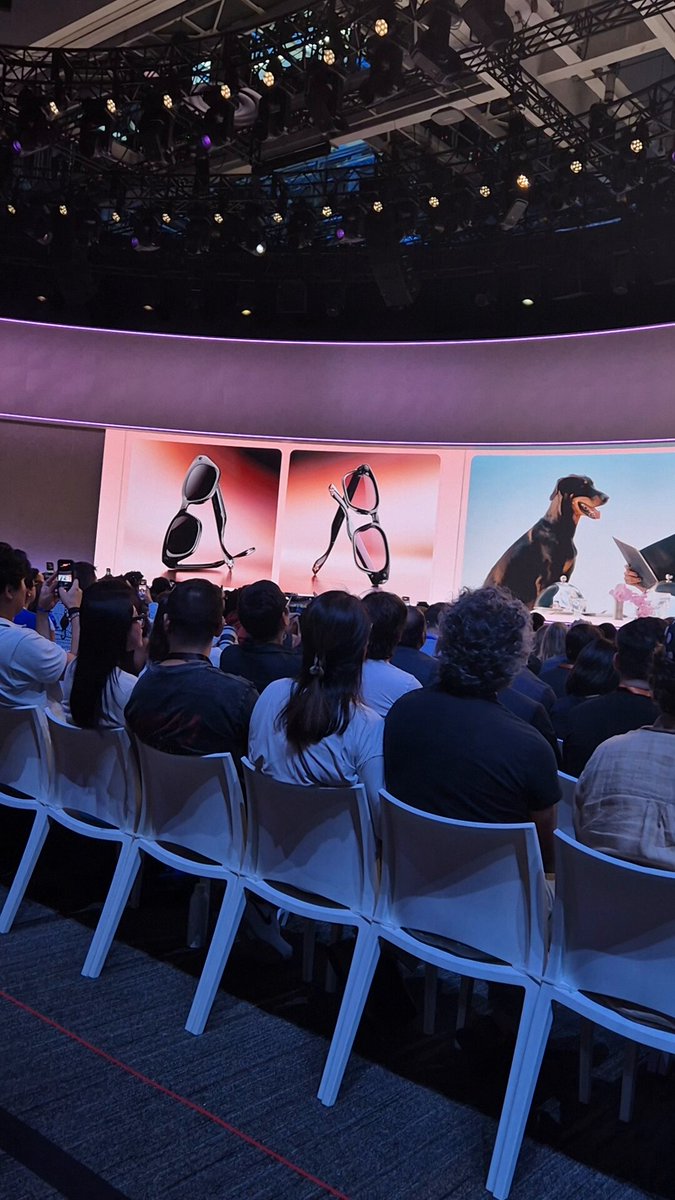
This can be the superpower of the Neural Band that Meta is giving together with the Ray-Ban Meta Display glasses. The video shows an old prototype bracelet by CTRL+LABS, the startup acquired by Meta and whose technology was used to develop the Neural Band. At the beginning of the video, the guy makes an action (a keyboard key press) with his hands, then the bracelet can substitute the key pressure, and at the end of the video, the guy doesn't even have to do the action; it is just sufficient that he "thinks" about it. As long as the brain is sending an electric message to the fingers, the full action is not necessary anymore. Just an "intention" to move them is necessary. If the Neural Band is evolved to this stage, and the users are educated to this, potentially, we may not even need to perform air taps or writing gestures, but we could just think about doing them. This would reduce a lot of the fatigue of using XR devices and the weirdness of using them on the street. Then why isn't this feature available today? I guess that the reason is twofold. First of all, we have accuracy: the full gesture is easier to detect for the system. Many people (me included) are praising the accuracy of the Neural Band, and this is amazing, because an input mechanism should have a reliability close to 100%. Then we, as users, have never been trained to just "think" about actions: it would feel weird and hard to learn. I think we should undergo some training to learn how to do this "thinking" operation properly. I hope that something like this could come in the upcoming years... that would be the real game-changer paradigm if compared to the camera-based tracking.
TonyVT SkarredGhost12,423 views • 1 year ago

I transformed my physical door into a mixed-reality portal that can bring you either to your next room or to magical virtual worlds! You can select where you want to go (like when you choose the floor in an elevator) and then when you open the door, you can exactly go to that place, physical or virtual that it may be. What I love the most is that this demo connects the physicality of the door with mixed reality, so you use a real tool to be able to access virtual realities. I've made this demo using #unity3d and #MetaQuest SDK. I've used Meta Scene Setup, so the demo is fully dynamic: it finds my door and adapts all the interfaces to it. Theoretically, it could work with all sliding doors that work like mine with no modifications to the APK. As usual, I'm thinking of making a blog post where I explain how I did it... let me know if you could be interested! And let me know also if you could be interested in some collaborations with me ;) The full video of the demo is on Youtube: #metaverse #VirtualReality #SpatialComputing
TonyVT SkarredGhost20,087 views • 2 years ago

What about feeling drunk in mixed reality? While everyone is working to reduce motion sickness in VR, I did a new crazy experiment where I actually brought it to maximum levels: working with Passthrough Projection, I completely distorted the perception of depth of the reality around me. So for instance, when I moved my head back, all reality looked like becoming very distant, distorting as if I entered the hyperspace. Walking and interacting with objects was very difficult because the perceived depth changed continuously. If you feel weird just by looking at the video, trust me that inside the headset, with the stereoscopy and the sensation of depth changing, it was much worse. I don't know what it can be useful for, but it was interesting to try it. And I could do that because I am an expert VR user and I developed high resistance to motion sickness, so I knew what I was doing. Do no try this yourself if you are not an experienced user (for this reason I am not sharing the APK). #VirtualReality #MixedReality #MetaQuest #metaverse #tecnology
TonyVT SkarredGhost16,346 views • 2 years ago
No more content to load