
Turbine Traveller
@Turbinetraveler • 90,178 subscribers
Aircraft Technician based in Nairobi| Avgeek |Sharing industry trends & breaking aviation news |Enlightening the skies| Reach out @[email protected]
Shorts


Videos


WATCH: Here is yesterday’s take-off of Vietnam Airlines Boeing 787-9 (VN-A867), flight VN34 to Hanoi, from Munich Airport’s Runway 26L. At the 0:57 timestamp, you can see the sudden jolt from the cabin as the tailstrike occurred, with the aircraft subsequently overrunning the runway.
Turbine Traveller1,897,566 просмотров • 2 месяцев назад
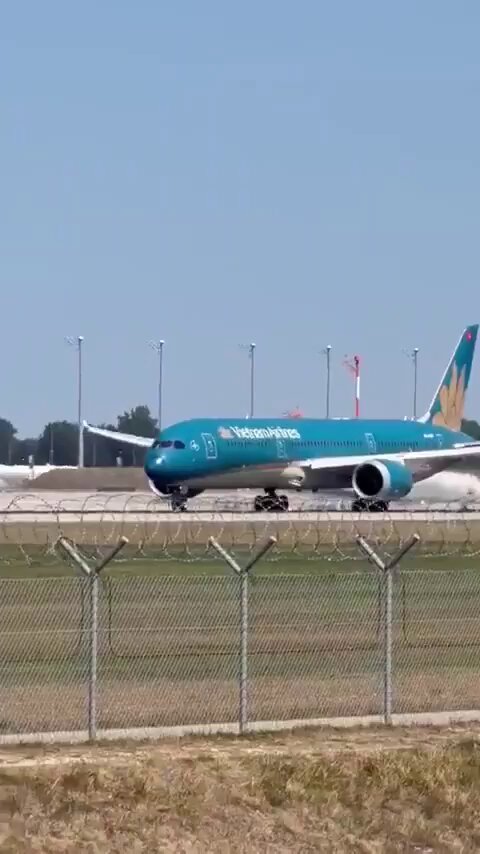
BRAKES WERE ACTIVATED DURING A B787-9 TAKEOFF AND THE AIRCRAFT RAN OFF THE RUNWAY AT MUNICH. A preliminary BFU investigation into a Vietnam Airlines Boeing 787-9 occurrence at Munich has found repeated brake pedal inputs during the take-off roll, with braking commands recorded on both sides. The aircraft, bound for Hanoi with 271 passengers and 16 crew, took off at 240.9 tonnes with V1 169 kt, Vr 175 kt and V2 180 kt. At 11:56:15 UTC, just seconds after TOGA was activated, the EAFR recorded rudder pedal input and movement of BOTH left-seat brake pedals. The aircraft continued accelerating, but braking activity was recorded again. At 11:57:12 UTC, the left BSCU recorded a maximum brake command of about 27%, while the right BSCU reached about 17%. The maximum recorded brake-pedal position was 7.2° out of a possible 12.5°. Shortly before rotation, the PM manually increased thrust from 100% to 101% N1. Then came the critical moment. At 11:57:14 UTC, rotation began at just 163 kt below the calculated Vr of 175 kt about abeam the runway threshold. The 787-9 lifted off from the grass beyond the runway 08R threshold. Its main landing gear and tail struck runway approach-lighting equipment, damaging 20 lamps. The aircraft climbed away, but the consequences of the takeoff became apparent. At 11:57:21 UTC, the leading-edge slats automatically extended as the aircraft's stall-protection system activated. At 11:57:22 UTC, TOGA mode was activated. V2 of 180 kt was finally reached at 76 ft radio altitude, followed by landing-gear retraction. The aircraft later returned to Munich after dumping approximately 62 tonnes of fuel. During the subsequent approaches, the crew reported expecting a flat tire on takeoff. Four tires on the LEFT main landing gear were found damaged after landing. The aircraft had suffered substantial fuselage damage when the tail contacted the ground and runway lighting. There were no injuries. The BFU has seized the Brake System Control Units (BSCUs) and Electric Brake Actuator Controllers for detailed examination. The investigation is ongoing, but the preliminary data paints a remarkable picture: brake inputs were recorded during the takeoff roll, braking commands were registered by both BSCUs, the aircraft rotated below the calculated Vr, and the 787-9 left the paved runway surface before becoming airborne. Think about this, a 240.9-tonne Boeing 787-9 Dreamliner, accelerating for takeoff, while the brakes were being applied. The final cause and why the braking occurred remains to be determined.
Turbine Traveller519,711 просмотров • 22 дней назад


DELTA FLIGHT 591 CARRYING PASSENGERS FROM DEF CON 34 IN LAS VEGAS HIT BY SUSPECTED WI-FI ATTACK MID AIR. Delta Flight 591 from Las Vegas to Atlanta reportedly encountered a suspected Wi-Fi attack involving passengers returning from DEF CON 34, which concluded in Las Vegas on August 9. According to an ACARS message sent by the crew, passengers were able to jam the aircraft’s Wi-Fi and broadcast a rogue network called “Delta WiFi Fast.” “WE HAVE A BUNCH OF PAX THAT WERE AT A CYBER CONFERENCE IN LAS… THEY WERE ABLE TO JAM OUR WIFI AND BROADCAST THEIR SIGNAL.” A second message alerted corporate security: “WE HAVE A PAX ON THIS HAS CREATED A SCAM WIFI CALLED DELTA WIFI FAST. WE BELIEVE THEY ARE TRYING TO SCAM THE OTHER PAX.” The technique involves a malicious device impersonating a legitimate Wi-Fi network and attempting to trick users into connecting to it. Once connected, victims can potentially be directed to fraudulent login pages designed to capture credentials or other sensitive information. After the aircraft arrived at ATL and parked at Gate A18, authorities reportedly boarded the aircraft and questioned passengers while investigating the suspected rogue network and the equipment used to broadcast it. Some of the passengers had just returned from DEF CON, one of the world’s largest cybersecurity conferences. The investigation will determine exactly what happened.
Turbine Traveller1,548,224 просмотров • 2 месяцев назад

THE "GOLDEN AGE" OF WIDEBODY AIRPLANES This is actual footage from inside a TWA Lockheed L-1011 TriStar flying from New York to West Palm Beach in April 1991. Straight away, you can't ignore the dirty, greasy wing and noisy cabin. In the cabin, passengers are spread out, some with entire rows to themselves. There is space everywhere. No packed overhead bins, no shoulder-to-shoulder seating. The TriStar even had a lower-deck galley, accessed by an elevator used by the flight attendants to move between the cabin and the galley. For a video shot in 1991, it is also remarkably well stabilized. 📹: Vincent Vuoto
Turbine Traveller895,312 просмотров • 1 месяц назад

This Airbus A320 crew decided to skip de-icing and let the aerodynamic forces do the job.
Turbine Traveller9,029,779 просмотров • 1 год назад


Yesterday, a JetBlue Airbus A320 operating flight B61971 from Fort Lauderdale to Austin refused the heading they were given and declared an emergency. When ATC issued a heading that appeared to take the aircraft toward a severe thunderstorm, the crew pushed back: “So you're gonna make us go through a, uh, severe thunderstorm?” The captain then made the call: “So we declare an emergency, making a left turn heading 260 for severe weather avoidance.” A good call from the cockpit crew keeping everyone on board safe.
Turbine Traveller846,634 просмотров • 1 месяц назад

This glider accident is the textbook definition of bad piloting. Remember the saying: “There are old pilots, and there are bold pilots, but there are no old bold pilots.” For starters, the pilot was recording himself—you can see his hand. He then clipped a tree, and they were down. Video via an_0w1
Turbine Traveller456,870 просмотров • 27 дней назад

The instructor called out loudly from behind but the student pilot did not even look back and furrrrrrr.
Turbine Traveller8,634,065 просмотров • 1 год назад

"I'm gonna do one more Barrel Roll, what could go wrong?" -The Pilot
Turbine Traveller9,449,657 просмотров • 1 год назад

WATCH: The moment a firefighting Huey helicopter performs an autorotation landing in Canada The helicopter suffered a mechanical failure, and its bucket hook became jammed, preventing the pilot from releasing the bucket. Despite the added complication, the pilot executed a remarkably smooth emergency landing. Brilliant work by the crew. Those pilots are incredibly skilled. Incident from 8/14/26. 📹: rocbolt
Turbine Traveller938,891 просмотров • 2 месяцев назад

For one week every July, Wittman Regional Airport (KOSH) in Oshkosh temporarily becomes the busiest airport in the world.
Turbine Traveller1,364,282 просмотров • 3 месяцев назад


WATCH: VIETNAM AIRLINES BOEING 787-9 SUFFERS TAILSTRIKE ON TAKE-OFF IN MUNICH This happened moments ago at Munich Airport. Vietnam Airlines Boeing 787-9, registered VN-A867, operating flight VN34 to Hanoi, appears to have struck its tail during take-off. The Dreamliner is currently holding over Munich area dumping fuel. More details to follow.
Turbine Traveller854,605 просмотров • 2 месяцев назад

Close-up footage of the helicopter incident in Tatra Kopřivnice, Czech Republic, in June 2026. What do you think happened to the cyclic at 00:10? It appears the pilot either briefly let go of the cyclic or it slipped from his hand. The helicopter immediately pitched nose-up, but the pilot quickly pushed the cyclic fully forward to regain control. 📹: tatra-danielkaras
Turbine Traveller1,318,366 просмотров • 3 месяцев назад

0:23
Sensitive content
This media may contain sensitive content.

Imagine being an air traffic controller and suddenly having TWO aircraft responding to the same callsign. That is exactly what happened in Phoenix late Thursday night. American Airlines had two Boeing 737-800s operating as AA2482 — one arriving from Chicago (ORD), while another was preparing to depart Phoenix (PHX) for Chicago. The inbound AA2482 finally touched down at 12:13 AM, more than 90 minutes behind schedule. The outbound AA2482, meanwhile, was already airborne after departing PHX at 11:58 PM. For a period, both aircraft ended up on the same ATC frequency with the same callsign: “American 2482.” The controller says, "I've been working air traffic for 25 years, I've never seen two aircraft pretty much merge with the same callsign." Props to that ATC! So calm and professional! His use of 'arrival' and 'departure' to designate each aircraft was incredibly quick thinking for the controller. 📹: theaviationcircle
Turbine Traveller816,016 просмотров • 2 месяцев назад