WRCPAST
@WRCPAST • 9,651 subscribers
Rallying has a massive following and being able to see and share pictures from the past is something I am very passionate about. Also a huge car fan.
Shorts


Videos

⚠️ Accident footage ⚠️ 🇮🇹 Marco Bezzecchi A frightening accident yesterday during the Moto GP race at the Dutch Grand Prix at Assen for Marco. The fact Marco is ok after such a high speed crash is absolutely unbelievable but perhaps there needs to be extra protection against that wall. These riders really are unbelievable but what a scary crash. 🎥 Credit to the fan who captured this scary moment. 👏🏻👏🏻 #motogp #assen #Bezzecchi #italy
WRCPAST1,451,807 views • 4 months ago

🇬🇧 Lotus 102C Isuzu V12 Test In 1991, Team Lotus secretly tested an experimental V12 Formula One engine developed by Isuzu. This project, which remains a fascinating "what-if" in motorsport history, centered on the Isuzu P799WE engine. The Engine (P799WE): A 75-degree, naturally aspirated 3.5-liter V12 designed by a small, four-person team at Isuzu. It was impressively powerful, producing between 640 and 765 bhp depending on the stage of development, which was competitive with the top engines of the era. The Chassis (Lotus 102C): To test the engine, Lotus modified its 102B chassis to accommodate the V12, renaming the resulting car the Lotus 102C. The Test: The car underwent system checks at the Hethel test track in late July and early August 1991. The primary on-track evaluation took place at Silverstone in early August 1991, with drivers Johnny Herbert and Mika Häkkinen conducting the tests. Performance: During the Silverstone test, the car was reportedly around six seconds off the pace of Ayrton Senna’s McLaren-Honda. Several factors contributed to this: the engine lacked an alternator (requiring heavy onboard batteries), the chassis was not optimized for the new V12, and the car was not running on specialized racing fuel or tires. Reliability: Despite the gap in lap times, the engine proved remarkably reliable during testing and was considered easy to work with by the Lotus mechanics. Economic Collapse: The project coincided with the collapse of the Japanese asset price bubble. This economic instability, combined with Isuzu witnessing the struggles of other Japanese manufacturers (like Yamaha and Subaru) in F1, led them to cancel their entry into the sport. Isuzu eventually displayed the P799WE engine in a concept vehicle called the Isuzu Como F1, a radical mid-engine pickup truck unveiled at the 1991 Tokyo Motor Show. While the F1 program never materialized, the P799WE remains a symbol of Isuzu's ambitious engineering capabilities during that era. Today, one of the few surviving examples of the engine is kept at the Tamiya headquarters and the Isuzu Plaza museum. 🎥 Formula 1 #cars #japan #Isuzu #lotus
WRCPAST677,366 views • 4 months ago

🇮🇹 2026 Rally Legend Liam Doran - Ford RS200 Very scary moment for Liam during the 2026 event. Liams words “Somehow we saved the car, l'm not sure what I would have done if we didn't. Thank you so much to the guys who put themselves on the line to help me and apologies for trying to get strangers to help me when clearly the risk was too high. Tonight I'm very relieved and happy that this situation didn't end worse!” 🎥 Liam Doran 👏🏻👏🏻 #ford #cars #italy #rallylegend
WRCPAST52,954 views • 17 days ago

🇮🇹 Ferrari F40 LM 1 of 19 The footage of ex F1 driver Jacques Laffite driving the Ferrari F40 LM is widely considered one of the most visceral and iconic pieces of automotive film recorded. Filmed in December 1992 for the French TV show Turbo, the sequence features the former F1 driver pushing the ultra-exclusive racer around the Mas du Clos circuit in France. The Vehicle: F40 LM (Le Mans) While the standard F40 was already a legend, the LM (built by Michelotto) was a different beast entirely Upgraded to roughly 720–780 hp (compared to the road car's 471 hp). Stripped down to approximately 1,050 kg. Equipped with a non-synchromesh (dog-ring) gearbox, requiring precise heel-and-toe shifting. Featured a more aggressive front splitter, an adjustable rear wing, and fixed headlights to replace the pop-ups. Laffite famously drives the car wearing casual slacks and deck shoes (loafers), without a helmet or fire suit, contrasting sharply with the car’s brutal nature. You can see Laffite physically wrestling with the heavy steering and the "recalcitrant" gearbox, demonstrating the immense skill required to manage the massive turbo lag and mechanical grip. The F40 LM driven by Laffite in that session (Chassis #79891) remains a "holy grail" for Ferrari collectors, representing the peak of the analog supercar era. 🎥 French TV Turbo 👏🏻🔥 #ferrari #f1 #cars #carporn
WRCPAST266,175 views • 5 months ago

🇬🇧 2010 Aston Martin Rapide Completely 🔩 Wipers not working? No problem. Or is there a problem? I wonder what the costs were 🫣 Very interesting upload by David Appleby Engineering unless you are the owner. 🎥 David Appleby Engineering 👏🏻👏🏻 #mechanic #uk #classiccar #cars
WRCPAST34,400 views • 28 days ago

🇲🇨 1977 Monaco Grand Prix Car 4 - Retired Lap 46 Gearbox 🇫🇷 Patrick Depailler - Six-wheeled Tyrrell P34 Ford Cosworth DFV V8 Half a lap around Monaco with Patrick Depailler from a fantastic camera viewpoint above the car and Patrick. 1976 was a successful year for the team as they took 14 podium finishes across 30 starts during its debut season. Why the car was abandoned 1977 was a different story as stated below. Goodyear prioritized development on standard tires for the rest of the grid, leaving the bespoke 10-inch front tires neglected and underperforming by 1977. Weight Penalty: The complex double front suspension and steering linkages added substantial weight, leaving the car hard to balance as competitors caught up. Rule Ban: FIA regulations eventually mandated that all F1 cars must have exactly four wheels total, permanently outlawing future six-wheeled designs. Amazing footage 🔥🔥 🎥 Formula 1 and Imineo👏🏻👏🏻 #monaco #cars #motorsport #TyrrellP34
WRCPAST63,593 views • 2 months ago

🇮🇹 1969 The Italian Job The opening sequence of the 1969 classic British crime film The Italian Job features one of the most famous automotive introductions in cinematic history. Car Model: A factory-fresh 1968 Lamborghini Miura P400 (Chassis #3586) finished in Arancio Miura (bright orange) with a white leather interior. Significance: It serves as the ultimate symbol of 1960s wealth, style, and high-performance engineering, contrasting sharply with the gritty East End crime elements that follow. The Sequence Plot: Heist planner Roger Beckerman (played by Rossano Brazzi) drives the Miura through the breathtaking curves of the Great St Bernard Pass in the Italian Alps. Music: The high-revving V12 engine is paired with the melancholic, lounge-pop track "On Days Like These," composed by Quincy Jones, with lyrics by Don Black and vocals by Matt Monro. Demise: Beckerman's journey is abruptly cut short when he is ambushed by the Mafia in a tunnel, who use a Caterpillar D7 bulldozer to push the Miura off a steep cliff into a gorge. Behind-the-Scenes Facts The Stunt Car: The car pushed down the mountain was not a working Lamborghini. Paramount Pictures used an already-damaged, engineless shell for the destruction scene. The Real Driver: Most of the thrilling mountain driving was performed by Lamborghini factory test driver Enzo Moruzzi, while actor Rossano Brazzi was filmed in close-ups wearing signature sunglasses. Zero Mileage: Because the Miura used for the driving shots was brand new and destined for a real customer immediately after filming, the production crew disconnected the speedometer and odometer so filming wouldn't put extra miles on the clock. The Lamborghini was clocked 😵💫🤣 What a film, car, music and opening scene 🇮🇹🔥 🎥 Paramount Pictures 👏🏻👏🏻 #films #italy #lamborghini #cars
WRCPAST37,907 views • 1 month ago

🇬🇧 1981 BBC Think Again The popular children's science presenter Johnny Ball drove into the studio in a Formula 2 car to explain the safety features designed to help drivers should they get into difficulties or have engine fires mid-race. The item was part of an episode which looked at the science behind different sorts of explosions. 🤯 Wonder what the team appreciated the clean up 🤣 Clip taken from Think Again, originally broadcast on BBC One, 6 February 1981. 🎥 BBC 👏🏻👏🏻 Formula 1 Zoe Ball Derek Warwick #cars #motorsport #uk #fia
WRCPAST18,892 views • 21 days ago

🇬🇧 1993 European Grand Prix Car 8 🇧🇷 Ayrton Senna - McLaren MP4/8 Ford V8 Qualifying - 4th Race - 🥇 Ayrton Senna just after finishing first at the 1993 European Grand Prix at Donington Park after arguably his best ever race in F1. First attempt at getting the Brazilian Flag didn’t go well but he was able to grab another before heading back to the pits. The end of a race back in 1993 looks extremely simple and basic with very little flamboyant celebrations. Fantastic to see 🔥🔥 🎥 Formula 1 Formula 1_AyrtonSenna Senna 22 🇧🇷 #senna #motorsport #brazil #uk
WRCPAST22,097 views • 1 month ago
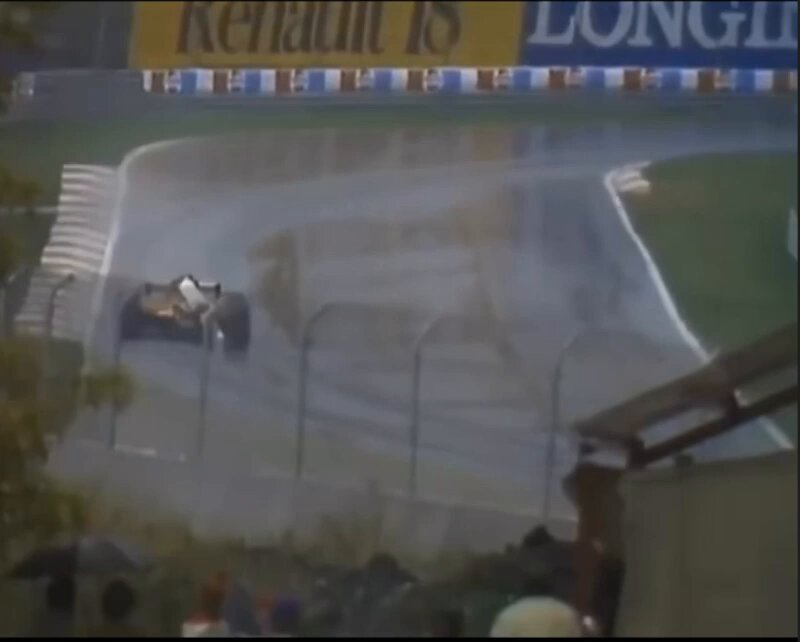
18th of January 1950 - 8th of May 1982 🇨🇦 Gille Villeneuve - Full name Joseph Gilles Henri Villeneuve 44 years today F1 lost one of its brightest stars. 🇨🇦 1981 Canadian Grand Prix The 1981 Canadian Grand Prix is etched in Formula 1 history as one of Gilles Villeneuve’s greatest "driving on instinct" moments. Held on September 27, 1981, at the Circuit Île Notre-Dame (now Circuit Gilles Villeneuve), the race was dominated by torrential rain and freezing conditions. Villeneuve’s performance that day is legendary because he finished the race on the podium despite his car being severely damaged. While battling through the field in the wet, Villeneuve made contact with another car, which damaged his front wing. The wing folded upward, completely blocking his forward vision. Instead of pitting immediately, Villeneuve used his peripheral vision—looking out the sides of the cockpit—to navigate the corners at high speed. Eventually, the wing flew off entirely. Despite the missing aerodynamic downforce and the treacherous track surface, he brought his Ferrari 126C home in 3rd place. 15 years after his death his son Jacques Villeneuve would win the F1 drivers Championship for Williams. R.I.P Gille Villeneuve 🇨🇦 🇮🇹 💔 🎥 Formula 1 #villeneuve #canada #ferrari #italy
WRCPAST90,580 views • 5 months ago

🇧🇷 2003 Brazilian Grand Prix Car 14 🇦🇺 Mark Webber - Jaguar R4 Cosworth V10 Car 8 🇪🇸 Fernando Alonso - Renault R23 V10 Lap 54 of a scheduled 71 laps (race eventually red-flagged and called). Mark Webber 💥 Webber lost control of his Jaguar at roughly 150 mph on the fast rise/approach to the start-finish straight (Arquibancadas). Outcome: Massive accident which destroyed the car and scattered green carbon-fibre debris across the circuit. Webber sat shaken in the remaining tub, unhurt. Fernando Alonso 💥 Race leaders Giancarlo Fisichella and Kimi Räikkönen narrowly threaded past the wreckage. Alonso approaching flat-out was caught out by visibility/radio comms through yellow flags, clipped one of Webber’s stray wheels. Alonso was launched violently into the barriers—recording a reported 35g impact into the tyre wall followed by a 60g secondary hit against the concrete. Alonso was concussed/bruised, evacuated in an ambulance, and missed the podium ceremony (classified 3rd). 🚩 Alonso's accident caused an immediate red flag. Due to timing confusion on the lap countback, Kimi Räikkönen was initially handed the victory on the podium while a fire-damaged Jordan smoked in pit lane. Days later, an FIA appeal confirmed Giancarlo Fisichella won the race (his maiden F1 victory). Two massive accidents for both drivers but thankfully relatively ok. 🎥 Formula 1 #brazil #cars #alonso #webber
WRCPAST20,269 views • 1 month ago

🇮🇹 1981 Italian Grand Prix Lap 20 Car 7 🇬🇧 John Watson - McLaren MP4/1 Car 4 🇮🇹 Michele Alboreto - Tyrrell 010 John Watson’s accident at the 1981 Italian Grand Prix at Monza is widely remembered as one of the most significant turning points in Formula 1 history. It wasn't just a terrifying crash; it was the ultimate, real-world test that permanently changed how racing cars were built. On Lap 20 of the race, Watson lost control of his McLaren exiting the high-speed Second Lesmo bend. The car spun and struck the trackside barriers at roughly 140 mph (225 km/h). The violence of the impact was immense and it tore the engine and gearbox completely off the back of the car. The breakaway rear assembly bounced across the track and clipped Michele Alboreto’s Tyrrell, forcing him out of the race as well. To the absolute shock of the crowd and commentators, Watson opened his visor, unbuckled his harness, and walked away from the smoking, shattered wreckage entirely uninjured. Before the 1981 season, Formula 1 chassis were traditionally constructed from sheets of riveted or welded aluminum. However, for 1981, McLaren designer John Barnard introduced the McLaren MP4/1—the very first F1 car to feature a monocoque made entirely from carbon fiber composite material. The F1 paddock was deeply skeptical of this "mysterious black plastic." Many rival designers and team bosses openly criticized the move, confidently predicting that if a carbon fiber car suffered a major accident, the chassis would "crack like an egg" or disintegrate into a lethal cloud of sharp, black dust. Watson's crash proved the exact opposite. While the aluminum parts and engine mounts sheared off as intended to dissipate energy, the central carbon fiber tub enclosing Watson remained completely intact. It didn't shatter; it absorbed and deflected the massive load, acting as an impenetrable safety cell. Watson's survival at Monza effectively validated carbon fiber technology, establishing the blueprint for the modern carbon composite survival cells that continue to save drivers' lives in motorsport today. 🎥 Formula 1 John Watson McLaren Mastercard Formula 1 Team Autodromo Nazionale Monza #f1 #cars #accident #italy
WRCPAST68,131 views • 5 months ago

🇬🇧 BBC Top Gear Motorsport 🇯🇵 1997 Subaru Impreza WRC Test Colin McRae taking Tiff Needell for a ride in his Subaru Impreza WRC97. Tiff then drives the car himself with Nicky Grist alongside and posts a time 10 seconds slower than McRae. Impressive considering the lack of time in the car and how fast McRae was in the Subaru. The WRC really was massive during the 80’s and 90’s. Another fantastic clip uploaded by VHS Rallies 👏🏻👏🏻 🎥 Top Gear Motorsport 👏🏻👏🏻 #japan #subaru #mcrae #wrc
WRCPAST60,934 views • 4 months ago

🇫🇷 1989 24 Hours of Le Mans Amazing fan footage taken beside the Mulsanne Straight. Historically a single unbroken straight, it was split into three equal sections by two chicanes in 1990 to limit dangerously high speeds which is the year after this footage. Overall results Car 63 🥇 🇩🇪 Jochen Mass/🇩🇪 Manuel Reuter/ 🇸🇪 Stanley Dickens - Team Sauber Mercedes Sauber C9 Car 61 🥈 🇮🇹 Mauro Baldi/🇬🇧 Kenny Acheson/ 🇮🇹 Gianfranco Brancatelli - Team Sauber Mercedes Sauber C9 Car 9 🥉 🇩🇪 Hans-Joachim Stuck/🇫🇷 Bob Wollek - Joest Racing Porsche 962C Amazing event and it will hopefully be a fantastic watch this weekend 🙏🏻 🎥 Credit to the original cameraman 👏🏻👏🏻 24 Hours of Le Mans #mercedes #porsche #france #cars
WRCPAST56,196 views • 4 months ago

🇫🇷 1989 24 Hours of Le Mans The 1989 24 Hours of Le Mans was a landmark event for Mercedes-Benz, marking the company's return to international sports car racing prominence with a dominant performance by the Sauber-Mercedes team. The Sauber-Mercedes C9s secured a resounding 1st, 2nd, and 5th place finish. The 1989 24 Hours of Le Mans was a landmark event for Mercedes-Benz, marking the company's return to international sports car racing prominence with a dominant performance by the Sauber-Mercedes team. Overall results Car 63 🥇 Drivers - Jochen Mass, Manuel Reuter, Stanley Dickens Car - Sauber C9 / Mercedes-Benz M119 Team - Team Sauber Mercedes Car 62 🥈 Drivers - Mauro Baldi, Kenny Acheson, Gianfranco Brancatelli Car - Sauber C9 / Mercedes-Benz M119 Team - Team Sauber Mercedes Car 9 🥉 Drivers - Hans-Joachim Stuck, Bob Wollek Car - Porsche 962C Team - Joest Racing Decided to keep the very chic photographer at the end as we always need a bit of glamour. Enjoy 🔥🔥 🎥 24 Hours of Le Mans 👏🏻👏🏻 #cars #porsche #mercedes #lemans
WRCPAST47,114 views • 4 months ago

40 Years Ago Today 26th of March 1958 - 15th of May 1986 🇮🇹 Elio de Angelis - 28 years of age ⚠️ Information about the fatal accident Elio de Angelis was a prominent Italian Formula One driver known for his elegance, musical talent, and technical skill. Often called the "last gentleman player" of F1, he was highly respected by his peers for his polite demeanor and fair racing style. Racing Career (1979–1986) De Angelis competed in 108 Grands Prix, primarily for Lotus, where he achieved his greatest successes. Death and Circumstances De Angelis died following a testing accident on May 14, 1986, at the Paul Ricard Circuit in France. The Accident During a test session, the rear wing of his Brabham BT55 detached at approximately 270 km/h. The loss of downforce caused the car to cartwheel over a barrier and land upside down, where it caught fire. This being a test day, nobody witnessed the whole incident, although two Benetton mechanics manning a speed trap caught the final stages. The car became airborne and then flipped into a series of rolls that pitched it over the guardrail, before it eventually came to rest inverted. The survival cell was intact, but the rollhoop and the fuel tank had been damaged as the car bounced over the barrier, and fuel was leaking out. De Angelis himself had suffered only a broken collarbone. Initially there was only some smoke. With little official help – Alan Jones who was the first driver on the scene said later that he was joined by two marshals wearing shorts "who just didn't have a clue" – attempts to turn the car over proved fruitless. Gradually a fire took hold. Meanwhile drivers, crew members from Brabham and other teams began to arrive from the pits. It was all too apparent that, this being a test day, there was insufficient safety cover – there was no Prof Sid Watkins, no fire vehicle and, it soon emerged, no helicopter. The main problem was not being able to turn it over. Because he was not badly injured he could have been pulled out pretty quickly, had the fire been kept down a bit. Eventually de Angelis was removed from the car. He'd been starved of oxygen by the flames, and it was discovered that he had no heartbeat. "We took his helmet off, and we really weren't sure of his condition," said Alexander. "Here was this guy with absolutely nothing wrong with him as far as we could see – there was no blood, nothing. "There was a young medical guy there with us, who didn't speak English, and in the end he got out a big syringe and stuck it in his chest. "Eventually a helicopter came, with some paramedics. They checked his pulse and stuff, and the line was moving. We carried the stretcher over to the helicopter." Having been resuscitated, de Angelis was transferred to the same hospital and seen by the same doctors who had treated Frank Williams after his road accident just a few months earlier. The rescue had come too late for de Angelis, and he died the following day in hospital, a victim of asphyxiation. Horrendous and so preventable 🥹💔 A clip of Elio de Angelis and his first win 🏆 R.I.P 💔💔 🎥 Formula 1 #italy #cars #france #accident
WRCPAST53,732 views • 5 months ago

⚠️ Accident Footage ⚠️ 🇲🇽 1988 Mexican Grand Prix Car 30 🇫🇷 Philippe Alliot - Larrousse Lola LC88 Ford V8 Qualifying Philippe Alliot’s accident during the final qualifying session of the 1988 Mexican Grand Prix is remembered as one of the most violent, yet miraculously survivable, crashes in Formula 1 history. While exiting the high-speed, banked Peraltada corner at over 240 km/h (149 mph), Alliot’s Lola LC88 suffered a rear wishbone failure. After striking the outside curbing, the car pulled sharply to the right, slammed backwards into the pit wall at approximately 150 mph, and barrel-rolled across the track. The car essentially disintegrated, eventually coming to a stop. Remarkably, Alliot climbed from the wreckage unhurt. The race The Larrousse team was forced to repair the same chassis overnight because they lacked a spare; Alliot had destroyed his previous chassis just two weeks earlier at the Monaco Grand Prix. After being cleared by F1 medical chief Professor Sid Watkins, Alliot started the race. However, his race was short-lived, ending on the first lap due to a cracked rear upright—a lingering issue likely resulting from the severity of his qualifying accident. A brutal accident which amazing resulted in no one in the pit lane being hurt either. In 2025, it was reported that Alliot had been dealing with a serious battle against pancreatic cancer, but he has continued to make public appearances and maintain a resilient public presence within the historic motorsport community. Keep fighting Philippe Alliot 🥊 🙏🏻 🎥 Formula 1 👏🏻👏🏻 #f1 #crash #cars #mexico
WRCPAST44,154 views • 4 months ago

🇮🇪 1982 Rothmans Circuit of Ireland Car 3 🇫🇮 Hannu Mikkola and Arne Hertz in their Audi Quattro having all sorts of issues with the clutch. The answer?? Coca Cola and flour The crew would actually manage to finish the event 6th overall 18mins 44secs behind winners McRae and Grindrod on their Opel Manta 400. 🎥 ITV Sport with Dickie Davis. 👏🏻👏🏻 R.I.P Hannu and Dickie 🥹 Coca-Cola #audi #ireland #wrc #cars
WRCPAST44,298 views • 5 months ago

🇮🇹 1994 San Marino Grand Prix Car 2 🇧🇷 Ayrton Senna - Williams Renault FW16 V10 Senna would lead his final ever lap in F1. On lap 7, Senna’s Williams FW16 failed to negotiate the high-speed Tamburello corner. The car left the track at approximately 190 mph but Senna was able to slow the car down to approximately 131 - 145 mph before hitting the concrete retaining wall. While the impact was massive, the fatal injury was caused by a piece of the front-right suspension assembly (specifically a tie-rod) penetrating Senna's helmet. After the crash, track marshals found a furled Austrian flag in Senna’s cockpit. 🇦🇹 He had intended to raise it after the race in honor of Ratzenberger. Out of respect to Senna and his family I will not show the accident. R.I.P Ayrton Senna and Roland Ratzenberger. 🇧🇷 🇦🇹 💔🥹 🎥 #f1 #senna #imola #motorsport #cars
WRCPAST41,770 views • 5 months ago

🇯🇵 1990 Japanese GP Race Weekend Car 1 Alain Prost in his stunning Ferrari 641 V12 during one of the weekend sessions. Famously Prost wouldn’t make it past the first corner and Senna and Prost came together which retired both at the time. Senna admitted later that it was intentional and pay back for their collision at the same circuit in 1989 while McLaren teammates. Ok mates is pushing it 🤣 Anyway enjoy this unbelievable onboard and the magnificent sound. 🇮🇹 🤌🏻❤️ 🎥 Formula 1 👏🏻👏🏻 #prost #japan #v12 #ferrari
WRCPAST43,037 views • 6 months ago