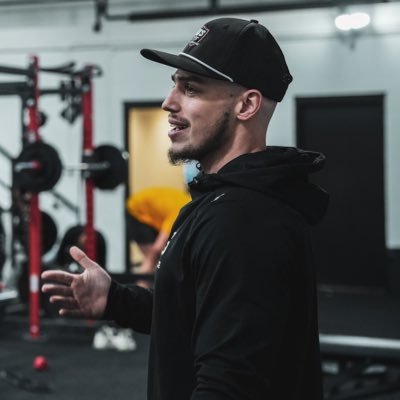
Continuing training with high intent to build high outputs... for Marshall Baseball 🦬🔥 Wednesday is usually a Max Velocity day for a couple reasons. An Acceleration-focused Monday does a really good job of not only ramping the athletes up to hit high outputs in the middle of the week, but it also is a more natural rust breaker from the weekend. Day 2: Hip Flexor Co-Contraction Bent Knee Hamstring Co-Contraction Supine Glute Ham Co-Contraction Light Split Exchange Leaps Light Hops 10 yard Sprint 20 yard Sprint Flying 10 w/ 20 yard Run-In Barbell Front Squat Split Stance DB RDL #realtrainingshow more
Nat Sauberan
18,253 Aufrufe • vor 2 Jahren
Game Day Priming for Marshall Baseball 🦬🔥 Biggest points... of emphasis: ✅Add everything in a small dosage within a short time parameter. “Small doses stimulate. Large doses annihilate.” Tony Holler ✅Program exercises that maximize intent and output. The session should be High CNS and set them up for a great performance during games or scouting. ✅Add in needed concepts as determined necessary. Love adding in the Hunter Eisenhower Force System, especially in the warm up. For this session, the goal was to get a rotational rhythm and then experience force across different time parameters depending on the high or low catch for each limb. This also extends into the circuit, just built into a crescendo for our Fast Force exercises. Warm Up: Rhythm Med Ball Side to Side Hip Toss Chest-Supported Plate Y High Drop Catch 1 Plate Drop Low Catch Circuit: Heavy Med Ball Slam Light Med Ball Slam Trap Bar Pin Pull Reactive Trap Bar Jump Bent Knee Hamstring Rebound Straight Leg Small to Large Primetimes Sprint Rest #realtrainingshow more
Nat Sauberan
58,279 Aufrufe • vor 2 Jahren
You do not need to be in the gym... six days a week. Doing so will reward you with worse progress, not more. Here's why: Fatigue accumulates. Not just from session to session. From week to week. From month to month. The hard leg session on Monday leaves a tax that has not been fully paid by the time you're back under a bar on Tuesday. Multiply that across six sessions and you are walking into every workout pre-fatigued. The first casualty is your high threshold motor units. The fibres with the most growth potential. The ones recruited only when the muscle is fresh enough to call on them with real load. Train under accumulated fatigue and those fibres never get touched. You're left stimulating the lower threshold fibres you maxed out years ago. Two rest days a week should be the bare minimum for anyone training hard. Three is better. Four sessions of about an hour each is not the maintenance protocol the high-volume crowd will tell you it is. It is the optimal dose for a natural lifter who wants to actually grow. Four hours of lifting a week. Four. That's it. The best physiques in your gym are almost always built on less work than the worst. The volume bros sweat five hours a week for a body the four-hour man built while still having time to read a book. More is not the answer. Recovered is.show more

Sama Hoole
147,964 Aufrufe • vor 4 Monaten
Ass Bench Update 🚨 After running GPT 6 Astra... in a loop for the past week, with a couple of steers a day, we have officially reached high-fidelity cheeks. I’m going to let this thing run in a self-improving cycle for as long as I can and see where the ass technology ends up in a month. Lots of different butt styles will be added, so no one is safe. Not even you, Granny. You’ll also be able to support the project and help fund the benching of other models like Fable, Gemini, etc. All it takes is a buck, and you can slap your sticker + website directly onto a cheek. The future of AI benchmarking is here More Soonshow more

Dev Ed
7,340,855 Aufrufe • vor 13 Tagen
The Bro Split that every young lad gets sold... on looks like this.⠀ ⠀ Monday: Chest⠀ Tuesday: Back⠀ Wednesday: Rest⠀ Thursday: Legs⠀ Friday: Shoulders⠀ Saturday: Arms⠀ Sunday: Rest⠀ ⠀ And yes, Arnold did it. Arnold also took enough drugs to sedate a medium-sized country, so perhaps not the most transferable template.⠀ ⠀ The problem is simple. Each muscle here gets hit once a week. Train hard enough and you'll trigger a window of muscle protein synthesis that runs for roughly 2-3 days. After that the window closes, and the muscle fibres begin to catabolise slowly. The back half of the week isn't neutral. It's quietly eroding the growth stimulus you picked up on Monday.⠀ ⠀ Once a week is not a holding pattern. It's a losing one.⠀ ⠀ The fix is training each muscle at least twice. An upper/lower split does this cleanly.⠀ ⠀ Monday: Upper⠀ Tuesday: Lower⠀ Wednesday: Rest⠀ Thursday: Upper⠀ Friday: Rest⠀ Saturday: Lower⠀ Sunday: Rest⠀ ⠀ Same days in the gym. Every muscle getting two shots at the growth window per week instead of one.⠀ ⠀ If there's a specific muscle you want to bring up faster, glutes being the obvious example, you can push that to three times a week with a full body approach, hitting the priority muscle first in every session when you're freshest.⠀ ⠀ Monday: Full Body (glutes first)⠀ Wednesday: Full Body (glutes first)⠀ Friday: Full Body (glutes first)⠀ ⠀ More frequent stimulus. More growth windows captured. Less of the week spent sliding backwards.⠀ ⠀ The Bro Split isn't useless. It just isn't optimal. And if you're going to spend the time, you may as well spend it on something that actually works.⠀ ⠀ Minimum twice a week per muscle. Three if you're serious about a lagging group. The rest is just detail.show more

Sama Hoole
24,136 Aufrufe • vor 5 Monaten
Test Sprint 2 wrap-up + reward decision — please... read in full Test Sprint 2 is done, and it ran better than Test Sprint 1. These are still our test sprints — we're using them to stress the system before things go fully live. The new tracking is holding up well overall; the one issue we hit is that publication counts glitch under peak load. We're already fixing it. Now the hard part. A large share of participants this sprint chose to game the system, and the volume of violations is simply too high to score the board fairly. So here's the call: the entire 1st-place reward pool gets split among ranks 11–50. Breakdown: - Ranks 11–25 → $20 USDC each - Ranks 26–30 → $10 USDC each - Ranks 31–50 → $100 in $CLAR each To make that happen, I'm placing my own account at #1 to hold the pool. Within 24 hours I'll push these rewards straight to the wallet linked to your profile. Make sure your linked wallet is correct and that you still have access to it. And to be clear — this is on top of what you can already claim in the leaderboard. Your own leaderboard rewards stay claimable as usual; this redistribution comes as an extra. We'd rather pay the honest contributors than reward farmed numbers. That's the standard from here on. 🫡show more

Clarnium.io
31,085 Aufrufe • vor 3 Monaten
GPT-6 Astra vs Fable 5.1 vs Kimi K3 vs... Sol Astra: Took 11 minutes. This is from a follow-up after the first attempt had rendering and UI bugs. The smoke feels a little off. I expected more detail, but it did a good job understanding the intent. Cost: $12.85. Fable 5.1: Took 18 minutes to complete the same test with high detailing. Cost: $12.60. Kimi K3: Took 10 minutes with a similar level of output and cost only $6.95. SOL: Took 7 minutes, but the output seemed messy. Cost: $5.78. Personally, I like Kimi K3 for delivering similar quality with better token efficiency, followed by fable 5.1 for realism. What about you? I’ll do a couple more tests before coming to a conclusion.show more

Bhavy☄️
77,499 Aufrufe • vor 17 Tagen
INF Gavin Kilen (Tennessee Baseball) will be a key... piece within a loaded Tennessee lineup this season. Earned the starting 2B job as a Freshman and contributed, but broke out last spring to the tune of a .330/.361/.591 slash line with 23 2B, 3 3B, 9 HR and 41 RBIs. Kilen is slightly undersized and has an average build at 5'11 and 180-lbs. Some room to fill out and add ~10 pounds or so. Relaxed, slightly crouched stance in the box with a medium high handset. Minimal load in which his hands drift slightly, leg lift leads into a small stride. Short, compact swing and takes a direct path to contact. Above-average hand speed, it's an operation that's tailored towards spraying line drives all over the yard. Kilen is a hit-over-power profile with an aggressive approach in the box. He has plus bat-to-ball skills and his feel for the barrel is evident. Last spring, Kilen worked a 93% IZ contact rate, including 95% against FB. His aggressive approach and somewhat free-swinger mentality does lead to some chase up against FB and secondaries down, but it hasn't been a hindrance to his production. Kilen pounces on pitches in the zone and steps in the box ready to hit. Would give his hit tool a 55. It's more gap power than it is over the fence power for Kilen, but he did tap into some more impact last season. Part of that is due to getting the ball up in the air more: between '23 and '24 he increased his FB+LD% from 44% to 51%. It will always play as slightly below average (fringy), but he did post a Max EV of 108.5 during the spring and 101.4 this summer. Kilen's HR impact and highest quality of contact comes to the pull side. Vast majority of his XBH power comes on pitches in the bottom-half of the zone, which makes sense given his bat path. Has shown the ability to work from gap-to-gap. Kilen was Louisville's every day SS last spring, but he'll slide over to 2B this season for Tennessee. I actually think that's where he profiles best defensively as a professional, where he has an average arm with some range. After seeing him at SS for a couple of summers, his actions and clock translate better at 2B. Kilen is a day 1 type this July with top-55 overall upside.show more

Peter Flaherty III
37,954 Aufrufe • vor 1 Jahr
He buys weather contracts for 2–20 cents and sells... them for $1. After 2 months, he makes $8,938 in profit. 2,782 transactions, with individual transactions yielding returns of 500–4,300%+. How it works: Polymarket asks: “Will the high in London be 19°C on June 9?” For forecasts 1–3 days in advance, weather models (GFS, ECMWF) have an accuracy of ±1°C. The market does not take this into account and estimates the probability roughly - Hence the gap between the price and the actual probability. Input logic: - Buys Yes at 2–20¢ when their own probability assessment is significantly higher than the market price - Diversifies across cities: London, Munich, Paris, Madrid, Istanbul, Istanbul - Maintains a small position size ($20–200) - limited risk, high upside potential Why doesn't everyone do this: It takes discipline to check the forecast every day and quickly open positions within a narrow time window. The market is inefficient precisely because most traders don't want to bother with weather APIs just for a few cents' difference in price. This isn't investment advice - it's just a good example of an information edge in a niche market.show more

Dekos
15,631 Aufrufe • vor 2 Monaten
Andrew Painter looks like a man changed: 7 IP,... 4 H, 1 R, 8 K, 20 Whiffs Changes? Grip *differences* look more like natural variance than anything -- would assume the body is moving differently: presetting into the glute + holding that hinge but the 4S looks legit It's the second start in a row where he's sitting over 97.0 MPH with over 18" of vert and a flatter approach than what we're used to, not to mention nearly 2500 RPM. The 4S missed a ton of bats and generated chases at a high clip -- not including touching 100 MPH on his 100th pitch Secondaries only seem to improve. The trio of breakers collectively got over 40% whiff, while the changeup induced plenty of weak contact + chases below the zone. Command of the split-change to lefties was near-perfect + slider was commanded well to both sides. 4S and sweeper found the middle a bit too often, but Painter was able to mix it well enough to keep the hitters unbalanced. With Nola's resurgence, Phillies staff might be a five-headed monstershow more

Joseph Cammisa
20,231 Aufrufe • vor 1 Monat
Americans handed over about 253 billion dollars in credit... card interest and fees in a single year, and for millions the debt never actually shrinks. Total household debt in the United States just hit a record of about 18.8 trillion dollars. Credit cards are only a slice of that, but they are the cruelest slice, because the interest rate almost never drops below 20 percent. Here is what that does. If you carry a balance of 5,000 dollars and pay only the minimum, it can take more than 15 years to clear, and cost you more than 6,000 dollars in interest alone. You end up paying for the same purchase twice. The amount Americans pay each year just in card interest is now more than triple what it was in 2021. This is not an accident of the market. High rates and low minimum payments are built to keep you paying, slowly, for as long as possible.show more

Anonymous
57,255 Aufrufe • vor 1 Monat
RHP/1B Trace Phillips (Middle Tennessee Baseball) is an interesting... draft-eligible sophomore on which to keep close tabs. Last spring, he hit .304/.360/.547 with 8 2B, 13 HR and 47 RBIs, but it’s his ability on the mound that's the root of his buzz. Phillips' back of the baseball card numbers last season are modest, but there is more to it than meets the eye. At 6'3" and 185-lbs, Phillips has an athletic, high-waisted frame. In the box, he has a simple setup with an ear-high handset and the bat horizontal above his back shoulder. Phillips has a slight load in which he has a noticeable barrel tip and a small stride. He moves well in the box and has some scissor action with his back leg. Phillips’ pure hit tool is fringey, but he has plus raw power and has shown the ability to drive the baseball to all fields. Max EV last spring of 109.4, if he's able to lift the ball more it will lead to a more impressive power output. Phillips’ current prospect status is largely driven by his ability on the mound. His numbers were unimpressive last season, but he took a step forward this fall. There’s some low hanging fruit to clean up in his delivery, but he has a short, whippy arm stroke and attacks from a low-three quarters slot with plenty of arm speed. Phillips’ FB has been up to 96 with ride through the zone (particular life at the top), though his best pitch is a high-70s-to-low-80s CH. He does a nice job of killing spin on it, and It averaged almost 15 MPH off his fastball this fall. It’s a plus pitch that flashes both fade to the arm side as well late tumble. Phillips completes his arsenal with a mid-80s slider that flashed above-average this fall with sharp, two-plane tilt. Both his changeup and slider profile as legitimate swing-and-miss offerings. Another positive development with Phillips this fall is that his strike-throwing took a step in the right direction. Mid-4th-6th round type this July. (📽️: Middle Tennessee Baseball)show more
Peter Flaherty III
10,984 Aufrufe • vor 1 Jahr
RHP Cole Leaman (Lehigh Baseball) is an arm I'm... really looking forward to following this spring. Fresh off a strong Sophomore season in which he worked a 2.31 ERA with 49 Ks to 23 BB across 46.2 IP. Showed some positive flashes on the Cape. While slightly undersized, Leaman has a strong and athletic build at 6' and 190-lbs. Has put on a lot of good weight over the last couple of years. Leaman has almost a "check point" delivery in which he takes a noticeable side step towards the 1B side, gathers himself and breaks into the rest of his motion. Lengthy arm stroke and attacks from a high-3/4 slot from a low release height. Leaman is a high-level athlete and a dynamic mover on the mound. Sits really well on his back glute and his lead leg block enables him to generate power and drive his back side through. Drop and drive delivery. Little bit of effort, but plenty of arm speed. Leaman's FB sits in the 91-94 range, but it was up to 96 this summer and 98 this fall. Jumps out of his hand from a ~5'3" release height and flashes riding life through the zone. Averaged 15" of carry this summer and 2,361 RPMs. Gets over the barrels of opposing hitters when located in the top-1/2 of the zone, which is where the pitch is at its best. Command can be erratic at times. Would give it a 55. Leaman's most-used off speed pitch is a high-70s-to-low-80s CB. Shape is inconsistent and it can get a little slurvy at times, but he snapped off a handful of really good ones between the spring and summer. When it's at its best, it will flash a bigger shape with sharp, downward tilt. Leaman will also mix in a low-to-mid-80s SL that's distinct in shape. Another pitch he's still gaining a feel for, but like his CB it's also shown big time flashes. Shape of it will vary, but it will sometimes flash plus with sharp, two-plane break (more sweep than depth) and essentially take a late, hard left turn. Rounds out his arsenal with a high-80s cutter and a mid-to-high-80s CH. The former is more intriguing than the latter. Curious to see how much he uses the cutter this spring, threw a couple this summer that had late glove-side life. Leaman has a very intriguing blend of athleticism and stuff, though he'll need to iron out his command and control in order to maximize his upside. As mentioned, it's a bit scattered right now and has hindered him in some starts. 5th-8th round type this July. (📽️: Falmouth Commodores)show more
Peter Flaherty III
26,757 Aufrufe • vor 1 Jahr
Minnesota has decided to pay workers up to $28,460... per year to take 20 weeks off. The paid leave is not just available to Somali citizens it is also available to illegal aliens. Paid time off for family or medical needs, covering things like bonding with a new baby, caring for a sick relative, or dealing with health issues. It’s capped at 12 weeks for medical leave and 12 for family leave, but you can combine them up to the 20-week max in a benefit year. Sweet. So who’s paying for it? A 0.88% payroll premium—split roughly evenly between employers and employees—expect billions to be raked in from hardworking people in Minnesota. ZERO GUARDRAILS: Manually designate ANYONE as the person you “cared” for—even out-of-state relatives—and collect taxpayer cash while on “vacation.” • Up to $1,423 PER WEEK • Up to 20 weeks of paid time off • Lawmakers warn of BILLION-DOLLAR fraud risks • Walz? Crickets. He doesn’t give a damn. As one critic puts it: “I can designate my uncle in Florida, head off on vacation, and it’s on YOUR EMPLOYER to prove otherwise! Cash in on 20 weeks of paid time off in the latest taxpayer funded giveaway.show more

JOSH DUNLAP
251,833 Aufrufe • vor 8 Monaten
This is not a mountain collapse caused by a... natural disaster. This is what Israel is doing in Lebanon every day: blowing up mountains—along with residents' homes—flattened village after village, despite the signed agreement, and despite that these villages are within the occupied territory. These are war crimes under international law: Wanton devastation not justified by military necessity, protected under Article 54 of Additional Protocol I to the Geneva Conventions. It is also an act of genocide according to Article Il of the UN Genocide Convention. Yet, the UN High Commissioner for Human Rights does not view them as war crimes—just as he saw no genocide in Gaza!show more

Mohamad Safa
19,137 Aufrufe • vor 21 Tagen
The 3.7 cm SockelFlak L/14.5 was a lightweight German... AA gun from late World War I. Designed by Krupp for Zeppelin defense but too heavy for air use, it hit the ground in 1917 at just 474 pounds with a short 14.5-caliber barrel firing 37mm rounds at 1,150 fps up to 7,200 feet. It fed 10-round clips at 120 rounds per minute on a 360-degree pedestal mount, using a knee trigger for fast tracking despite dirt jams. Around 150 were built in 1917 with the first 20 delivered in December. An order for 190 was placed but only 150 reached service by the November 1918 armistice, seeing limited action as one of Germany's earliest dedicated light AA guns.show more

Aviation Archive - Tim Farmer
175,767 Aufrufe • vor 2 Monaten
⚾️ It is no secret that elbow injuries, specifically... UCL injuries, have been on a rise in recent years ➡️ The reason for this is so multi-factorial that it is impossible to pinpoint any 1 reason for an injury 💪 With the constant improvement in the development of pitchers, both skill side and S&C, we are seeing an increase in velocity across all levels of baseball 🎟This is obviously a Great thing for Punching Tickets but also leads to more forces being passed through the medial elbow 🔥There are really 3 proactive actions we actions we can take to counteract this: 1) Address pitching mechanics if there are deficiencies 2) Appropriately manage chronic/acute AND Total workloads 3) Increase the capacity and stress the elbow can handle 🔥 We will specifically dive in to the 3rd component of this in this thread. In short, the answer is simple, GET STRONG FOREARMS 3 WAYS VALGUS FORCE IS DISPERSED ✅ Radiocapitellar Joint Compression When a valgus stress is applied to the elbow, it is attempting to open up or gap the medial (inside) portion of the elbow. This is also the Orthopedic Test for a UCL injury. While this force is trying to gap the medial portion of the elbow, it is also compressing the lateral side. When the radius and lateral humerus compress, this acts as a stopping point for the elbow going into that valgus motion ✅ Forearm Musculature In addition to the UCL on the medial side of the elbow, there is also a group of forearm muscles that span that area and attach to the same portion of the elbow, the medial epicondyle. These muscles include: Pronator Teres, Flexor Carpi Ulnaris, Flexor Carpi Radialis, Flexor Digitorum Superfiscialis, and the Palmaris Longus. With that specific attachment to the medial epicondyle and their respective distal attachments, these do a great job of accepting the valgus force and protecting the UCL. There is some research that states FCU does the best job of the muscles listed, but we believe the best action is to strengthen all of them. The best ways to attack this is with movements including: finger flexion, wrist flexion, Ulnar deviation (moving pinky towards medial elbow), and Pronation of the forearm ✅ Ulnar Collateral Ligament (UCL) What doesn’t get absorbed by the first two structures is placed on the UCL. Previous research has shown that a UCL with no other structures involved is able to withstand ~35 nm of force before failure The Problem is: Every Pitch produces far more than 35nm of Valgus Stress. This shows us just how important the other 2 mechanisms are! * Exercises in the videos should be a complement to your entire S&C Program and is not designed to replace itshow more

Armored Heat
33,221 Aufrufe • vor 3 Jahren