The Soviet Buran program developed reusable orbital spacecraft comparable... to the U.S. Space Shuttle, but with far more advanced automation. Its lone 1988 mission showcased a fully unmanned launch, orbit, and autonomous landing—an unprecedented achievement at the time. Lifted by the Energia rocket rather than onboard engines, the orbiter relied on sophisticated avionics and a unique engine-less design. Despite its technical success, the Buran program was canceled after the Cold War, and the only flown orbiter was later destroyed in a 2002 hangar collapse.show more

Wars
15,058 Aufrufe • vor 8 Monaten
China's first reusable rocket, Zhuque-3, sadly failed its maiden... flight. The first stage failed to recover during the landing, but the actual landing point was very close to the expected location. The second stage successfully entered the predetermined orbit. Failure is the mother of success. This is a brand new area for China's space program. Learn from this failure and wish for success next time!show more

Li Zexin 李泽欣
330,024 Aufrufe • vor 10 Monaten
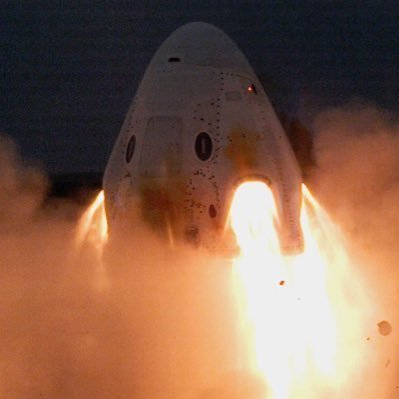
Dragon Launch Escape Initiated During the launch escape test,... where SpaceX intentionally destroyed an entire rocket to prove its safety, Dragon was fed the normal launch sequence for an ISS mission. Dragon wasn’t told to escape, but its onboard autonomous flight computers noticed the loss of thrust on Falcon before the Merlin engines could even fully shut down. Once Dragon realized there was a mission critical anomaly, it instantly initiated the launch escape sequence firing all 8 SuperDraco thrusters, separating explosive bolts on the second stage, and took autonomous control of the mission, in less time than any human reaction on the ground or in the capsule could of realized. Falcon, the crew, Dragon, and the ground can all initiate an escape if required. Although this test was uncrewed (meaning nobody was on the rocket during the test), if there was a life threatening emergency that would put the mission at risk, Dragon could leave and get out of the situation immediately.show more
SpoxSpace
79,093 Aufrufe • vor 1 Jahr
🚀 CHINA JUST TOOK A MAJOR STEP TOWARD REUSABLE... ROCKETS China successfully launched the Zhuque-3 reusable rocket on August 19, and, for the first time, successfully landed an orbital-class first-stage booster on land using landing legs. The rocket was developed by Chinese private space company LandSpace, whose previous Zhuque-3 recovery attempt in December 2025 failed during landing.show more

Mossad Commentary
38,654 Aufrufe • vor 2 Monaten
An SU-34 closes in, hot on the tail of... a Saab JAS 39 Gripen. The Sukhoi SU-35 stands as one of Russia’s most formidable fighter jets, renowned for its sheer size and striking presence in the sky. Its twin engines, broad wingspan, and aggressive silhouette make it tower over lighter fighters like the Saab JAS 39 Gripen, projecting dominance both on the ground and in flight. The SU-35’s design balances raw power with refined aerodynamics, creating a jet that is as agile as it is visually imposing. Developed in the late 2000s as an advanced evolution of the SU-27, the SU-35 features thrust-vectoring engines that enable maneuvers beyond the capabilities of most aircraft. It can exceed Mach 2.25 and fly nearly 2,200 miles without refueling. Its sophisticated radar can track up to 30 targets simultaneously and engage multiple threats at once, making the SU-35 not just a giant of the skies, but a precision predator in combat.show more
Wars
10,727 Aufrufe • vor 8 Monaten
This video shows a static fire test of the... Archimedes rocket engine, developed by Rocket Lab. Archimedes uses liquid methane (LCH.) as fuel and liquid oxygen (LOX) as the oxidizer, a combination known as methalox. During combustion, these cryogenic propellants produce extremely high temperatures (over 3,000°C), hotter than lava. To survive this, the engine circulates cold fuel through its walls before burning it, a technique called regenerative cooling. Multiple Archimedes engines will power Rocket Lab's upcoming Neutron rocket, which is being built to launch satellites and cargo to orbit with lower cost and higher reliability. Rocket Lab is best known for its Electron rocket and is now expanding into larger, reusable launch vehicles with Neutron.show more

Mechanical Knowledge
19,463 Aufrufe • vor 5 Monaten
62 years ago and still going viral from time... to time September 21, 1964 - North American XB-70, a prototype Mach 3 bomber, has an incident in California. On landing at Edwards AFB after its maiden flight, a landing gear malfunction caused a fire on touchdown. Damage to the aircraft was repaired shortly after, and the test program continued. Despite impressive performance, the XB-70 Valkyrie program was cancelled in 1969 due to factors such as high costs and the introduction of intercontinental ballistic missiles limiting its intended role. The jet involved in this mishap [62-001] was one of only two XB-70s built and is currently on display at Wright-Patterson AFB. The other jet [62-002] was lost in a fatal accident during a photo shoot in 1966.show more

Francisco Cunha - ✈️ Aviation et al
41,259 Aufrufe • vor 29 Tagen
This is not AI. On January 19, 2025, during... Starship Flight 7, SpaceX's Super Heavy booster made a flawless return to the launch pad, caught by its massive mechanical arms. This reusable rocket milestone demonstrates how close we are to rapid, fully reusable spaceflight-boosters landing safely, ready to be refueled and flown again, paving the way for more frequent and affordable space missions. ( 🎥 Space Agency )show more

Philosophy Of Physics
21,813 Aufrufe • vor 8 Monaten
NEWS: SpaceX has released a statement after today's successful... 11th Starship test flight. "Every major objective of the flight test was achieved, providing valuable data as we prepare the next generation of Starship and Super Heavy. The flight test began with Super Heavy igniting all 33 Raptor engines and ascending over the Gulf. The successful first-stage ascent was followed by a hot-staging maneuver, with Starship’s upper stage igniting its six Raptor engines to continue its flight to space. Following stage separation, the Super Heavy booster completed its boostback burn to put it on a course to a pre-planned splashdown zone off the coast of Texas using 12 of the 13 planned engines. Under the same angle of attack tested on the previous flight, the booster descended until successfully igniting all 13 planned engines (including one that did not relight during the boostback burn) for the high-thrust portion of the landing burn. The booster successfully executed a unique landing burn planned for use on the next generation booster. Super Heavy hovered above the water before shutting down its engines and splashing down. After completing a full-duration ascent burn, Starship achieved its planned velocity and trajectory. During flight, Starship successfully deployed eight Starlink simulators and executed the third in-space relight of a Raptor engine, demonstrating a critical capability for future deorbit burns. Starship re-entered the Earth’s atmosphere and was able to gather extensive data on the performance of its heatshield as it was intentionally stressed to test the limits of the vehicle’s capabilities. In the final minutes of flight, Starship performed a dynamic banking maneuver to mimic the trajectory that future missions returning to Starbase will fly. Starship then guided itself using its four flaps to the pre-planned splashdown zone in the Indian Ocean, successfully executing a landing flip, landing burn, and soft splashdown. Focus now turns to the next generation of Starship and Super Heavy, with multiple vehicles currently in active build and preparing for tests. This next iteration will be used for the first Starship orbital flights, operational payload missions, propellant transfer, and more as we iterate to a fully and rapidly reusable vehicle with service to Earth orbit, the Moon, Mars, and beyond."show more

Sawyer Merritt
273,302 Aufrufe • vor 1 Jahr
Watch our Blue Ghost Mission 2 lunar lander come... together! This timelapse captures the assembly of our lander's main structural and fluid components. Next up, integrating avionics, payloads, and engines. Our Riders 2 the Dark mission features two vehicles: our Blue Ghost lander stacked atop our Elytra orbiter. Each is assembled separately before stacking at the launch site, creating a 22-foot-tall spacecraft—more than 3X the height of our Mission 1 lander. Stay tuned for Elytra stacking in the coming weeks!show more

Firefly Aerospace
44,811 Aufrufe • vor 3 Monaten
Our Blue Ghost Mission 2 milestones are stacking up...... 22 feet to be exact! The team completed structure qualification testing at NASA JPL on our fully stacked Blue Ghost lander and Elytra Dark orbiter model. After a series of vibration and acoustic tests, this milestone helps prove our spacecraft are equipped to withstand the intense environments they’ll experience during launch and in transit to the Moon. Congrats to the team and thanks JPL for the hospitality at y'alls historic test facility. More on the mission here:show more
Firefly Aerospace
54,154 Aufrufe • vor 10 Monaten
After 82 years, a powerful symbol of Estonia’s fight... for freedom is finally coming home. 🇪🇪 In September 1944, as Soviet forces advanced on Tallinn, a young Estonian, Eugen Vilder, climbed the flagpole at Kadriorg Palace and rescued the Estonian flag so it would not fall into Soviet hands. For decades, that very flag was preserved far from home in Australia. The blue-black-white had flown over Kadriorg for only a few brief days during the government of Otto Tief — a fragile moment of Estonian independence between the collapse of Nazi occupation and the arrival of Soviet rule. Now, more than eight decades later, the flag returns to Estonia as a reminder of courage, resistance, and the unbroken will of a nation that refused to forget its freedom.show more

Margus Tsahkna
143,970 Aufrufe • vor 7 Monaten