We validated 7 different systems programming languages across three... dimensions: 1. Type safety 2. Ease of use 3. Frequency of footguns To make the results scientifically undeniable, we visualized everything using the BALLS framework. Behold our benchmarks. Exported via ffmpeg-rsshow more

The Institute for Type Safe Memetic Research
46,610 Aufrufe • vor 2 Monaten
3-4-2-1 > 3-1-5-1 > 5-4-1 Two different rotations in... attack using the AM's to overload the oppositions midfield ⚽️ Start of the transition they position themselves at the peak of the diamond, the further we move up the field, we create the ultimate overload imo creating a 3-1show more

fmcatenaccio
41,085 Aufrufe • vor 8 Monaten
New Generation Model! 🚨 We're introducing the Mistral model... to our expanding lineup of generation models. Mistral brings efficient performance and strong language understanding capabilities to our platform. Initial testing shows promising results in code comprehension and generation tasks, making it a valuable addition to development workflows. While we continue to optimize its implementation, early benchmarks demonstrate consistent and reliable outputs across various programming tasks.show more

ALCHEMIST AI 🔮
16,435 Aufrufe • vor 1 Jahr
Full day 3 of our Springball lift for or... Line Group. thread. Day 1 and 2 are Squat and Bench Focused. We do cut the volume down by about 1/3 during springball. Priority goes to the lift we get the most MEANINGFUL results from. Low box clean 3x2 at 75%show more

Conor Hughes
49,170 Aufrufe • vor 1 Jahr
We’re excited to introduce ShinkaEvolve: An open-source framework that... evolves programs for scientific discovery with unprecedented sample-efficiency. Blog: Code: Like AlphaEvolve and its variants, our framework leverages LLMs to find state-of-the-art solutions to complex problems, but using orders of magnitude fewer resources! Many evolutionary AI systems are powerful but act like brute-force engines, burning thousands of samples to find good solutions. This makes discovery slow and expensive. We took inspiration from the efficiency of nature. ‘Shinka’ (進化) is Japanese for evolution, and we designed our system to be just as resourceful. On the classic circle packing optimization problem, ShinkaEvolve discovered a new state-of-the-art solution using only 150 samples. This is a big leap in efficiency compared to previous methods that required thousands of evaluations. We applied ShinkaEvolve to a diverse set of hard problems with real-world applications: 1/ AIME Math Reasoning: It evolved sophisticated agentic scaffolds that significantly outperform strong baselines, discovering an entire Pareto frontier of solutions trading performance for efficiency. 2/ Competitive Programming: On ALE-Bench (a benchmark for NP-Hard optimization problems), ShinkaEvolve took the best existing agent's solutions and improved them, turning a 5th place solution on one task into a 2nd place leaderboard rank in a competitive programming competition. 3/ LLM Training: We even turned ShinkaEvolve inward to improve LLMs themselves. It tackled the open challenge of designing load balancing losses for Mixture-of-Experts (MoE) models. It discovered a novel loss function that leads to better expert specialization and consistently improves model performance and perplexity. ShinkaEvolve achieves its remarkable sample-efficiency through three key innovations that work together: (1) an adaptive parent sampling strategy to balance exploration and exploitation, (2) novelty-based rejection filtering to avoid redundant work, and (3) a bandit-based LLM ensemble that dynamically picks the best model for the job. By making ShinkaEvolve open-source and highly sample-efficient, our goal is to democratize access to advanced, open-ended discovery tools. Our vision for ShinkaEvolve is to be an easy-to-use companion tool to help scientists and engineers with their daily work. We believe that building more efficient, nature-inspired systems is key to unlocking the future of AI-driven scientific research. We are excited to see what the community builds with it! Learn more in our technical report:show more

Sakana AI
360,407 Aufrufe • vor 11 Monaten
we just scaled a B2B SaaS from $0 to... $420k ARR in 30 days… and we used ONLY linkedin the most UNTAPPED lead gen platform of 2026 so i just sat down, pressed record, and dropped a 14-minute masterclass going through the ENTIRE GTM system behind how we did this here's what's included: 1. the two-phase framework behind every post we publish 2. exact lead magnet structure that got 6,000 comments from a single post 3. how we repurposed one post across 5 profiles and turned 1,000 comments into 9,000 4. our comment reply script that drives free trials before people even open a resource 5. the DM triage system for handling thousands of conversations at once 6. our conversion architecture inside every lead magnet 7. the hook library with our top performers and why each one worked 8. the profile optimization that took conversions from 2% to 8% 9. the exact content calendar that we followed for 30 straight days 10. the trend monitoring system that let us post within 24 hours of any major launch 11. our email capture play (4,800 subscribers in 30 days) 12. the posting cadence, repurposing schedule, and DM follow-up timing down to the hour plus a bonus 120-day case study where we scaled a different SaaS to €42,975/mo using this same system like + comment "SAAS" and i'll DM you EVERYTHING (must be following + RT for priority access)show more

paolo trivellato
16,946 Aufrufe • vor 4 Monaten
1/ Happy to share UniDisc - Unified Multimodal Discrete... Diffusion – We train a 1.5 billion parameter transformer model from scratch on 250 million image/caption pairs using a **discrete diffusion objective**. Our model has all the benefits of diffusion models but now in multimodal space! - flexible compute-quality tradeoff, zero-shot inpainting and editing, better control via classifier-free guidance and lower latency! We open source everything - our code, weights and the training dataset.show more

Mihir Prabhudesai
105,034 Aufrufe • vor 1 Jahr
Hi it’s Guido! I have ended my participation in... the global hunger strike against the race to superintelligence on Wednesday after 30 days in front of Anthropic. I’m doing well as I rebuild my strength to continue the fight. Thank you so much to everyone who has helped support this effort and joined in the work of mobilizing our society against this threat! Thanks to you and the dedication of Michaël Trazzi, Denys Sheremet & Samuel Shadrach news of these actions has been published across three continents and untold numbers of people have been reached by the urgency of our message: the race to superintelligence threatens all we love and we must end it now! We who have everything at stake cannot stand by while this malignant conspiracy against the safety and security of the human race flourishes under the aid and protection of the corrupt and inept governments of this world. We have the potential inside us and between us to compel the end to this race today- through direct, non-violent action in mass. Holding this potential, it is our duty to make this power real and to secure the future for humanity. Let’s not hide from the duty we owe each other and the future generations of this world but take up this challenge that love and honor compel us to with fearlessness and determination.show more

Guido Reichstadter
33,560 Aufrufe • vor 11 Monaten
[Discrete Fourier Transform] by Hand ✍️ In signal processing,... the Discrete Fourier Transform (DFT) is no doubt the most important method. But the math involved is extremely complex, literally, involving a summation over a complex number term e^(-iwt). I developed this exercise to demonstrate that underneath such complexity, DFT is just a series of matrix multiplications you can calculate by hand. ✍️ Once you see that, it should not surprise you that a deep neural network, which is also a series of matrix multiplications, with activation functions in-between, can learn to perform DFT to process and analyze signals so effectively. How does DFT work? [1] Given ↳ Signals A, B, and C in the 🟧 frequency domain: ◦ A = cos(w) + 2cos(2w) ◦ B = cos(w) + cos(3w) + cos(4w) ◦ C = -cos(2w) + cos(3w) ◦ Each signal is a weighed sum of four cosine waves at frequencies 1w, 2w, 3w, and 4w. ◦ We will apply Inverse DFT to convert the signals to time domain representations, and then demonstrate DFT can convert back to their original frequency domain representations. ↳ Signal X in the 🟩 time domain. X is sampled at 10 time points 1t, 2t, …, 10t: ◦ X = [-2.5, -1.8, 3, -0.7, -1.0, -0.7, 3, -1.8, -2.5, 5] ◦ Suppose X is also a weighted sum of the same four cosine waves, but we don’t already know their weights. We will apply DFT to discover them. [2] 🟧 Frequency Matrix (F) ↳ Write the coefficients of A, B, C as a matrix F. Each signal is a row. Each frequency is a column. ↳ A → [1, 2, 0, 0] ↳ B → [1, 0, 1, 1] ↳ C → [0, 1-, 1, 0] [3] Cosine → Discrete ↳ Sample from the continuous cosine waves at discrete time points 1t, 2t, 3t, to 10t. [4] Cosine Matrix (W) ↳ Write the samples as a matrix, Each frequency is a row. Each time point is a column. [5] Inverse DFT: 🟧 Frequency → 🟩 Time ↳ Multiply the frequency matrix F and the cosine matrix W. ↳ The meaning of this multiplication is to linearly combine the four cosine waves (rows in W) into time-domain signals (rows in T) using the weights specified in F. ↳ The result is matrix T, which are signals A, B, C converted to the time domain. Each signal is a row. Each time point is a column. [6] Transpose ↳ Transpose T, converting each signal’s time domain representation from a row to a column. [7] DFT: 🟩 Time → 🟧 Frequency ↳ Multiply the cosine matrix W with the transpose of matrix T. ↳ The purpose of this multiplication is to take a dot-product between each time-domain signal (columns in the transpose of T) and each cosine wave (rows in W), which has the effect of projecting the signal onto a cosine wave to determine how much they are correlated. Zero means not correlated at all. ↳ The result is an intermediate version of the “recovered” frequency matrix where each column corresponds to a signal and each row corresponds to a frequency. ↳ Compared to the original frequency matrix F, this intermediate matrix has non-zero weights in the correct places, but scaled up by a factor of 5 (n/2, n=10). For example, signal A, originally [1,2,0,0], is recovered at [5,10,0,0]. [8] Scale ↳ Multiply each value by 2/n = 1/5 to scale down the intermediate matrix to match the magnitude of the original frequency matrix F. [9] Transpose ↳ Transpose the recovered frequency matrix back to the same orientation of the original frequency matrix F. ↳ Like magic 🪄, the result is identical to the original F, which means DFT successfully recovered the frequency components of signals A, B, C. [10] Apply DFT to X: 🟩 Time → 🟧 Frequency ↳ Now that we have some confidence in DFT’s ability to recover frequency components, we apply DFT to X’s time-domain representation by multiplying W with X. ↳ The result is the an intermediate matrix. [11] Scale ↳ Similarly, we scale down by a factor of 5 to obtain the recovered frequency components of X (a column). [12] Transpose ↳ Similarly, we transpose the recovered column to row to match the orientation of the frequency matrix. ↳ Using the coefficients [0,0,3,2], we can write the equation of X as 3cos(3w) + 2cos(4w). Notes: I hope this by hand exercise helps you understand the essence of DFT. But there is more technical details, such as: • Sine: The complete DFT math also includes sine waves that follow a similar calculation process. • Phase: Here, we assume all the cosine waves are aligned at the origin, namely, phase is 0. If a phase p is added, for example, cos(w+p), we will need to calculate the sine component and use their ratio to figure out what p is. • Magnitude: If phase is not zero, the magnitude will need to be calculated by combining both cosine and sine terms.show more

Tom Yeh
116,622 Aufrufe • vor 2 Jahren
This scene has about 100 Easter eggs… 1. Our... Film Director/DPs Grandma on the left (Fenn) 2. Our Head of Comms grandpa on the right (Kendall Pennington) 3. Our head of prototyping’s grandpas photography behind the plant in the back (Wagner Chapman) 4. Baby Pictures of our head of architecture & fabrication + his girlfriend Nancy who also built this set (@erooere ) 5. Our friends furniture book being pushed in. At the beginning of the scene Etc etc etc All shot in our head of Proto’s living room (we built the shelving for the shot). People don’t understand the level of focus and detail this team brings to EVERYTHING. And admittedly… this was as much about launching NEO as it was putting our family on a billboard in Time Square— that’s how we rock.show more
dar
43,181 Aufrufe • vor 10 Monaten
The #NeiroArmy has been dominating Shield Trending from Day... 1, and we have been following #NEIRO’s journey from Day 1, so it only makes sense that we make this official. We are excited to announce that Neiro On Ethereum and Chatter Shield are partnering together to foster the advancement of both organic raiding and effective marketing through the use of Shield Raiding tools and Premium services. Massive communities like $NEIRO rely on quality raiding tools like our Shield bot for engagement and premium AD space for exposure across all of TG (and soon other platforms). Here’s to $SHIELD 💛 $NEIRO 🥂 #SHIELDUp #PowerofCommunity #Woofshow more

Chatter Shield
43,942 Aufrufe • vor 1 Jahr
One trick we discovered for avoiding realistic face moderation... issues in Seedance 2.0 is using character turnaround sheets (front / side / back views). The first video is one of our experiment results — and it runs successfully. We’ve now integrated character turnarounds directly into our workflow + canvas system: 1. If your artwork was generated on our site, you can drag the image into the canvas directly from the Assets tab 2. Click the “Character Turnaround” button above the image to automatically generate a 3-view turnaround sheet 3. Create a new video node and use the turnaround sheet directly with Seedance 2.0 inside the workflow I’ve shared the workflow link in the comments if you want to explore the exact prompts, setup, and workflow details.show more

underwood
33,422 Aufrufe • vor 3 Monaten
The highlight of the past election was how technology... disrupted ZANU PF's rigging strategy. They used ZANU PF's member register to move those who are not their members from their traditional polling stations in cities. They gerrymandered the electoral maps and then created double candidates. In every step, Team Pachedu followed them and highlighted these discrepencies and pointed areas of focus. Zimbabwe Electoral Commission refused with the voters roll. Pple didn't know where to vote & the double candidates made it so they don't know who to vote for. A week before elections we released CredibleVote Bots on Whatsapp and Android which completely disrupted the ZEC-ZANU plan. 487 000 pple checked where & who to vote for in 5 days and 84% of these were in Hre, 10% in Byo. By our calculation, CCC wld hve potentially lost 32 seats without this. On election day, CredibleVote had 2 war rooms. One in Mashonaland & the other Matabeleland far away cities powered by satellite internet. We deployed Meshtastic repeaters across the country to cover areas without network. Maximum range we got was 53km but repeaters made it we cld get results from 150km away. We also had MQTT servers that relayed this info to our result servers. All this work was done by volunteers outside of CCC. The only thing we asked of CCC was that they shld have polling agents at every polling station. Then the issue of resources came up. We again built the #Mazizi platform to crowdsource from supporters & that raised $105K which was miniscule compared to the need. This setup was novel and it was a culmination of 2yrs of planning, coding & deployment by pple who didn't have a stake in CCC. I believe ZANU PF & the State machinery never knew abt our work. They raided ZESN probably after the noise by Team Pachedu about Mandla. That did not affect the Crediblevote work at all. Results were coming in from our network , from CCC agents and we also opened a crowd platform for anyone to send V11. In the backend we were using computer vision & language models to read V11s & sort them. There were 3 tiers of validation. Our roving agents had highest trust, then CCC agents, then the crowd. In the first 48hrs after elections, we received & validated results from 10500 polling stations. We got a further 1600 from CCC as some agents chose to hand deliver their V11 etc... I had a meeting with Nelson Chamisa & presented him with what we had. We had close to 350 V11s from Mash East & West which had no stamps and the agents were saying ZEC had said they didn't have stamps but ZANU PF agents were bringing stamped V11 pointing to conniving with Zimbabwe Electoral Commission NC, said we shld wait for ZEC to release their results. Unlike in 2018, Zimbabwe Electoral Commission chose to not release their results from each polling station. They used bruteforce to ram unsubstantiated numbers to pple. The responsibility of a credible election lies on the electoral board and nobody else. We had a debate as to whether we shld just release all the ~12100 results we had or not. The SADC report came out and it became clear that the most logical thing to do was reject the whole process & all results given the irregularities that SADC also acknowledged. I was shocked & distraught when folks chose to go parliament. In the end, I think the gun prevailed as it always temporarily does. What we showed is that no process run by the military can ever wield a product that represents the will of the pple. I have written this to highlight the power of volunteers, technology & commitment in challenging autocratic systems. I hope in future others will build on top of our work. I wish I cld thank all the volunteers by name but you know yourselves.show more

Freeman
79,623 Aufrufe • vor 2 Jahren
10 years ago today, Drake released 'VIEWS' 🦉 It... remains the last rap album to debut with over 1 MILLION units in its first week and currently sits at over 12 BILLION streams on Spotify. "The album is based around the change of the seasons in our city. It starts out in the wintertime... Winter to summer and back to winter again. It's just to show you the two extreme moods that we have. We're grateful for our summers but we also make our winters work... You start to value your days a lot more when most people won't go outside type of thing... It creates a different person. I thought it was important to make the album here during the winter." — Drake Favorite tracks on the album?show more

Kurrco
802,088 Aufrufe • vor 4 Monaten
LETS ‘LEAP’ TOGETHER🌙 Our community is at the forefront... of everything we do! The LEAP presale system on our SD Launchpad is no different, it’s all designed to reward you the FEG (Feed Every Gorilla) holders from the community! #LEAPtogether 🌙 To celebrate hitting 100M combined MC, we are giving away 100K FEGtoken’s 💸 🏆 TO WIN 1️⃣ Tag 3 friends! 2️⃣ Use # above plus #FEGtoken & #SmartDeFi 3️⃣ Tell us why you think LEAP will be a huge success for both the space & holders! 💪🏽❤️🦍 THE MARKETING TEAM Amazing Video by Adam Dewey Bowenshow more

FEG (Feed Every Gorilla)
28,395 Aufrufe • vor 2 Jahren
"The Last Seed" 🌱 We want to giveaway 1... last seed before our collection reveal. How can you win? 1. Create a visual of your island using an AI tool 2. Post it on Twitter with #thelastseed 3. Like & RT this tweet 4. Link your post in the comments below Deadline: Monday 15th, 4pm (UTC). One submission per person Good luck 🌱show more

Youmio
30,970 Aufrufe • vor 2 Jahren
Ola recently announced that they are bringing affordable AI... to Indian developers. 𝐉𝐚𝐫𝐯𝐢𝐬𝐥𝐚𝐛𝐬 an Indian company has been providing affordable GPUs for developers across the globe since 2020. We are a little known, so I want to share our story here. 𝐖𝐡𝐨 𝐰𝐞 𝐚𝐫𝐞 We are bootstrapped, building from the outskirts of Coimbatore. Started as a small team of 4, from humble backgrounds none from IITs/IIMs. Currently, we are a team of 12+. 𝐖𝐡𝐚𝐭 𝐰𝐞 𝐚𝐜𝐡𝐢𝐞𝐯𝐞𝐝 The cost of hosting GPU servers 4 years back in India was insanely high. We got 2 quotes which charged us Rs. 1.5L for a single server per month. At that cost, it was not practical for us to do the business. So we went to the first principle to build an MVP for a mini data center/server room. For the first few years, we ran all our servers from a room fitted with ACs, a UPS, and a Generator, which experts claimed would not work. As we scaled, we faced the heat of our setup, but by then we accumulated more money than we had. So last year we moved it to a tier 3+ DC near Bangalore. This helped us boost the confidence of our users, as we have redundancy for power, internet, and networking which gives us and our customers a lot of peaceful nights. 𝐖𝐡𝐨 𝐮𝐬𝐞𝐬 𝐉𝐚𝐫𝐯𝐢𝐬𝐥𝐚𝐛𝐬 Developers and artists from across the world have supported us in our journey. Some prominent companies are ZOHO (My inspiration), Weights and Biases, UNC, UpGrad, and many more. 𝐑𝐞𝐯𝐞𝐧𝐮𝐞 We crossed 580K USD in the last financial year, the highest ever in our history. Being bootstrapped, the only way for us to grow is to put all the money back. Our customers are our investors, as a founder I have hardly taken a paycheck for the last 4+ years, since the team also believes in our vision they are happy not taking a fancy cheque. 𝐕𝐢𝐬𝐢𝐨𝐧 As AI evolves, we want to bring the capabilities of AI to users at the lowest prices possible. Being bootstrapped, the only way to survive is to be frugal and disciplined. 𝐇𝐢𝐫𝐢𝐧𝐠 I am proud of our hiring strategy. We hired only freshers to date, and most of our hires do not have a formal degree. They come from rural areas and economically challenged backgrounds. The average age of our new team is 19. They have played an active role in building our V2 of Jarvislabs and improving the product daily. I love to thank everyone for supporting us in our journey. Thanks to Analytics India Magazine, INDIAai, fastai for recognizing us in our early years. If our story resonates with you, Please share our story to inspire others & support our mission. #StartupIndiashow more

Vishnu - Jarvislabs.ai
67,679 Aufrufe • vor 2 Jahren
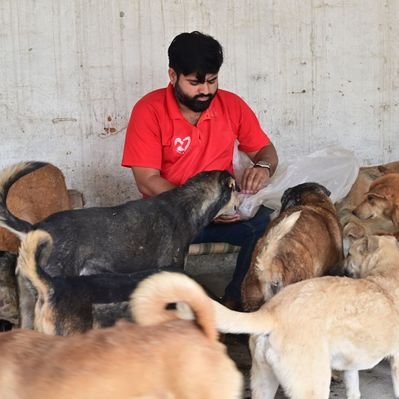
For over 5 years, we have been feeding thousands... of stray dogs across Noida and not a single conflict has occurred during our feeding drives. Why? Because we do it with care, compassion, and respect. We feed in silent hours, away from human foot traffic, in designated areas, always mindful of the community and the strays’ territories. This not only keeps the dogs calm but also makes vaccination and sterilization easier, helping prevent conflicts with humans. Feeding is not just about food—it’s about safety, peace, and trust. It ensures these voiceless souls don’t wander into other zones, reduces aggression, and allows them to live with dignity. Our program reaches thousands of strays every day, across different parts of the city, and it’s only possible because of people like you who care, love, and support them. Feeding, vaccination, and sterilization are the pillars of coexistence. Let’s join hands to do more, to care more, and to make our city safer and kinder for both humans and animals Pytm n gpay 7042677382 #dogsshow more
Vidit Sharma 🇮🇳
10,316 Aufrufe • vor 1 Jahr
And here we go — welcome to Day 1... of Based 7 Days of Xmas. We’re starting simple… but essential. 🎁 Day 1 Challenge 1) Quote tweet this post 2) Tag a fellow Pal & wish them “Merry Xmas from all of us at Based” in your native language 3) Use #BASEDXMAS 🎲 3 winners chosen at random ❤️ But if an entry truly stands out… it might just win our hearts and who knows.. it is the season of giving after all ;) 🎁 Presents to be won 🥇 1st: 6 Blind Boxes 🥈 2nd: 4 Blind Boxes 🥉 3rd: 2 Blind Boxes Merry Day 1 Xmas Pals 🎄✨ Let the cheers begin! ⏳24 hoursshow more

BasedPals
24,225 Aufrufe • vor 8 Monaten