Loading video...

Video Failed to Load

Go Home

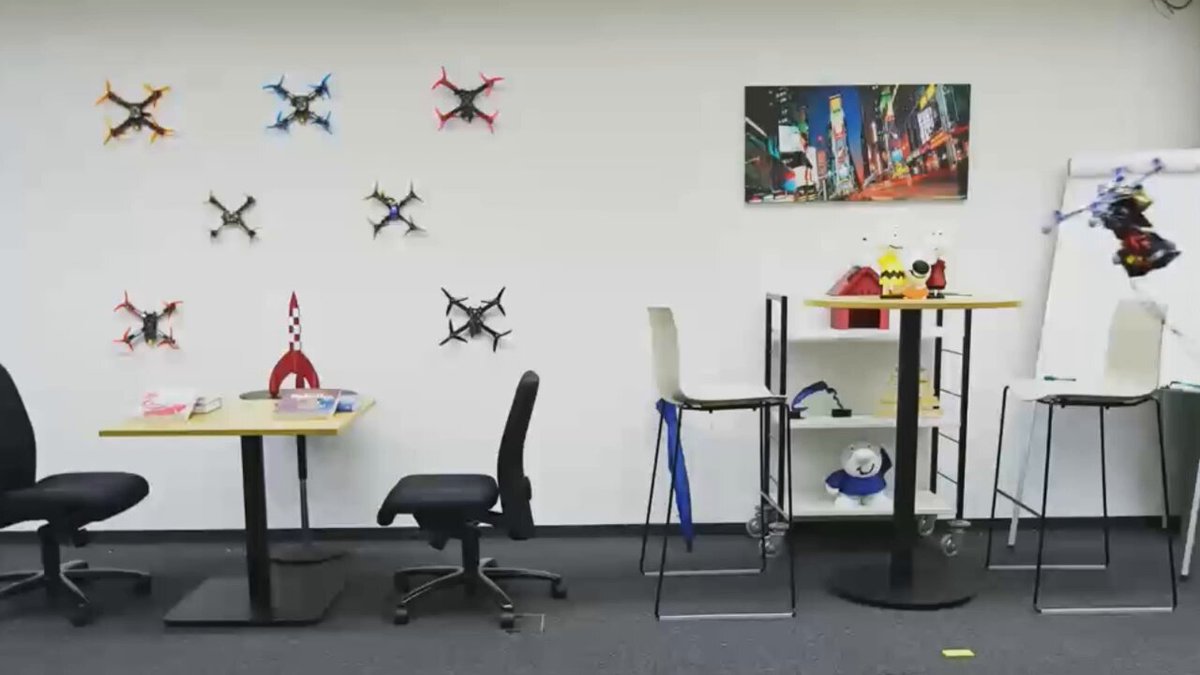
(1/2) Mesh2NeRF: Direct Mesh Supervision for Neural Radiance Field Representation and Generation #ECCV2024! We show a theoretical derivation to create radiance fields directly from meshes. Thus, we can obtain GT training data for generative NeRF methods.
16,835 views • 1 year ago •via X (Twitter)

2 Comments

Matthias Niessner's profile picture
Matthias Niessner1 year ago

(2/2) Main idea: Mesh2NeRF characterizes the density field as an occupancy function around the surface, and it determines view-dependent color through its underlying reflection function. Great work by @YujinChen_cv, @yinyu_nie, B. Ummenhofer, R. Birkl, M. Paulitsch, M. Mueller.

Eugene's profile picture
Eugene1 year ago

That’s a huge improvement! ✨

Related Videos

We are excited to share our work “Event-Aided Sharp Radiance Field Reconstruction for Fast-Flying Drones” published in IEEE Transactions on Robotics IEEE Transactions on Robotics (T-RO), which tackles sharp radiance field reconstruction under agile drone motion, where RGB frames are heavily motion-blurred and pose priors become unreliable! 4 years in the making! Code & dataset released! PDF: Code & Dataset: Full Narrated Video: High-speed flight is essential for time- and battery-constrained missions (e.g., inspection, exploration, search & rescue). However, fast motion corrupts visual data with severe motion blur and introduces drift/noise in visual-inertial odometry, making NeRF-based 3D reconstruction particularly brittle. We propose a unified framework that leverages asynchronous #EventCamera streams together with motion-blurred frames to reconstruct high-fidelity radiance fields from agile drone flights. Our key idea is to embed event-image fusion directly into radiance field optimization while jointly refining a shared, continuous-time camera trajectory initialized from event-based VIO. This enables us to recover sharp radiance fields and accurate trajectories without ground-truth supervision during training. We validate our method on synthetic data and on real sequences captured by a drone flying up to 2 m/s. Despite severe blur and noisy pose priors, our method preserves fine scene details and achieves a performance gain of over 50% on real-world data compared to state-of-the-art methods. Kudos to Rong Zou and Marco Cannici! Marco Cannici Reference: Rong Zou*, Marco Cannici*, Davide Scaramuzza Event-Aided Sharp Radiance Field Reconstruction for Fast-Flying Drones IEEE Transactions on Robotics (T-RO), 2026 NCCR Robotics European Research Council (ERC) AUTOASSESS UZH IfI University of Zurich UZH Science Prophesee SynSense UZH Space Hub

Davide Scaramuzza

11,946 views • 4 months ago

Nvidia announces GAvatar: Animatable 3D Gaussian Avatars with Implicit Mesh Learning paper page: Gaussian splatting has emerged as a powerful 3D representation that harnesses the advantages of both explicit (mesh) and implicit (NeRF) 3D representations. In this paper, we seek to leverage Gaussian splatting to generate realistic animatable avatars from textual descriptions, addressing the limitations (e.g., flexibility and efficiency) imposed by mesh or NeRF-based representations. However, a naive application of Gaussian splatting cannot generate high-quality animatable avatars and suffers from learning instability; it also cannot capture fine avatar geometries and often leads to degenerate body parts. To tackle these problems, we first propose a primitive-based 3D Gaussian representation where Gaussians are defined inside pose-driven primitives to facilitate animation. Second, to stabilize and amortize the learning of millions of Gaussians, we propose to use neural implicit fields to predict the Gaussian attributes (e.g., colors). Finally, to capture fine avatar geometries and extract detailed meshes, we propose a novel SDF-based implicit mesh learning approach for 3D Gaussians that regularizes the underlying geometries and extracts highly detailed textured meshes. Our proposed method, GAvatar, enables the large-scale generation of diverse animatable avatars using only text prompts. GAvatar significantly surpasses existing methods in terms of both appearance and geometry quality, and achieves extremely fast rendering (100 fps) at 1K resolution.

AK

140,960 views • 2 years ago